จำนวน Repository ( 19 )
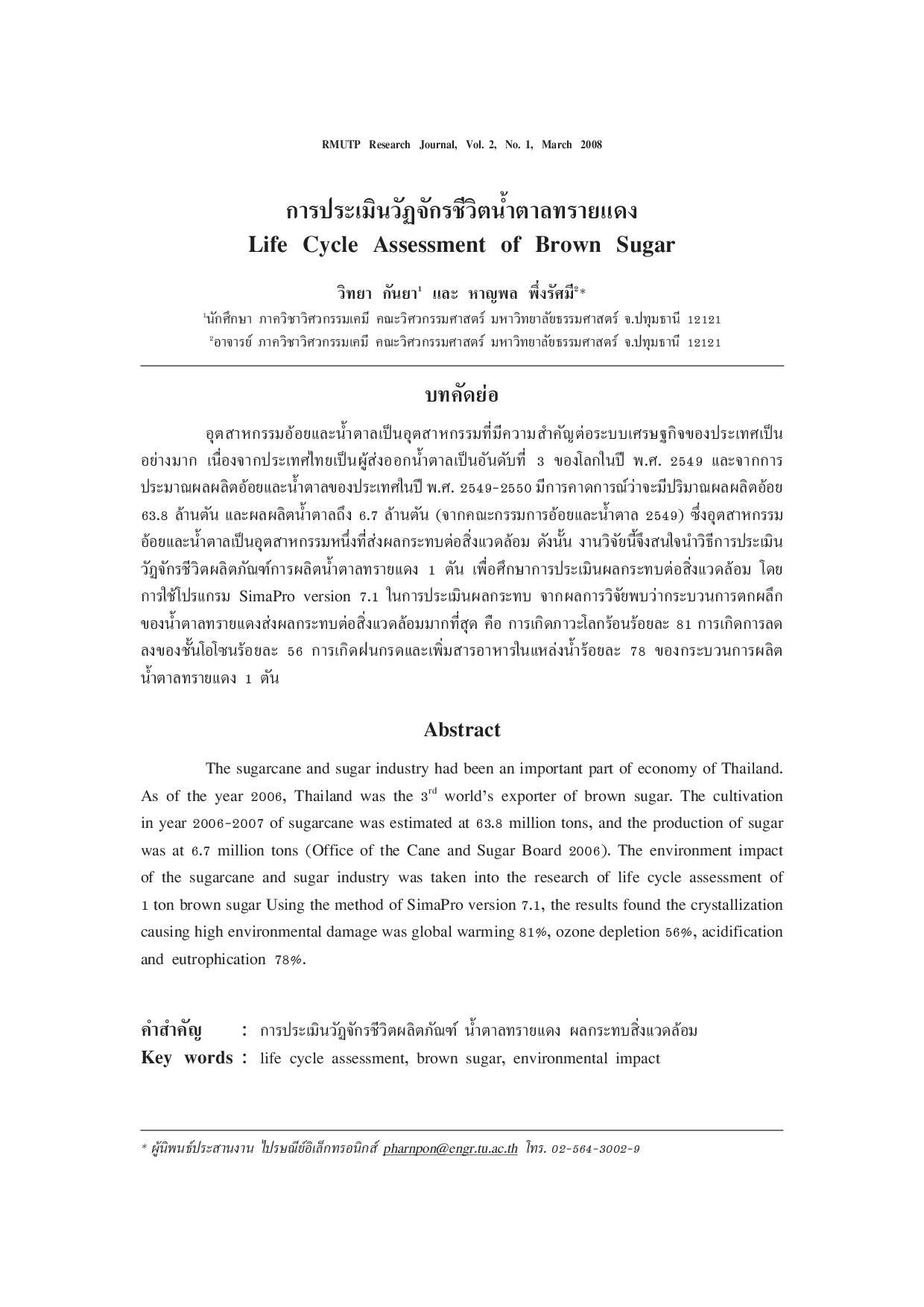
Life Cycle Assessment of Brown Sugar
The sugarcane and sugar industry had been an important part of economy of Thailand. As of the year 2006 Thailand was the 3rd world๛s exporter of brown sugar. The cultivation in year 2006-2007 of sugarcane was estimated at 63.8 million tons and the production of sugar was at 6.7 million tons (Office of the Cane and Sugar Board 2006). The environment impact of the sugarcane and sugar industry was taken into the research of life cycle assessment of 1 ton brown sugar Using the method of SimaPro version 7.1 the results found the crystallization causing high environmental damage was global warming 81% ozone depletion 56% acidification and eutrophication 78%.

การพัฒนาผลิตภัณฑ์น้ำตาลสดผง
The objective of this research was to study the optimal supersaturated temperature of palm sap powder by heating at 3 different temperatures (120 125 and 130 ºC). The initial sap contained moisture content pH and total soluble solid by 86.63% 6.84 and 15.5 ºBrix respectively. The result showed that the optimal supersaturated temperature of palm sap powder was found to be at 120 ºC. This powder had the yellow-light brown that contained L* a* and b* color value of 68.85 5.39 and 23.74 respectively. While the total soluble solid and Aw of this powder contained 84.84 ºBrix and 0.6 respectively. The sensorial evaluation was accepted in range of like moderately level (p≤0.05). The total microorganisms were 3.6x10² CFU/g and the yeast and molds were 10 CFU/g in which microbiological quality of this product was in standard of dried foods. This study pointed out that supersaturated technique can be utilized in palm sap powder production.
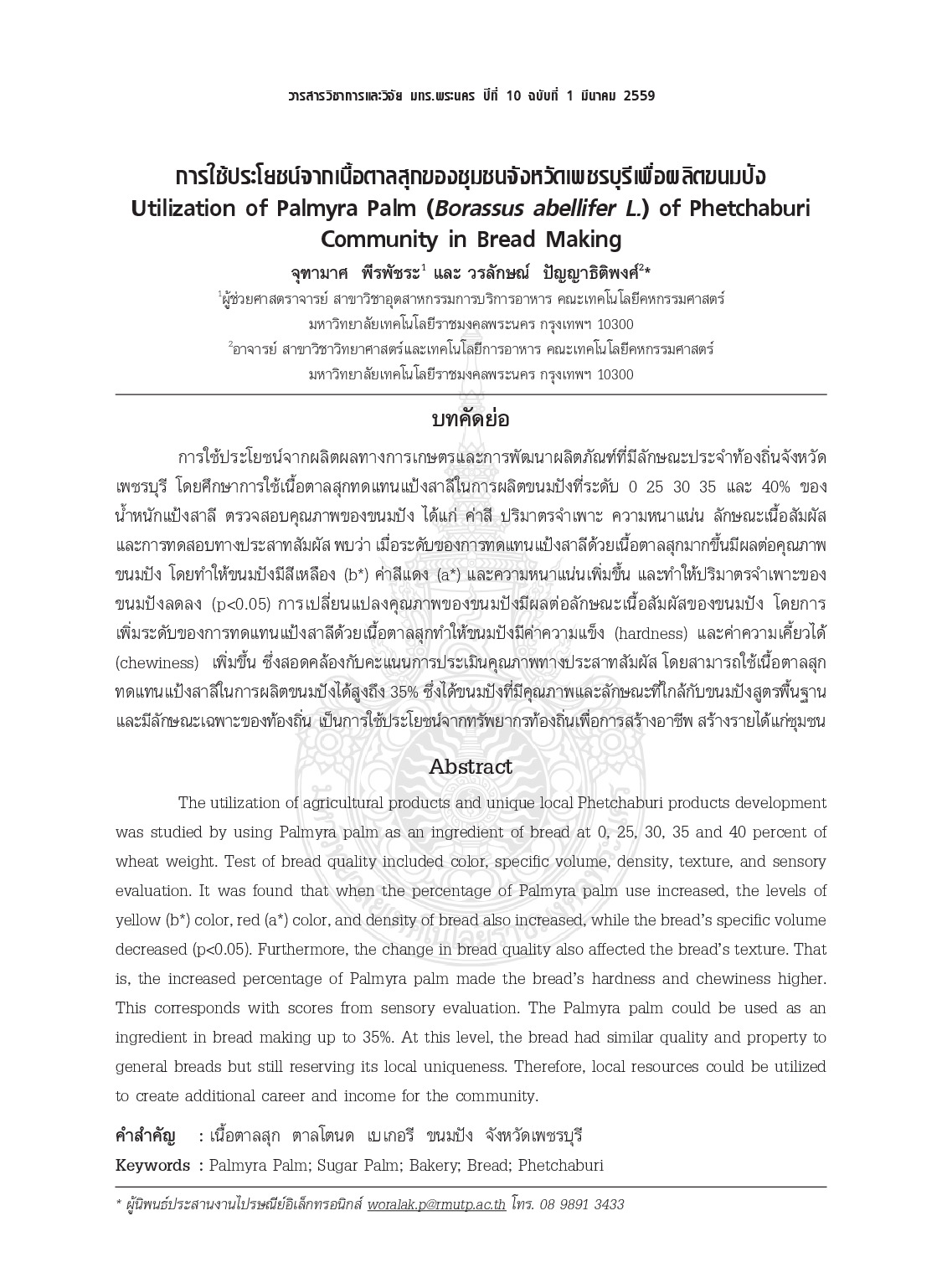
การใช้ประโยชน์จากเนื้อตาลสุกของชุมชนจังหวัดเพชรบุรีเพื่อผลิตขนมปัง
The utilization of agricultural products and unique local Phetchaburi products development was studied by using Palmyra palm as an ingredient of bread at 0 25 30 35 and 40 percent of wheat weight. Test of bread quality included color specific volume density texture and sensory evaluation. It was found that when the percentage of Palmyra palm use increased the levels of yellow (b*) color red (a*) color and density of bread also increased while the bread’s specific volume decreased (p<0.05). Furthermore the change in bread quality also affected the bread’s texture. That is the increased percentage of Palmyra palm made the bread’s hardness and chewiness higher. This corresponds with scores from sensory evaluation. The Palmyra palm could be used as an ingredient in bread making up to 35%. At this level the bread had similar quality and property to general breads but still reserving its local uniqueness. Therefore local resources could be utilized to create additional career and
การเตรียมผ้าไม่ทอจากใบอ้อย
This research was concerned with the fiber separation and non-woven preparation form sugar canes leaves. The separation process was carried out by chemical pulping method at 100 degree Celsius. In order to study the suitable condition for separation process the concentration of sodium hydroxide ranging from 0 -20 grams per liter and boiling time 15 30 45 60 75 90 105 and 120 minutes were performed. Web formation process was performed by wet laid method and polyvinyl alcohol was selected as binder in web bonding process. in order to study the suitable amount of binder in bonding process concentration of polyvinyl alcohol ranging from 1 2 4 6 8 and 10 % w/v coated on web surface and cured at 120 degree Celsius. Bursting strength as well as physical properties evaluation of non-woven fabrics was performed. For antimicrobial finishing process was performed by spray method and pad method. The finishing result was evaluated by MTCC test method 147-1998 (Qualitative) and 100 -1999 (Quantitative) The result was found that appropriate condition for fiber separation was recommended as follows: the amount of sodium hydroxide of 10 grams per liter and boiling time 60 minutes. The suitable amount of polyvinyl alcohol for web bonding process was 2 % w/v. Bursting strength of non-woven fabric was 53 kN/m 3 and padding method was a suitable method for antimicrobial finishing (antimicrobial area 0.3 millimeters )