จำนวน Repository ( 23 )

การบำบัดฟอสเฟตจากน้ำเสียด้วยวัสดุกรองร่วมกับเปลือกหอย
The objective of this research was to study the treatment of Phosphate from wastewater by filter material with shells. Various parameters include pH temperature turbidity DO nitride ammonium and phosphate were investigated and compared before and after filler wastewater. The results show that the quality of wastewater after treatment enhancing with adding filter material with shells. The optimum ratio treatment of phosphate is resulting in maximum values was around 0.05 mg/liter (50% compare with wastewater before treatment) with formula no. 3 that not have time to filler. Moreover the results demonstrated the treatment of Phosphate from wastewater by filter material with shells can be improvement the value of turbidity nitride ammonia and DO for wastewater.
The plant growth and production from swine farm wastewater usage
The usage of wastewater from swine farm for agriculture have study on the production of three plants such as shallot (Allium ascalonicum L.) marigold (Tagetes erecta L.) and ruzi grass (Bachiaria ruziziensis). The experiment was focusing on the growth production and metals accumulation (Pb Cu Fe Zn) in plant. The results shown that swine farm wastewater were a lot of organic substant and nutrient. The biological oxygen demand and chemical oxygen demand were out of standard. The heavy metals lead zinc copper and iron were amount 0.106 0.218 0.082 และ 0.866 mg/kg respectively. The productivity of shallot and ruzi grass were high growing that treated by swine farm wastewater. The marigold production (flower size dry weight and fresh weight) treated by swine farm wastewater found that were not significant from the marigold production that treated by control water. The amount of lead in shallot ruzi grass and marigold flower were out of standard. The shallot and ruzi root found the amount of zinc out of standard. The amount of copper and iron were not out of standard all three plant.
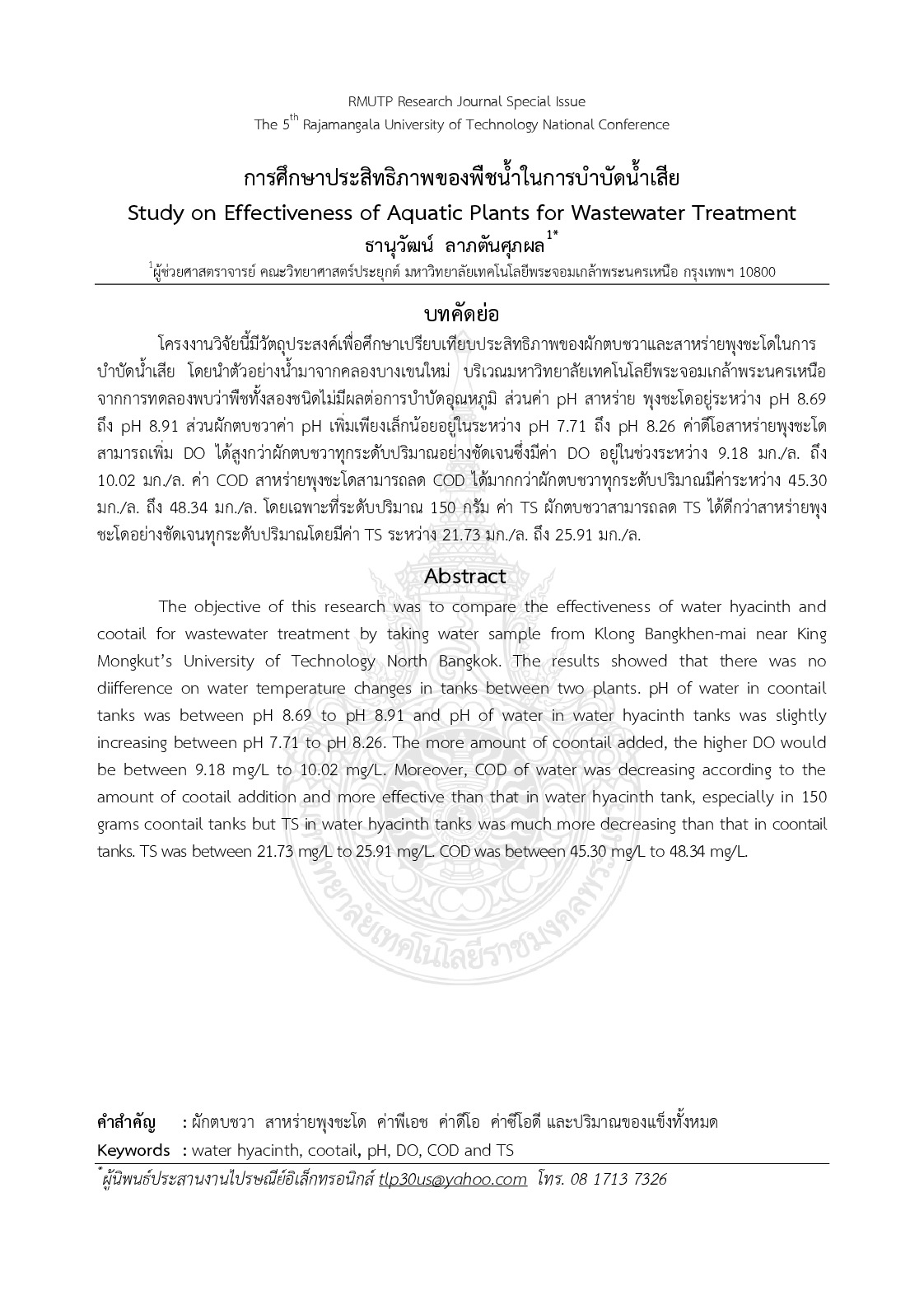
Study on effectiveness of aquatic plants for wastewater treatment
The objective of this research was to compare the effectiveness of water hyacinth and cootail for wastewater treatment by taking water sample from Klong Bangkhen-mai near King Mongkut’s University of Technology North Bangkok. The results showed that there was no diifference on water temperature changes in tanks between two plants. pH of water in coontail tanks was between pH 8.69 to pH 8.91 and pH of water in water hyacinth tanks was slightly increasing between pH 7.71 to pH 8.26. The more amount of coontail added the higher DO would be between 9.18 mg/L to 10.02 mg/L. Moreover COD of water was decreasing according to the amount of cootail addition and more effective than that in water hyacinth tank especially in 150 grams coontail tanks but TS in water hyacinth tanks was much more decreasing than that in coontail tanks. TS was between 21.73 mg/L to 25.91 mg/L. COD was between 45.30 mg/L to 48.34 mg/L.
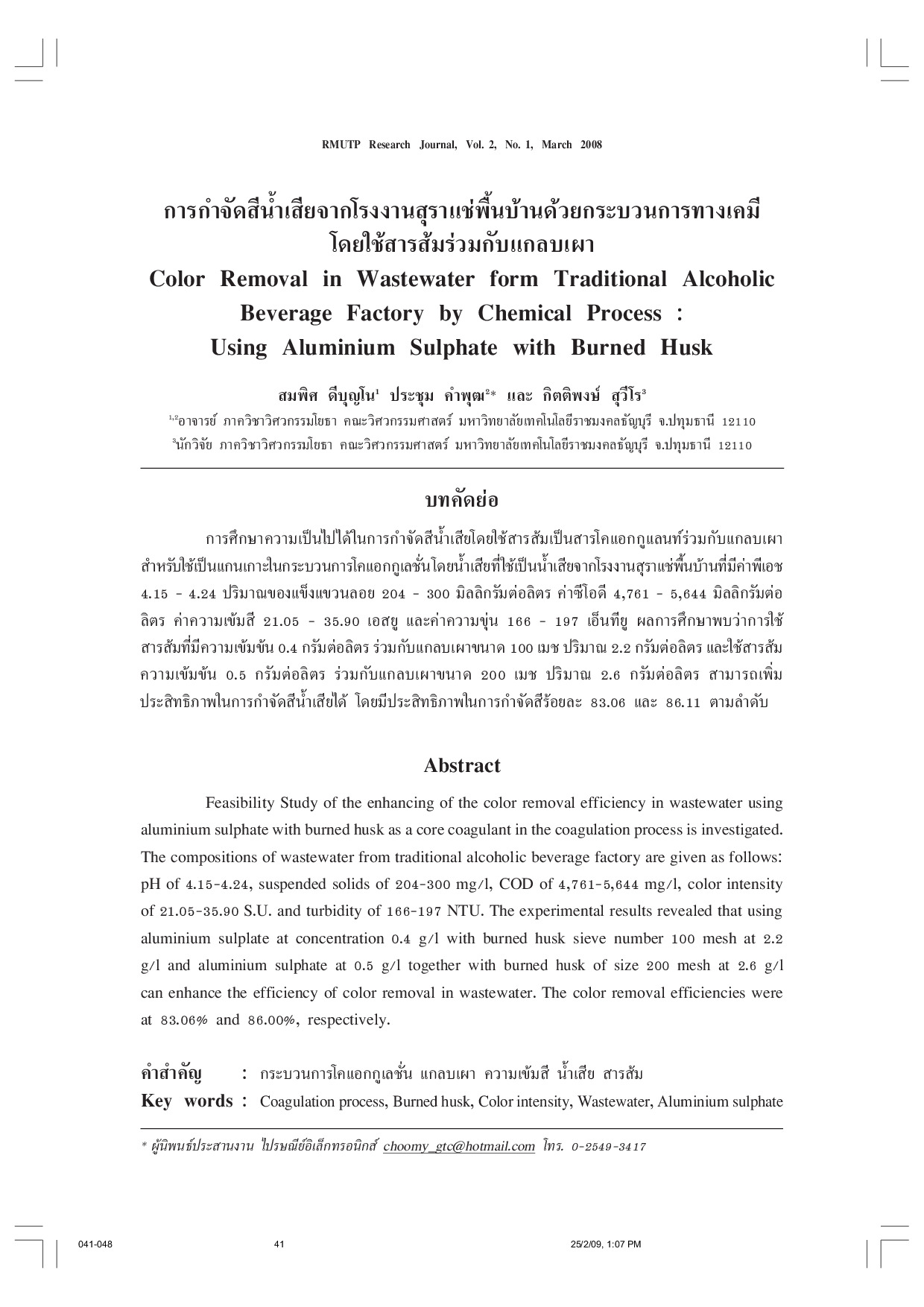
Color Removal in Wastewater form Traditional Alcoholic Beverage Factory by Chemical Process : Using Aluminium Sulphate with Burned Husk
Feasibility Study of the enhancing of the color removal efficiency in wastewater using aluminium sulphate with burned husk as a core coagulant in the coagulation process is investigated. The compositions of wastewater from traditional alcoholic beverage factory are given as follows: pH of 4.15-4.24 suspended solids of 204-300 mg/l COD of 4761-5644 mg/l color intensity of 21.05-35.90 S.U. and turbidity of 166-197 NTU. The experimental results revealed that using aluminium sulplate at concentration 0.4 g/l with burned husk sieve number 100 mesh at 2.2 g/l and aluminium sulphate at 0.5 g/l together with burned husk of size 200 mesh at 2.6 g/l can enhance the efficiency of color removal in wastewater. The color removal efficiencies were at 83.06% and 86.00% respectively.
ไส้กรองน้ำเซรามิคจากเถ้าอุตสาหกรรมเพื่อบำบัดน้ำเสียฟอกย้อม
This research studied the efficiencies of ceramic membrane filtration from industrial asphalt for dyeing wastewater treatment by forming a ceramic membrane in a diameter of 6 cm height of 2 cm. An appropriate proportion of industrial ashes: kaolin: sodium hydroxide solution mixed with sodium silicate solution was 46:18:36 at 800 ° C. For the properties analysis of ceramic membrane made from industrial ashes found that a shrinkage value compression resistance and density water absorption value and permeate flux were found 3 percents 0.6 Kilonewtons per cubic centimeter and 1.93 grams per cubic centimeter 45 percents 8.61 milliliters per square centimeter per minute respectively. Structural surface by a scanning electron microscopy was found that the porous inside of material was closely aligned together. Moreover precipitation of synthetic wastewater by using industrial ashes could help to increase the efficiencies of dyeing wastewater treatment. From the experiment it was found that the precipitation of synthetic wastewater with industrial ash was 94 percent filtration efficiency. On the other hand the efficiencies of synthetic wastewater treatment without precipitating of industrial ashes found only 69 percent. Moreover this research offers a new option for industrial wastes utilization.