จำนวน Repository ( 26 )
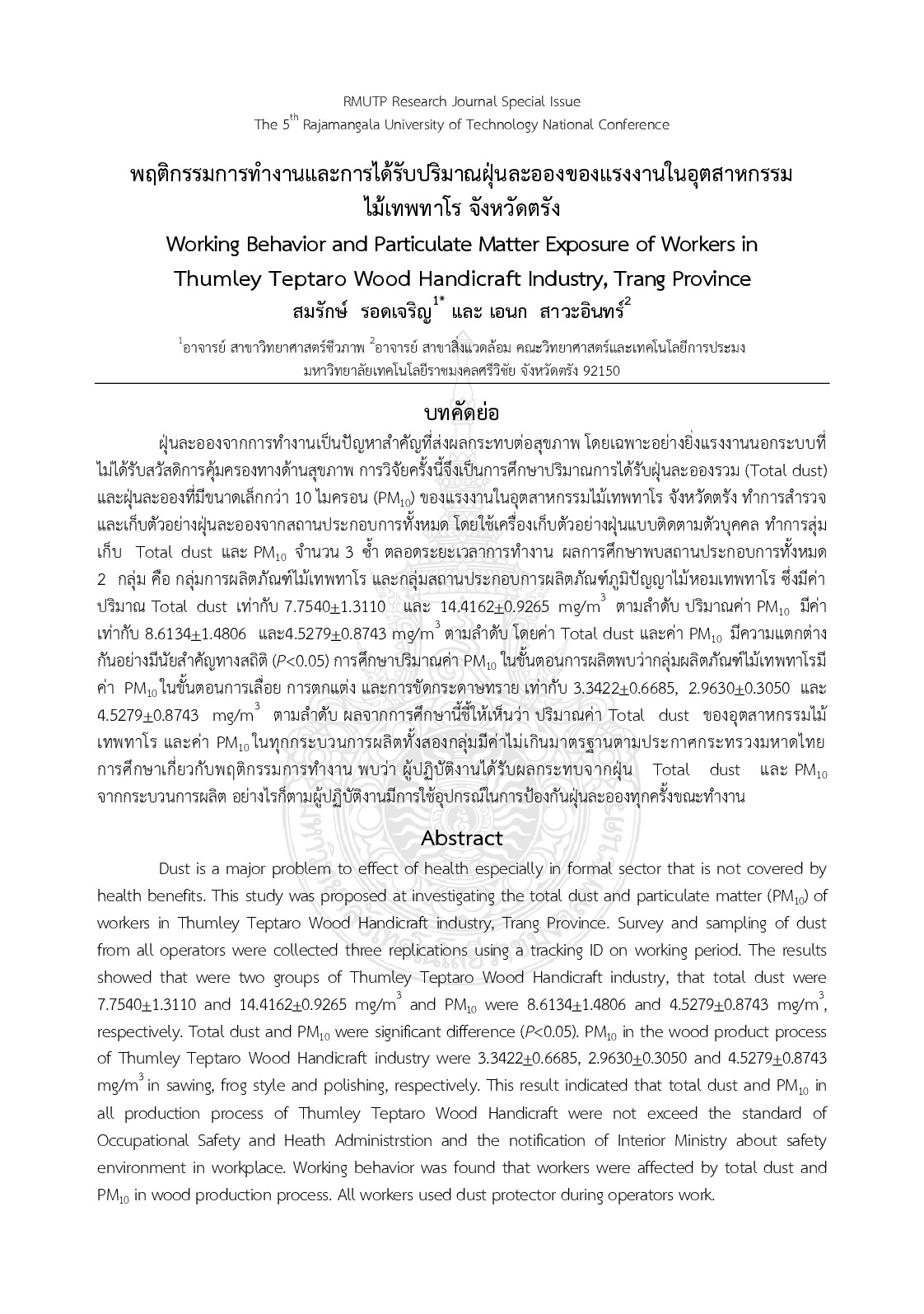
Working behavior and particulate matter exposure of workers in thumley teptaro wood handicraft industry, trang province
Dust is a major problem to effect of health especially in formal sector that is not covered by health benefits. This study was proposed at investigating the total dust and particulate matter (PM10) of workers in Thumley Teptaro Wood Handicraft industry Trang Province. Survey and sampling of dust from all operators were collected three replications using a tracking ID on working period. The results showed that were two groups of Thumley Teptaro Wood Handicraft industry that total dust were 7.7540+1.3110 and 14.4162+0.9265 mg/m3 and PM10 were 8.6134+1.4806 and 4.5279+0.8743 mg/m3 respectively. Total dust and PM10 were significant difference (P<0.05). PM10 in the wood product process of Thumley Teptaro Wood Handicraft industry were 3.3422+0.6685 2.9630+0.3050 and 4.5279+0.8743 mg/m3 in sawing frog style and polishing respectively. This result indicated that total dust and PM10 in all production process of Thumley Teptaro Wood Handicraft were not exceed the standard of Occupational Safety and Heath Administrstion and the notification of Interior Ministry about safety environment in workplace. Working behavior was found that workers were affected by total dust and PM10 in wood production process. All workers used dust protector during operators work.

การใช้ดินขาวผสม กากมะพร้าว เส้นใยจากต้นข้าวโพดและเส้นใยจากเปลือกทุเรียนเพิ่มประสิทธิภาพการป้องกันความร้อนและลดน้ำหนักในผนังคอนกรีตบล็อก
This research aims to study the application of kaolin with coconut meal plywood from corncobs and durian peel in concrete masonry unit wall for increasing effective heat protection and lightweight. The ratio of cement type 1: kaolin is equal to 1: 60 by weight. The kaolin is replaced by fiber include coconut meal fiber corn cob fiber durian peel fiber with 1.67% 3.33% and 5% by weight of kaolin. The kaolin concrete block mixed with fiber sample size is formed to 6.9 x 39 x 19 centimeter with the hydraulic compactor. The samples tested in physical and mechanical properties follow the TIS 58-2533 standard. Resulting their fibers can reduce the density thermal conductivity and compressive strength and increase the changing length and water absorption of kaolin concrete blocks. The kaolin concrete block without fiber has highest compressive strength followed by the kaolin concrete block mixed with corn cob fiber the kaolin concrete block mixed with coconut meal fiber and the kaolin concrete block mixed with durian peel fiber has lowest compressive strength respectively. However their fibers have possibility to be composite materials to reduce weight of kaolin concrete blocks.
การใช้กากมะพร้าว ตันข้าวโพดและเปลือกทุเรียนเป็นวัสดุประกอบชีวภาพทดแทนไม้ในแผ่นใยอัดความหนาแน่นปานกลาง
This research aims to study the application of coconut meal corn cob and durian peel as wood-substituted biocomposites in medium density fiberboard. The fiber: urea formaldehyde glue: isocyanate glue with polymeric diphenymethane diisocyanate type (pMDI) ratio is equal to 1: 0.13: 0.003. The fibers are taken from coconut meal corn cob and durian peel that 7 ratios are used to all of fiber mixing. The fiberboard production use 130°C of temperature with 20 – 50 kg/sq.cm of compressive pressure with 8 minutes per piece of rate. Their fiberboards have 603 – 856 kg/m of density that was tested follow the TIS 876-2547 standard. Resulting the MM33 ratio (coconut meal fibers: corn cob fibers: durian peel fibers is equal to 0.33: 0.33: 0.33) and the CC50 ratio (coconut meal fibers: corn cob fibers: durian peel fibers is equal to 0.50: 0.25: 0.25) can pass the standard in physical properties and mechanical properties. Moreover their fiberboards have good thermal insulation.
การใช้ไม้พฤาษ์และไม้จามจุรีเป็นองค์ประกอบในโครงสร้างไม้
The Research of this paper to propose the usage of Albizia lebbeck (L.) Benth. and Samanea saman Merill are fast-growing commonly found in Thailand. However these species of wood could not be utilized as structural components either economically or safely due to the lack of recommended values for their engineering properties. Therefore the objective of this research was to study their physical and mechanical properties based on statistical data obtained from 11 series of tests in accordance with ASTM 0-143. 0-198 and 0-1037. The number of samples for each test was large enough to ensure 99% interval of confidence. Then goodness-of-fit tests were performed for each set of data to achieve at least 95% level of confidence. Buildings analyzed included residences offices and schools. The buildings were limited to two-storeyed buildings with f1oor-to-f1oor height of 3.00 meters. Given to joists and beams were simply supported. Values of structural reliability were obtained by using accurate methods. Results from testing showed that engineering properties of both species of wood could be represented well by normal distribution. Reliability analyses and designs of wood sections for joists. beams and columns showed that designs of Joists and beams wWe controlled by deflection; whereas those of columns were controlled by buckling. Based on these reasons the governing basic variable for designs of wood sections was the modulus of elasticity (E). If the accepted value of failure probability (P) for serviceability limit states was set to be 10-4. the corresponding upper limit coefficient of variation (COV) of E would be 0.269. Similarty if the accepted value of P for Ultimate limit states was set to be 10~. the corresponding upper limit COY of E would be 0.210. Since COY of E for both species of wood were lower than limit COY mentioned above. they could be used safely as structural components. Proposed design procedures were similar to Working Stress Methods. The only difference from E.I.T. standard was live load. Instead of nominal live loads for residence. office and school as stated In the Municipal law. mean Ifve loads based on data gathered in Thailand were recommended. Wood sections obtalnec from numerical procedures proposed were as large as those obtained from WCCAL Software. Furthennore recommended wood sections and factor of safety (FS) were summarized in appendices. It was also interesting to note that the value of E for compression and tension parallel to grain of both species of wood could be used to predict the corresponding value of E for bending.
Creating and Evaluating the Effectiveness of Computer Assisted Instruction Program for Courses of Practiced To Wooden Joint
The purposes of the research were to create? and efficiency validation of computer assisted for the courses of practiced to wooden joint based standard 90/90 and analyse the leaning achievement of the student after by using computer assisted instruction. The subjects in the study were 17 first year diploma students enrolled in Rajamangala University of Technology Phra Nakhon. The Researcher using the experiment by let the students do until test before class And then study by using computer assisted instruction focused on practiced to basic turning. After that let students do the unit test again at the class and calculate to find out the efficiency of the computer assisted instruction and analyse the leaning achievement of students after study. The research result revealed that the efficiency of the computer assisted Instruction was efficient in standard 90/90 Moreover after learning achievement At significant level of 0.05