จำนวน Repository ( 286 )
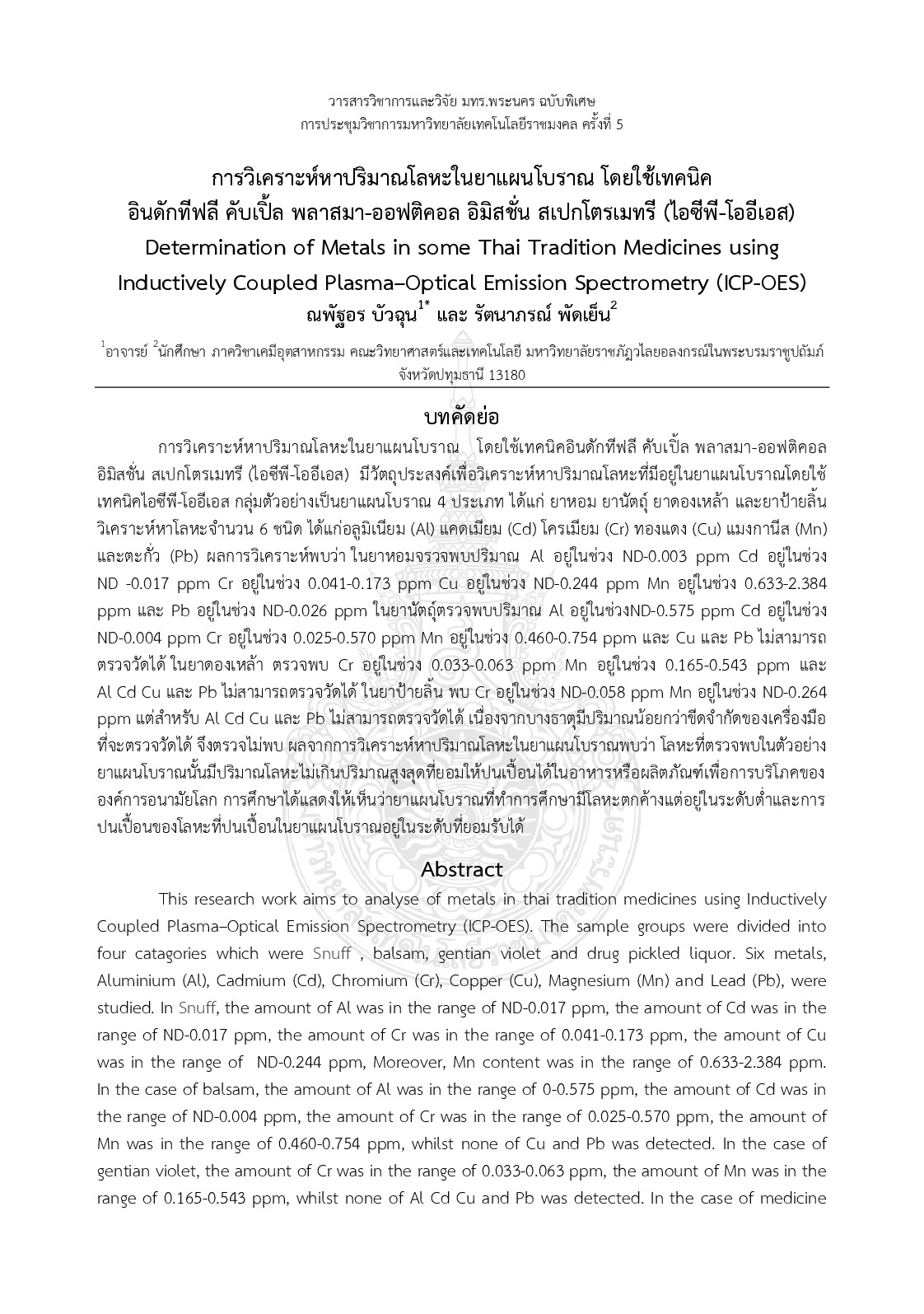
Determination of metals in some thai tradition medicines using inductively coupled plasma–optical emission spectrometry (ICP-OES)
This research work aims to analyse of metals in thai tradition medicines using Inductively Coupled Plasma–Optical Emission Spectrometry (ICP-OES). The sample groups were divided into four catagories which were Snuff balsam gentian violet and drug pickled liquor. Six metals Aluminium (Al) Cadmium (Cd) Chromium (Cr) Copper (Cu) Magnesium (Mn) and Lead (Pb) were studied. In Snuff the amount of Al was in the range of ND-0.017 ppm the amount of Cd was in the range of ND-0.017 ppm the amount of Cr was in the range of 0.041-0.173 ppm the amount of Cu was in the range of ND-0.244 ppm Moreover Mn content was in the range of 0.633-2.384 ppm. In the case of balsam the amount of Al was in the range of 0-0.575 ppm the amount of Cd was in the range of ND-0.004 ppm the amount of Cr was in the range of 0.025-0.570 ppm the amount of Mn was in the range of 0.460-0.754 ppm whilst none of Cu and Pb was detected. In the case of gentian violet the amount of Cr was in the range of 0.033-0.063 ppm the amount of Mn was in the range of 0.165-0.543 ppm whilst none of Al Cd Cu and Pb was detected. In the case of medicine pickled the amount of Cr was in the range of ND-0.058 ppm the amount of Mn was in the range of ND-0.264 ppm the amount of Ni was in the range of 0-0.034 ppm no metals Al Cd Cu and Pb was observed. The detected metals in thai tradition medicines have the contamination value under the optimization scale for consumable under WHO. It show that some metals were retained in thai tradition medicines and the contamination level of metals in were acceptable.
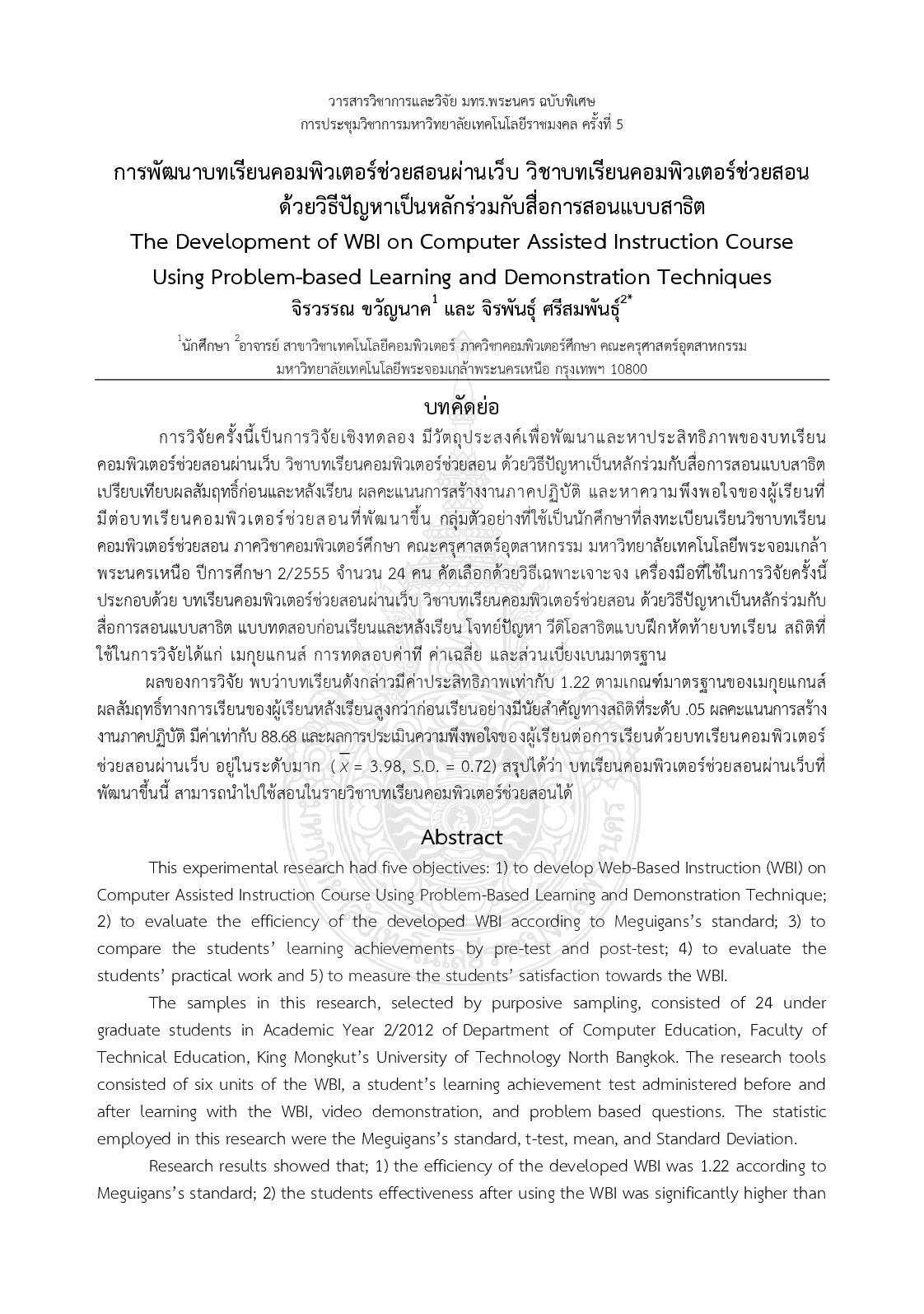
The development of wbi on computer assisted instruction course using problem-based learning and demonstration techniques
This experimental research had five objectives: 1) to develop Web-Based Instruction (WBI) on Computer Assisted Instruction Course Using Problem-Based Learning and Demonstration Technique; 2) to evaluate the efficiency of the developed WBI according to Meguigans’s standard; 3) to compare the students’ learning achievements by pre-test and post-test; 4) to evaluate the students’ practical work and 5) to measure the students’ satisfaction towards the WBI. The samples in this research selected by purposive sampling consisted of 24 under graduate students in Academic Year 2/2012 of Department of Computer Education Faculty of Technical Education King Mongkut’s University of Technology North Bangkok. The research tools consisted of six units of the WBI a student’s learning achievement test administered before and after learning with the WBI video demonstration and problem based questions. The statistic employed in this research were the Meguigans’s standard t-test mean and Standard Deviation. Research results showed that; 1) the efficiency of the developed WBI was 1.22 according to Meguigans’s standard; 2) the students effectiveness after using the WBI was significantly higher than before using it at .05; 3) the average score of the practical work was 88.68 higher than 80; 4) the students’ satisfactory was at a good level. In conclusion the developed WBI can be used for the target group properly.
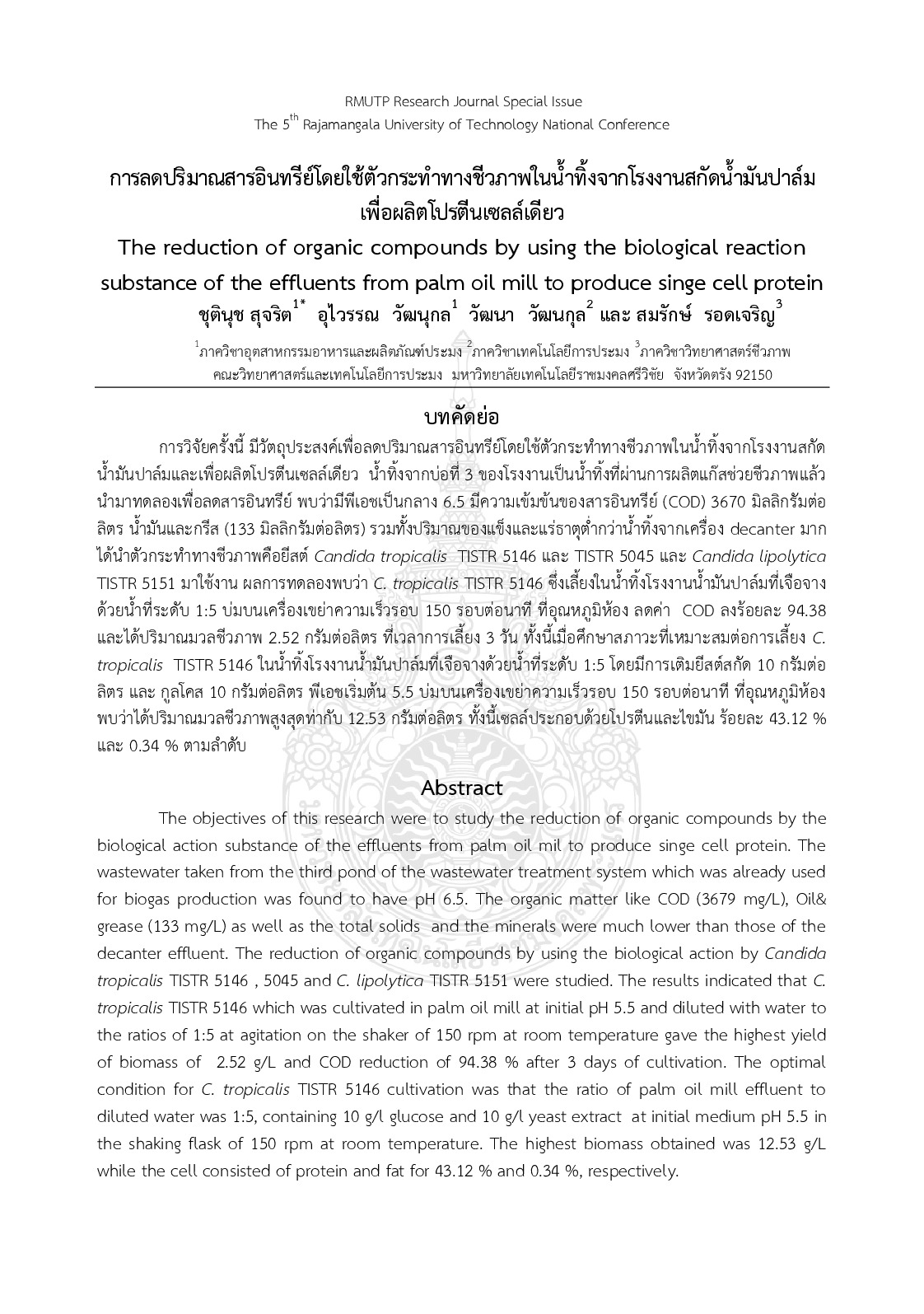
The reduction of organic compounds by using the biological reaction substance of the effluents from palm oil mill to produce singe cell protein
The objectives of this research were to study the reduction of organic compounds by the biological action substance of the effluents from palm oil mil to produce singe cell protein. The wastewater taken from the third pond of the wastewater treatment system which was already used for biogas production was found to have pH 6.5. The organic matter like COD (3679 mg/L) Oil& grease (133 mg/L) as well as the total solids and the minerals were much lower than those of the decanter effluent. The reduction of organic compounds by using the biological action by Candida tropicalis TISTR 5146 5045 and C. lipolytica TISTR 5151 were studied. The results indicated that C. tropicalis TISTR 5146 which was cultivated in palm oil mill at initial pH 5.5 and diluted with water to the ratios of 1:5 at agitation on the shaker of 150 rpm at room temperature gave the highest yield of biomass of 2.52 g/L and COD reduction of 94.38 % after 3 days of cultivation. The optimal condition for C. tropicalis TISTR 5146 cultivation was that the ratio of palm oil mill effluent to diluted water was 1:5 containing 10 g/l glucose and 10 g/l yeast extract at initial medium pH 5.5 in the shaking flask of 150 rpm at room temperature. The highest biomass obtained was 12.53 g/L while the cell consisted of protein and fat for 43.12 % and 0.34 % respectively.
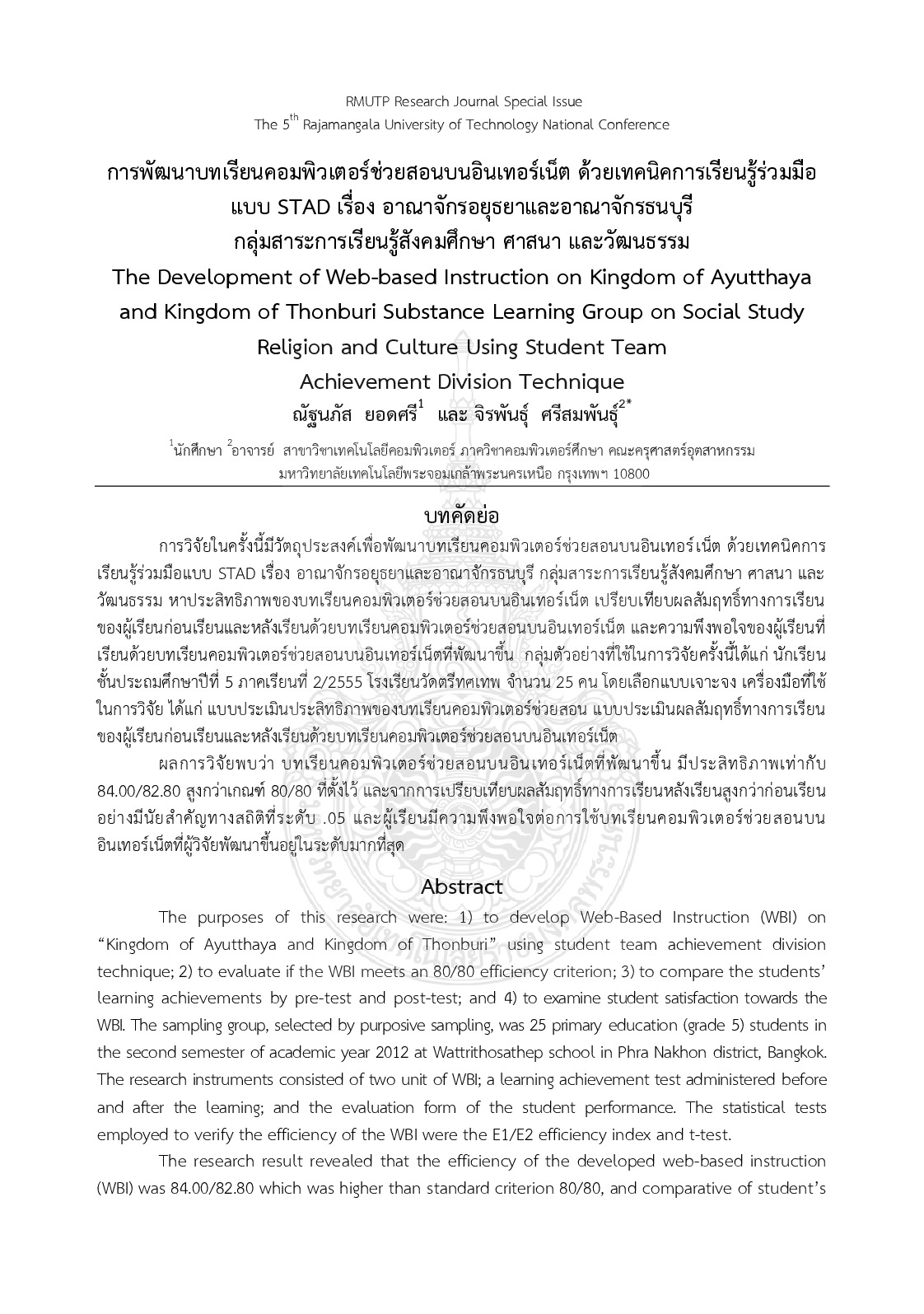
The development of web-based instruction on kingdom of ayutthaya and kingdom of thonburi substance learning group on social study religion and culture using student team achievement division technique
The purposes of this research were: 1) to develop Web-Based Instruction (WBI) on “Kingdom of Ayutthaya and Kingdom of Thonburi”กusing student team achievement division technique; 2) to evaluate if the WBI meets an 80/80 efficiency criterion; 3) to compare the students’ learning achievements by pre-test and post-test; and 4) to examine student satisfaction towards the WBI. The sampling group selected by purposive sampling was 25 primary education (grade 5) students in the second semester of academic year 2012 at Wattrithosathep school in Phra Nakhon district Bangkok. The research instruments consisted of two unit of WBI; a learning achievement test administered before and after the learning; and the evaluation form of the student performance. The statistical tests employed to verify the efficiency of the WBI were the E1/E2 efficiency index and t-test. The research result revealed that the efficiency of the developed web-based instruction (WBI) was 84.00/82.80 which was higher than standard criterion 80/80 and comparative of student’s achievement it was found that the student achieved learning progress significantly level of .05. Finally it was found that the learners opinion after using the developed web-based instruction (WBI) was very satisfactory.
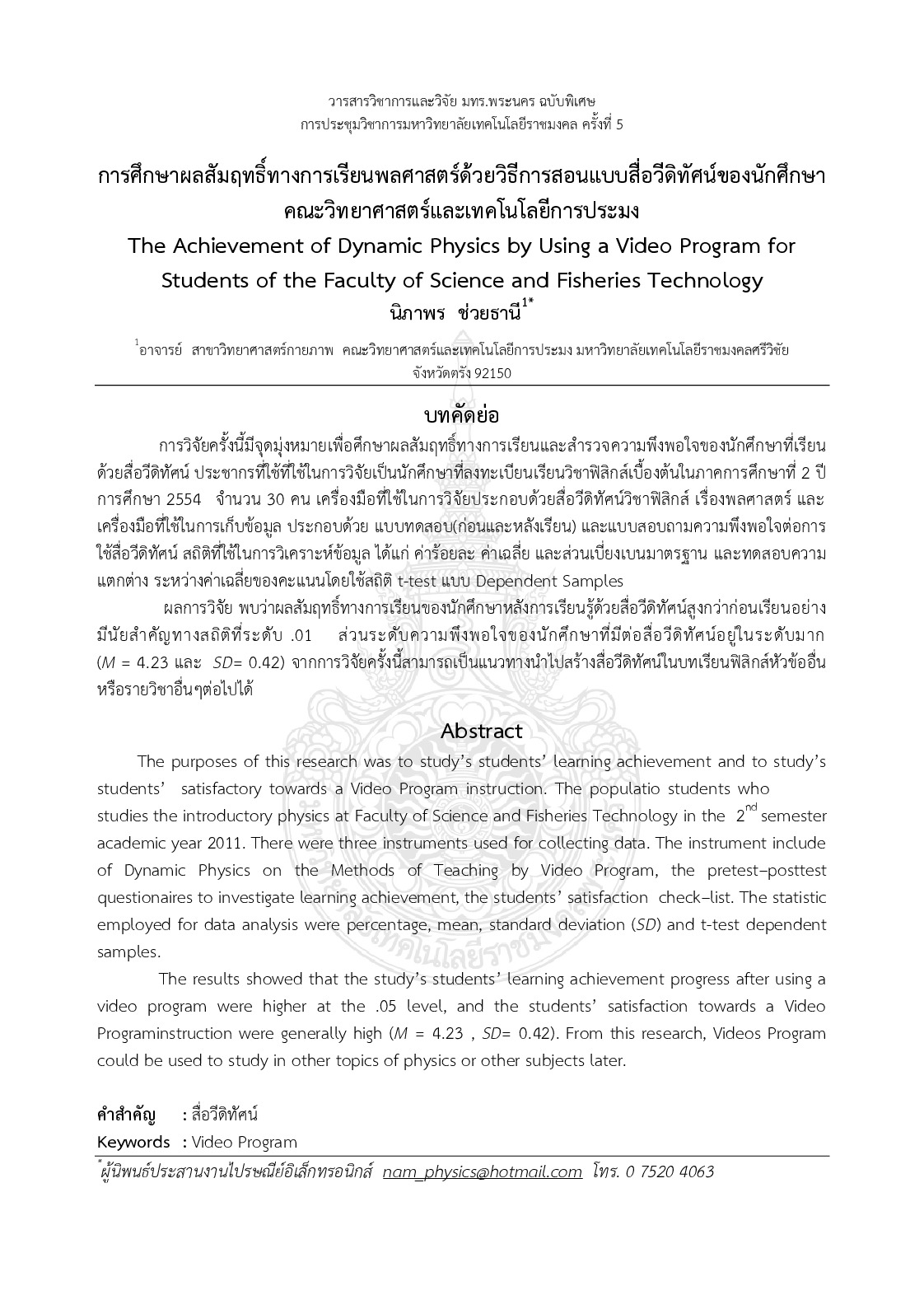
The achievement of dynamic physics by using a video program for students of the faculty of science and fisheries technology
The purposes of this research was to study’s students’ learning achievement and to study’s students’ satisfactory towards a Video Program instruction. The population of 30 students who studies the introductory physics at Faculty of Science and Fisheries Technology in the 2nd semester academic year 2011. There were three instruments used for collecting data. The instrument include of Dynamic Physics on the Methods of Teaching by Video Program the pretest–posttest questionaires to investigate learning achievement the students’ satisfaction check–list. The statistic employed for data analysis were percentage mean standard deviation (SD) and t-test dependent samples. The results showed that the study’s students’ learning achievement progress after using a video program were higher at the .05 level and the students’ satisfaction towards a Video Programinstruction were generally high (M = 4.23 SD= 0.42). From this research Videos Program could be used to study in other topics of physics or other subjects later.