จำนวน Repository ( 361 )

The design and development problem in wear house and decoration group for one Tumbon one product production group (OTOP), mini and medium SMEs in pathumthani province.
This research aimed to study and analyse conditions and problems in designing and developing household and decorative products of One Tambon One Product (OTOP) small and medium enterprises (SMEs) in Pathumthani province. The informants were 4 OTOP entrepreneurs and 205 OTOP SMEs. The research was conducted by means of interviews observations and questionnaires. The data was statistically analysed using frequency percentages mean and standard deviation. The results showed that conditions and problems in designing and developing household and decorative OTOP products ranged from home-based production site a lack of knowledge in product design and development transportation creativity artistic relations product specifications marketing to product design and development laws. Four entrepreneurs from these groups of products: lotus-fiber flowers silk flowers and bamboo lamps were found to have the problem of dyeing materials whilst those from the group of Thai/Japanese clay flowers had the problem of clay. The researcher had analysed piloted and concluded the problems and then passed on product development techniques to the entrepreneurs. It was found that they could use the given knowledge to make beautiful products and they satisfied with the reducing cost of production.
Optimization for sewing machine setup using experimental design technique
The objective of the research was to identify the optimized thread tensile values for the setup of Model D – We 1218-55 computerized 18-needles sewing machine in order to minimize a number of times the machine halts. The cause of the sewing machine halting which reduced the efficiencies of the machine was found to be torn threads. In order to maximize the efficiencies the experimental design technique was utilized to find the optimal values for five types of cloth: polo tc-cool cotton jacket and shirt. The method involved three nested designs which are the type of thread number of sewing layers and thread-hole size. The three thread tensile levels experimented were low (2 oz.) medium (5 oz.) and high (8 oz.) and the response was the number of times the machine halted in the span of 30 minutes. The ANOVA (Analysis of Variance) used for the experimental design showed that the three factors significantly affected the machine’s halt. The number of times the machine halted was used to create Surface Plot with polynomial trend-lines and the quadratic equation was applied to determine the optimal value for each type of thread number of sewing layers and thread-hole size. The values obtained were then set for another experiment the results of which were that the sewing machine halted less frequently and the efficiencies thus increased about by 77.01%.
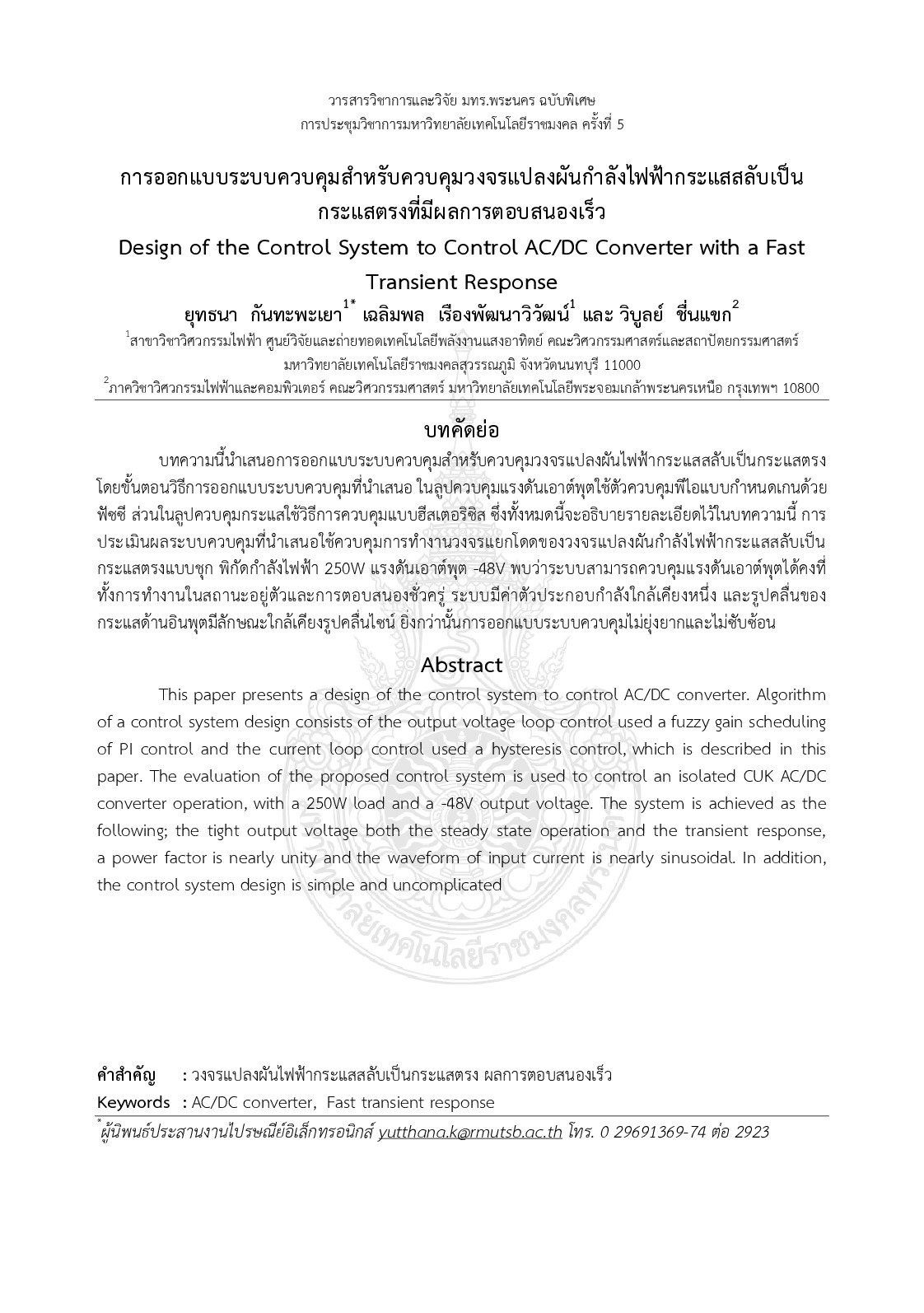
Design of the control system to control AC/DC converter with a fast transient response
This paper presents a design of the control system to control AC/DC converter. Algorithm of a control system design consists of the output voltage loop control used a fuzzy gain scheduling of PI control and the current loop control used a hysteresis control which is described in this paper. The evaluation of the proposed control system is used to control an isolated CUK AC/DC converter operation with a 250W load and a -48V output voltage. The system is achieved as the following; the tight output voltage both the steady state operation and the transient response a power factor is nearly unity and the waveform of input current is nearly sinusoidal. In addition the control system design is simple and uncomplicated
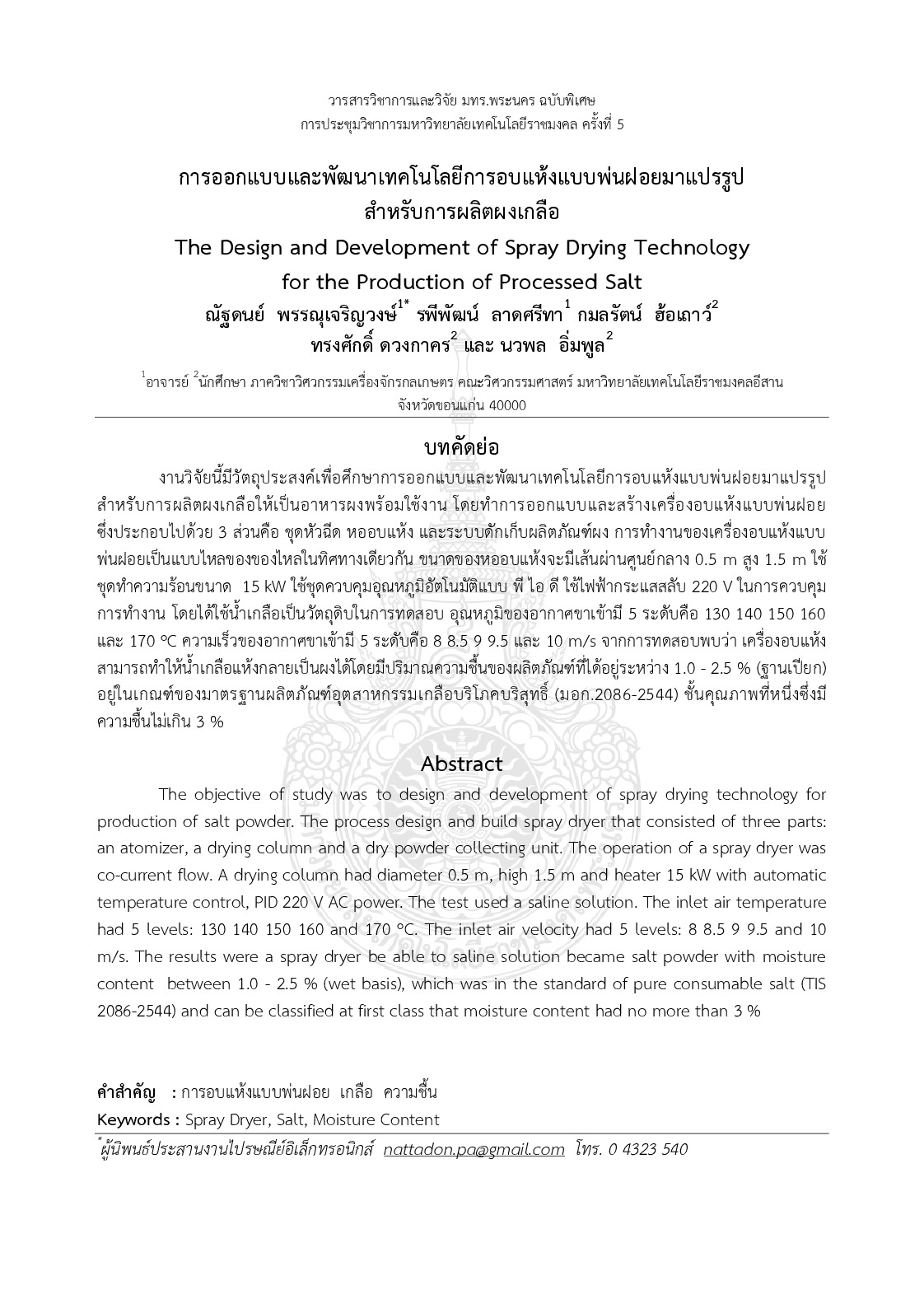
The design and development of spray drying technology for the production of processed salt
The objective of study was to design and development of spray drying technology for production of salt powder. The process design and build spray dryer that consisted of three parts: an atomizer a drying column and a dry powder collecting unit. The operation of a spray dryer was co-current flow. A drying column had diameter 0.5 m high 1.5 m and heater 15 kW with automatic temperature control PID 220 V AC power. The test used a saline solution. The inlet air temperature had 5 levels: 130 140 150 160 and 170 ?C. The inlet air velocity had 5 levels: 8 8.5 9 9.5 and 10 m/s. The results were a spray dryer be able to saline solution became salt powder with moisture content between 1.0 - 2.5 % (wet basis) which was in the standard of pure consumable salt (TIS 2086-2544) and can be classified at first class that moisture content had no more than 3 %
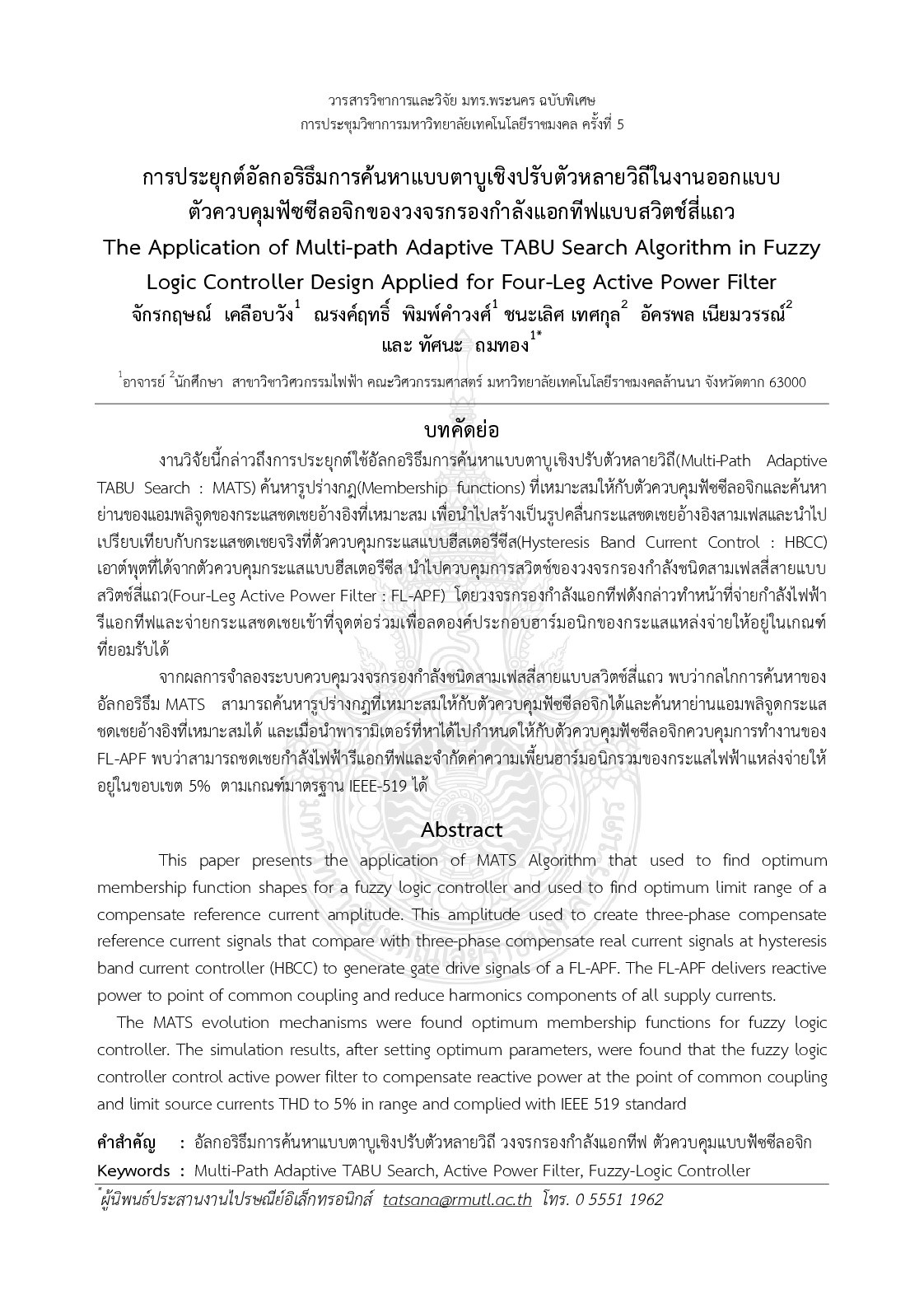
The application of multi-path adaptive TABU search algorithm in fuzzy logic controller design applied for four-leg active power filter
This paper presents the application of MATS Algorithm that used to find optimum membership function shapes for a fuzzy logic controller and used to find optimum limit range of a compensate reference current amplitude. This amplitude used to create three-phase compensate reference current signals that compare with three-phase compensate real current signals at hysteresis band current controller (HBCC) to generate gate drive signals of a FL-APF. The FL-APF delivers reactive power to point of common coupling and reduce harmonics components of all supply currents. The MATS evolution mechanisms were found optimum membership functions for fuzzy logic controller. The simulation results after setting optimum parameters were found that the fuzzy logic controller control active power filter to compensate reactive power at the point of common coupling and limit source currents THD to 5% in range and complied with IEEE 519 standard