จำนวน Repository ( 372 )
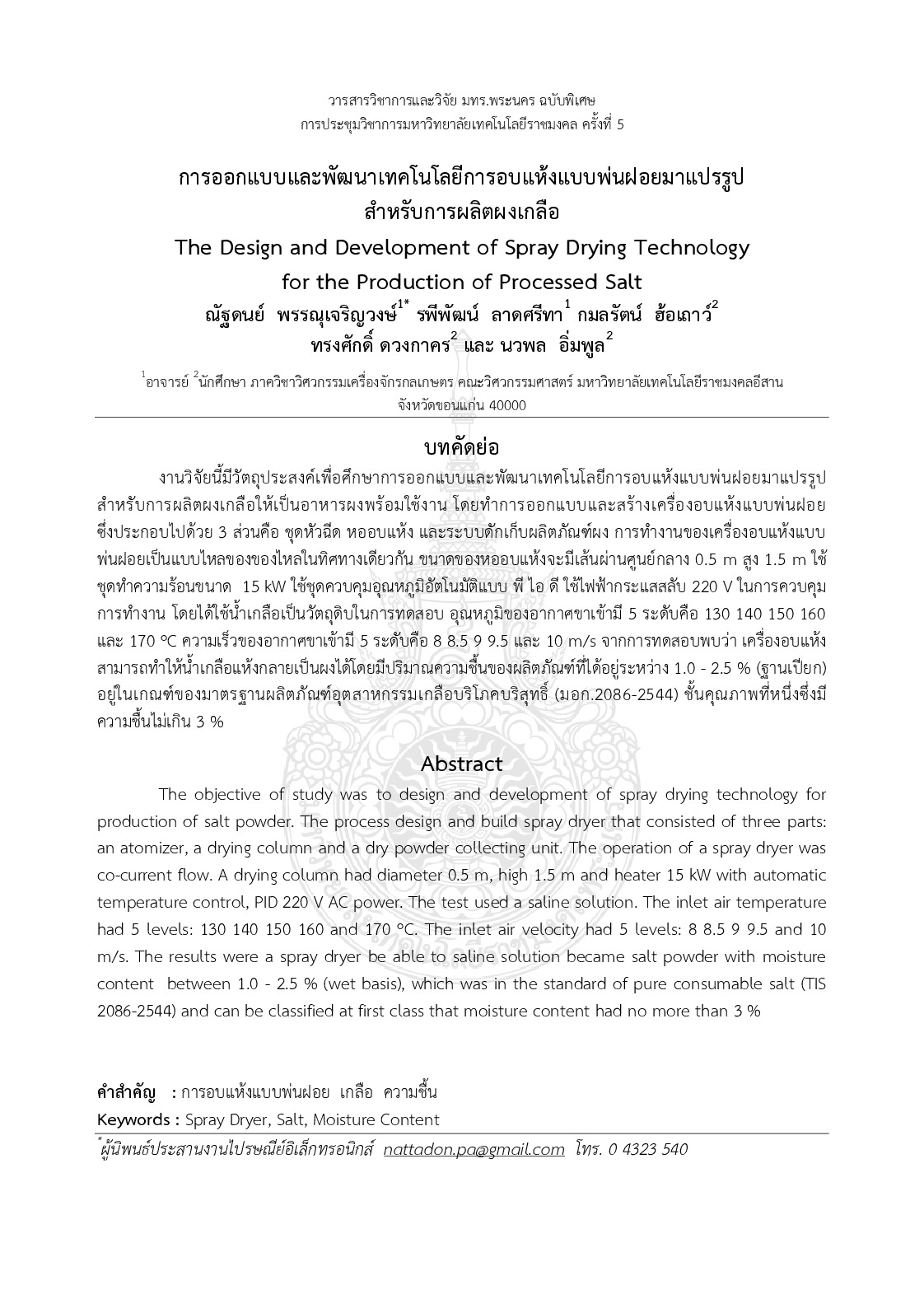
The design and development of spray drying technology for the production of processed salt
The objective of study was to design and development of spray drying technology for production of salt powder. The process design and build spray dryer that consisted of three parts: an atomizer a drying column and a dry powder collecting unit. The operation of a spray dryer was co-current flow. A drying column had diameter 0.5 m high 1.5 m and heater 15 kW with automatic temperature control PID 220 V AC power. The test used a saline solution. The inlet air temperature had 5 levels: 130 140 150 160 and 170 ?C. The inlet air velocity had 5 levels: 8 8.5 9 9.5 and 10 m/s. The results were a spray dryer be able to saline solution became salt powder with moisture content between 1.0 - 2.5 % (wet basis) which was in the standard of pure consumable salt (TIS 2086-2544) and can be classified at first class that moisture content had no more than 3 %
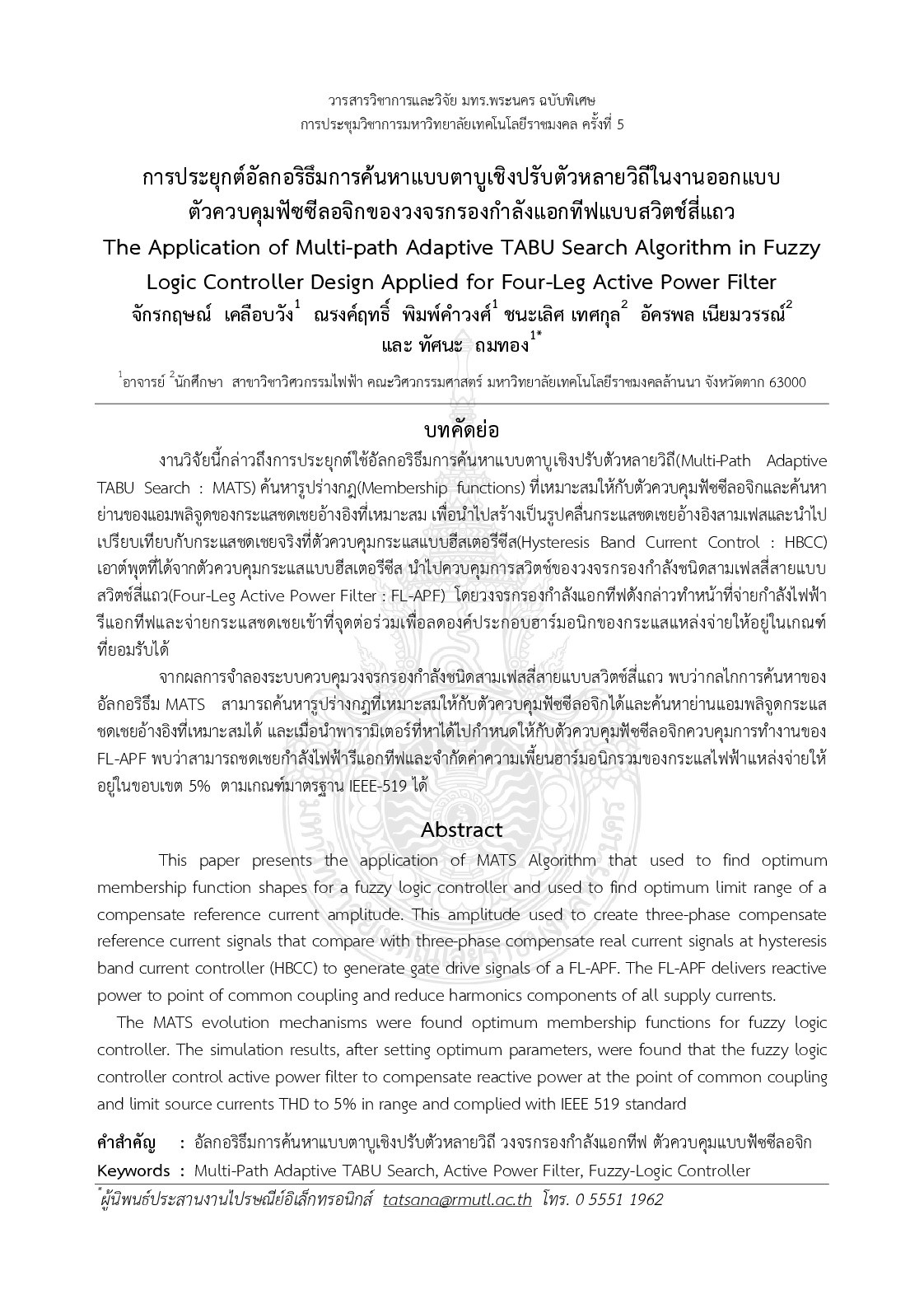
The application of multi-path adaptive TABU search algorithm in fuzzy logic controller design applied for four-leg active power filter
This paper presents the application of MATS Algorithm that used to find optimum membership function shapes for a fuzzy logic controller and used to find optimum limit range of a compensate reference current amplitude. This amplitude used to create three-phase compensate reference current signals that compare with three-phase compensate real current signals at hysteresis band current controller (HBCC) to generate gate drive signals of a FL-APF. The FL-APF delivers reactive power to point of common coupling and reduce harmonics components of all supply currents. The MATS evolution mechanisms were found optimum membership functions for fuzzy logic controller. The simulation results after setting optimum parameters were found that the fuzzy logic controller control active power filter to compensate reactive power at the point of common coupling and limit source currents THD to 5% in range and complied with IEEE 519 standard
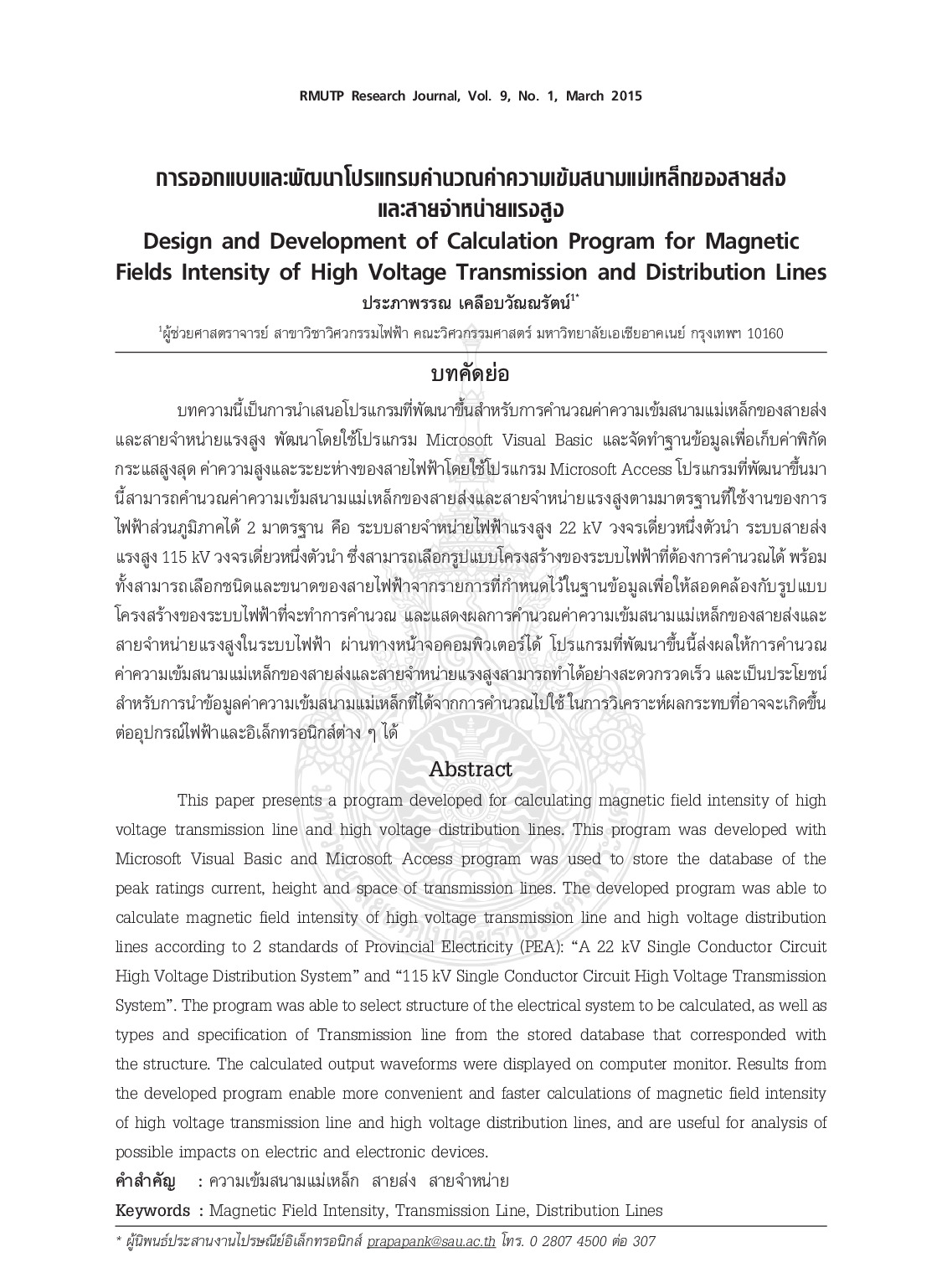
Design and development of calculation program for magnetic fields intensity of high voltage transmission and distribution lines
This paper presents a program developed for calculating magnetic field intensity of high voltage transmission line and high voltage distribution lines. This program was developed with Microsoft Visual Basic and Microsoft Access program was used to store the database of the peak ratings current height and space of transmission lines. The developed program was able to calculate magnetic field intensity of high voltage transmission line and high voltage distribution lines according to 2 standards of Provincial Electricity (PEA): “A 22 kV Single Conductor Circuit High Voltage Distribution System” and “115 kV Single Conductor Circuit High Voltage Transmission System”. The program was able to select structure of the electrical system to be calculated as well as types and specification of Transmission line from the stored database that corresponded with the structure. The calculated output waveforms were displayed on computer monitor. Results from the developed program enable more convenient and faster calculations of magnetic field intensity of high voltage transmission line and high voltage distribution lines and are useful for analysis of possible impacts on electric and electronic devices.
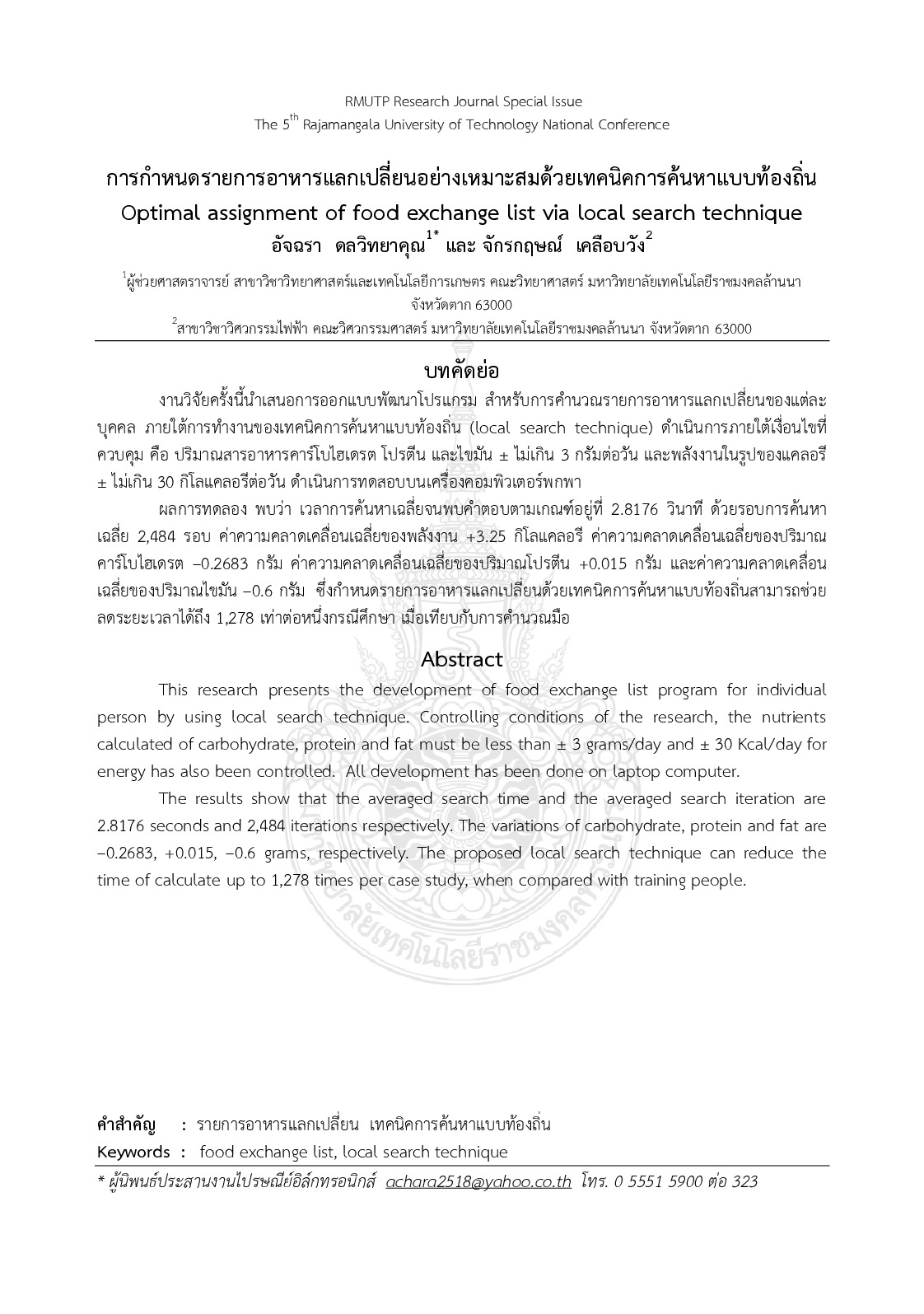
Optimal assignment of food exchange list via local search technique
This research presents the development of food exchange list program for individual person by using local search technique. Controlling conditions of the research the nutrients calculated of carbohydrate protein and fat must be less than 3 grams/day and 30 Kcal/day for energy has also been controlled. All development has been done on laptop computer. The results show that the averaged search time and the averaged search iteration are 2.8176 seconds and 2484 iterations respectively. The variations of carbohydrate protein and fat are –0.2683 +0.015 –0.6 grams respectively. The proposed local search technique can reduce the time of calculate up to 1278 times per case study when compared with training people.
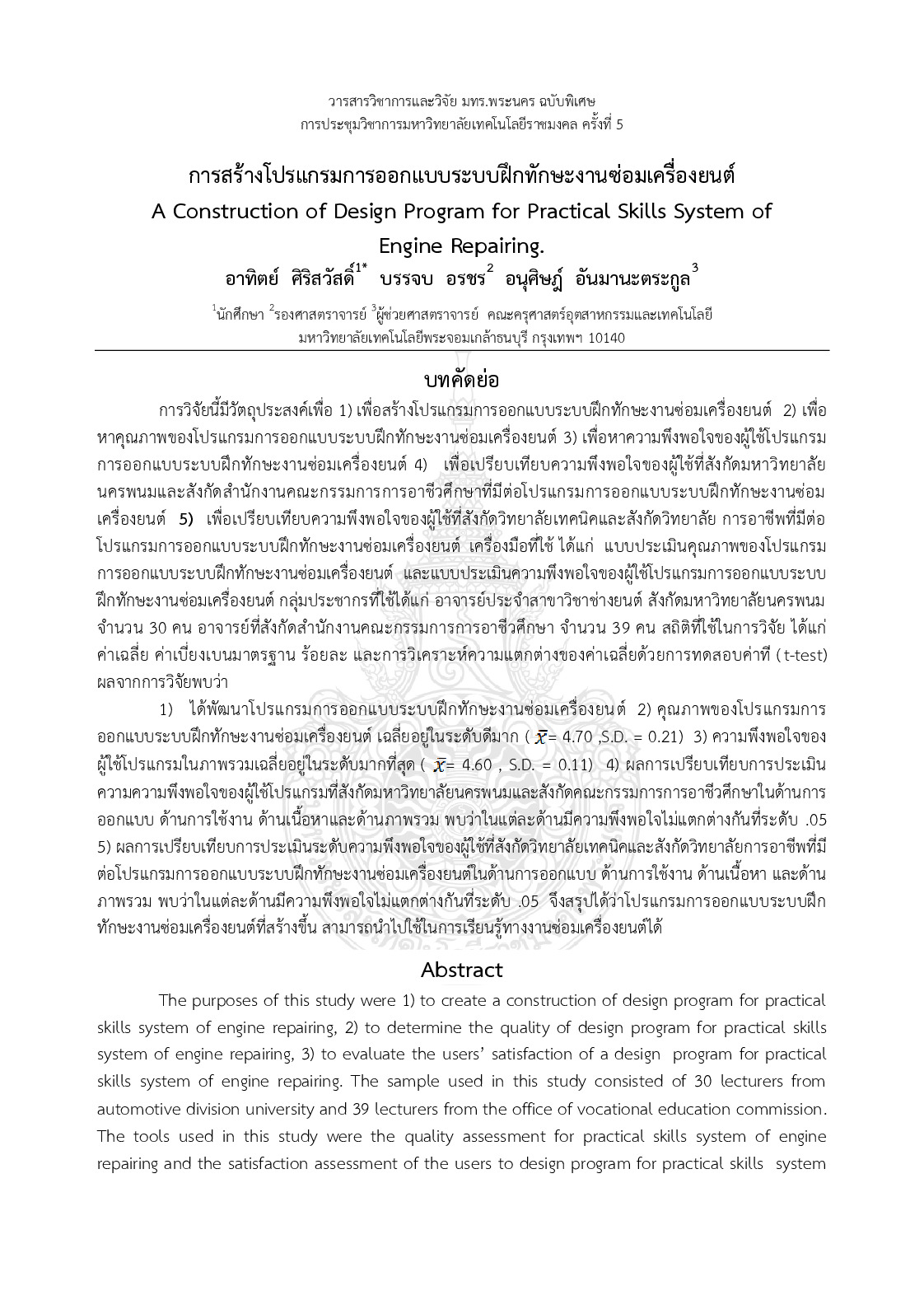
A construction of design program for practical skills system of engine repairing.
The purposes of this study were 1) to create a construction of design program for practical skills system of engine repairing 2) to determine the quality of design program for practical skills system of engine repairing 3) to evaluate the users’ satisfaction of a design program for practical skills system of engine repairing. The sample used in this study consisted of 30 lecturers from automotive division university and 39 lecturers from the office of vocational education commission. The tools used in this study were the quality assessment for practical skills system of engine repairing and the satisfaction assessment of the users to design program for practical skills system of engine repairing. The statistics used for data analysis were percentage mean standard deviation and t-test for dependent samples. The results of the study were as follows: 1) the quality of were very good level design program of for practical skills system of engine repairing( = 4.70 S.D. = 0.21). 2) User’s satisfaction level after accessing the program were very good level ( = 4.60 S.D. = 0.11). 3) The results were compared to assess the satisfaction level of the user from Nakhonphanom university and the office of vocational education commission towards of design program for practical skills system of engine repairing in the field of design content and application found that in each of the satisfaction level did not differ significantly at .05 level. 4) The results were compared to assess the satisfaction level of industrial community education and technical college towards of design program for practical skills system of engine repairing in the field of design content and the application found that in each of the satisfaction level did not difference at significance level .05