จำนวน Repository ( 2131 )

Media Exposure and Media Literacy of Youths in Bangkok
The purpose of research is to study media exposures behavior of youths in Bangkok level of media literacy and trend of media literacy after respondents acquired media exposures. The data were collected from 400 senior high school students in Bangkok Then those collected data were analyzed by the descriptive statistic composing of frequency percentage and mean. The methodologies of the study were questionnaires media literacy scale and Likert scale to gain the multi-stage random sampling. The result of the study indicated frequency of samples behavior to media exposures mainly from Internet 1-3 hours a day. Analysis of the data was done by calculating each questioning category in percentage. In this regard most of samples liked to watch television alone at 66.80% surfing Internet 91.5% listening to the radio 85.3% and reading newspaper 92.3%. The reason of media exposures for entertainment is television at 81.30% surfing internet 61.80% and listening to the radio 61.30%. However the main reason of media exposure to get information is newspaper at 46.80%. The prime time of media exposures by watching television and surfing internet is between 8.01 pm to midnight at 60% and 75.30% respectively. In addition the result of the study indicated level of
Behavior academic dishonesty among students in Rajamangala University of Technology Phra Nakhon
การวิจัยครั้งนี้มีวัตถุประสงค์เพื่อศึกษาและเปรียบเทียบพฤติกรรมไม่ซื่อสัตย์ทางวิชาการของนักศึกษามหาวิทยาลัยเทคโนโลยีราชมงคลพระนครจำแนกตามตัวแปรเพศ คณะที่ศึกษาอยู่ และผลการศึกษาเฉลี่ยสะสม และหาความสัมพันธ์ระหว่างตัวแปรสถานการณ์ ตัวแปรจิตลักษณะเดิมของบุคคล ตัวแปรจิตลักษณะตามสถานการณ์ กับพฤติกรรมไม่ซื่อสัตย์ทางวิชาการของนักศึกษามหาวิทยาลัยเทคโนโลยีราชมงคลพระนครทั้ง 9 คณะ ในภาคเรียนที่ 1 ปีการศึกษา 2553 เครื่องมือที่ผู้วิจัยใช้ในการเก็บรวบรวมข้อมูลครั้งนี้ เป็นแบบสอบถาม การวิเคราะห์ข้อมูลใช้ค่าสถิติ ร้อยละ ค่าเฉลี่ย ส่วนเบี่ยงเบนมาตรฐาน สถิติที การวิเคราะห์ความแปรปรวน และค่าสัมประสิทธิ์สหพันธ์ ผลการวิจัย พบว่า นักศึกษาส่วนใหญ่ไม่เคยกระทำความไม่ซื่อสัตย์ทางวิชาการ ประมาณ 56.96 ส่วนนักศึกษาที่รายงานว่าตนเคยกระทำพฤติกรรมไม่ซื่อสัตย์ทางวิชาการ ส่วนใหญ่เป็นการลอกแบบฝึกหัด รองลงไปเป็นการทุจริตในการสอบ และไม่ซื่อสัตย์ในการทำรายงาน พฤติกรรมไม่ซื่อสัตย์ทางวิชาการระหว่างนักศึกษาชายกับนักศึกษาหญิง โดยภาพรวมและรายด้านไม่แตกต่างกันอย่างมีนัยสำคัญทางสถิติที่ระดับ .05 แต่เมื่อจำแนกตามคณะที่ศึกษาและจำแนกตามผลการศึกษาเฉลี่ยสะสม พบว่า โดยภาพรวมแตกต่างกันอย่างมีนัยสำคัญทางสถิติที่ระดับ .05 และเมื่อพิจารณาตามด้านพบว่า ด้านความไม่ซื่อสัตย์ในการทำรายงาน และด้านการทุจริตในการสอบ มีพฤติกรรมไม่ซื่อสัตย์ทางวิชาการแตกต่างกันอย่างมีนัยสำคัญทางสถิติที่ระดับ .05 ส่วนด้านการลอกแบบฝึกหัดมีพฤติกรรมไม่ซื่อสัตย์ทางวิชาการแตกต่างอย่างไม่มีนัยสำคัญทางสถิติที่ระดับ .05 การทดสอบความสัมพันธ์ระหว่างตัวแปร พบว่า พฤติกรรมไม่ซื่อสัตย์ทางวิชาการ มีความสัมพันธ์ในทิศทางเดียวกันกับตัวแปรสถานการณ์ และตัวแปรจิตลักษณะตามสถานการณ์อย่างมีนัยสำคัญทางสถิติ 0.05
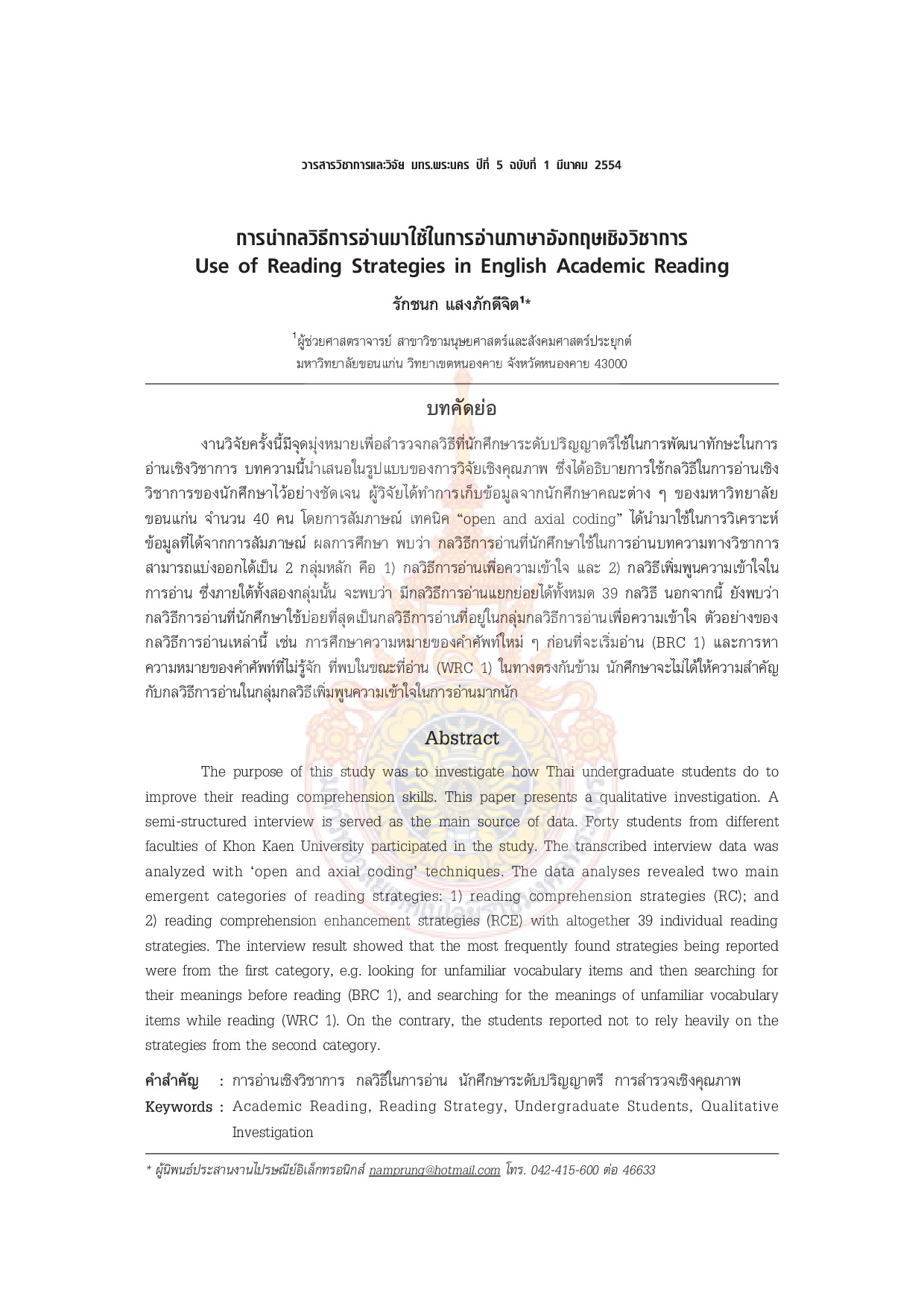
Use of Reading Strategies in English Academic Reading
The purpose of this study was to investigate how Thai undergraduate students do to improve their reading comprehension skills. This paper presents a qualitative investigation. A semi-structured interview is served as the main source of data. Forty students from different faculties of Khon Kaen University participated in the study. The transcribed interview data was analyzed with ‘open and axial coding’ techniques. The data analyses revealed two main emergent categories of reading strategies: 1) reading comprehension strategies (RC); and 2) reading comprehension enhancement strategies (RCE) with altogether 39 individual reading strategies. The interview result showed that the most frequently found strategies being reported were from the first category e.g. looking for unfamiliar vocabulary items and then searching for their meanings before reading (BRC 1) and searching for the meanings of unfamiliar vocabulary items while reading (WRC 1). On the contrary the students reported not to rely heavily on the strategies from the second category
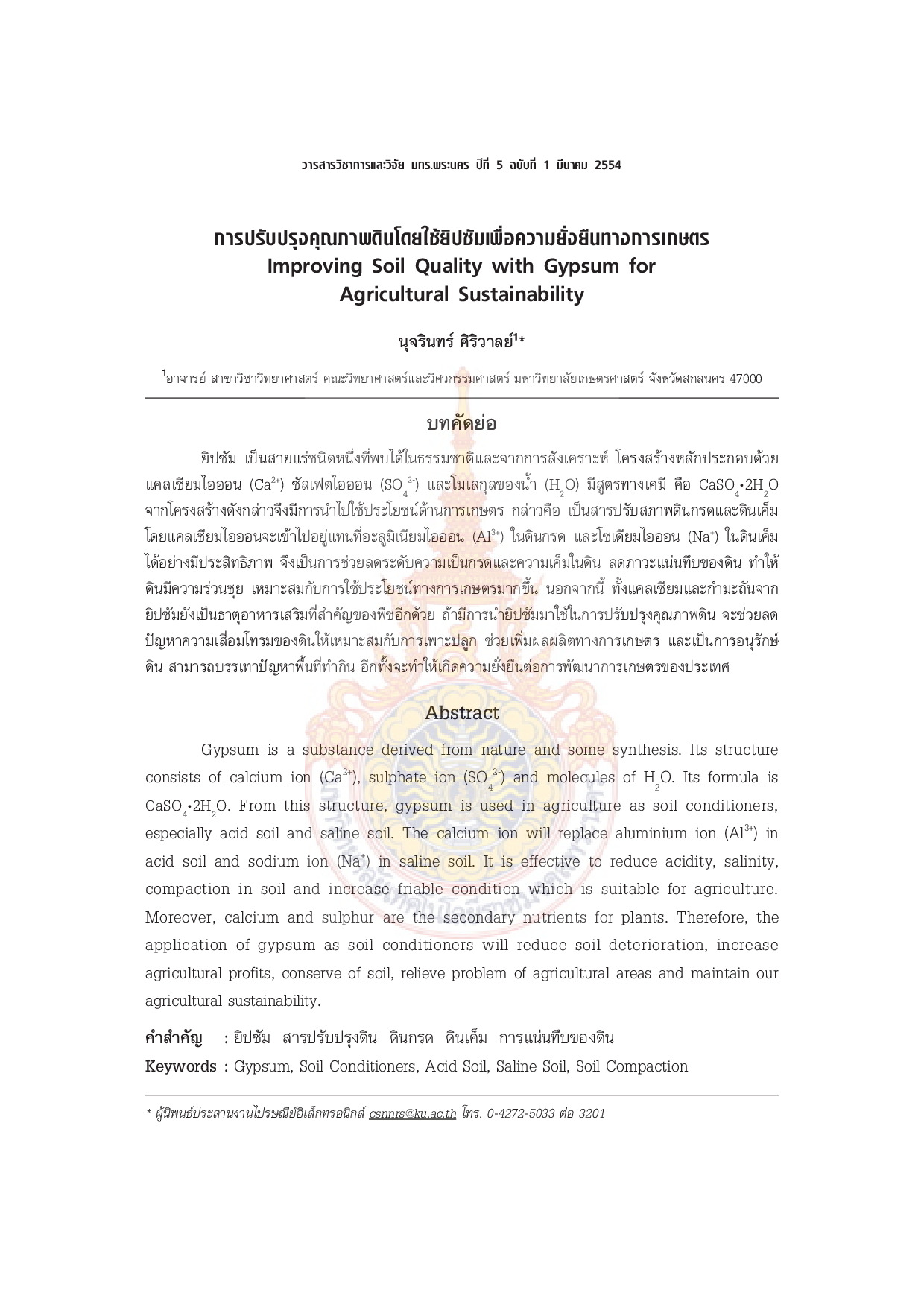
Improving Soil Quality with Gypsum for Agricultural Sustainability
Gypsum is a substance derived from nature and some synthesis. Its structure consists of calcium ion (Ca2+) sulphate ion (SO4 2-) and molecules of H2O. Its formula is CaSO4.2H2O. From this structure gypsum is used in agriculture as soil conditioners especially acid soil and saline soil. The calcium ion will replace aluminium ion (Al3+) in acid soil and sodium ion (Na+) in saline soil. It is effective to reduce acidity salinity compaction in soil and increase friable condition which is suitable for agriculture. Moreover calcium and sulphur are the secondary nutrients for plants. Therefore the application of gypsum as soil conditioners will reduce soil deterioration increase agricultural profits conserve of soil relieve problem of agricultural areas and maintain our agricultural sustainability
THE UTILITIES AND MEDIA EXPLOSURES OF THE STUDENT OF RAJAMANGGALA UNIVERSITY OF TECHNOLOGY PHRANAKORN THEWES CAMPUS
The aim of this is to study the relationship among the parameters such as demographic characteristic and the utilities and media explosures of the student of RMUTP THEWES CAMPUS by using surveying research for 303 sampleis.