จำนวน Repository ( 262 )
การศึกษากระบวนการทำงานของโรงงานเสื้อผ้าอุตสาหกรรม : กรณีศึกษาบริษัทบูติคนิวซิตี้ จำกัด (มหาชน)
This research provides the understanding of fashion industry production. Aims of this research are to develop teaching ability of lecturers and to develop and apply into related subject areas in order to increase the quality. This research and taken by quality-oriented education. Collecting data through documents and related websites explore the working process in garment industry include non-formal interview. The research found that Boutique New City has owned and provides a large number of license brands in order to support several targets. Most is sold in company’s own stores which located in famous and modern shopping department stores. Each store has been set its display to attract and promote new arrival to the customer. Production process consists of flow chart of organization’s working process and subprocess. For examples cutting sewing decorating delivery and storage process. However working mainly depends on documents while management and main concept have been received from France. There is no marketing research department in Boutique New City Company Limited. This makes employees are able to understand marketing but there are 4 products managers for each brand. There are sources from 140 selling points have been evaluated by marketing management system in head office. Organization also provides member subscription in order to understand customer behavior. The patterns of fabrics are designed by in-house graphic company or purchased license design from other countries through trade fair.

ปัจจัยที่มีผลต่อการปรับตัวทางสังคมของนักศึกษา คณะครุศาสตร์อุตสาหกรรมหลักสูตรครุศาสตร์อุตสาหกรรมบัณฑิต (หลักสูตร 5 ปี)
This paper is a survey research. The objective is to study the factors of Social Adjustment of Technical Education Faculty Students B.S. of Technical Education (5 years curriculum) Faculty of the industrial education Rajamangala University of Technology Phra Nakhon. The random sampling is conducted within the full-time students from 3 majors. The random sampling technique in this paper is derived from Krehbiel-Morgan table. The total number of sample is 167 students. Research Methodology This paper uses the survey method to collect the data. The data analysis process is based on the average percentage value of standard deviation and t-test F-test techniques. The research results can be summarized as follows: 1. Students with different genders have overall social adjustment ability indifferently. 2. Students with different ages have overall social adjustment indifferently. This implies that age is not a factor in social adjustment. 3. Students who graduated from different curriculum have overall social adjustment ability differently. The students who graduated from vocational-qualification curriculum have overall social adjustment ability higher than students who graduated from academic-qualification curriculum. In specific aspect of social adjustment to classmate the result is also the same. 4. Students with different sequence of birth have overall social adjustment ability indifferently. 5. Students with different family status in society have overall social adjustment ability indifferently. 6. Students with their parents in different occupation have overall social adjustment ability indifferently. 7. Students with different average-income-per-month families have overall social adjustment ability indifferently. However in specific aspect of social adjustment to general person the students with higher average-income-per-month families have social adjustment ability better than the students with lower average-income-per-month families. 8. Students with different family characteristics have overall social adjustment ability differently. The students with large family have overall social adjustment ability higher than students with small family.
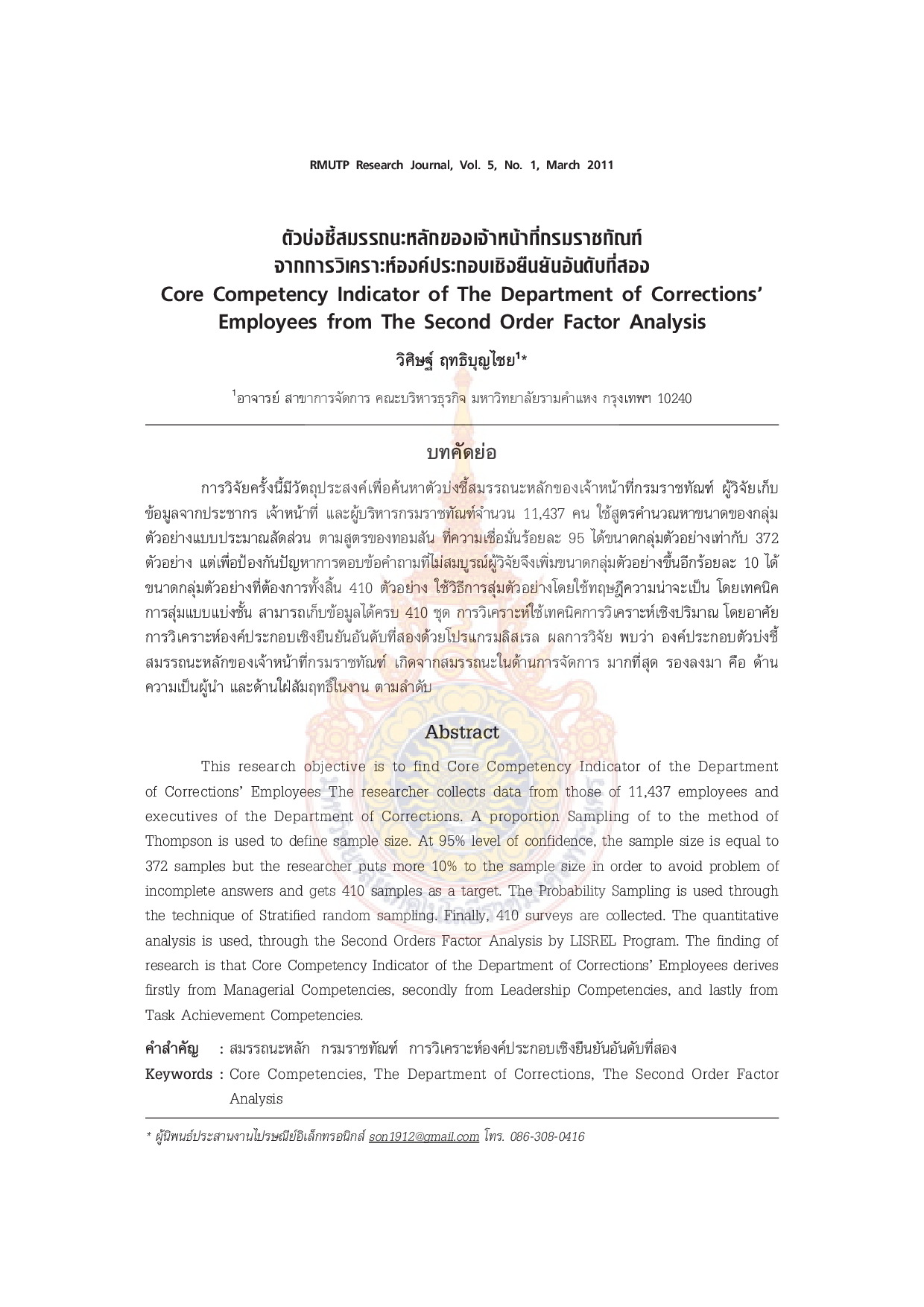
Core Competency Indicator of The Department of Corrections’ Employees from The Second Order Factor Analysis
This research objective is to find Core Competency Indicator of the Department of Corrections’ Employees The researcher collects data from those of 11437 employees and executives of the Department of Corrections. A proportion Sampling of to the method of Thompson is used to define sample size. At 95% level of confidence the sample size is equal to 372 samples but the researcher puts more 10% to the sample size in order to avoid problem of incomplete answers and gets 410 samples as a target. The Probability Sampling is used through the technique of Stratified random sampling. Finally 410 surveys are collected. The quantitative analysis is used through the Second Orders Factor Analysis by LISREL Program. The finding of research is that Core Competency Indicator of the Department of Corrections’ Employees derives firstly from Managerial Competencies secondly from Leadership Competencies and lastly fromTask Achievement Competencies