จำนวน Repository ( 231 )
Influencing to make decision to buy green label product
The objective of this study was to study about consumers’ knowledge to green label an opinion and an effect to buy green label product. The subjects of this study were choser from the people who care with environment and lived in Bangkok. The instruments were Questionnaire. The data collected was statistically analyzed by percentage mean T-test Independent One Way ANOVA Chi-Square Spearman Rank Order Correlation Coefficient and LSD (Fisher’s Least Significant Different) The findings of this study revealed that : 1. The populations were more female than male. The most populations were 16-25 and the second one were 26-35. The first education level was bachelor degree and the second one was diploma. For an occupation the first was office workers and the second was students. 2. Involving in using green label products. 2.1 Using green label products which solving pollution. (1) Using gasohol. (2) Using non-mercury dry cells and paint. (3) Using non-CFC spray. (4) Using non-CFC refrigerator. 2.2 Using pr oducts which were not destroy water and economy. (1) Using non-phosphate detergent. (2) Using economic sanitary ware. (3) Using economic tap. (4) Using non washing Clothes. 2.3 Using products which reduce rubbish. (1) Using solar disintegrate bags. (2) Using refill products. (3) Using recycle plastic. 2.4 Using reduce destroying forest. (1) Using recycle tissue or paper. (2) Using recycle packages. 2.5 Using non-toxic products. (1) Using Non-toxic plants. (2) Using herbal products. (3) Using bio-fertilizer. 2.6 Using eco-energy. (1) Using eco-light bulb. (2) Using eco-refrigerator. (3) Using eco-air conditioner. (4) Using eco-electric fan. (5) Using eco-electric no. 5. 3. The population’ opinion about green label products’ mean was good. 4. The acknowledging about green label products revealed that the information media hadn’t enough. The first media which gave data the most was TV . The second was internet and newspaper. They wanted the government to fight more. The data which was important was telling about qualification and usefulness of the products and presented more about the products. For the contributing in the project or informing to someone revealed that they kindly to join the project. The populations’ understanding in green label products was moderate. The reason to buy the products was to protect environment and believe in quality and good for health. They wanted the government to pass the environmental law. 5. Hypothesis 5.1 The different sex and age had non-different opinion. 5.2 The different education had different opinion. The Graduate degree population had more knowledge in green label products more than the lower degree. 5.3 The different career had different opinion. The civil servant and the state enterprise employee and more knowledge in green label products more than the others. 5.4 The different type of media had non-different opinion. 5.5 The different type of media had an effect to buy the products. 5.6 The green products’ knowledge hadn’t an effect to buy the products. 5.7 The green label products’ knowledge hadn’t relate to the type of media.

การพัฒนาและสร้างเครื่องมือในการช้อนเนื้อเยื่อใบสับปะรด
Currently the pineapple leaf paper that is produced by using local wisdom is 50 centimeters wide and 64 centimeters long. Therefore the product of the Cooperative is small. And because the size of the paper is limited they cannot be used for producing room divider big umbrella or big painting as per customer’s demand and the members of the cooperative cannot produce large sheet of paper. The researchers therefore designed the Pineapple fibrous leaf sieving Equipment in order to produce large sheet of paper. The equipment consists of a square basin for washing leaf fiber sized 185 centimeters 10 centimeter deep with a 90-centimeter high stand to support the basin and installed the mechanism to lift up the sieve that is used to take up the pineapple leaf fiber. The sieve is 150 centimeters x 150 centimeters which is the largest size possible because the leaf fiber washing must is done by hand. If the sieve is bigger we will not be able to reach to the leaf fiber in the center. Base on the experiment of pineapple leaf paper production by using the new equipment as compared to the paper production as per local wisdom by using 2.5 kilograms pineapple leaf fiber and the paper thickness shall be fixed at 0.35 millimeters it is found that the production that use pineapple fibrous leaf sieving equipment takes 647 second on average and the production as per local wisdom takes 1421 second on average. In other words the equipment can help to reduce the time in paper production of 774 second or 54 %. Apart from that the researcher produced the paper with different thickness by increasing the pineapple leaf fiber by 0.5 kilograms per one sheet of paper so that there are more options to choose in order to match with various products. The amount of leaf fiber used in the production starts from 3 kilograms to 7.5 kilogram per sheet and the thickness of the paper is from 0.36 millimeters and the thickest paper is 1.2 millimeters thick using approximately 7.5 kilograms of leaf fiber. If we use more leaf fiber for paper production the paper will be overweight and it will be sagging.
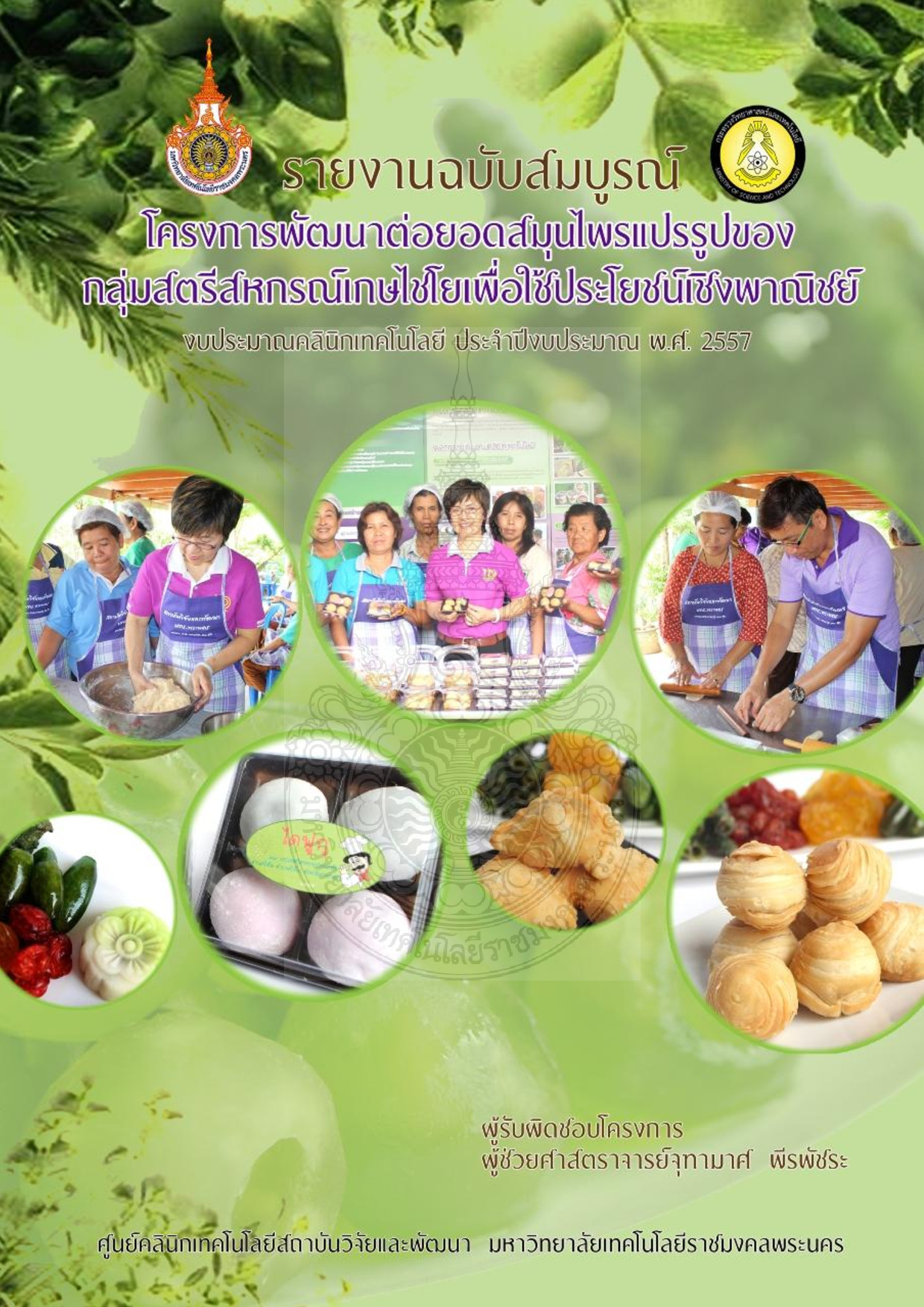
การถ่ายทอดเทคโนโลยีการสร้างตราสินค้าและบรรจุภัณฑ์เพื่อเพิ่มมูลค่าผลิตภัณฑ์จากเศษวัสดุสิ่งทอเหลือทิ้ง
The research’s purpose is the knowledge transfer of the technology about branding and packaging to increase product’s value from waste textiles for the community groups and interested person. The assessment method for evaluation is studying the local product’s information the processing rag’s group in Ban Dongdang Tambon Dongdeang Jaturapakpiman Roy-ed. The researcher selected the brand and packaging prototypes and the product from the research about branding and packaging to increase product’s value from waste textiles (Fiscal year in 2013) which are appropriate to the product being sold. Because that research has the heart shape petal’s brand label for packaging the winner from 25 styles that selected from 5 experts. And has been applied to a prototype of 8 products. The 8 products are The packaging for bag The packaging for hat The packaging for lamp The packaging for shoe The packaging for textile’s box The packaging for bedspread The packaging for carpet The packaging for Cushions The packaging for Scatter cushion The packaging for tablecloth The packaging for fabric wall and frame. The goal of knowledge transfer are 30 persons. The survey of the participants’ satisfaction by the questionnaires data collection the data from the frequency statistic percentage and median. The result is the participants 25 persons (50 %) were mostly female 13 persons (43.34%) with secondary education 15 persons (50%) between the ages of 31- 40 years old 10 persons (33.33%) a farmer and seamstress 18 persons (60%) with monthly income less than 5000 bath. Satisfaction is divided into 3 topics the purpose of project the structure of the course the content of the course.The purpose of project is the most satisfied (4.68%). The structure of the course is satisfactory (3.97%). The content of the course is satisfactory (4.45%). And the satisfaction to the reproductive technology about branding and packaging to increase product’s value from waste textiles project in the service processes is satisfactory (4.50%) Lecturer team is the most satisfied (4.68%) The facilities is the most satisfied (4.68%). Ban Dong deang’s rag and processing group has a satisfaction’s average of the project is the most satisfied (4.48%).

Potential of extracts of Ficus hispida linn for controlling germination and Growth of Weed in Rice Field for Increase the value of biodiversity and its sustainable use
The potential of extracts of the Ficus hispida Linn to inhibit germination and growth of barnyardgrass (Echinochloa crus-galli) a common weed in rice. The bark leaves and fruit of F. hispida isolated by the Maceration and extracted by the polarity of the solvent (Sequential Extraction) with organic solvents such as hexane ethyl acetate and methanol when each part of the crude extract was tested the type of phytochemical tested for germinate inhibition root length inhibition stem length inhibition and dry weight inhibition of barnyardgrass and selected extracts with highest inhibition to separation using column chromatography the fractions tested repeating. The results showed that 1. Crude methanolic extracts from the bark leaves and fruit of barnyardgrass at a concentration of 3000 ppm showed highest inhibited percentage of germinate inhibition root length inhibition stem length inhibition and dry weight inhibition. 2. Fractions methanolic extracts from the bark leaves and fruit of barnyardgrass on a separate with column chromatography found that fractions extracts F5 F8 and F2 showed highest inhibited percentage of germinate inhibition root length inhibition stem length inhibition and dry weight inhibition.