จำนวน Repository ( 3447 )
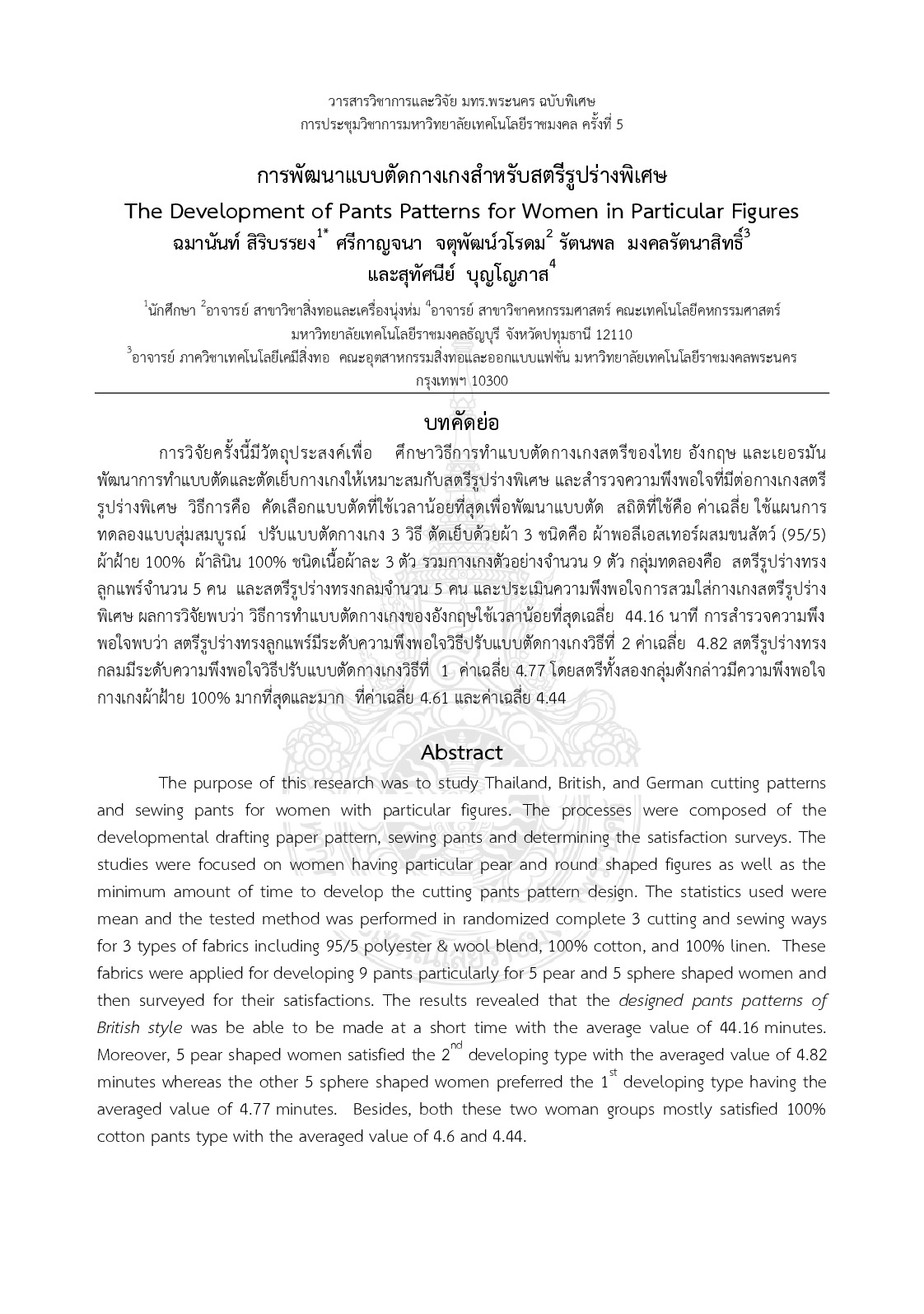
The development of pants patterns for women in particular figures
The purpose of this research was to study Thailand British and German cutting patterns and sewing pants for women with particular figures. The processes were composed of the developmental drafting paper pattern sewing pants and determining the satisfaction surveys. The studies were focused on women having particular pear and round shaped figures as well as the minimum amount of time to develop the cutting pants pattern design. The statistics used were mean and the tested method was performed in randomized complete 3 cutting and sewing ways for 3 types of fabrics including 95/5 polyester & wool blend 100% cotton and 100% linen. These fabrics were applied for developing 9 pants particularly for 5 pear and 5 sphere shaped women and then surveyed for their satisfactions. The results revealed that the designed pants patterns of British style was be able to be made at a short time with the average value of 44.16 minutes. Moreover 5 pear shaped women satisfied the 2nd developing type with the averaged value of 4.82 minutes whereas the other 5 sphere shaped women preferred the 1st developing type having the averaged value of 4.77 minutes. Besides both these two woman groups mostly satisfied 100% cotton pants type with the averaged value of 4.6 and 4.44.
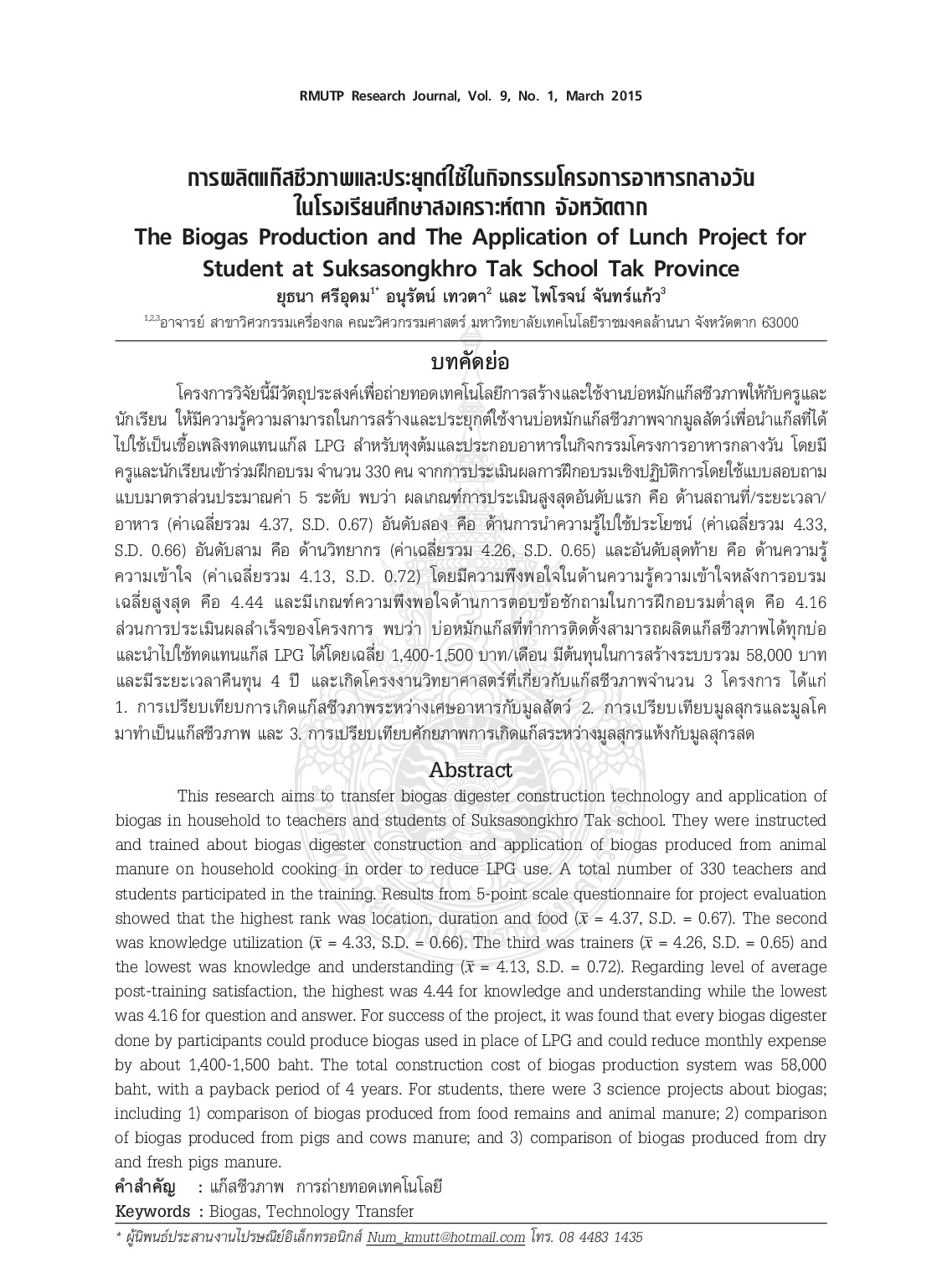
The biogas production and the application of lunch project for student at suksasongkhro tak school tak province
This research aims to transfer biogas digester construction technology and application of biogas in household to teachers and students of Suksasongkhro Tak school. They were instructed and trained about biogas digester construction and application of biogas produced from animal manure on household cooking in order to reduce LPG use. A total number of 330 teachers and students participated in the training. Results from 5-point scale questionnaire for project evaluation showed that the highest rank was location duration and food ( = 4.37 SD = 0.67). The second was knowledge utilization ( = 4.33 SD = 0.66). The third was trainers ( = 4.26 SD = 0.65) and the lowest was knowledge and understanding ( = 4.13 SD = 0.72). Regarding level of average post-training satisfaction the highest was 4.44 for knowledge and understanding while the lowest was 4.16 for question and answer. For success of the project it was found that every biogas digester done by participants could produce biogas used in place of LPG and could reduce monthly expense by about 1400 – 1500 baht. The total construction cost of biogas production system was 58000 baht with a payback period of 4 years. For students there were 3 science projects about biogas; including 1) comparison of biogas produced from food remains and animal manure; 2) comparison of biogas produced from pigs and cows manure; and 3) comparison of biogas produced from dry and fresh pigs manure.
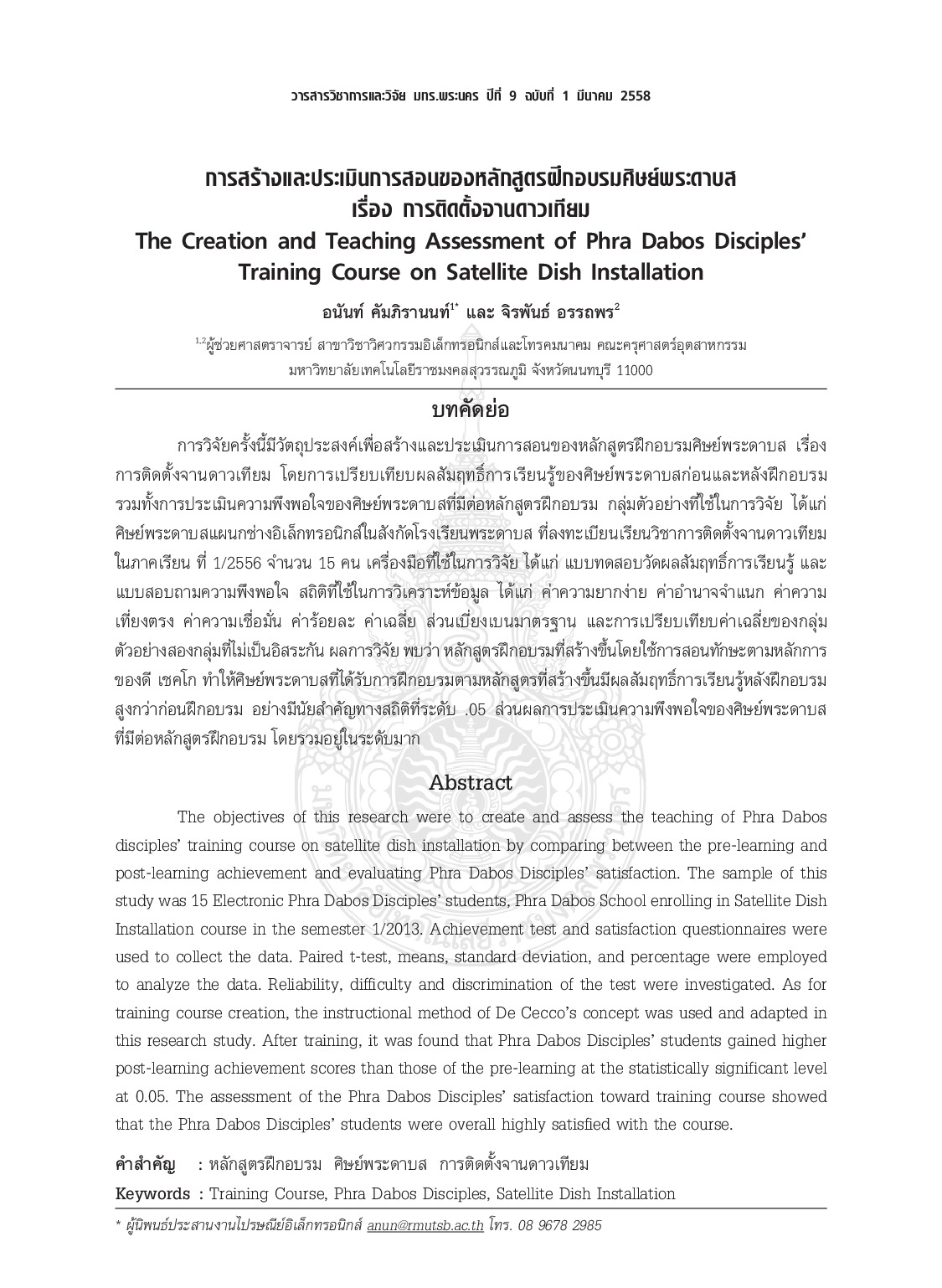
The creation and teaching assessment of phra dabos disciples’ training course on satellite dish installation
The objectives of this research were to create and assess the teaching of Phra Dabos disciples’ training course on satellite dish installation by comparing between the pre-learning and post-learning achievement and evaluating Phra Dabos Disciples’ satisfaction. The sample of this study was 15 Electronic Phra Dabos Disciples’ students Phra Dabos School enrolling in Satellite Dish Installation course in the semester 1/2013. Achievement test and satisfaction questionnaires were used to collect the data. Paired t-test means standard deviation and percentage were employed to analyze the data. Reliability difficulty and discrimination of the test were investigated. As for training course creation the instructional method of De Cecco’s concept was used and adapted in this research study. After training it was found that Phra Dabos Disciples’ students gained higher post-learning achievement scores than those of the pre-learning at the statistically significant level at 0.05. The assessment of the Phra Dabos Disciples’ satisfaction toward training course showed that the Phra Dabos Disciples’ students were overall highly satisfied with the course.
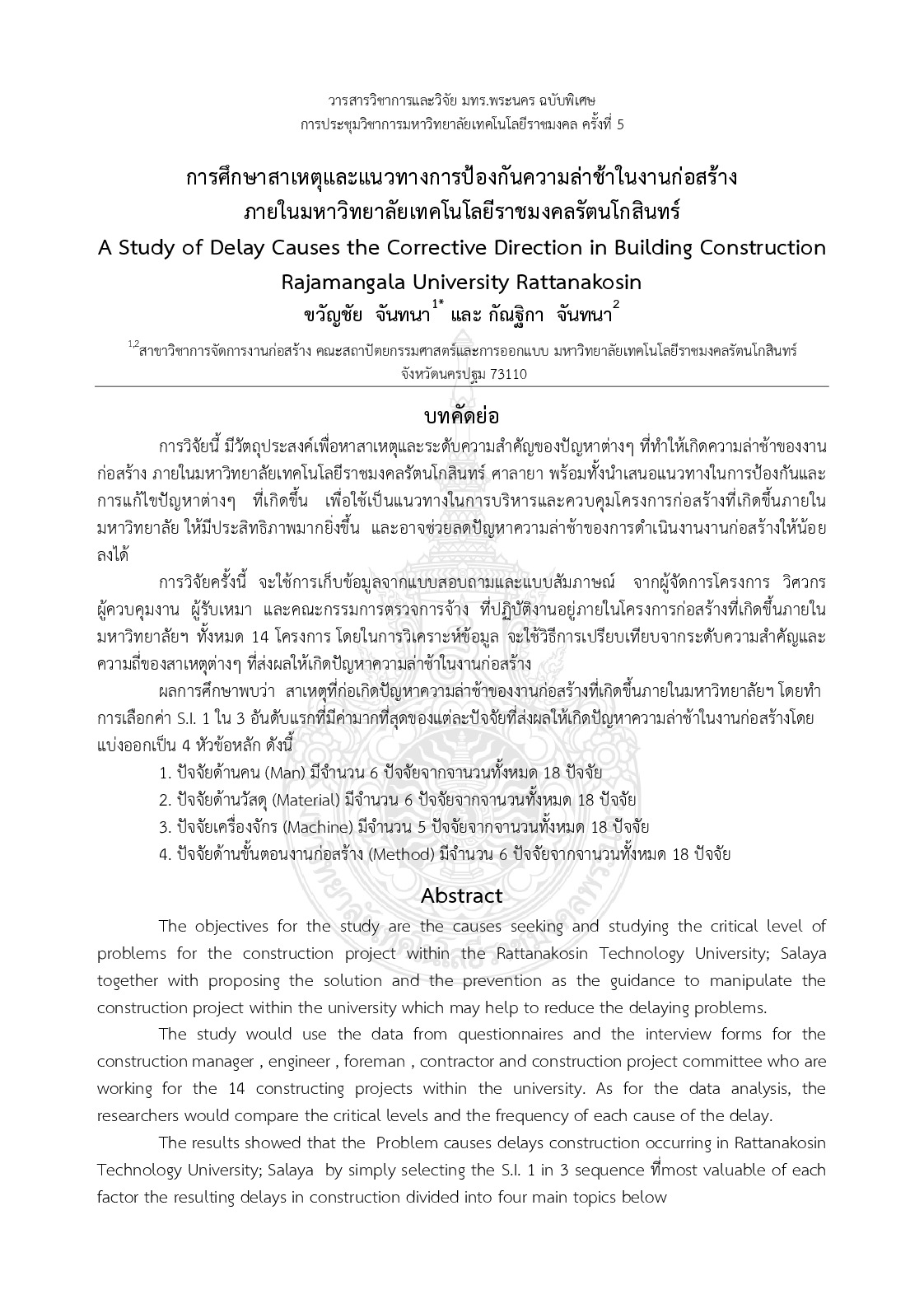
A study of delay causes the corrective direction in building construction Rajamangala University Rattanakosin
The objectives for the study are the causes seeking and studying the critical level of problems for the construction project within the Rattanakosin Technology University; Salaya together with proposing the solution and the prevention as the guidance to manipulate the construction project within the university which may help to reduce the delaying problems. The study would use the data from questionnaires and the interview forms for the construction manager engineer foreman contractor and construction project committee who are working for the 14 constructing projects within the university. As for the data analysis the researchers would compare the critical levels and the frequency of each cause of the delay. The results showed that the Problem causes delays construction occurring in Rattanakosin Technology University; Salaya by simply selecting the S.I. 1 in 3 sequence ที่most valuable of each factor the resulting delays in construction divided into four main topics below 1. Man : of 6 factors the total number of 18 factors 2. Material : of 6 factors the total number of 18 factors 3. Machine : of 5 factors the total number of 18 factors 4. Method : of 6 factors the total number of 18 factors
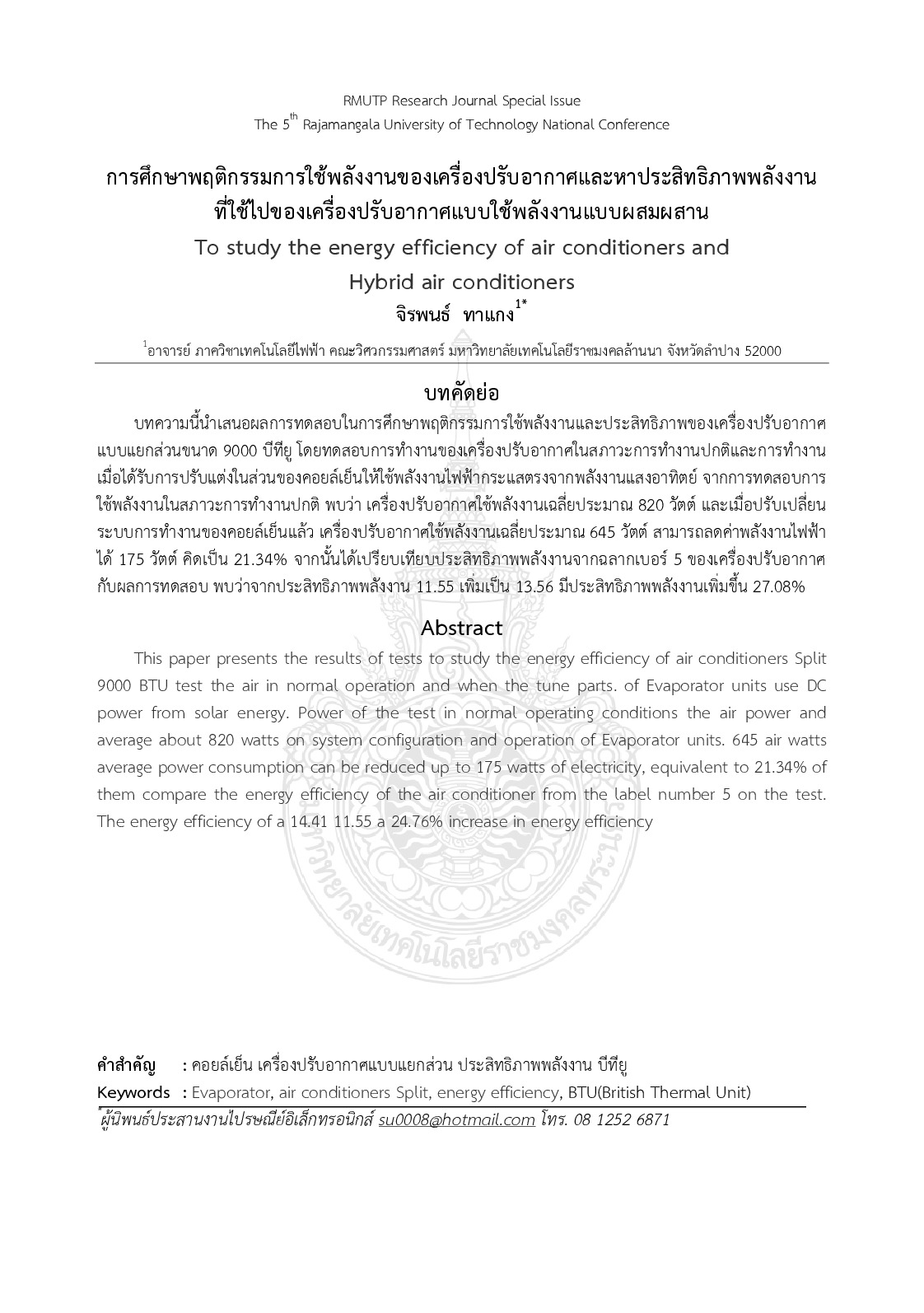
To study the energy efficiency of air conditioners and hybrid air conditioners
This paper presents the results of tests to study the energy efficiency of air conditioners Split 9000 BTU test the air in normal operation and when the tune parts. of Evaporator units use DC power from solar energy. Power of the test in normal operating conditions the air power and average about 820 watts on system configuration and operation of Evaporator units. 645 air watts average power consumption can be reduced up to 175 watts of electricity equivalent to 21.34% of them compare the energy efficiency of the air conditioner from the label number 5 on the test. The energy efficiency of a 14.41 11.55 a 24.76% increase in energy efficiency