จำนวน Repository ( 3447 )
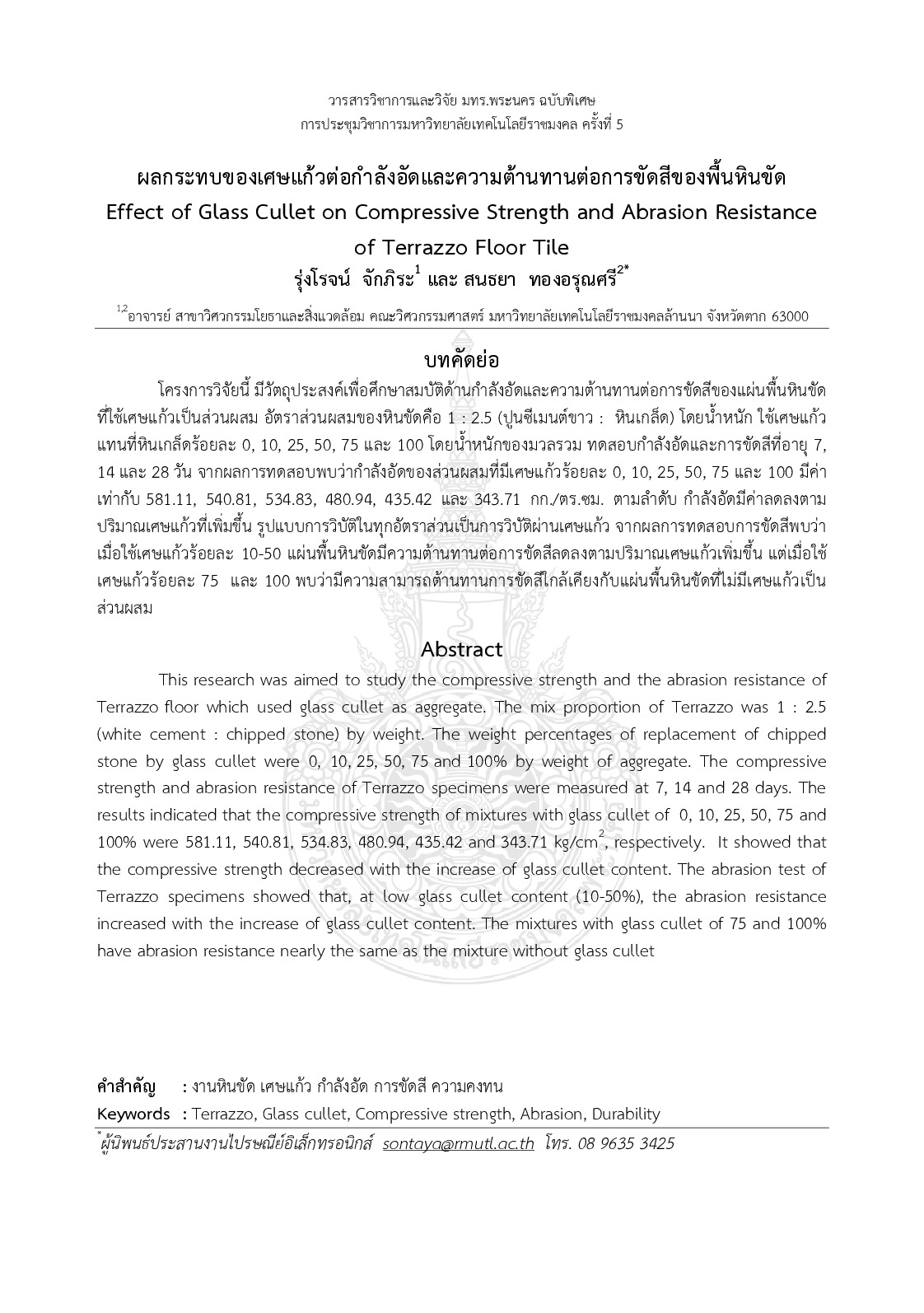
Effect of glass cullet on compressive strength and abrasion resistance of terrazzo floor tile
This research was aimed to study the compressive strength and the abrasion resistance of Terrazzo floor which used glass cullet as aggregate. The mix proportion of Terrazzo was 1 : 2.5 (white cement : chipped stone) by weight. The weight percentages of replacement of chipped stone by glass cullet were 0 10 25 50 75 and 100% by weight of aggregate. The compressive strength and abrasion resistance of Terrazzo specimens were measured at 7 14 and 28 days. The results indicated that the compressive strength of mixtures with glass cullet of 0 10 25 50 75 and 100% were 581.11 540.81 534.83 480.94 435.42 and 343.71 kg/cm2 respectively. It showed that the compressive strength decreased with the increase of glass cullet content. The abrasion test of Terrazzo specimens showed that at low glass cullet content (10-50%) the abrasion resistance increased with the increase of glass cullet content. The mixtures with glass cullet of 75 and 100% have abrasion resistance nearly the same as the mixture without glass cullet
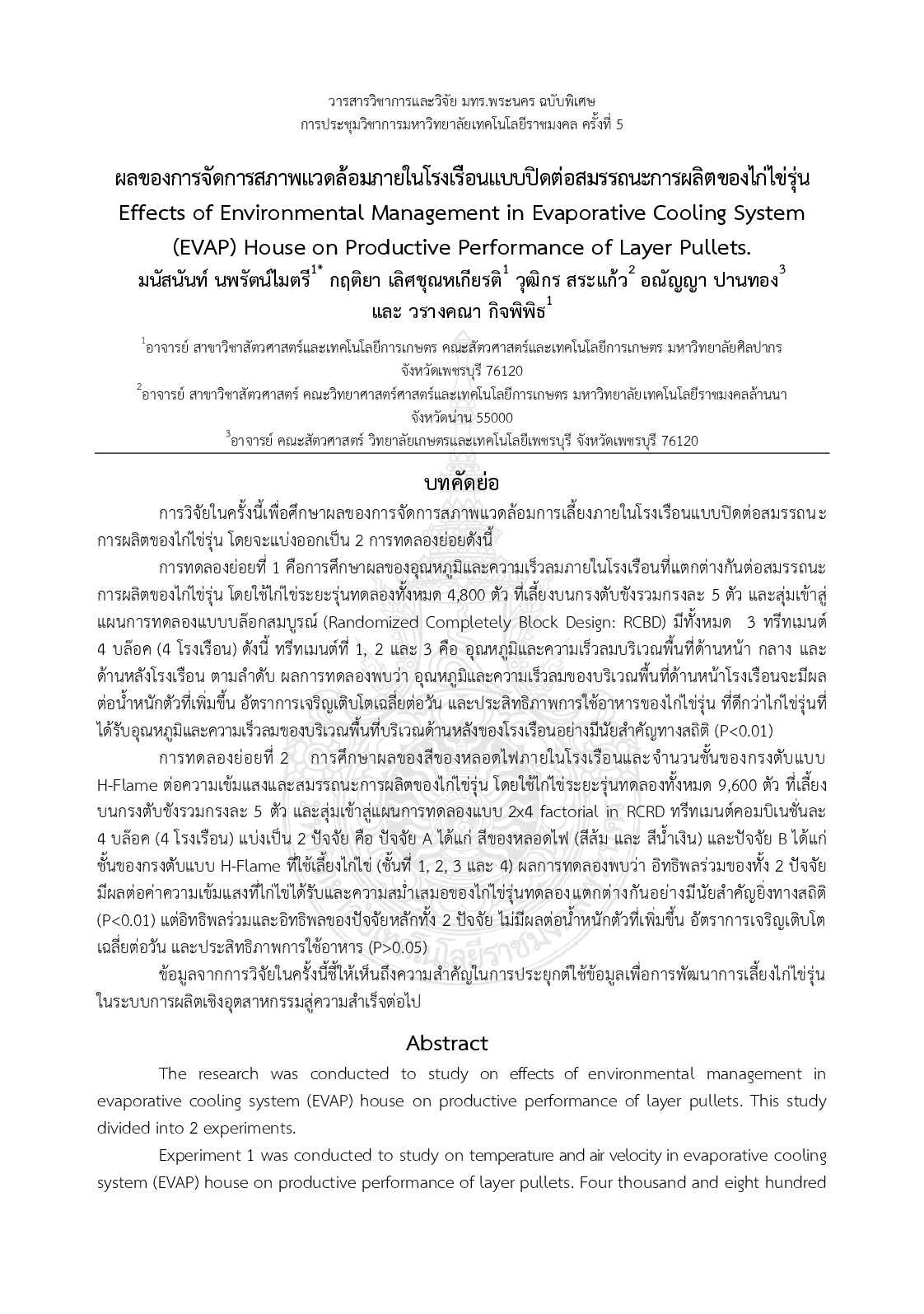
Effects of environmental management in evaporative cooling system (EVAP) house on productive performance of layer pullets
The research was conducted to study on effects of environmental management in evaporative cooling system (EVAP) house on productive performance of layer pullets. This study divided into 2 experiments. Experiment 1 was conducted to study on temperature and air velocity in evaporative cooling system (EVAP) house on productive performance of layer pullets. Four thousand and eight hundred layer pullets were raised on battery cage with 5 birds per cage and assigned in a Randomized Completely Block Design (RCBD) experiment with three treatments. Each treatment consisted of four blocks (four houses) and followed different temperature and air velocity in raising area of evaporative cooling system (EVAP) house as front area central area and back area. Results showed that temperature and air velocity in front area was grater body weight gain (BWG) average daily gain (ADG) and feed conversion ratio (FCR) of layer pullets than layer pullets were raised in back area of evaporative cooling system (EVAP) house (P<0.01) Experiment 2 was conducted to study on light color and number of H-Flame battery cage row in evaporative cooling system (EVAP) house on light intensity and productive performance of layer pullets. Nine thousand and six hundred layer pullets were raised on H-Flame battery cage with 5 birds per cage and assigned in a 2x4 factorial in Randomized Completely Block Design (RCBD) experiment with two factors. Factor A was light color comprised of range and blue). While Factor B was number of battery cage row comprised (first row second row third row and fourth row). Each treatment consisted of four blocks (four houses). Results showed that interaction between factor A and B on light intensity and uniformity of layer pullets with highly significantly different (P<0.01). However interaction between factor A and B and main effect (factor A and B) were investigated on body weight gain (BWG) average daily gain (ADG) and feed conversion ratio (FCR) (P>0.05). The data from this research was suggests the important for implicate to improve the egg production industry in further success.
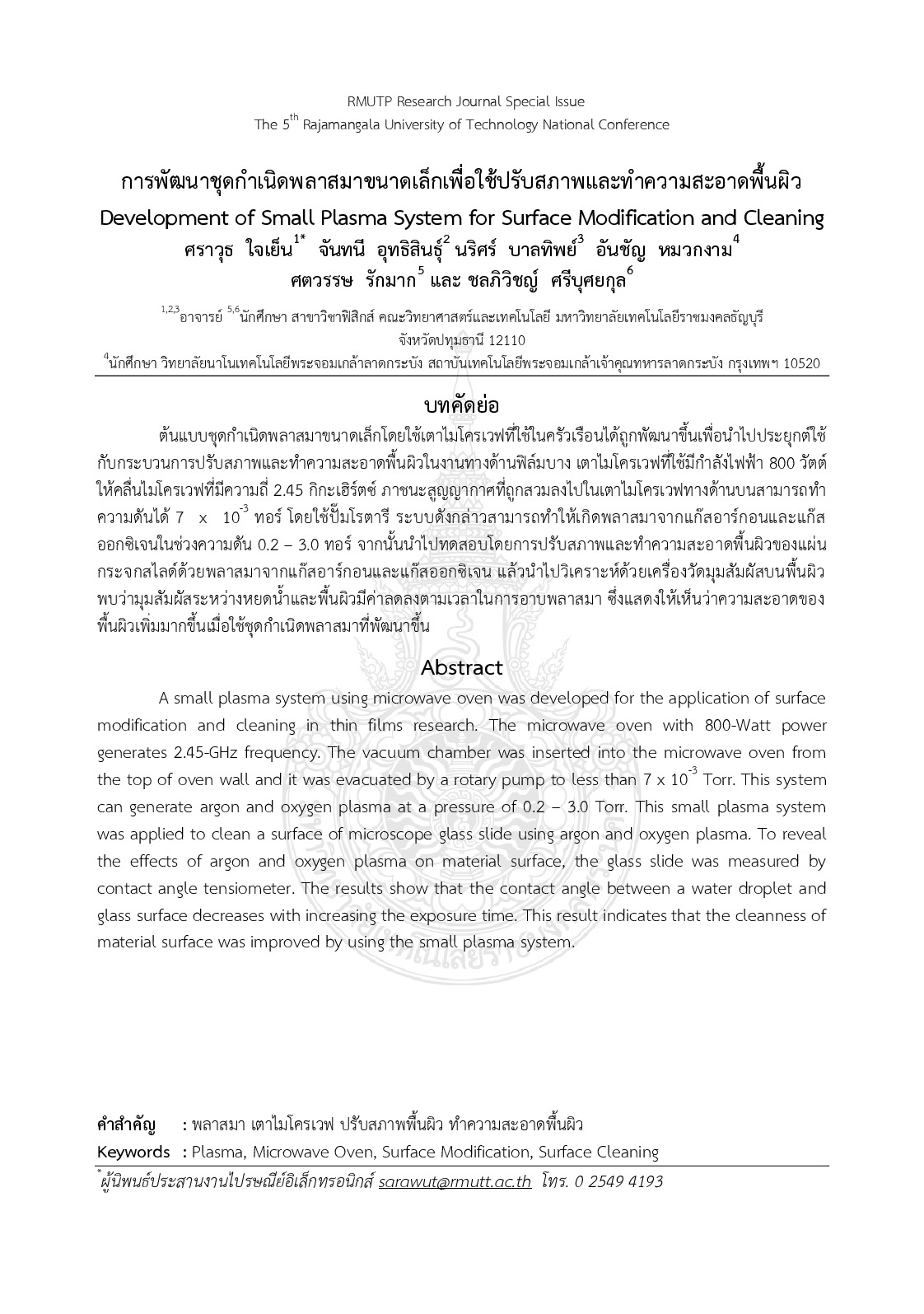
Development of small plasma system for surface modification and cleaning
A small plasma system using microwave oven was developed for the application of surface modification and cleaning in thin films research. The microwave oven with 800-Watt power generates 2.45-GHz frequency. The vacuum chamber was inserted into the microwave oven from the top of oven wall and it was evacuated by a rotary pump to less than 7 x 10⁻³ Torr. This system can generate argon and oxygen plasma at a pressure of 0.2 – 3.0 Torr. This small plasma system was applied to clean a surface of microscope glass slide using argon and oxygen plasma. To reveal the effects of argon and oxygen plasma on material surface the glass slide was measured by contact angle tensiometer. The results show that the contact angle between a water droplet and glass surface decreases with increasing the exposure time. This result indicates that the cleanness of material surface was improved by using the small plasma system.
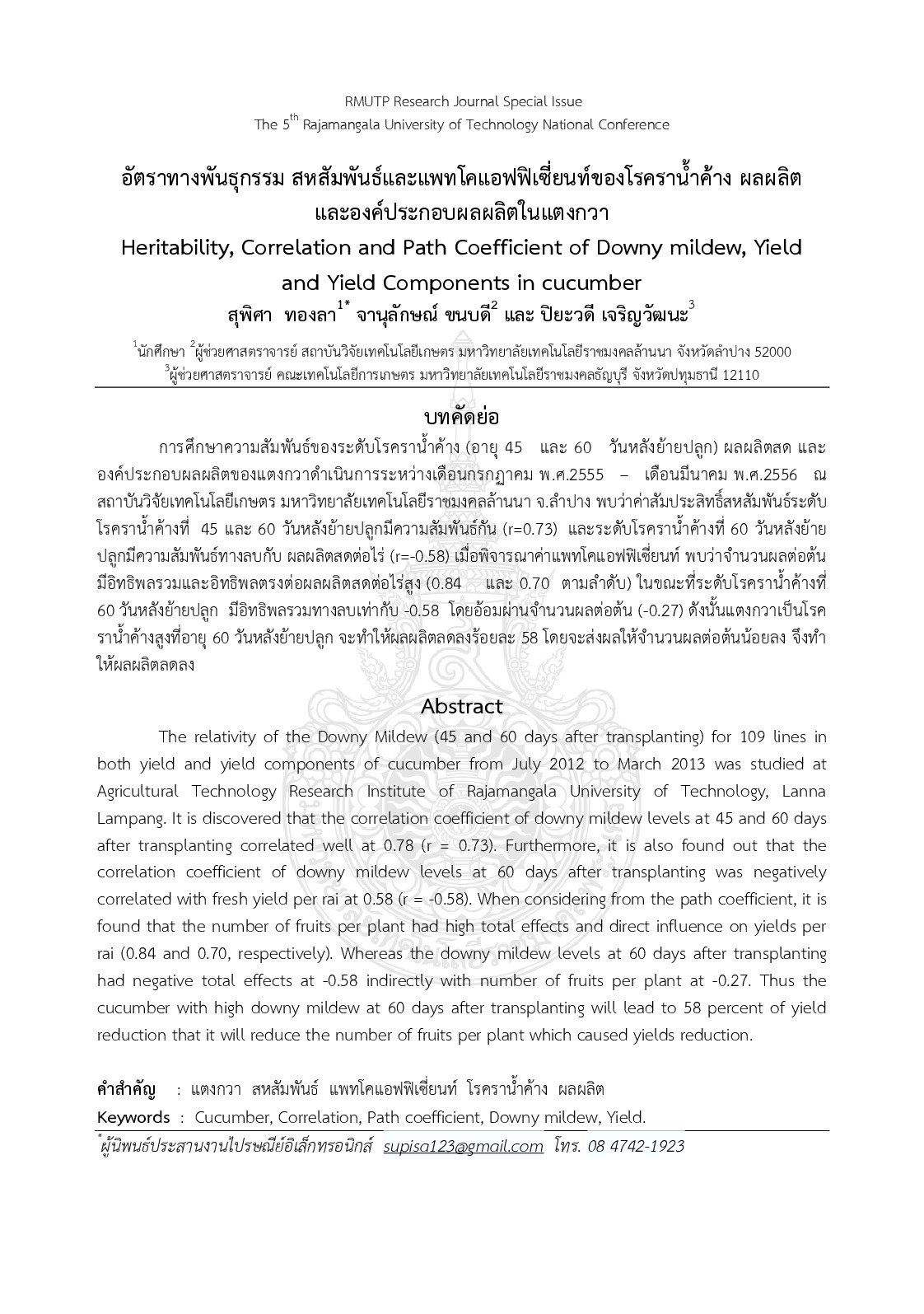
Heritability, correlation and path coefficient of downy mildew, yield and yield components in cucumber
The relativity of the Downy Mildew (45 and 60 days after transplanting) for 109 lines in both yield and yield components of cucumber from July 2012 to March 2013 was studied at Agricultural Technology Research Institute of Rajamangala University of Technology Lanna Lampang. It is discovered that the correlation coefficient of downy mildew levels at 45 and 60 days after transplanting correlated well at 0.78 (r = 0.73). Furthermore it is also found out that the correlation coefficient of downy mildew levels at 60 days after transplanting was negatively correlated with fresh yield per rai at 0.58 (r = -0.58). When considering from the path coefficient it is found that the number of fruits per plant had high total effects and direct influence on yields per rai (0.84 and 0.70 respectively). Whereas the downy mildew levels at 60 days after transplanting had negative total effects at -0.58 indirectly with number of fruits per plant at -0.27. Thus the cucumber with high downy mildew at 60 days after transplanting will lead to 58 percent of yield reduction that it will reduce the number of fruits per plant which caused yields reduction.
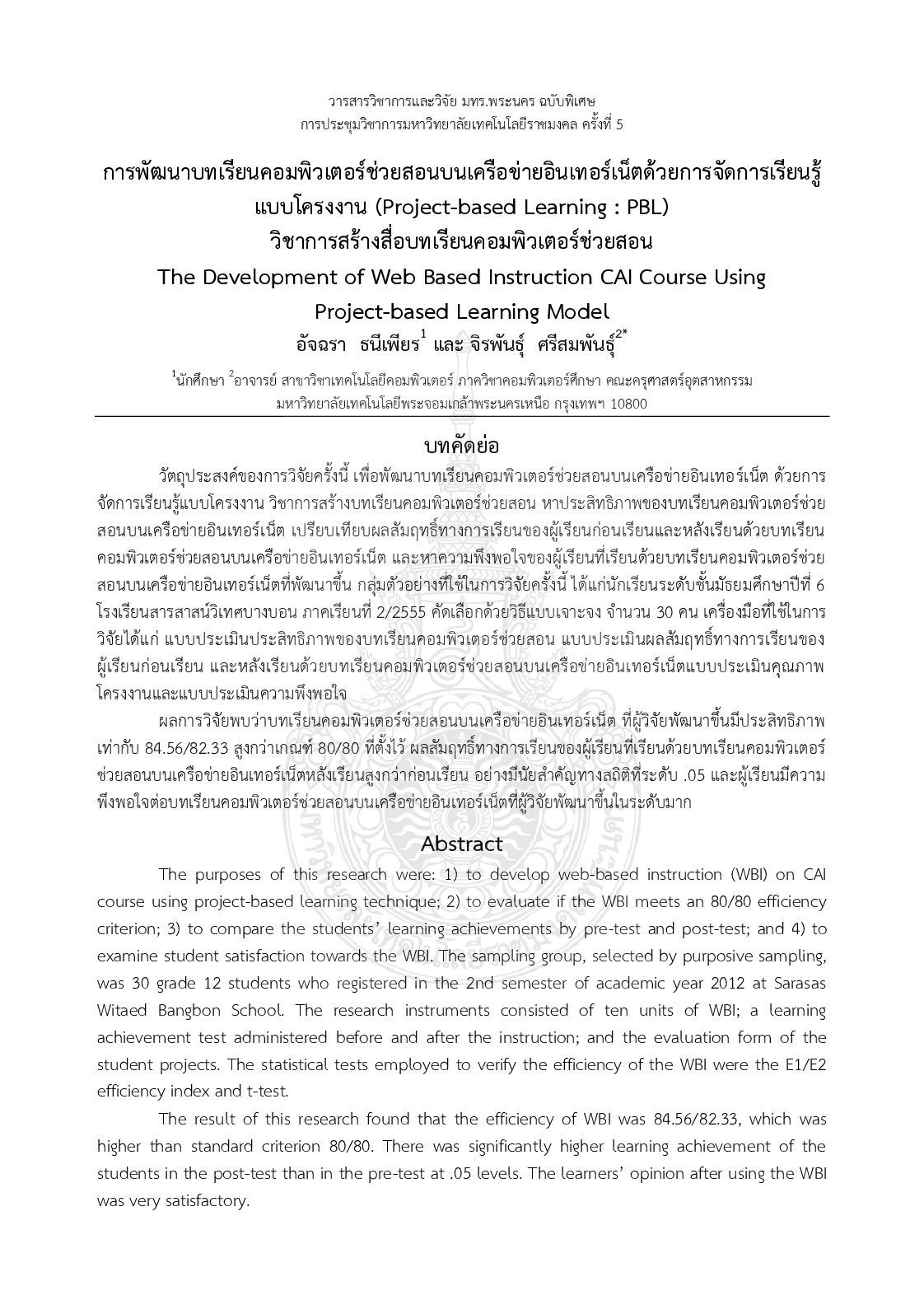
The development of web based instruction CAI course using project-based learning model
The purposes of this research were: 1) to develop web-based instruction (WBI) on CAI course using project-based learning technique; 2) to evaluate if the WBI meets an 80/80 efficiency criterion; 3) to compare the students’ learning achievements by pre-test and post-test; and 4) to examine student satisfaction towards the WBI. The sampling group selected by purposive sampling was 30 grade 12 students who registered in the 2nd semester of academic year 2012 at Sarasas Witaed Bangbon School. The research instruments consisted of ten units of WBI; a learning achievement test administered before and after the instruction; and the evaluation form of the student projects. The statistical tests employed to verify the efficiency of the WBI were the E1/E2 efficiency index and t-test. The result of this research found that the efficiency of WBI was 84.56/82.33 which was higher than standard criterion 80/80. There was significantly higher learning achievement of the students in the post-test than in the pre-test at .05 levels. The learners’ opinion after using the WBI was very satisfactory.