จำนวน Repository ( 3447 )
Influence of the mordant on dyeing properties of cotton yarn with natural dye extracted from teak leaves
The objective of this research was to study influence of five different kinds of the mordant copper sulfate (CuSO4) ferrous sulphate (FeSO4) alum and chitosan on dyeing properties of cotton yarn with natural dye extracted from teak leaves. Cotton yarn dyeing with the extracted dye from teak leaves was carried out at 60?C for 30 minutes with a material to liquor ratio of 1:5. Three mordanting methods such as pre mordanting simultaneous mordanting and post mordanting were used. After that dyed clothes were subjected to measurement using CIELAB system and fastness tests. The effect of kinds of mordents on the hue of dyeing of cotton yarn shown that CuSO4 FeSO4 gave greenish yellow and yellowish brown respectively. While as alum and chitosan gave violet red. Moreover using CuSO4 (pre mordanting or simultaneous mordanting) and FeSO4 (simultaneous mordanting) improved fastness properties to light better than without a mordant.
Nutrient composition and ruminal degradability of arachis glabata using nylon bag technique in dairy cattle
Arachis glabata is new variety forage which tolerates drought and provide high protein.This kind of plant is suitable as dairy cow diet. The research was divided into 2 experiments Experiment 1 was conducted to study on nutritive value of Arachis glabata.The experimental design was Randomized Completely Block Design (RCBD) experiment with three treatments. Each treatment consisted of three blocks (three crops) and followed different three variety of Arachis glabata as Cv. Florigraze Cv. Arbook and Cv. Ecotart. Results showed that three variety of Arachis glabata were 28.26-30.75 % of dry matter (P>0.05). In addition Arachis glabata Cv. Arbook was grater 19.78 % of protein than other group of Arachis glabata (P<0.01). Furthermore Arachis glabata Cv. Florigraze was grater 17.63 of hemicelluloses and 3830.00 kcal/kg of gross energy significant different among other group of Arachis glabata (P<0.05). Experiment 2 was conducted to study on ruminal degradability of Arachis glabata using In situ technique in dairy cattle. The experimental design was Randomized Completely Block Design (RCBD) experiment with three treatments. Each treatment consisted of three blocks (three ruminally fistulated dairy cattle) and followed different three variety of Arachis glabata as Cv. Florigraze Cv. Arbook and Cv. Ecotart. Results showed that Arachis glabata Cv. Florigraze and Arachis glabata Cv. Arbook was grater dry matter organic matter and protein degradability at 0-4 hour and 24-28 hour than Arachis glabata Cv Ecotart (P<0.05). In addition kinetic of degradation (a b c and p) of dry matter organic matter and protein were not significant different (P>0.05) among three variety of Arachis glabata.
Factors influencing to the inappropriate behaviors for scuba diving in coral reef
The study of factors influencing to the inappropriate behaviors of SCUBA divers in coral reef areas was done. The study performed by Quota sampling technique which the data was collected from 279 divers. The frequency of inappropriate behaviors of divers was recorded for in 10 minutes each. The results show that the average contacts damage and interference to aquatic organisms made by individual divers were 2.20 0.22 0.02 ? 0.01 and 1.70 0.20 respectively. No significant difference of factors of contact and damage made by divers but there was significant difference between nationality (t = 5.24; df = 277; p < 0.001) and pointer possession (t = 2.59; df = 277; p < 0.01) with the number of times divers made interference the aquatic organisms. This study results can be used to propose the guidelines and management strategies for conservative and sustainable of SCUBA diving in the coral reef.
Semi-automatic mapping of electric poles using sfm technique
The objective of this research is to proposed a semi-automatic method for mapping electric poles using the structure from motion technique or SFM. First an epipolar geometry for each image pair is estimated. Then the 3D structures are obtained using incremental SFM technique which will give us both 3D point cloud of the study area and camera parameters. Also vertical 2D lines are extracted from the input images. These 2D lines and the 3D structures are then integreated for estimating the positions of electric pole in 3D space. Finally these 3D electric poles are then geo-registered by estimating 3D rigid transformation from embeded coordinates in the input images.
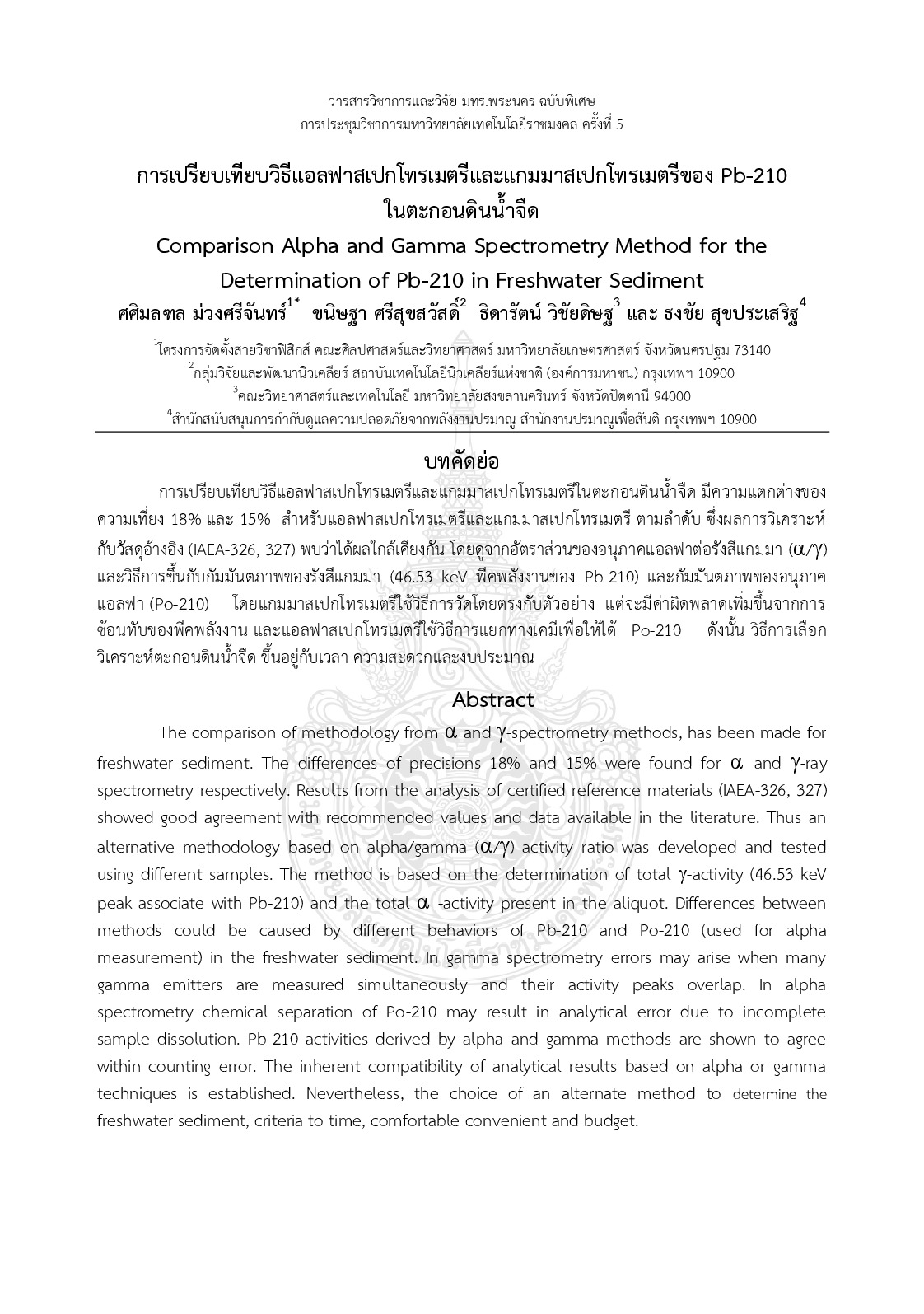
Comparison alpha and gamma spectrometry method for the determination of pb-210 in freshwater sediment
The comparison of methodology from and -spectrometry methods has been made for freshwater sediment. The differences of precisions 18% and 15% were found for ? and -ray spectrometry respectively. Results from the analysis of certified reference materials (IAEA-326 327) showed good agreement with recommended values and data available in the literature. Thus an alternative methodology based on alpha/gamma activity ratio was developed and tested using different samples. The method is based on the determination of total -activity (46.53 keV peak associate with Pb-210) and the total -activity present in the aliquot. Differences between methods could be caused by different behaviors of Pb-210 and Po-210 (used for alpha measurement) in the freshwater sediment. In gamma spectrometry errors may arise when many gamma emitters are measured simultaneously and their activity peaks overlap. In alpha spectrometry chemical separation of Po-210 may result in analytical error due to incomplete sample dissolution. Pb-210 activities derived by alpha and gamma methods are shown to agree within counting error. The inherent compatibility of analytical results based on alpha or gamma techniques is established. Nevertheless the choice of an alternate method to determine the freshwater sediment criteria to time comfortable convenient and budget.