จำนวน Repository ( 278 )

การพัฒนามาลัยจากผ้าด้วยเทคโนโลยีการตกแต่งกลิ่น
This research studies the development of fabric garland with fragrance addition technology by investigating the method of covering microcapsule fragrance on fabric which is the material of making garland. The result of the study shows that: The study of covering gelatin on polyester fabric shows that the small amounts of gelatin applied on polyester lower the strength of the fabric which is not suitable for marking garland. Due to the requirement of the strength in making garland by folding fabrics and passing them through thread into round shape lacking of the strength causes the difficulty for the making process. Gelatin provides stiffness and hardness to the fabric which is easy to form into various shapes. Before adding fragrance the result of stiffness test shows that the fabric has bending length of warp yarn at 5.9 centimeters and weft yarn at 4.1 centimeters; however after adding fragrance bending length of warp yarn is at 2.7 centimeters and weft yarn is at 1.9 respectively. Then the efficiency of covering microcapsule fragrance on fabric is tested by Scanning Electron Microscope (SEA). After adding fragrance the result shows that: (1) the numbers of microcapsule are higher (2) microcapsules form in round shape and (3) the size of microcapsules are similar. However after 30 day of applying microcapsule to the fabric it shows that (1) the numbers of microcapsule are lower and (2) microcapsules are not in complete round shape due to the deterioration. For the process of making garland with nonmicrocapsule and microcapsule fabric it demonstrates that microcapsule fabric does not impact the process of making garland but it adds the value for fragrance addition which is able to be considered as added value.
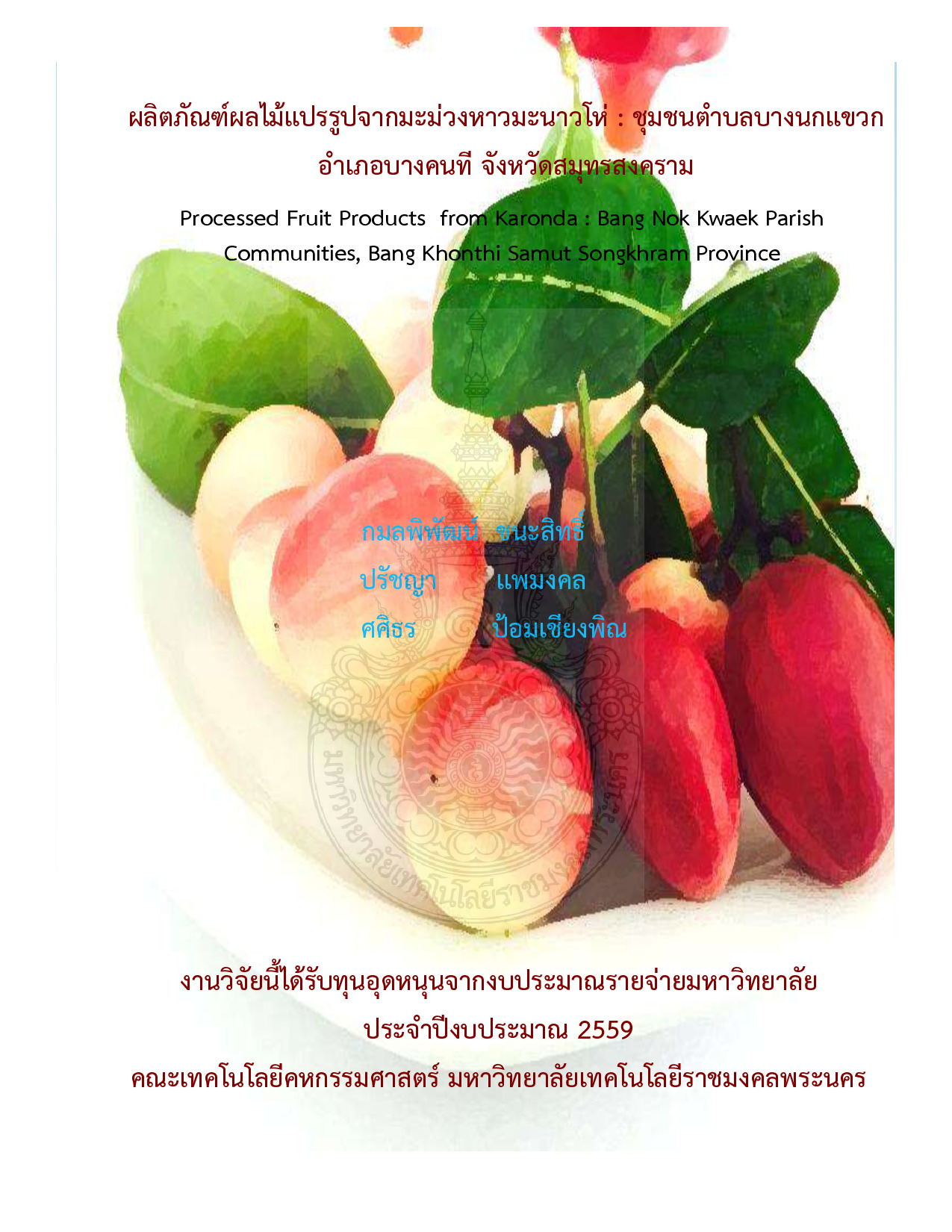
ผลิตภัณฑ์ผลไม้แปรรูปจากมะม่วงหาวมะนาวโห่ : ชุมชนตำบลบางนกแขวก อำเภอบางคนที จังหวัดสมุทรสงคราม
The purpose of the study of processed fruit products from Karonda : Bang Nok Kwaek parish communities Bang Khonthi Samut Songkhram Province is to study the proper quantity of the Koranda fruit in the product the quality in the product’s process and the consumers’ acceptance (Consumer Test) in the product. The processed products are Karonda fruit jelly instant pasteurized Karonda fruit juice with extra fiber Karonda fruit sorbet Karonda fruit yoghurt ice-cream and concentrated juice (sauce) for drink mixing. The product has been tested by Randomized Complete Block Design (RCBD) method. The process was consisted with offering a tasting and evaluated in color scent taste matter and overall satisfaction by giving 9 point Hedonic scale from 70 consumers. And has been compared the difference of average means at 95% trustiness by Duncan’s New Multiple Range Test (DMRT) by an instant statistical analysis software. The result information is as the followings; The physical properties indicates of Karonda fruit the total acidity of 2.30 with the pH and the color was found that the brightness (L *) of 16.52 fee (a *) equal to 8.95 and (b. *) equals 5.37. The study of the chemical quality of Karonda fruit amount of energy in calories carbohydrates 73.2 percent 18.3 percent protein 1.57 percent 1.32 percent humidity fats fiber 83.7 percent ash 4.26 percent and 0.75 Vitamin C is found. The duration of ripening fruit yawning lemon booed affect the vitamin C in the fruit of the mango yawning lemon booed the oil will have more vitamin C than ripe to t 2 so I scratched the reduction of vitamin C may. Is due to be deployed as a compound to breathe. And led to the synthesis of new carbon structures during ripening. Karonda fruit jelly. The most acceptances level for Karonda fruit juice in the product is at 1:6 for its best flexibility. Since the juice concentration affects the jelly as it lowers the matter (flexibility). Too much of acid in Karonda fruit juice is able to unstabilize jelly matter. From the study of Pectin quantity the consumer has the most acceptance at the level of 10 grams which is the best recipe that keeps the good jelly matter (flexibility) stabilized. The physical properties indicates that there are the level of color hue at 5R color brightness at Value 4 Chroma at 14 sweetness at 35 Brix and pH at 3.05. The study of the chemical quality of Karonda fruit jelly in each 100 grams provides 120 kilocalories of energy 69.60 grams of humidity 0.11 gram of fat 29.80 grams of carbohydrate 0.41 gram of fiber 0.50 gram of ash and 0.45 gram of acidity. The consumer satisfaction is at 97.30 percent. Instant pasteurized Karonda fruit juice with extra fiber. The acceptance is at 100 percent of replacing Okra fruit juice by Karonda fruit juice. The acceptance study shows that the most proper fiber quantity adding to Karonda fruit juice is at 15 percent. The acceptance study shows that the most proper Pectin quantity affecting coconut jelly spreading is at 3 percent. The analysis results of the physical properties indicate that instant pasteurized Karonda fruit juice with extra fiber has color hue level at 5R value at 4 and Chroma at 12 which rendered the product to dark red. Also the pH level is at 3.29 sweetness is at 17 Brix firness g force 1 is at 11.29 g Viscosityag.sec AREA F-T 1:2 is at 339.507 ag.sec. The study of the chemical quality of Karonda fruit juice in each 100 grams provides 63.3 kilocalories of energy 83.9 grams of humidity 0.01 gram of fat 0.10 gram of protein 15.8 grams of carbohydrate 0.41 gram of fiber 0.24 gram of ash and 0.18 gram of pH balance. The consumer satisfaction to instant pasteurized Karonda fruit juice with extra fiber is at 98.66 percent. Karonda fruit sorbet. The most proper quantity of Karonda fruit juice is at 30 percent. The physical properties of Karonda fruit sorbet contain the brightness level at L*34.32 red color level at a*41.26 yellow color level at b*21.18 meltable solid quantity at 30*Brix and pH balance at 2.40. The study of the chemical quality of Karonda fruit sorbet in each 100 grams provides 91.8 kilocalories of energy 77.1 grams of humidity 0.15 gram of fat <0.20 gram of protein 22.6 grams of carbohydrate 0.11 gram of fiber and 0.12 gram of ash. The consumer satisfaction to Karonda fruit sorbet is at 100 percent. Karonda fruit yoghurt ice-cream. The most proper quantity of Karonda fruit added in the yoghurt ice-cream is at 10 percent of the whole ingredient. The consumers’ acceptance has been given the most for its scent taste matter (smoothness) and overall satisfaction which has the average mean at 7.24 7.77 7.17 and 7.67 consequently. The physical properties of Karonda fruit yoghurt ice-cream contain the viscosity level at 364.798 cps. color hue at 10P Value at 8/6 Chroma at N9/.5 overrun statistics at 4.55 and Karonda fruit yoghurt ice-cream melting rate at 89.90. The chemical quality of Karonda fruit yoghurt ice-cream in each 100 grams provides 214 kilocalories of energy 64.0 grams of humidity 14.6 gram of fat 3.14 gram of protein 17.5 grams of carbohydrate 0.76 gram of fiber 0.74 gram of ash and 5.67 pH balance. The consumer satisfaction to Karonda fruit yoghurt ice-cream is at 100 percent. Concentrated juice (sauce) for drink mixing. The most acceptance recipe is the strawberry sauce recipe number 1 with the replacement of Karonda fruit at 80 percent. The physical properties contain the viscosity level at 9.28 cps sweetness at 21 Brix color hue at 5R Value at 2 and Chroma at 4. The chemical quality of concentrated juice (sauce) for drink mixing in each 100 grams provides 91.1 kilocalories of energy 77.2 grams of humidity 0.30 gram of fat 0.1 gram of protein 22.3 grams of carbohydrate 0.76 gram of fiber 0.4 gram of vitamin C and 0.56 of pH balance. The consumer satisfaction concentrated juice (sauce) for drink mixing is at the maximum satisfaction at 92.0 percent as the concentrated juice (sauce) emphasizes the better taste of smoothie drink mixing and easy to consume.
การพัฒนาผลิตภัณฑ์ผนังคอนกรีตมวลเบาด้วยการเสริมแผ่นโฟมอัดแน่นเพื่อเป็นฉนวนความร้อน
This research has objectives to study the production to find the proper size of steel wire mesh to test the properties and to study the implementation of high strength and thermal insulation cement-bonded fiberboard from coconut meal corncob fibers and steel wire mesh. The mixture ratio of cement-bonded fiberboard included Portland cement type1: sand: coconut meal fiber: corncob fiber: water: calcium chloride equal to 1: 0.2: 0.0125: 0.0375: 0.3: 0.03 by weight and 5 different sizes of steel wire mesh were reinforced. Casted by compression and sharking machine. Tested the properties follow the TIS.878-2537. From the results 1 mm of diameter and 1” of gab of steel wire mesh (? 1 mm # 1”) was the proper size to reinforce the cement-bonded fiberboard to get highest bending strength. Moreover this cement-bonded fiberboard can pass the required standard. The high strength and thermal insulation cement-bonded fiberboard from coconut meal corncob fibers and steel wire mesh has the possibility to construction as exterior building wall.
พืชถิ่นเดียวและสถานะการอนุรักษ์ของพืชวงศ์โพโดสเต็มเอซีอี้ในภาคตะวันออกเฉียงเหนือของประเทศไทย
Podostemaceae a family of aquatic flowering plant restricted to river rapids and waterfalls are widely reported to be the high incidence of endemism and in need for conservation. The present study analyses endemism and conservation status of the Podostemaceae in northeastern floristic region Thailand using past and current taxonomic records personal field collections geographic ranges IUCN assessment and a combination of river number in which a species occurs. The plants grown in one river and two rivers are considered as narrow endemic species. Among the six genera and 22 species recognized two genera are endemic eighteen species are endemic to Thailand eleven species of the 18 are narrowly distributed and confined in northeastern floristic region and the other 4 species are not endemic. Considering the conservation status two species are classified as Critically Endangered distributed in a single river ten species as Vulnerable distributed in 1-2 rivers six species as Near Threatened two species as Least Concern and two species as Data Deficient. Loei province is the most species-rich area in Thailand with 12 species five of them are restricted in Loei.
การใช้เทคโนโลยีสำหรับชุมชนในการพัฒนาผลิตภัณฑ์ คอนกรีตบล็อก ลดอุณหภูมิจากเศษหินพัมมิซ
This research aims to produce scrap page kaolin of brick construction. The kaolin clay ratio of 100: 0 80:20 60:40 50:50 40:60 20:80 and 0: 100 by volume Add mixed with rice husk and rice 15 percent by weight A total of seven ratios. According to standard tests or TIS. 77-2545 ordinary story brick building. The moisture content and water absorption is increasing. While density Thermal conductivity resistance flexural and compressive strength tends to decrease. The best ratio of 80:20 by volume with compressive strength 43.16 kg / cm 2 and 24.93 percent water absorption. Criteria standard of TIS. 77-2545 requiring compressive strength not less than 35 kg / cm2 and water absorption must not be higher than 25 percent. Can be used in the manufacture of brick construction including building decorative wall can be developed into products. Because skin color and beautiful