จำนวน Repository ( 3447 )
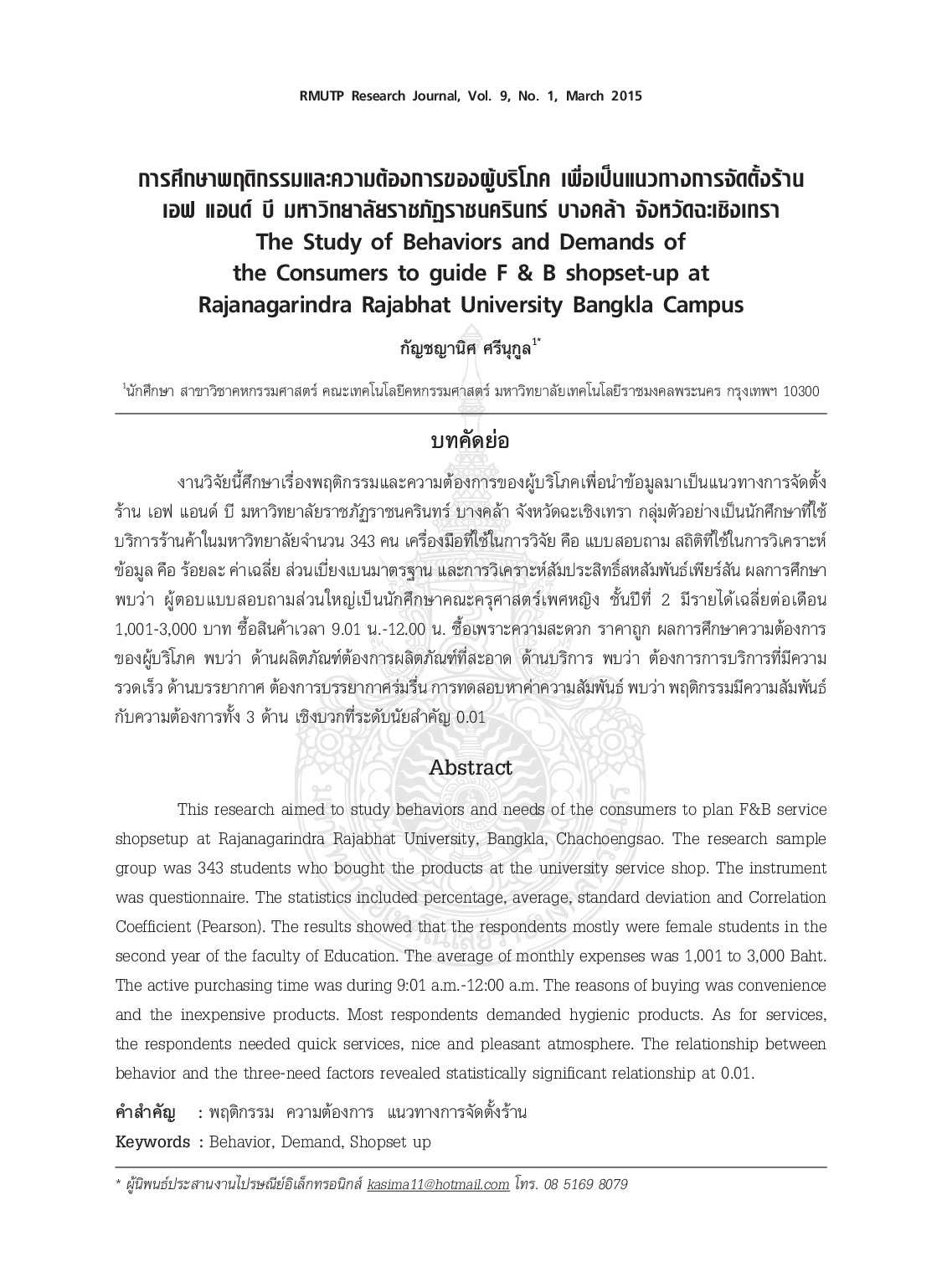
The study of behaviors and demands of the consumers to guide F & B shopset-up at Rajanagarindra Rajabhat University bangkla campus
This research aimed to study behaviors and needs of the consumers to plan F&B service shopsetup at Rajanagarindra Rajabhat University Bangkla Chachoengsao. The research sample group was 343 students who bought the products at the university service shop. The instrument was questionnaire. The statistics included percentage average standard deviation and Correlation Coefficient (Pearson).The results showed that the respondents mostly were female students in the second year of the faculty of Education. The average of monthly expenses was 1001 to 3000 Baht. The active purchasing time was during 9:01 a.m.-12:00 a.m. The reasons of buying was convenience and the inexpensive products. Most respondents demanded hygienic products. As for services the respondents needed quick services nice and pleasant atmosphere. The relationship between behavior and the three-need factors revealed statistically significant relationship at 0.01.
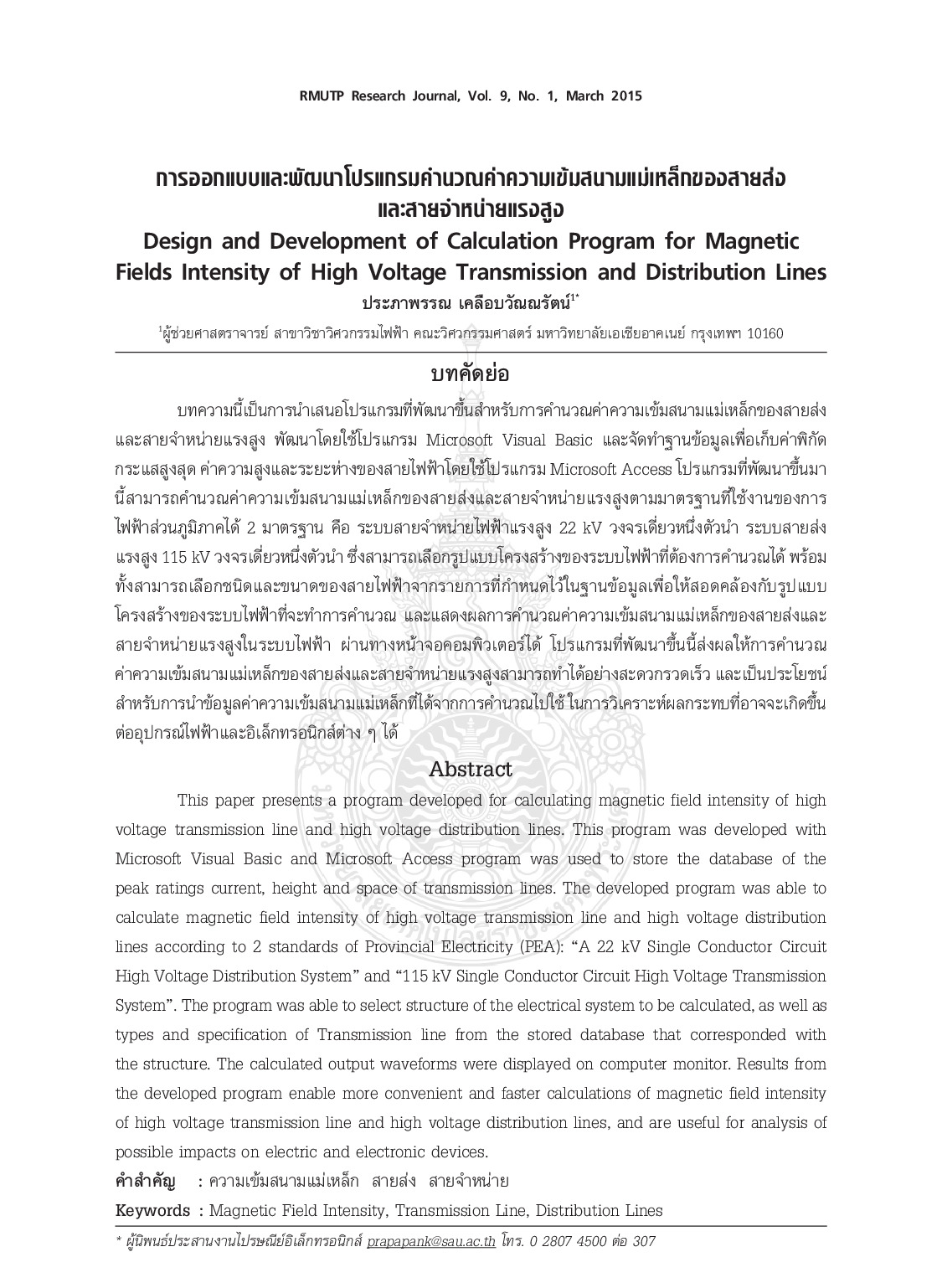
Design and development of calculation program for magnetic fields intensity of high voltage transmission and distribution lines
This paper presents a program developed for calculating magnetic field intensity of high voltage transmission line and high voltage distribution lines. This program was developed with Microsoft Visual Basic and Microsoft Access program was used to store the database of the peak ratings current height and space of transmission lines. The developed program was able to calculate magnetic field intensity of high voltage transmission line and high voltage distribution lines according to 2 standards of Provincial Electricity (PEA): “A 22 kV Single Conductor Circuit High Voltage Distribution System” and “115 kV Single Conductor Circuit High Voltage Transmission System”. The program was able to select structure of the electrical system to be calculated as well as types and specification of Transmission line from the stored database that corresponded with the structure. The calculated output waveforms were displayed on computer monitor. Results from the developed program enable more convenient and faster calculations of magnetic field intensity of high voltage transmission line and high voltage distribution lines and are useful for analysis of possible impacts on electric and electronic devices.
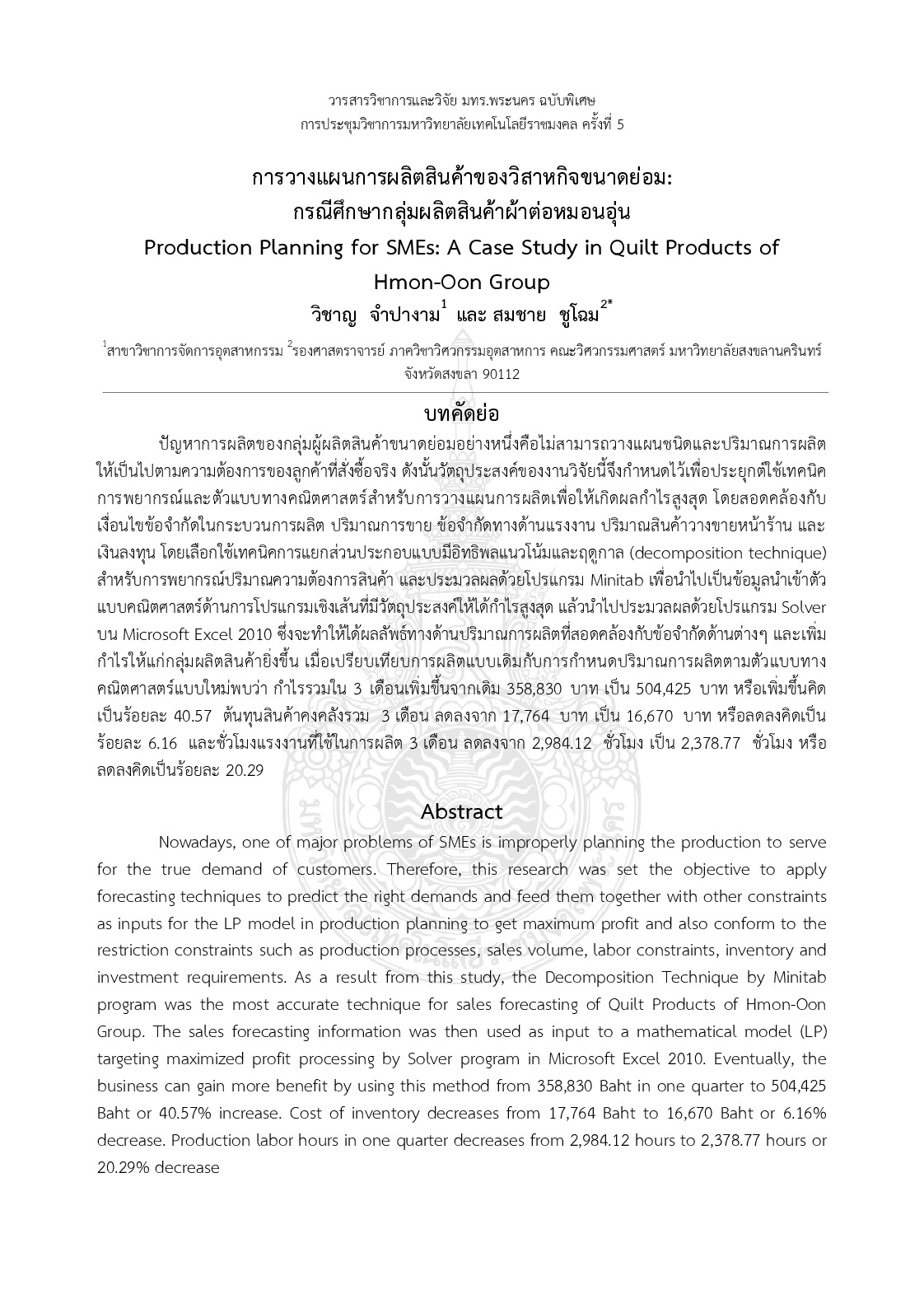
Production planning for SMEs: a case study in quilt products of hmon-oon group
Nowadays one of major problems of SMEs is improperly planning the production to serve for the true demand of customers. Therefore this research was set the objective to apply forecasting techniques to predict the right demands and feed them together with other constraints as inputs for the LP model in production planning to get maximum profit and also conform to the restriction constraints such as production processes sales volume labor constraints inventory and investment requirements. As a result from this study the Decomposition Technique by Minitab program was the most accurate technique for sales forecasting of Quilt Products of Hmon-Oon Group. The sales forecasting information was then used as input to a mathematical model (LP) targeting maximized profit processing by Solver program in Microsoft Excel 2010. Eventually the business can gain more benefit by using this method from 358830 Baht in one quarter to 504425 Baht or 40.57% increase. Cost of inventory decreases from 17764 Baht to 16670 Baht or 6.16% decrease. Production labor hours in one quarter decreases from 2984.12 hours to 2378.77 hours or 20.29% decrease
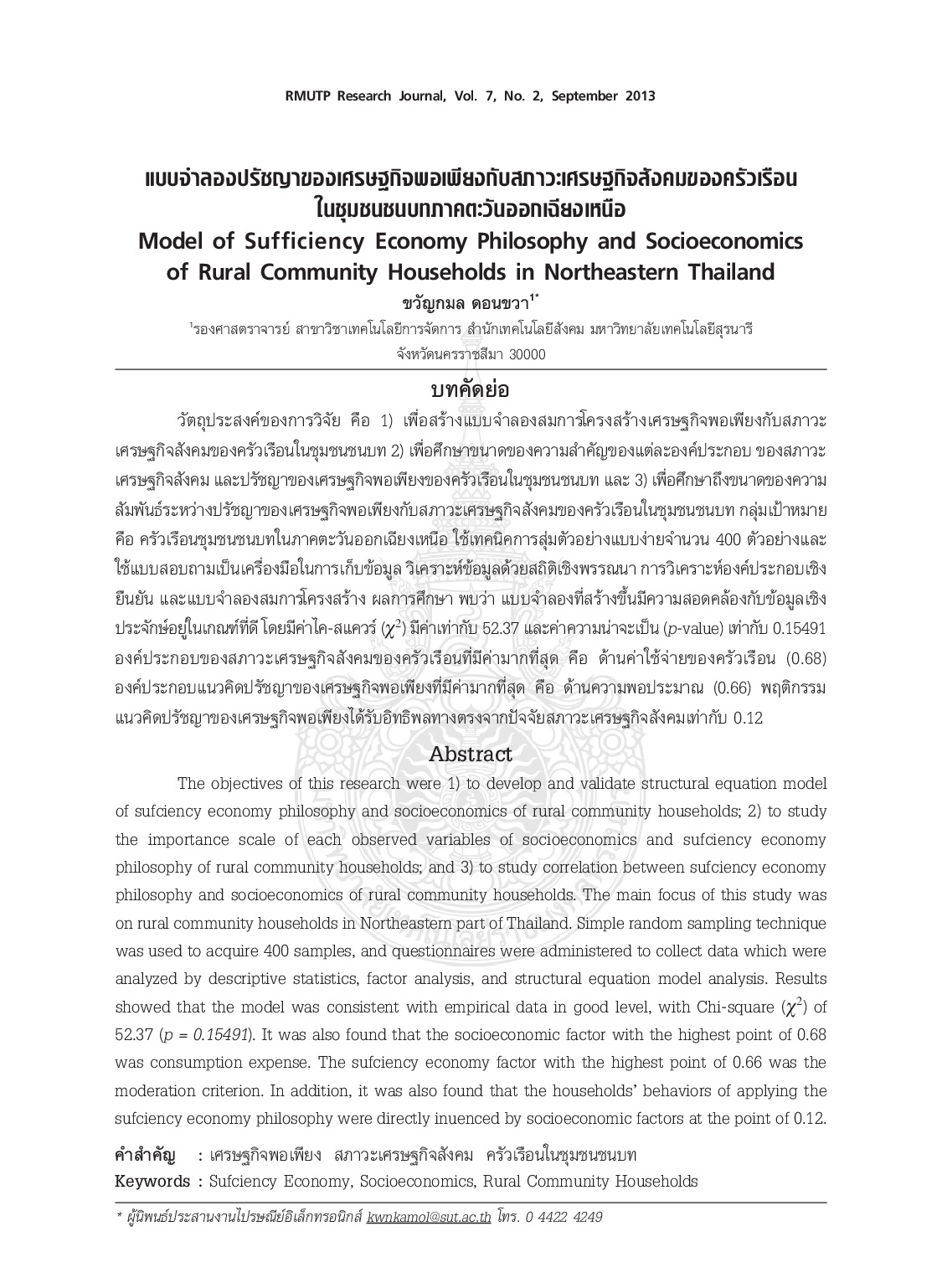
The model of a sufficiency economy philosophy with socioeconomics of rural community’s households, Northeastern Thailand
The objectives of this research were 1) to develop and validate the structural equation model of application of the sufficiency economy philosophy with socioeconomics of rural community households 2) to study the importance scale of each of the observed variables with socioeconomics and the sufficiency economy philosophy of rural community households and 3) to study the correlation level between the sufficiency economy philosophy and socioeconomics of rural community households. The main focus of this study was on rural community households. Simple random sampling technique was used to arrive at 400 samples and a questionnaire was administered to collect data and analyzed by descriptive statistics factor analysis and structural equation model analysis. The result showed that the model was consistent with the empirical data. Goodness of fit measures were found to be: Chi-square 52.37(p- value= 0.15491). It was also found that the factor loading of socioeconomics with the highest point was the consumption expenditure at 0.68 whereas the factor loading of the sufficiency economy philosophy with the highest point was the criterion of moderation at 0.66. Besides it was found that the rural community households’ behavior of applying the sufficiency economy philosophy received direct influence from the socioeconomic factors at the point of 0.12.
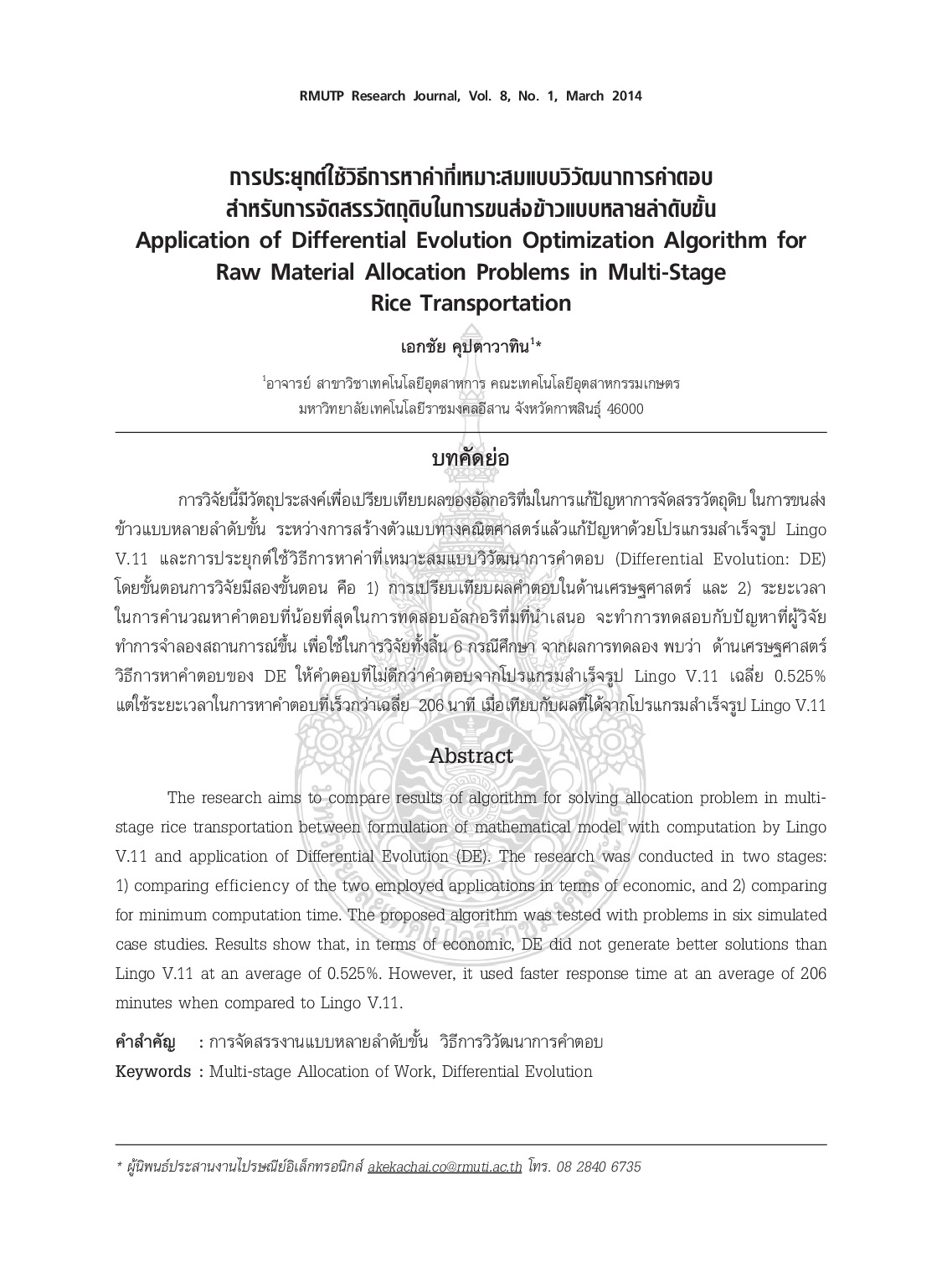
Application of differential evolution optimization algorithm for raw material allocation problems in multi-stage rice transportation
The research aims to compare results of algorithm for solving allocation problem in multi-stage rice transportation between formulation of mathematical model with computation by Lingo V.11 and application of Differential Evolution (DE). The research was conducted in two stages: 1) comparing efficiency of the two employed applications in terms of economic and 2) comparing for minimum computation time. The proposed algorithm was tested with problems in six simulated case studies. Results show that in terms of economic DE did not generate better solutions than Lingo V.11 at an average of 0.525%. However it used faster response time at an average of 206 minutes when compared to Lingo V.11.