จำนวน Repository ( 3447 )
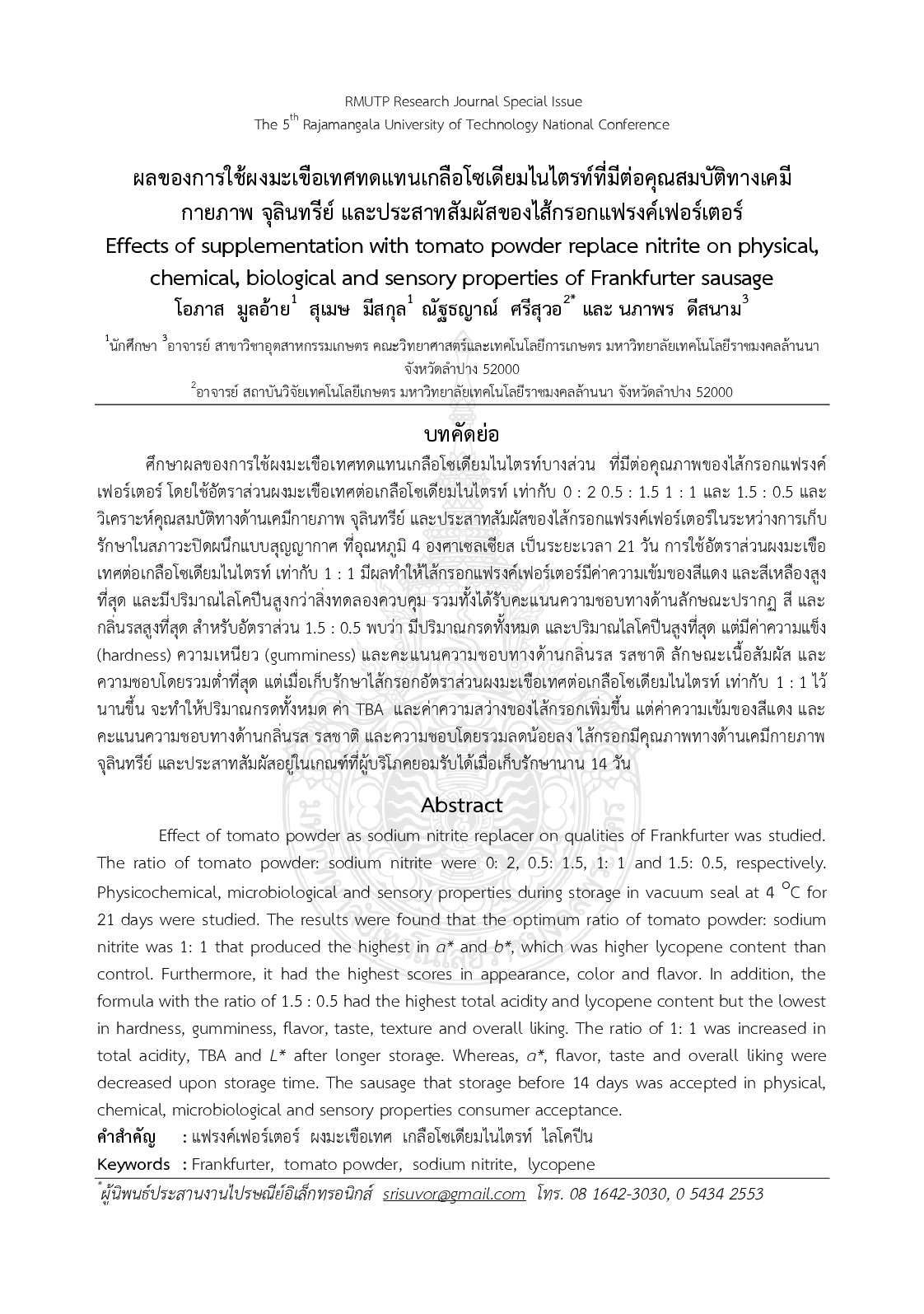
Effects of supplementation with tomato powder replace nitrite on physical, chemical, biological and sensory properties of frankfurter sausage
Effect of tomato powder as sodium nitrite replacer on qualities of Frankfurter was studied. The ratio of tomato powder: sodium nitrite were 0: 2 0.5: 1.5 1: 1 and 1.5: 0.5 respectively. Physicochemical microbiological and sensory properties during storage in vacuum seal at 4 ?C for 21 days were studied. The results were found that the optimum ratio of tomato powder: sodium nitrite was 1: 1 that produced the highest in a* and b* which was higher lycopene content than control. Furthermore it had the highest scores in appearance color and flavor. In addition the formula with the ratio of 1.5 : 0.5 had the highest total acidity and lycopene content but the lowest in hardness gumminess flavor taste texture and overall liking. The ratio of 1: 1 was increased in total acidity TBA and L* after longer storage. Whereas a* flavor taste and overall liking were decreased upon storage time. The sausage that storage before 14 days was accepted in physical chemical microbiological and sensory properties consumer acceptance.
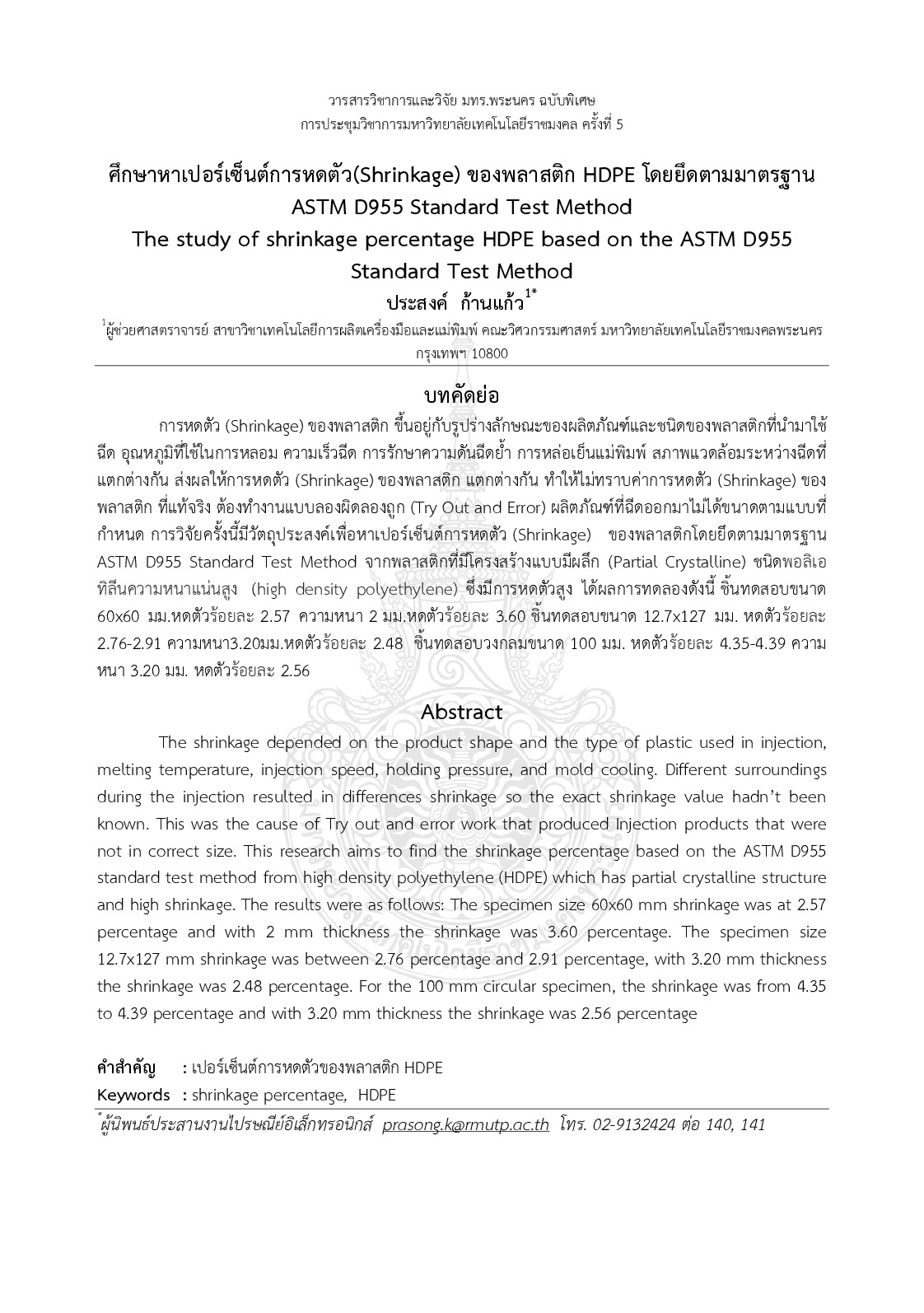
The study of shrinkage percentage HDPE based on the ASTM D955 Standard test method
The shrinkage depended on the product shape and the type of plastic used in injection melting temperature injection speed holding pressure and mold cooling. Different surroundings during the injection resulted in differences shrinkage so the exact shrinkage value hadn’t been known. This was the cause of Try out and error work that produced Injection products that were not in correct size. This research aims to find the shrinkage percentage based on the ASTM D955 standard test method from high density polyethylene (HDPE) which has partial crystalline structure and high shrinkage. The results were as follows: The specimen size 60x60 mm shrinkage was at 2.57 percentage and with 2 mm thickness the shrinkage was 3.60 percentage. The specimen size 12.7x127 mm shrinkage was between 2.76 percentage and 2.91 percentage with 3.20 mm thickness the shrinkage was 2.48 percentage. For the 100 mm circular specimen the shrinkage was from 4.35 to 4.39 percentage and with 3.20 mm thickness the shrinkage was 2.56 percentage
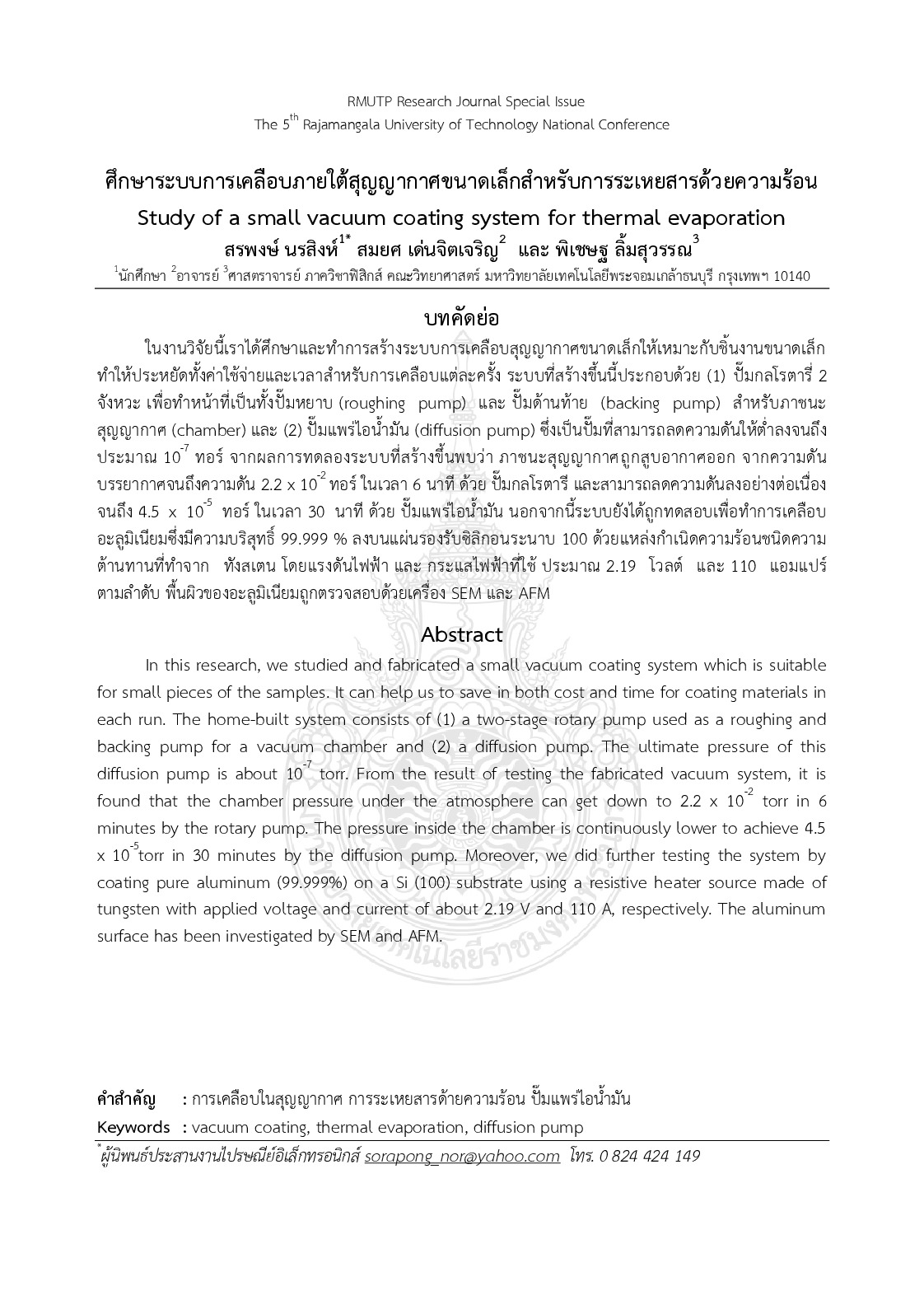
Study of a small vacuum coating system for thermal evaporation
In this research we studied and fabricated a small vacuum coating system which is suitable for small pieces of the samples. It can help us to save in both cost and time for coating materials in each run. The home-built system consists of (1) a two-stage rotary pump used as a roughing and backing pump for a vacuum chamber and (2) a diffusion pump. The ultimate pressure of this diffusion pump is about 10-7 torr. From the result of testing the fabricated vacuum system it is found that the chamber pressure under the atmosphere can get down to 2.2 x 10⁻² torr in 6 minutes by the rotary pump. The pressure inside the chamber is continuously lower to achieve 4.5 x 10⁻⁵torr in 30 minutes by the diffusion pump. Moreover we did further testing the system by coating pure aluminum (99.999%) on a Si (100) substrate using a resistive heater source made of tungsten with applied voltage and current of about 2.19 V and 110 A respectively. The aluminum surface has been investigated by SEM and AFM.
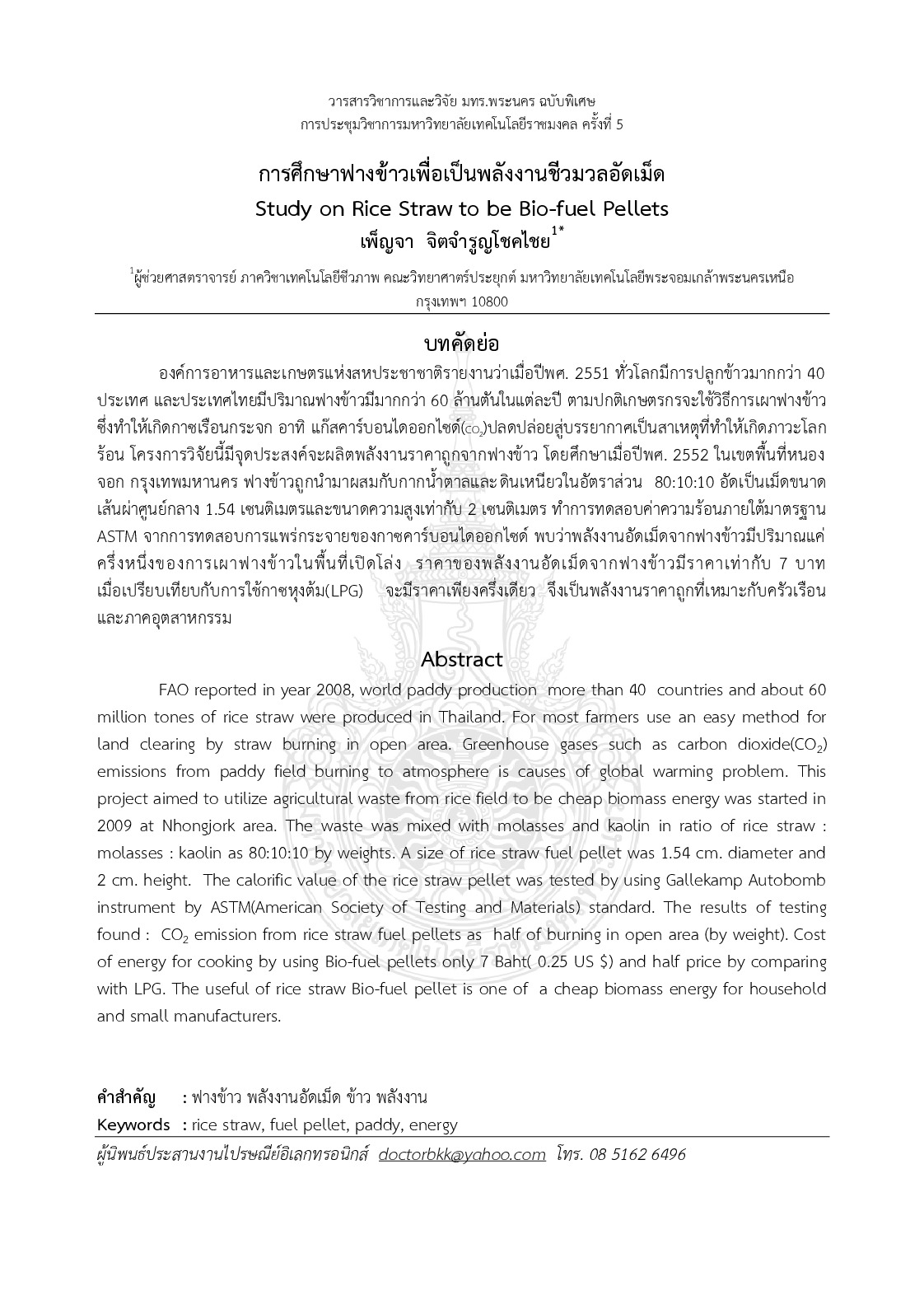
Study on rice straw to be bio-fuel pellets
FAO reported in year 2008 world paddy production more than 40 countries and about 60 million tones of rice straw were produced in Thailand. For most farmers use an easy method for land clearing by straw burning in open area. Greenhouse gases such as carbon dioxide(CO2) emissions from paddy field burning to atmosphere is causes of global warming problem. This project aimed to utilize agricultural waste from rice field to be cheap biomass energy was started in 2009 at Nhongjork area. The waste was mixed with molasses and kaolin in ratio of rice straw : molasses : kaolin as 80:10:10 by weights. A size of rice straw fuel pellet was 1.54 cm. diameter and 2 cm. height. The calorific value of the rice straw pellet was tested by using Gallekamp Autobomb instrument by ASTM(American Society of Testing and Materials) standard. The results of testing found : CO2 emission from rice straw fuel pellets as half of burning in open area (by weight). Cost of energy for cooking by using Bio-fuel pellets only 7 Baht( 0.25 US $) and half price by comparing with LPG. The useful of rice straw Bio-fuel pellet is one of a cheap biomass energy for household and small manufacturers.
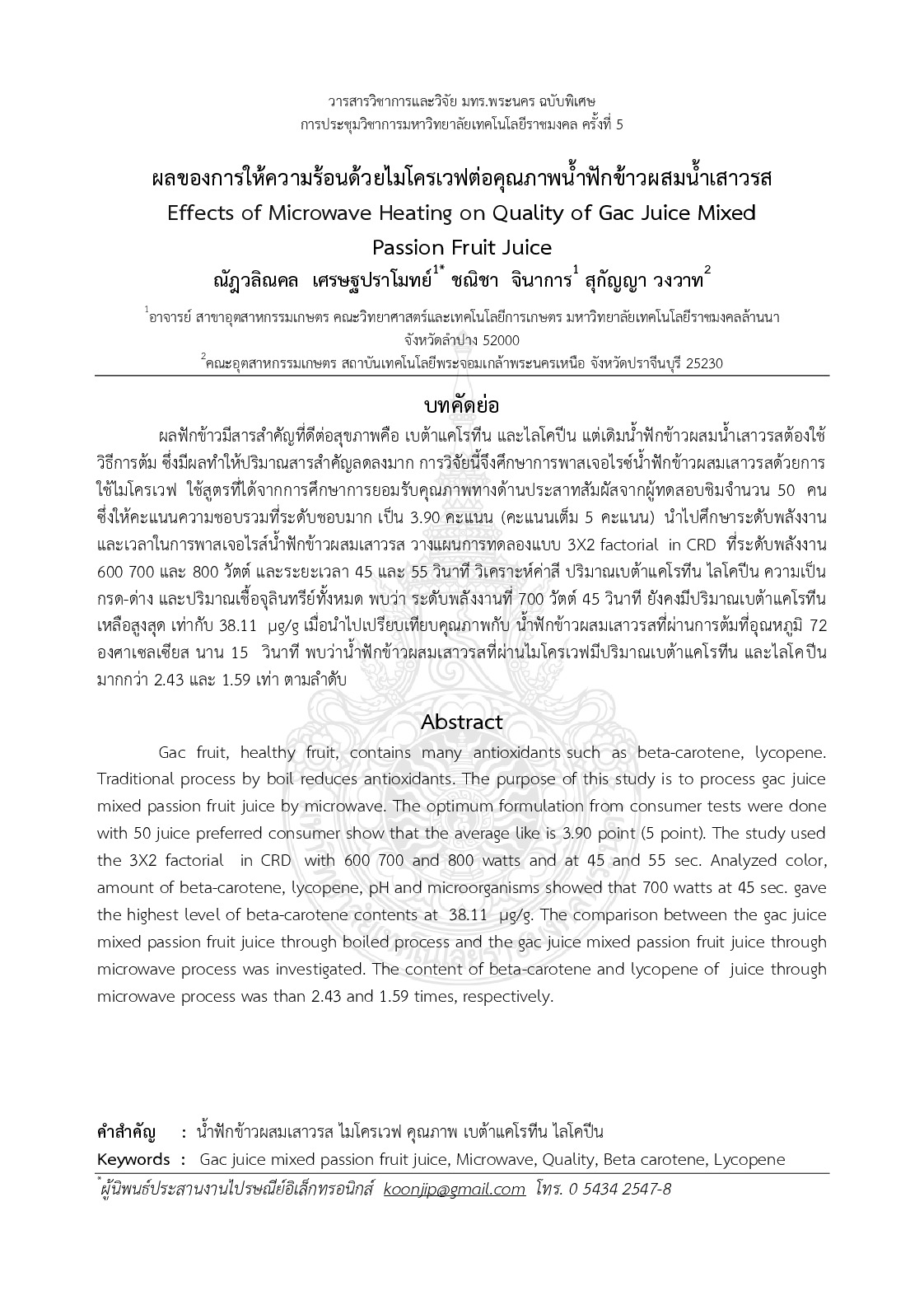
Effects of microwave heating on quality of gac juice mixed passion fruit juice
Gac fruit healthy fruit contains many antioxidants such as beta-carotene lycopene. Traditional process by boil reduces antioxidants. The purpose of this study is to process gac juice mixed passion fruit juice by microwave. The optimum formulation from consumer tests were done with 50 juice preferred consumer show that the average like is 3.90 point (5 point). The study used the 3X2 factorial in CRD with 600 700 and 800 watts and at 45 and 55 sec. Analyzed color amount of beta-carotene lycopene pH and microorganisms showed that 700 watts at 45 sec. gave the highest level of beta-carotene contents at 38.11 ?g/g. The comparison between the gac juice mixed passion fruit juice through boiled process and the gac juice mixed passion fruit juice through microwave process was investigated. The content of beta-carotene and lycopene of juice through microwave process was than 2.43 and 1.59 times respectively.