จำนวน Repository ( 3447 )

Situation and Demand Regarding ICT Training of Elderly in Bangkok
This study employs a mixed method research which is a combination of quantitative and qualitative measures to investigate situation and demand in relation to Information and Communications Technology (ICT) training of the elderly in Bangkok. For quantitative method questionnaires are used to obtain information from a total of 355 senior citizens. These data are examined and evaluated by way of descriptive statistical analysis involving frequency percentage mean and standard deviation with t-test and a one-way analysis of variance (ANOVA). For qualitative method in-depth interviews of 10 coordinators of the Association for the Elderly are undertaken and a focus group of 10 representatives of the Association for the Elderly is employed. The results show that a majority of the elderly do not have a computer (56.3%) or experience of using ICT (33.8%) but indicate demand for ICT training (59.4%) with regard to reading information and news and communicating by way of the internet. In detail there is demand for free training courses dealing with computer use and the internet as well as searching queries convenience of travel to training centres and trainers who understand the capability of the elderly. Comparison by income shows that the elderly whose average monthly income is more than 30000 bahts pay more attention to training courses and services travel convenience and trainers than do those on lower income. Furthermore the demand for training is higher for the elderly who have ICT experiences than for those with no experience. In conclusion the findings of this study suggest that policymakers should provide the elderly in Bangkok with public-access computers free internet connection availability of reduced-price computers and financial support for ICT training courses.
Problems and Barriers for cooperative Education Student Trainee Recruitment according to the Work Place’s concept : A Case Study of Undergraduates of Business Administration Faculty : A Case Study of Undergraduates of Business Administration Faculty, Rajamangala University of Technology Phra Nakhon
This research is to study the problems and barriers for cooperative education student trainee recruitment according to the work place’s concept the aspects of training management training format training students’ qualifications and training students’ knowledge. The population are owners of various workplaces who accept 180 fourth year undergraduate students in training. Questionnaires are used to collect data statistically analyzed by Percentage Mean and Standard Deviation. The findings of the research reveals problems and obstacles as follow : 1. For the training management aspect the workplaces are not able to cooperate with the university to set aims and prepare the students before training the workplaces do not recognize purposes of the university’s training course the suitable positions for the students are not provided by the workplaces. 2. For the training students’ qualifications the students are unlikely to make decision in their performances’ problem solving no self-confidence and carefulness in their performances. 3. For the training students’ knowledge the students are unable to analyze and plan their performances; they have not a good command of both written and spoken English and Thai. In addition they lack of vocational skills.
Knowledge and Perspective of Students Towards Personal Financial Management: Case Study of Rajamangala University of Technology in Bangkok Area
The purpose of this study was to study and compare knowledge and perspective of undergraduates towards personal financial management in 4 aspects: income spending saving and investment. The undergraduates were classified by gender academic years major subjects monthly income sources of income and parent’s occupation. The samples in this research were 1419 undergraduates. The study participates selected by stratified random sampling and simple random sampling. The 98 item questionnaires of rating scales and test was used as the research instrument. percentage mean standard deviation t - test for independent sample F – test Scheffe’s test and Pearson product-moment correlation analysis were statistical method to analyze data. The results were as follows: 1. Knowledge about personal financial management of undergraduates all aspects were in moderate levels that income was the highest while spending and saving was in the lowest rank. 2. Perspective about personal financial management of undergraduates all aspects were in moderate levels that income was the highest while saving and spending was in the lowest rank. 3. There was significant difference for knowledge about personal financial management of undergraduates at the 0.05 level among undergraduates in different gender different academic years different major subjects different monthly income different sources of income and different parent’s occupation. 4. There was significant difference for perspective about personal financial management of undergraduates at the 0.05 level among undergraduates in different gender different academic years different major subjects different monthly income different sources of income and different parent’s occupation. 5. Knowledge about personal financial management of students was positive correlate with perspective about personal financial management of students with statistically significant at 0.01 level.
Problems and Guidelines for Development on Saving: Case Study of Phya Prasit Community Dusit District Bangkok
The purpose of this study was to study and compare problems of members of community Phya Prasit towards saving in two aspects: knowledge of saving and perspective of saving. The samples were classified by gender age occupation status education and monthly income. The samples in this research were 126 members of community Phya Prasit. The study participants selected by simple random sampling. The test with 23 items and questionnaires of rating scales with 24 items were used as the research instrument. Percentage mean standard deviation t - test for independent sample F - test and Scheffe’s test analysis were statistical method to analyze data. The results were as follows: 1. Since income of the members of community were relatively low no extra revenue and debt to be paid. So guidelines for the development on savings were as follows: training to make plan for savings promote to make the household account training to make extra money training planned to spending and training to make the knowledge of investment. 2. Problems of members of community Phya Prasit towards saving: in aspect of knowledge on saving of members of community were relatively low while perspective of saving was in a great extent. 3. There were significant difference for problems of members of community Phya Prasit in aspect of knowledge of saving at the 0.05 level among members of community Phya Prasit in different gender and different age. 4. There was significant difference for problems of members of community Phya Prasit in aspect of perspective of saving at the 0.05 level among members of community Phya Prasit in different occupation.
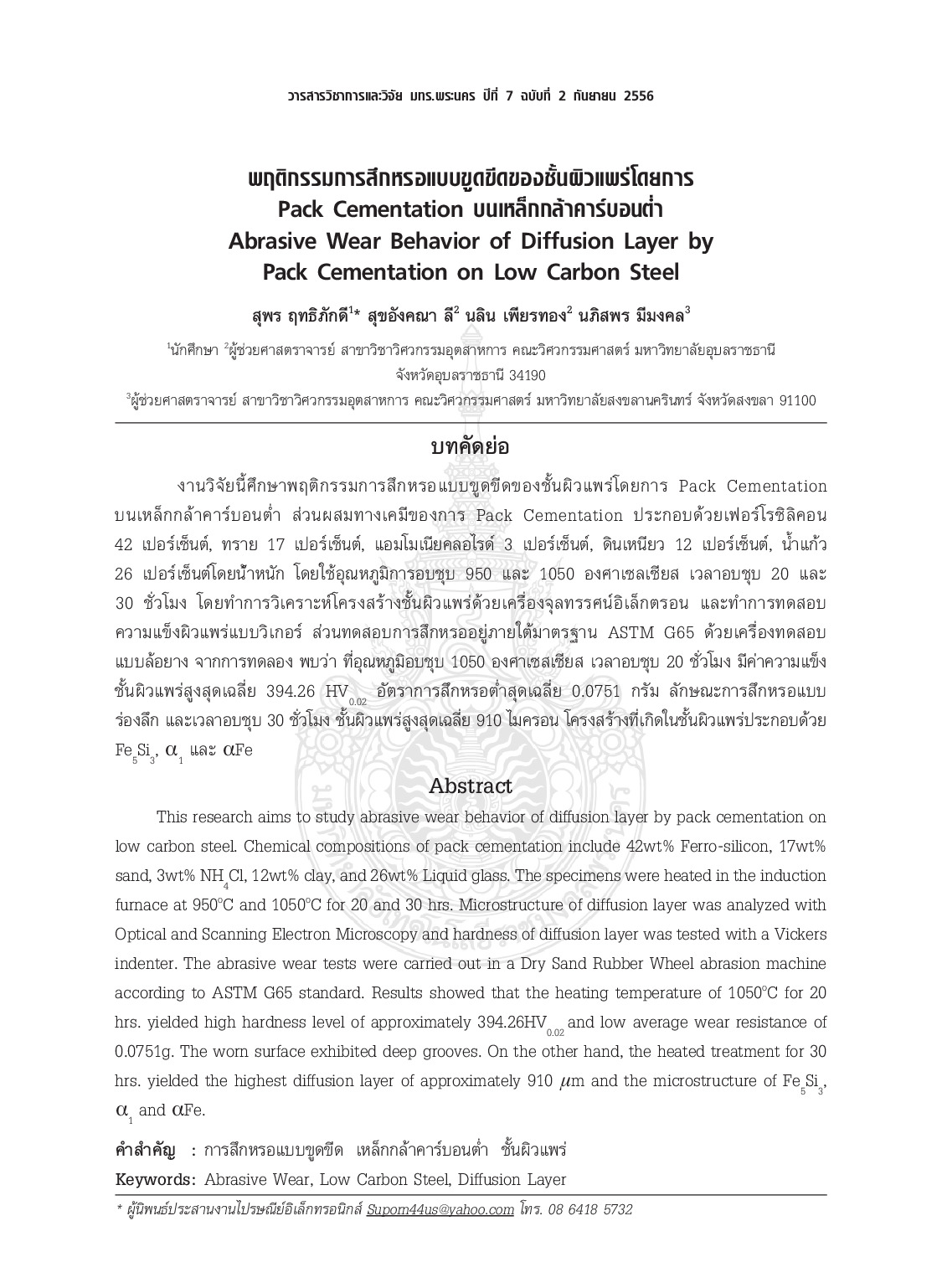
Abrasive wear behavior of diffusion layer by Pack Cementation on low carbon steel
This research aims to study abrasive wear behavior of diffusion layer by pack cementation on low carbon steel. Chemical compositions of pack cementation include 42wt% Ferro-silicon 17wt% sand 3wt% NH4Cl 12wt% clay and 26wt% Liquid glass. The specimens were heated in the induction furnace at 950?C and 1050?C for 20 and 30 hrs. Microstructure of diffusion layer was analyzed with Optical and Scanning Electron Microscopy and hardness of diffusion layer was tested with a Vickers indenter. The abrasive wear tests were carried out in a Dry Sand Rubber Wheel abrasion machine according to ASTM G65 standard. Results showed that the heating temperature of 1050?C for 20 hrs. yielded high hardness level of approximately 394.26HV0.02 and low average wear resistance of 0.0751g. The worn surface exhibited deep grooves. On the other hand the heated treatment for 30 hrs. yielded the highest diffusion layer of approximately 910?m and the microstructure of Fe5Si3 ?1 and ?Fe.