จำนวน Repository ( 286 )
ระบบควบคุมการจัดเก็บพลังงานไฟฟ้าจากเซลล์แสงอาทิตย์โดยใช้ตัวเก็บประจุไฟฟ้าแบบซุปเปอร์ควบคุมด้วยระบบฝังตัว
To store electrical power from solar cells are generally used battery as storage. Recent development in capacitor technology achieves with higher capacitancc smaller and low cost especially dcvelopment of a supcr capacitor (doublc laycrs). This research study used a super capacitor to store electrical power from solar cells. The results show that super and electrolyte capacitor can be used without battery with more power density and fast charge. But capacitor discharging must be controlled. The important disadvantage is super capacitor is used with low voltage and high rate of charge leakage. In case of electrolytic capacitor can use with higher voltage low rate of charge leakage but lower capacitance.
หุ่นยนต์เคลื่อนที่ตามวัตถุเป้าหมายที่กำหนดโดยใช้การประมวลผลภาพ
In present there are widely use robot in many fields. Mobile robot can help us in several task such as moving to toxic area risk area or explosion area mine. Movement control can be used in many ways. This paper proposed mobile robot that movc by wheels. It move to previous defined picture. By using small camera process an images and check it that is the previous one by using neural network. If it is robot will move toward to that picture. The movement is in flat plane. If that defined picture is not in center robot will move to left or right depend on its position until it is on center. This paper proposed image processing only.

การพัฒนาวัสดุอาหารจากวัสดุเหลือทิ้งทางการเกษตรเพื่อการประหยัดพลังงานและลดการถ่ายเทความร้อนเข้าสู่อาคาร
The objective of this research is to study the implementing the agricultural residue to the design of outdoor paving block for lowering the building temperature. The base layer admixture (layer no.1) is selected from cement type1: quarry dust: rice husk: rice straw: water ratios equal to 1: 3: 0: 0: 0.3 1: 1: 0: 1: 0.5 1: 1. 0.25: 0.75: 0.5 1: 1: 0.5: 0.5: 0.5 1: 1: 0.75: 0.25: 0.5 and 1: 1: 1: 0: 0.5 by weight. The surface layer admixture (layer no.2) is white silica cement: yellow stone chip no.4: water equals to 1: 4: 0.3 by weight. The exterior floor-covering blocks were tested following density testing water absorption testing compressive testing and surface temperature testing compare with laterite sandstone paving concrete block marble and granite. Resulting the best ratio of cement type1: quarry dust: rice husk: rice straw: water is 1: 1: 0.75: 0.25: 0.5 that has properties at 28 days following 1939.43 kg/m of density 14.97 % of water absorption 284.69 ksc of compressive strength and lower than other paving blocks around 3 – 13 degrees Celsius of surface temperature
A study of obtained knowledge using from physics I for engineers for daily life application of undergraduate student at Rajamangala University of Technology Phra Nakhon
The purpose of this study was to investigate obtained knowledge using from Physics I for Engineers for daily life application of undergraduate student from faculty of engineering Rajamangala University of Technology Phra Nakorn. Sample was 316 students which taken from four engineering majors; computer electrical industrial and mechanical engineering. A questionnaire a four point scale was used as testing tool. The statistical analyses were performed in mean standard deviation and one way analysis of variance. The results revealed that students used their obtained knowledge in moderate level (3.10). Students in each programs showed significantly different used their obtained knowledge at 0.05 level. Electrical engineering students (3.27) showed highest number of the course content using follow by mechanical engineering (3.09) computer engineering (3.07) and industrial engineering (2.75) respectively.
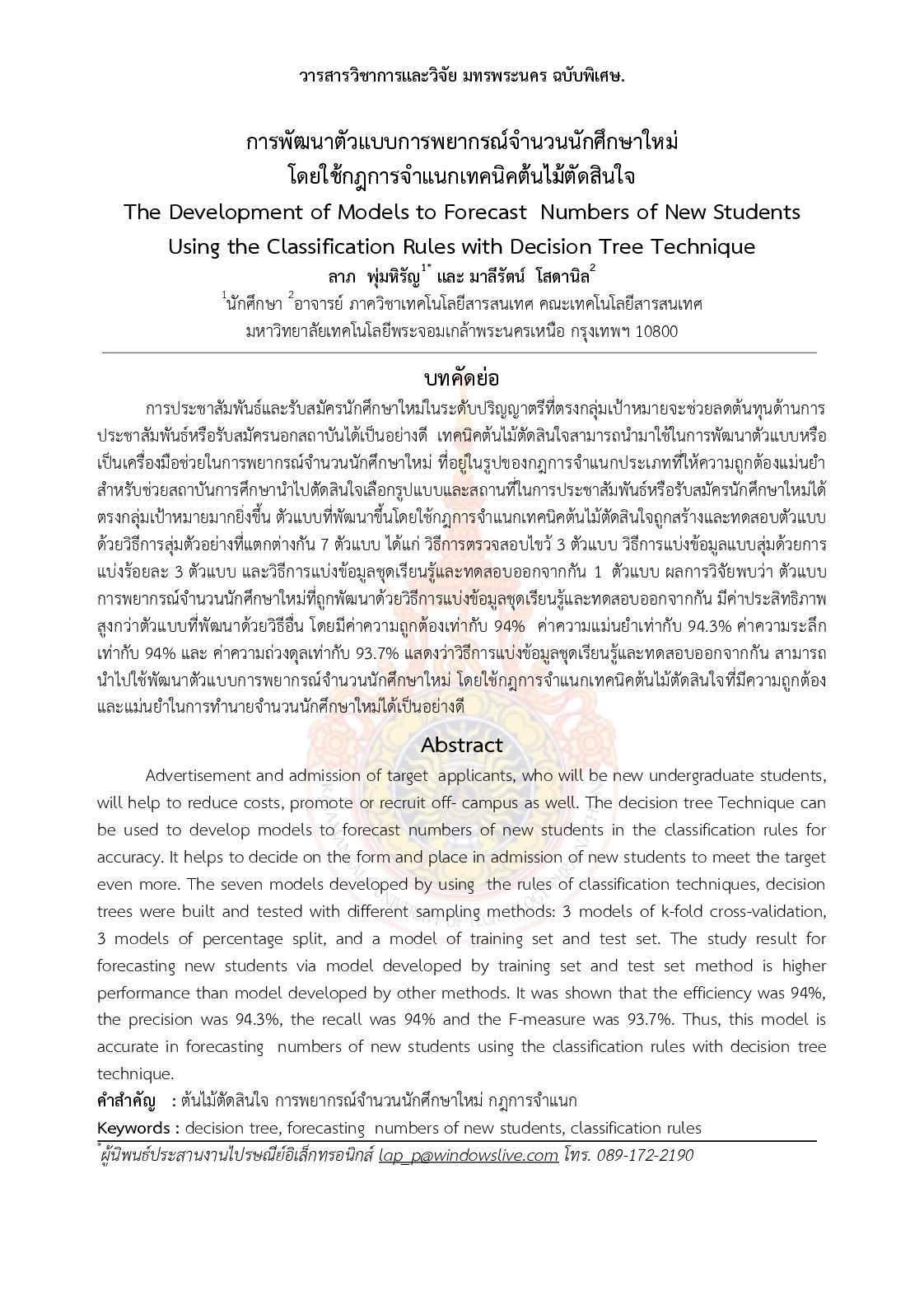
The Development of Models to Forecast Numbers of New StudentsUsing the Classification Rules with Decision Tree Technique
Advertisement and admission of target applicants who will be new undergraduate studentswill help to reduce costs promote or recruit off- campus as well. The decision tree Technique can be used to develop models to forecast numbers of new students in the classification rules for accuracy. It helps to decide on the form and place in admission of new students to meet the target even more. The seven models developed by using the rules of classification techniques decision trees were built and tested with different sampling methods: 3 models of k-fold cross-validation 3 models of percentage split and a model of training set and test set. The study result for forecasting new students via model developed by training set and test set method is higher performance than model developed by other methods. It was shown that the efficiency was 94% the precision was 94.3% the recall was 94% and the F-measure was 93.7%. Thus this model is accurate in forecasting numbers of new students using the classification rules with decision tree technique.