จำนวน Repository ( 33 )
การพัฒนาผลิตภัณฑ์เปลือกเสาวรสแช่อิ่มอบแห้ง
The development product of dried pickled passion fruit peel aimed to study appropriate production process of dried pickled passion fruit peel to study the preservation and examine the acceptance from the customers. The result showed that the appropriate way to produce dried pickled passion fruit peel was the 30% 40% and 50% of intensity in syrup. With the intensity of syrup started from 30% the appearance color and smell of final product got highest average score. Therefore the production should be slow pickled with 30% of syrup intensity. In terms of preservation there was no microorganism over Thai industrial standard institute of fruits and vegetables 161/2015. Finally most of the customers accepted this product

การพัฒนาต้นแบบหลักสูตรระยะสั้นเพื่อการบริการวิชาการของมหาวิทยาลัย เทคโนโลยีราชมงคลพระนคร ในการส่งเสริมการประกอบอาชีพในยุคดิจิตอล
From the Development of a Prototype of Rajamangala University of Technology Phra Nakhon’s Acedemic Outreach Service for Occupational Promoting in Digital Age. Found that Mostly female Percentage 89.27 Most of them are 31-35 years old or 32.88%. Most of them have experience in short courses in the period of 11-15 years or 33.91%. 98.62% of learners needs related to training course development. (1) The requirements for the development of training curricula were 274 (94.80%). Training Course (2) Reason for Studying: 163 students (56.40%) Want to apply knowledge to work in the amount of 43.60% who want to bring their knowledge to improve their skills. study Cake making was 30.10%. (4) The training period was mostly 2 days 42.91% (5). Most practice 50.17% (6) What you want to get after training is most needed. diploma 50.87% Satisfaction of learners on the training curriculum as a whole. In the aspect of training the satisfaction level (X = 4.04) was highest (X = 4.12). = 4.54). In terms of training services the overall satisfaction of the training services was very high (X = 4.09). The facilitation and service of staff (X = 4.51). Overall the lecturer provided the lecture. The knowledge level was high (X = 4.13). The highest mean score (X = 4.45). The content of the training curriculum was found to be satisfactory at the high level (X = 4.36). The content of the course can be used (X = 4.67). At the highest level (X = 4.24)
การพัฒนาผลิตภัณฑ์พริกแกงก้อนเพื่อการผลิตใน
The research has developed the recipes and methods of producing chili curry green curry coconut milk red curry (Southern) and sour curry. The curry paste mixed with shrimp paste to make it convenient and to use. Learn how to mold chili curry the use of stainless steel blocks in forming the most convenient. Drying temperature of 65°C 2-stage and 11-hour drying time. The quality and physical chemical microbiological and sensory characteristics of chilli curry also passed the standard of community products. The design of packaging for cube green curry cube coconut milk curry (southern) and cube sour curry paste were the most accepted among Khuan Prai community members. To use the recipes for commercial distribution continues. A study of consumer acceptance of cube chili curry products. It was found that 150 general consumers accepted 100% Shelf life of 5 months was from April to August 2018. It was found that cube curry had a number of yeasts. Exceeded the standard in 5 months Red Curry (Southern) and Red Curry are also standard products. The research was conducted on September 1-2 2018 at Khuan Prai community enterprise Phunphin Surat Thani. 25 people can make cube chili curry products. It will also scale up the product to the community for distribution
การปรับปรุงคุณภาพมะขามหวานด้วยความร้อนระดับครัวเรือนเพื่อวิสาหกิจชุมชน
Sweet tamarind is a unique and economic plant of Phetchaboon province and it has already been geographical indication (GI) registered. One of its main problems is fungal degeneration which cannot be physically visible. This causes the consumer’s uncertainty on its quality especially sweet tamarind from small communities. This led to the study on the use of household heat to reduce fungal degeneration by steaming at 100oC for 50 60 70 and 80 minutes and drying in the hot air oven at 70oC for 3 hours. It was found that increasing the heat resulted in darkening the sweet tamarind color and heightening up its content moisture (p<0.05) statistical significance. Drying temperature at 60 70 and 80oC revealed the higher the heat the shorter the drying time and the sweet tamarind content was darker. In addition drying significantly decreased the moisture and preference score of sweet tamarind (p<0.05). The storage of sweet tamarind in mesh bag at ambient temperature revealed that the increase of the storage time resulted in a significant increase in the moisture of the sweet tamarind shell (p<0.05) and could preserve the tamarind for at least 12 weeks without the deterioration from the fungus.
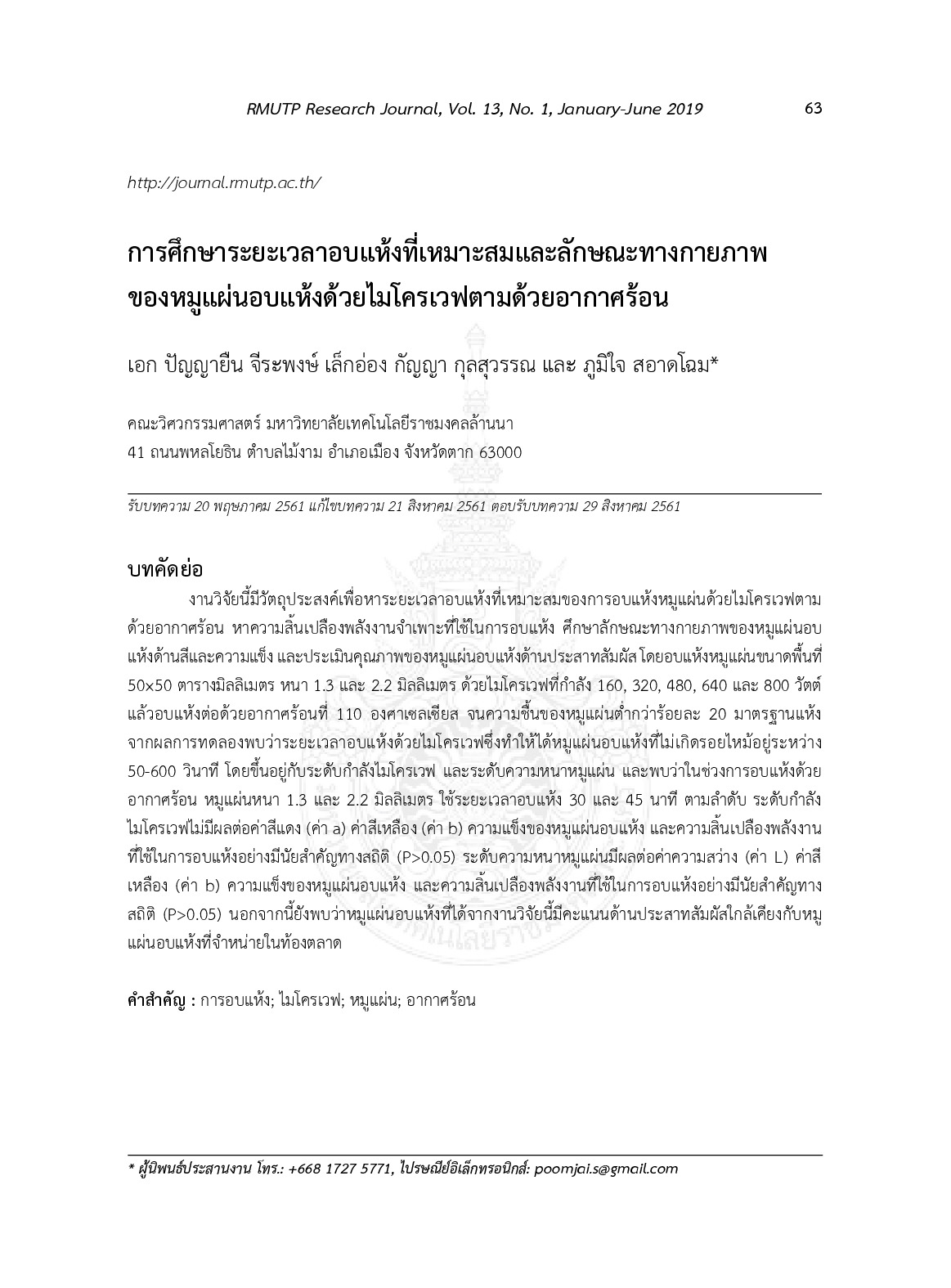
การศึกษาระยะเวลาอบแห้งที่เหมาะสมและลักษระทางกายภาพของหมูแผ่นอบแห้งด้วยไมโครเวฟตามด้วยอากาศร้อน
The objectives of this research were to determine the suitable times of pork slices drying using microwave followed by hot air and to find specific energy consumption during drying. The physical characteristic (color and hardness) and the sensory test of dried pork slices were also investigated. Pork slices with the sizes of 50x50x1.3 and 50x50x2.2 millimeters were dried using the microwave at the powers of 160 320 480 640 and 800 watts until the samples did not burn during drying. Then the samples were dried using hot air at a temperature of 110oC until the moistures of the samples were lower than 20% dry basis. Based on the experimental results it was found that the suitable times of the samples drying using microwave were 50-600 seconds which depended on the microwave powers and the pork thicknesses. In hot air drying period drying times of the samples with thicknesses of 1.3 and 2.2 millimeters were 30 and 45 minutes respectively. The microwave powers had no significant effect on the redness (a value) and yellowness (b value) of dried pork the hardness of dried pork and the specific energy consumption (P<0.05). The pork thicknesses had the significant effect on the lightness (L value) and yellowness (b value) of dried pork the hardness of dried pork and the specific energy consumption (P<0.05). Moreover sensory scores of the dried pork obtained from this research were close to those obtained from the local market.