จำนวน Repository ( 31 )

การใช้ประโยชน์และความคุ้มค่าของระบบสารสนเทศกิจกรรมนักศึกษา
The purpose of this research is to study the Rajamangala University of Technology Phra Nakhon student activities information system usage and payoff if it meets the requirements of the university in order to keep track of the students extra curriculum activities and to study the user satisfaction usage and payoff of the system. 385 samples were systematically randomly selected among 10153 students studying in the undergraduate class year 1 to year 3 and the personnel working in all Faculties of the university at the 95% confidence level. The study found the following results: The majority of the respondents mainly were female 54.5 percent 96.4 percent were students studying in year 1 41.3 percent and from Business Administration Faculty 36.9 percent. Overall satisfaction toward the student activities information system was at a high level with an average of 3.66. Overall usage of the student activities information system was at a high level with an average of 3.74 and overall payoff of the student activities information system was at a high level with an average of 3.77. The hypothesis testing showed that different personal factors including gender occupation/status class and faculty did not varied the satisfaction toward the student activities information system statistically significant at the .05 level. Different personal factors including gender occupation/status class and faculty did not varied the usage of the student activities information system statistically significant at the .05 level. Different personal factors including gender occupation/status class and faculty did not varied the payoff of the student activities information system statistically significant at the .05 level. Satisfaction toward the student activities information system including system quality information quality and service quality is positively related to the usage of the student activities information system statistically significant at the .05 level and the student activities information system usage is positively related to the student activities information system payoff statistically significant at the .05 level.
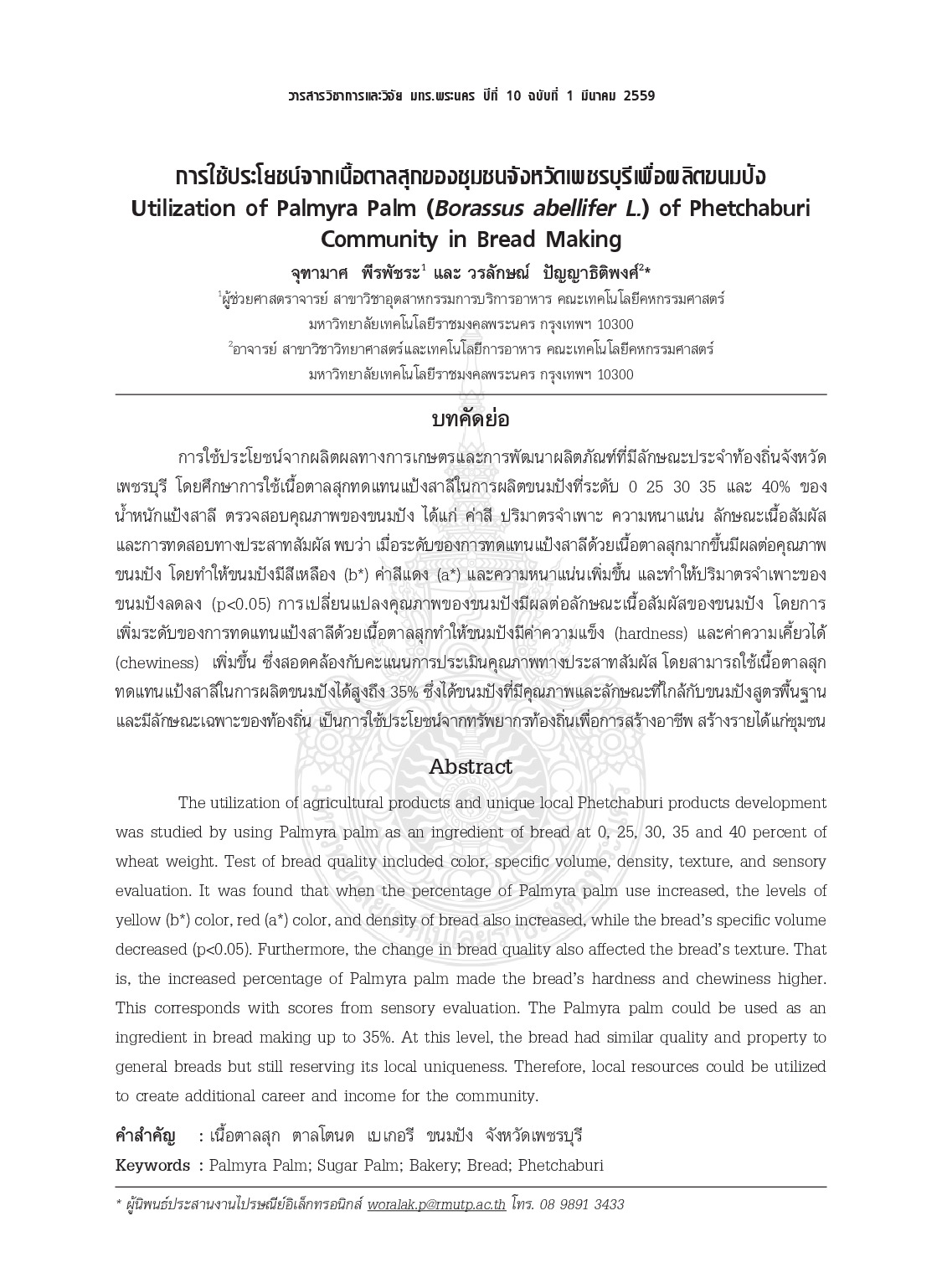
การใช้ประโยชน์จากเนื้อตาลสุกของชุมชนจังหวัดเพชรบุรีเพื่อผลิตขนมปัง
The utilization of agricultural products and unique local Phetchaburi products development was studied by using Palmyra palm as an ingredient of bread at 0 25 30 35 and 40 percent of wheat weight. Test of bread quality included color specific volume density texture and sensory evaluation. It was found that when the percentage of Palmyra palm use increased the levels of yellow (b*) color red (a*) color and density of bread also increased while the bread’s specific volume decreased (p<0.05). Furthermore the change in bread quality also affected the bread’s texture. That is the increased percentage of Palmyra palm made the bread’s hardness and chewiness higher. This corresponds with scores from sensory evaluation. The Palmyra palm could be used as an ingredient in bread making up to 35%. At this level the bread had similar quality and property to general breads but still reserving its local uniqueness. Therefore local resources could be utilized to create additional career and
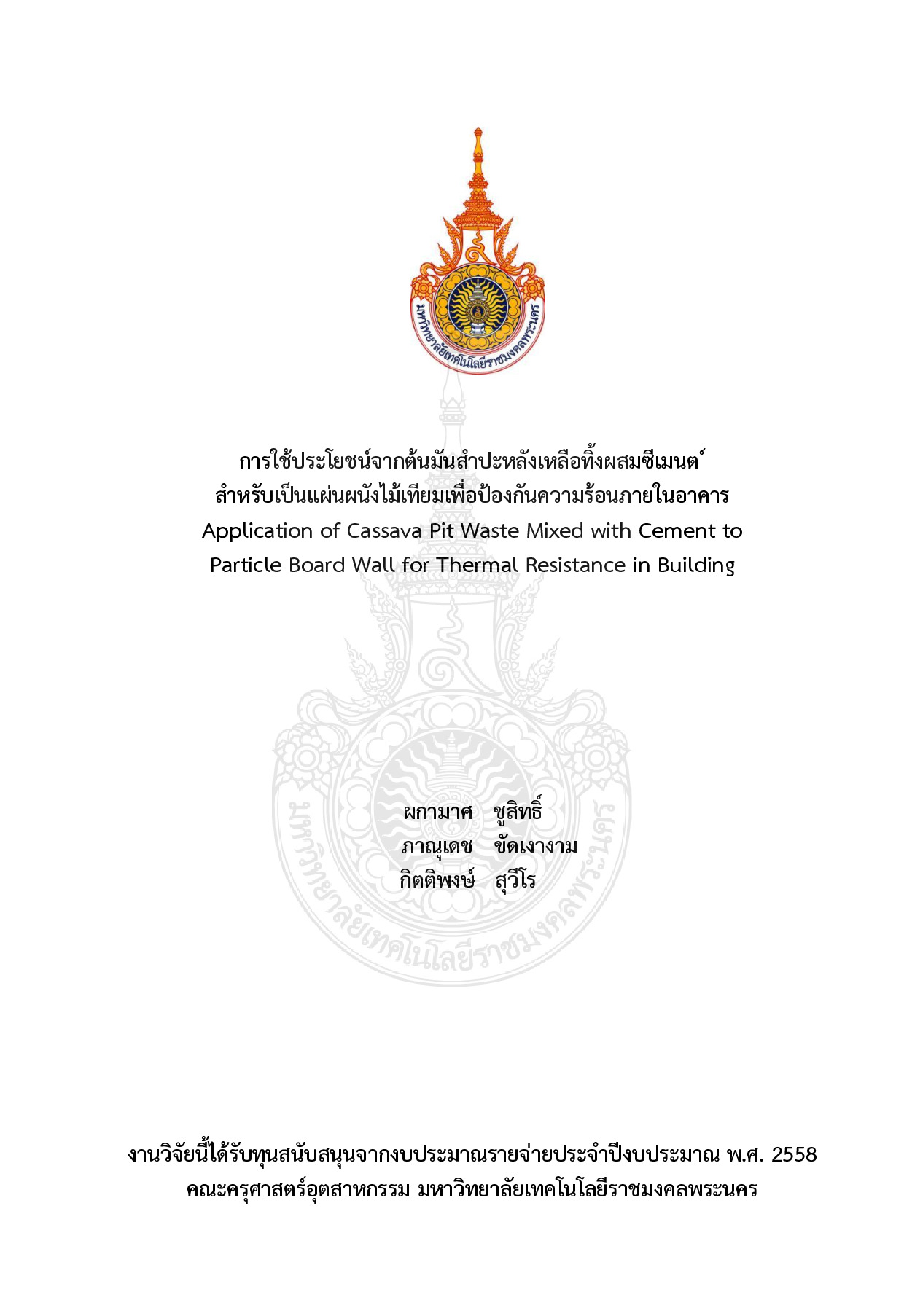
การใช้ประโยชน์จากต้นมันสำปะหลังเหลือทิ้งผสมซีเมนต์ สำหรับเป็นแผ่นผนังไม้เทียมเพื่อป้องกันความร้อนภายในอาคาร
This research aims to study the using cassava pit wastes mixed with cement to particle board walls. The Portland cement type1: fine sand: tap water ratio is equal to 1: 0.5: 0.416 by weight. The ratios of cassava pit wastes to cement are used following: 0.05 0.06 0.07 0.08 0.09 and 0.10 by weight. The cassava pit wastes are crushed by plastic plastics granulators (pass sieve no.4). The casting of particle board walls use the compression machine in room temperature (30 – 35 degree of Celsius) and control 0.75 g/cm3 of density. The TIS 878-2537 standard (cement bonded particle board: high density) is followed to test the properties of particle board wall. Resulting the cassava pit wastes mixed with cement can cast to particle board walls and have good properties especially the thermal insulation property.
การศึกษาการใช้ประโยชน์เศษเส้นด้ายไหมเหลือทิ้ง เพื่อใช้ทำเครื่องประดับสตรี
The objectives of this research are to use waste silk yarn for making women accessories and transfer the created technology to a women community in Surin Province. The required information for product design was collected. Subsequently 15 conceptual designs were made including necklace bracelet and bangle earring and pin. The experts were asked to choose the best 5 designs out of 15 designs. Then the prototypes were made by using waste silk yarn. Finally the most suitable product was selected for further technology transfer to a target group of 55 women who live in Surin. The questionnaires were used to asses the satisfactory of the training. The corresponding data was statistically analyzed. The results from the evaluated questionnaires show that most of the attended women are 31–40 years old and graduated from lower secondary schools. They are merchants and their average earnings are below 5000 Baht/month. Regard to the training program in terms of preparation instructors and overview most of them are satisfied the program in the high level to very high level. The average satisfactory for all of 3 aspects is in the high level.
การใช้ประโยชน์จากบัวหลวงเป็นส่วนประกอบในอาหารเพื่อเพิ่มมูลค่า
The main purposes research of Value Adding of Nelumbo Nucifera (Lotus) as the Food lngrestent are (1) Studying the possibility of using Nelumbo Nucifera (Lotus) as the Food ingredient. (2)Studying chemical components of food products using Nelumbo Nucifera (Lotus) as their ingredients. (3)Studying consumer acceptance. from the research when using Nelumbo Nucifera (Lotus) as the food ingredient in 10 menus} indicated that deletable imitaion fruits (Kanom look-choob)has its reputation up to 50 percent of consumer acceptance after using lotus beads instead of peeled green beans. Coconut Macaroon(Kanom Ba-binX has 60 percent of consumer satisfaction after using lotus roots instead of ripe coconut. Rolled Wafer (Thong Muan)adding lotus petal to ingresients had consumer acceptance at only 3 percent. Thai Meringe(Sommanat) has 10 percent of conumer satisfaction after using lotus beads powder instead of wheat flour. Cake has 10 percent of consumer satisfaction after using lotus beads powder instead of wheat flour.Cookieshas 10 percent of consumer satisfaction after using lotus beads powder of wheat flour.Waffle has 10 percent of consumer satisfaction after using lotus beads powder instead of wheat flour. Sandwich Spread after using lotus young stem instead of pickle has acceptance at 50 percent. Pork Balls adding lotus young stem at 20 percent.