จำนวน Repository ( 26 )
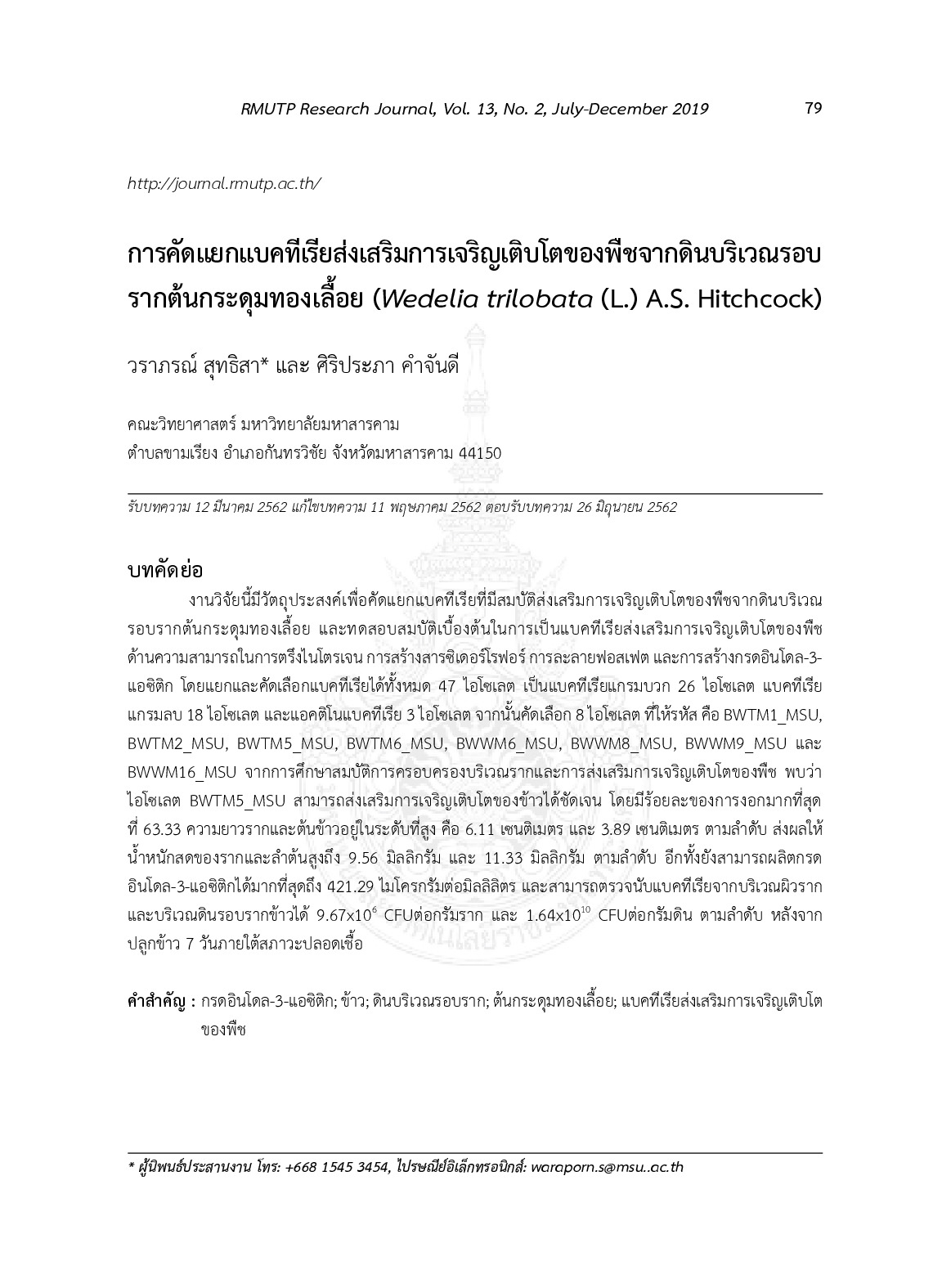
การคัดแยกแบคทีเรียส่งเสริมการเจริญเติมโตของพืชจากดินบริเวณรอบรากต้นกระดุมทองเลื้อย (Wedelia trilobata (L.) A.S. hitchcock)
The objective of this research was to isolate plant growth promoting rhizobacteria from Wedelia trilobata (L.) A.S. Hitchcock rhizosphere and preliminarily test their plant growth promoting properties such as nitrogen fixation siderophore production phosphate solubilization and indole-3-acetic acid production. Forty-seven bacterial isolates were obtained including 26 isolates of gram positive 18 isolates of gram negative and 3 isolates of actinobacteria. After that 8 isolates (including BWTM1_MSU BWTM2_MSU BWTM5_MSU BWTM6_MSU BWWM6_MSU BWWM8_MSU BWWM9_MSU and BWWM16_MSU) were selected for studying on root colonization and plant growth promoting properties under aseptic condition. The results showed that BWTM5_MSU had the evident on the promotion of plant growth with the most percentage of rice seed germination (63.33%) high level of root and shoot length with 6.11 cm and 3.89 cm respectively. As a result the root and shoot fresh weight was as high as 9.56 mg and 11.33 mg respectively. It also correlated with the highest production of indole-3-acetic acid up to 421.29 ug/ml. The root colonization was studied by counting rhizobacteria isolate BWTM5_MSU from rice rhizoplane and rhizosphere with presented bacterial number at 9.67x10⁶ CFU/g root and 1.64x10 10 CFU/g soil respectively.
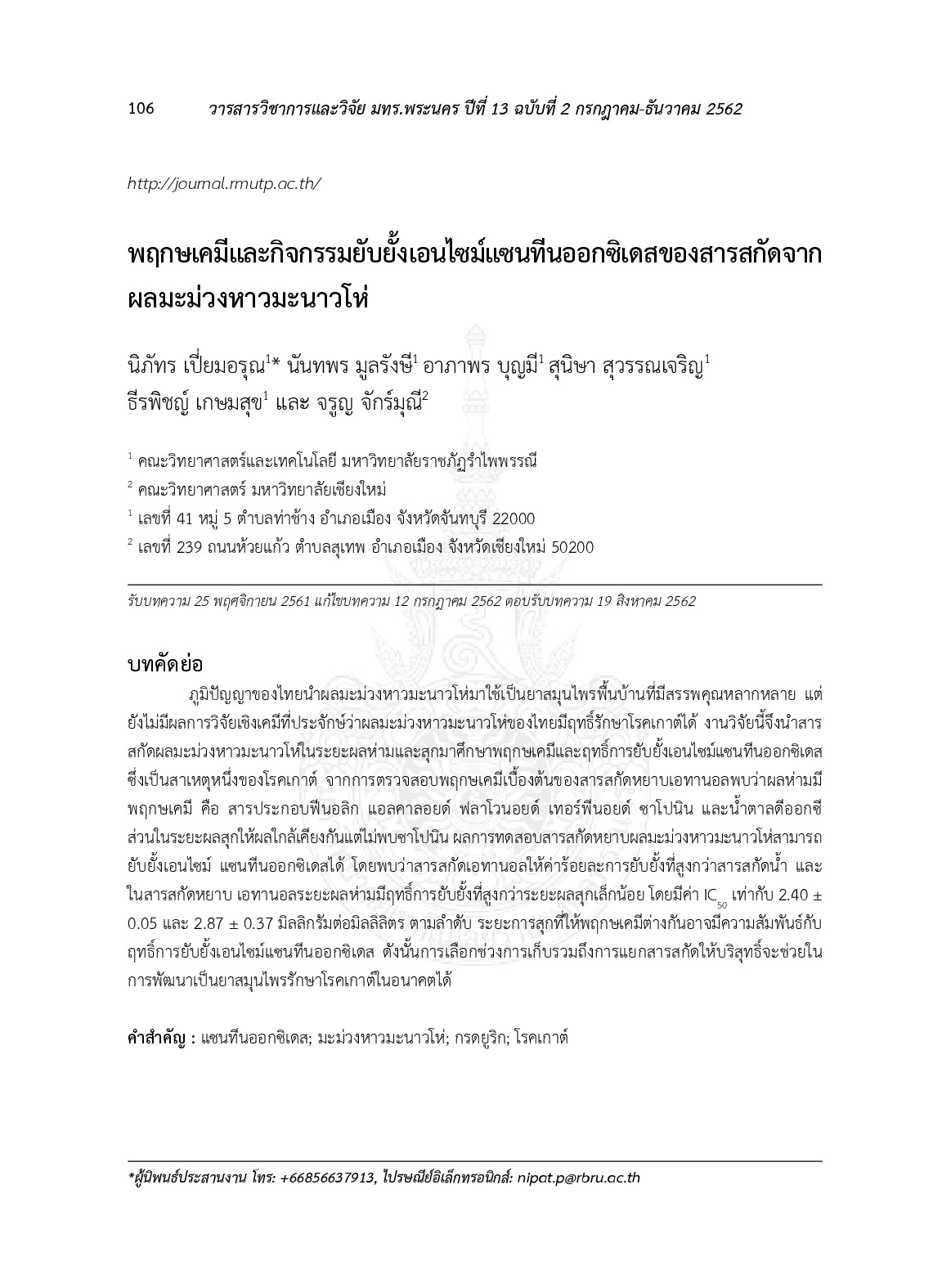
พฤกษเคมีและกิจกรรมยับยั้งเอนไซม์แซนทีนออกซิเดสของสารสกัดจากผลมะม่วงหาวมะนาวโห่
The Thai wisdom knows the benefits of Carissa carandas L. to be used as a traditional herbal medicine. However there was no scientific evidence to show that Carissa carandas L. of Thailand can treat gout or not. In this research the Carissa carandas L. fruit extract in semi-ripening and ripe stage were studied for the phytochemical and inhibitory activity of xanthine oxidase one of the causes of gout. The result of hytochemical indicated that the crude extract from semi-ripening stage fruit contained many substances; phenolic compounds alkaloids flavonoids terpenoids saponins and deoxy sugars. While the ripe stage fruit contained the similar substances excepted saponins. The extract solution of Carissa carandas L. showed the xanthine oxidase inhibitory activity as the ethanolic extract solution gave the higher activity than water extract solution. The crude extracts of semi-ripening stage fruit presented the higher activity than the ripe stage one with the IC 50 values of 2.40 ± 0.05 and 2.87 ± 0.37 mg/mL respectively. The result of ripening stage with different phytochemical may be related to inhibition of xanthine oxidase activity. Therefore the selecting of sampling period and purification of extract may be a choice for using as medicine for gout

กระบวนการผลิตผักแกะสลักบรรจุในภาชนะปิดสนิท
The study of vegetable-carved processing packed in hermetically sealed container for 5 types of plant e.g. carrot pumpkin radish green papaya and cucumber which carved into rose or leave shape and preserved in acidified-pickle (7.23% vinegar 64.81% water 0.81% salt 27.00% sugar and 0.15% lactic acid pH 3.27). The processing were conducted by sanitized carved-carrot pumpkin and radish in peroxyacetic acid solution (80 mg/l 3 min) or dipped in tap water (3 min) for green papaya and cucumber. Then all carved-vegetables were blanched in calcium chloride solution (0.5% 3 min) followed by preserved in acidified-pickle in plastic box with a lid and stored for 4 days at room temperature (25ºC). The results showed that pH and °Brix decreased during 4 days storage and showed obviously tended to equilibrium. However carved-radish and cucumber were spoiled by microorganisms as a film on the surface of pickle solution and gas bubble was occurred inside a container on 4th days of the storage. Hence carrot and pumpkin were used in the next experiment which preserved in preservative-added recipe (27.03% vinegar 27.03% water 0.9% salt 45.05% sugar and 200 ppm sodium metabisulfite pH 3.39) with hot-filled method in glass bottle. Treatment was compared with carved-vegetables preserved in acidified-pickle and kept at 4oC as the control. The pH of samples of pickle solution carved-vegetables and mixed-sample of both treatments showed lower than 4.6 and °Brix were gradually decreased during storage periods.The appearance of both treatments were maintain good and not different between treatments. Shelf-life of carved-carrot -pumpkin and -radish stored in hermetically sealed container was up to 7 days. Total bacteria count Escherichia coli yeast-molds were not exceeded than the standard limited by Ministry of Public Health and Staphylococcus aureus was not detected
การพัฒนาวัสดุจีโอโพลีเมอร์จากเถ้าแกลบและเถ้าชานอ้อย
This research studies the potential for using waste ash from industrial and agricultural by–products as a geopolymer material. This paper presents a study of the resistance to chloride penetration and resistance to sulfuric acid of geopolymer mortar containing ground rice husk ash (RA) and ground bagasse ash (BA). Geopolymer mortars with constant liquid to ash ratio and similar flow were used for the tests. Compressive strength porosity chloride penetration test Rapid migration test of chloride depth chloride ion diffusion coefficient immersion test of chloride depth and weight loss with impressed sulfuric acid were investigated. Test results show that the workable flow of geopolymer mortar was in the range of 110–115% and was dependent on the ratio by mass of sodium silicate to NaOH and the concentration of NaOH. Extra water was used to improve the workabililty. In case of rice husk ash geopolymer mortar the geopolymer mortars with high strengths were obtained with concentration of NaOH of 15M with the sodium silicate to NaOH ratio by weight of 2.5. However the bagasee ash geopolymer mortars with high strengths were obtained with concentration of NaOH of 10M with the sodium silicate to NaOH ratio by weight of 2.5. The use of rice husk ash and bagasse ash produces geopolymer mixes with good strength and resistance to acid and chloride penetration. The resistance to acid and chloride penetration is higher with an increase in the sodium silicate to NaOH ratio by weight of 2.5.
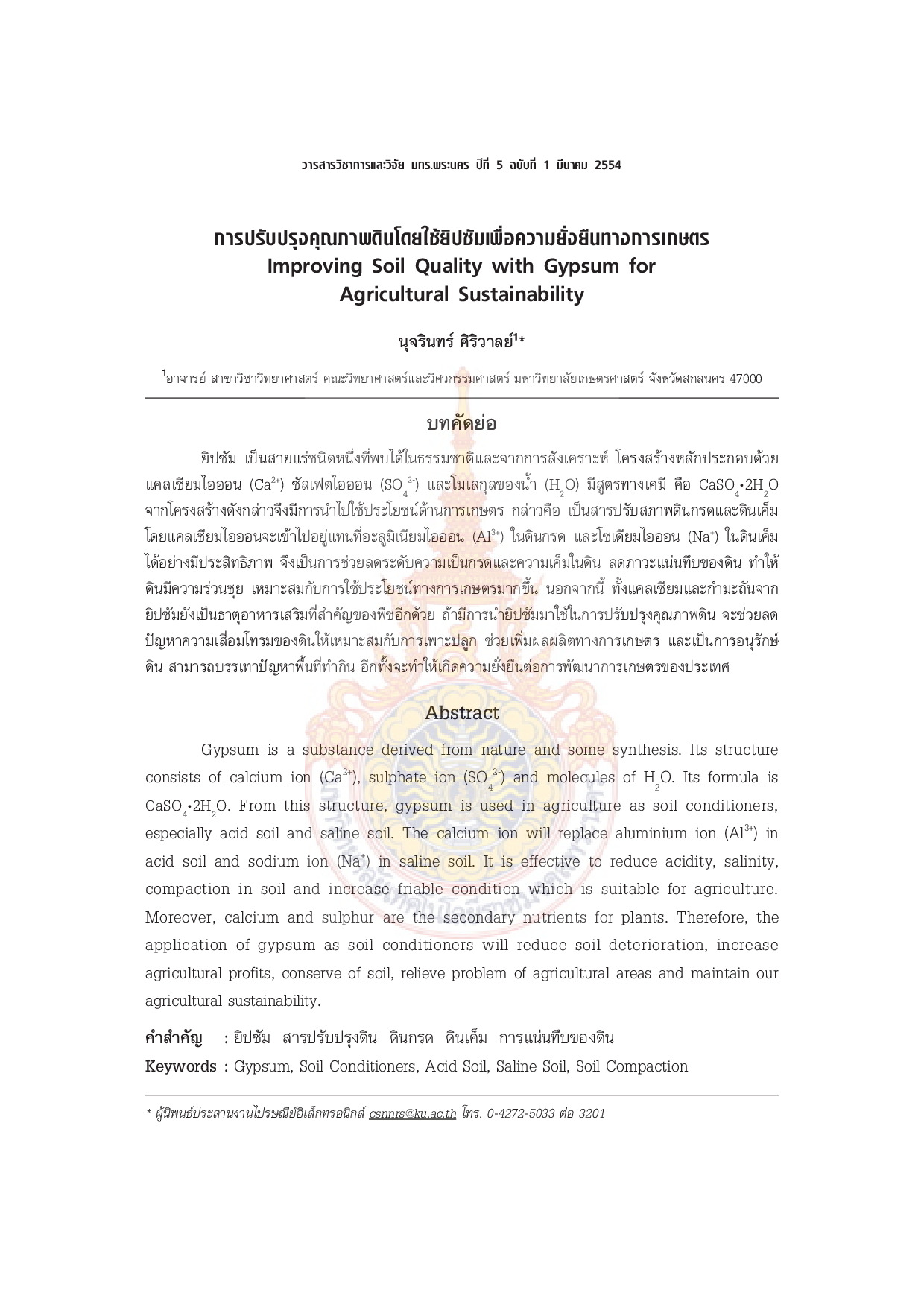
Improving Soil Quality with Gypsum for Agricultural Sustainability
Gypsum is a substance derived from nature and some synthesis. Its structure consists of calcium ion (Ca2+) sulphate ion (SO4 2-) and molecules of H2O. Its formula is CaSO4.2H2O. From this structure gypsum is used in agriculture as soil conditioners especially acid soil and saline soil. The calcium ion will replace aluminium ion (Al3+) in acid soil and sodium ion (Na+) in saline soil. It is effective to reduce acidity salinity compaction in soil and increase friable condition which is suitable for agriculture. Moreover calcium and sulphur are the secondary nutrients for plants. Therefore the application of gypsum as soil conditioners will reduce soil deterioration increase agricultural profits conserve of soil relieve problem of agricultural areas and maintain our agricultural sustainability