จำนวน Repository ( 70 )

การเพิ่มประสิทธิภาพระบบปรับอากาศรถยนต์ด้วยการซับคูลสารทําความเย็นโดยน้ำที่ควบแน่นจากคอยล์เย็น
Currently transport has played an important role in everyday life resulting in huge traffic jams caused by big city streets and pollution problems from global warming to global temperatures are rising. Since humans are creatures that prefer comfort in all areas which contrasts with the higher temperatures of the Earth. Currently the use of air conditioning a lot. To modify the temperature is reduced in the range 2 3 to 25 degrees Celsius makes people feel comfortable. However the use of air conditioning in the car cabin cooling efficiency can be increased to a higher level than it is by cooling the refrigerant. The aim of this research is to test and compare the performance of car air conditioning systems usually equipped with a heat exchanger. Using water from the condensation of evaporator as a medium for heat transfer. By installing the equipment at the outlet of the condenser. This causes the temperature of the refrigerant is low. The pipe lengths in the equipment from the calculation of 1 .2 meters and copper lines that increases the length of the tubes was calculated to compare with a length of 1.6 meters to test the speed of the compressor 1000 1500 2000 and. 2500 rpm and a wind speed of 20 35 and 50 kilometers per hour. The results of experiment found that the temperature refrigerant equipment decreased from an average of 1.6 degrees Celsius the pipe length of 1.2 meters and 1.6 meters of pipe temperature drops 1.8 degrees average temperature attended Eva sufficiently reduced operator. It increases energy efficiency ratio averaged 6.68% of the pipe length 1.2 m and 22.24% at a length of 1.6 meters as well as to increase the coefficient of performance of the air conditioning system. 6 .6 9 % of the pipe length of 1.2 meters and a length of 1.6 meters at 22.4% with the key factor in optimizing the cars air conditioning system. Making the refrigerant from the condenser the temperature drops to pull heat out of the cabin through evaporator higher.
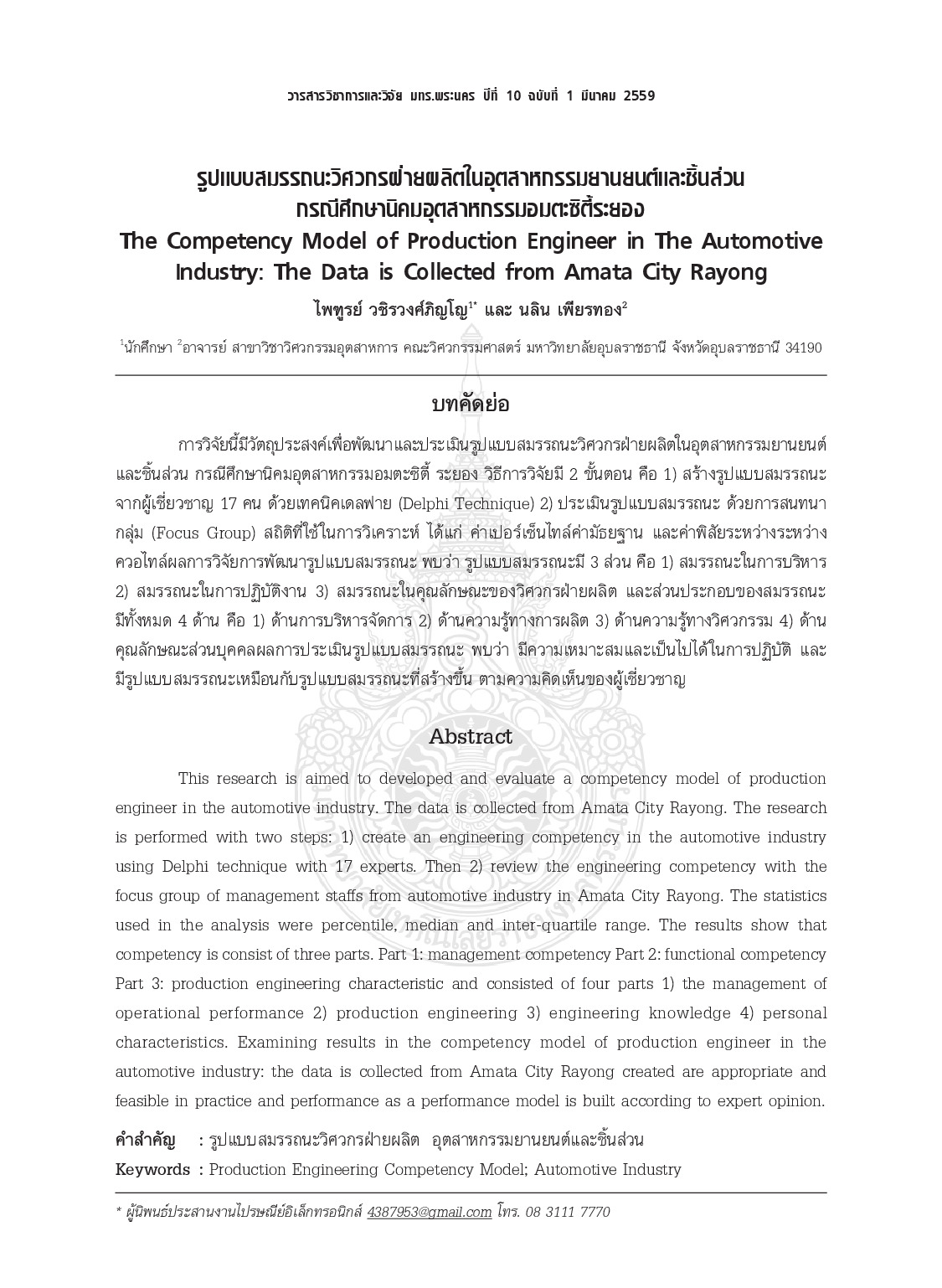
รูปแบบสมรรถนะวิศวกรฝ่ายผลิตในอุตสาหกรรมยานยนต์และชิ้นส่วน กรณีศึกษานิคมอุตสาหกรรมอมตะซิตี้ระยอง
This research is aimed to developed and evaluate a competency model of production engineer in the automotive industry. The data is collected from Amata City Rayong. The research is performed with two steps: 1) create an engineering competency in the automotive industry using Delphi technique with 17 experts. Then 2) review the engineering competency with the focus group of management staffs from automotive industry in Amata City Rayong. The statistics used in the analysis were percentile median and inter-quartile range. The results show that competency is consist of three parts. Part 1: management competency Part 2: functional competency Part 3: production engineering characteristic and consisted of four parts 1) the management of operational performance 2) production engineering 3) engineering knowledge 4) personal characteristics. Examining results in the competency model of production engineer in the automotive industry: the data is collected from Amata City Rayong created are appropriate and feasible in practice and performance as a performance model is built according to expert opinion.
การวิเคราะห์สินค้าบกพร่องในโรงงานผลิตชิ้นส่วนรถยนต์โดยใช้ ตัวแบบผสมเชิงเส้นวางนัยทั่วไป
The objectives of this research are to propose a proper model for defective products in an autoparts manufacturing industry to apply the proposed model to the defective products data to investigate the factors related to the machines producing defective products and to compare the proposed model with the generalized estimating equations model (GEE). The proposed model is a generalized linear mixed model (GLMM) in which the dependent variables have a Poisson distribution. The parameter are estimated using a Bayesian method. The data were collected from 12 machines 15 days for each machine from an autoparts manufacturing factory. The data collection dates vary depending on the working steps and the product types. The results show that the proposed model fits the data. The factors related to the machines producing defective products are working steps workers and product types. According to the estimates of the factors effects the working step producing the largest number of defective products is the working step 2 followed by the working steps 3 1 and 4 respectively. The worker producing the largest of defective products is the worker 4 followed by the workers 10 5 8 6 2 3 1 7 and 9 respectively. The product type 3 has the largest number of defective products followed by the product types 2 and 1 respectively. If the population-averaged effects are focused the GEE is applied. However the subject-specific is focused the GLMM is applied.
การเลือกฟังก์ชันการแจกแจงความน่าจะเป็นสะสมสำหรับแนวโน้มเพื่อสร้างตัวแบบสำหรับวิเคราะห์ข้อมูลอนุกรมเวลาหลายๆตัวพร้อมกันที่มีค่า อัตตสหสัมพันธ์แนวโน้ม และค่าผิดปกติ ด้วยวิธีของเบย์: กรณีศึกษาราคาหุ้นที่มีความผันผวนของตลาดหลักทรัพย์แห่งประเทศไทย
The objective of this research is to select a proper cumulative function for trend in an analysis of simultaneous multiple time series data with autocorrelation trend and outliers using a Bayesian method. The proposed model is applied to fluctuate stock price data in the stock exchange of Thailand. The data consist of the closing prices of 5 stocks. The algorithms are written in OpenBUGS and the performance of the model is evaluated via a simulation study in R. The cumulative distribution functions considered here are a Weibull cumulative distribution function and an exponential cumulative distribution. They are compared using RMSE MAPE and MAE as criteria. The research found that an exponential cumulative function for trends gives smaller values of the three criteria in both model fitting and model validation for the4 stocks EA NWR and KTB. However a Weibull cumulative distribution function gives smaller values of three criteria for the PTT in both model fitting and model validation.
การวิเคราะห์สาเหตุของการผลิตสินค้าบกพร่องและเสียด้วยตัวแบบการถดถอยโลจิสติกส์แบบเบย์: กรณีศึกษาโรงงานผลิตชิ้นส่วนรถยนต์
This research proposes a Bayesian logistic regression model which is applied to the data from autoparts manufacturing machines. Factors related to defective and bad products are investigated. The proposed model is compared with the logistic regression using maximum likelihood method for parameter estimation. The data were collected from 132 machines in an autoparts manufacturing factory. The research found that useful life machine type 6 worker group 3 and 4 working step 1 and 2 influence to the risk of producing defective and bad products. When the useful life is increased by 1 month the risk of producing defective and bad products will be increased by 2.2%. The risk that the machine type 6 will produce defective and bad products is 4.078 times greater than the risk that the machine type will do. The risk that the worker group 3 will produce defective and bad products is 61.7% less than the risk that the worker group 12 will do. The risk that the worker group 4 will produce defective and bad products is 61.5% less than the risk that the worker group 12 will do. The risk that the working step 1 will produce defective and bad products is 2.831 times greater than the risk that the working step 4 will do. The risk that the working step 2 will produce defective and bad products is 13.8 % greater than the risk that the working step 4 will do. The parameter estimates from the Bayesian logistic regression are very close to the ones from the logistic regression using maximum likelihood method for parameter estimation