จำนวน Repository ( 30 )
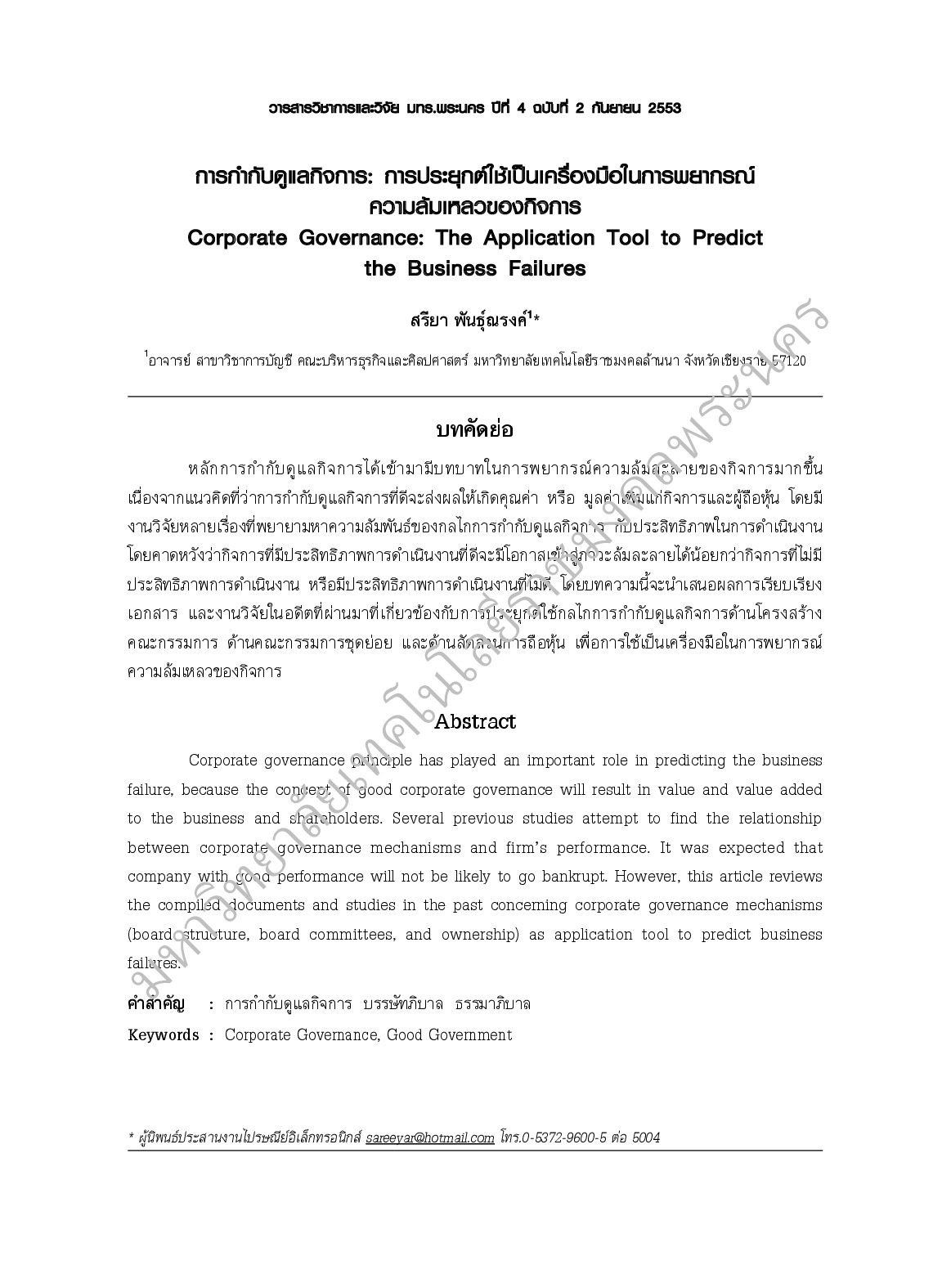
การกำกับดูแลกิจการ : การประยุกต์ใช้เป็นเครื่องมือในการพยากรณ์ความล้มเหลวของกิจการ
Corporate governance principle has played an important role in predicting the business failure because the concept of good corporate governance will result in value and value added to the business and shareholders. Several previous studies attempt to find the relationship between corporate governance mechanisms and firm’s performance. It was expected that company with good performance will not be likely to go bankrupt. However this article reviews the compiled documents and studies in the past concerning corporate governance mechanisms (board structure board committees and ownership) as application tool to predict business failures.
เทคนิคการวิเคราะห์คุณภาพกำไรของบริษัทจดทะเบียนในตลาดหลักทรัพย์แห่งประเทศไทยกลุ่มพลังงานและสาธารณูปโภค และกลุ่มปิโตรเคมีและเคมีภัณฑ์
The objective of this research is to study the techniques of profit quality analysis and the consistency of the profit quality with different profit quality analysis techniques; and to compare profit sustainability between large companies and small companies of the industrial energy and utilities group and the petrochemical and chemical group. The data is collected from financial statements and data entry forms (Form 56-1) from 2012 to 2018. A total of 47 companies are analyzed using descriptive statistics including mean and standard deviation; and inferential statistics including multiple regression analysis and analysis of the average difference between 2 groups The research found that in the analysis of the profit quality consistency in all 4 methods there were only 13 companies in the energy and utilities group with consistent quality of profits accounting for 39.39%; and 20 with inconsistent results accounting for 60.61%. In the petrochemical and chemical group there was only 1 company with consistent quality in all 4 methods representing 7.14%; and 13 companies with inconsistent quality representing 92.86%. In addition when comparing the profit sustainability between large companies and small companies it was found that there was no statistical difference in profit sustainability (sig = 0.305> 0.05). When comparing the profit sustainability between energy and utilities group and the petrochemical and chemical group it was found that petrochemical and chemical companies had a higher profit sustainability than the energy and utilities group at statistical significance of 0.01 (sig = 0.009 <0.01).
ปัจจัยที่ส่งผลต่อความยั่งยืนของกำไร และมูลค่ากิจการ กรณีศึกษาตลาด หลักทรัพย์แห่งประเทศไทย SET 100
The objective of this research aimed to study factors affecting earning persistence and firm value of list firms in the stock exchange of Thailand in set 100 Index. The data was collected in 5 years period from 2011 – 2015 which including 213 samples and then analyzed data by using descriptive statistics and multiple regression analysis. The research revealed growth rate of sales current earnings and cash flow for short term investment reflected to earnings persistence. Furthermore this research also shed some light on factors affecting firm value and found that earnings persistence financial risk dispersed ownership structure and discretionary accrual directly affected to firm value. These results provided more information to investors about significant factors for decision making especially discretionary accrual factor. Therefore firms who have low level of earnings management and high level of earning persistence will reflect to future firm value.
ความสัมพันธ์ระหว่างความสามารถในการทำกำไรกับอัตราส่วนราคาตลาดต่อกำไร และอัตราเงินปันผลตอบแทนของบริษัทจดทะเบียนในตลาดหลักทรัพย์แห่งประเทศไทย
This research aims to study the relationship between profitability which included gross margin operating margin net profit margin return on assets return on equity and earnings per share and price to earnings ratio and dividend yield. The data were collected from financial statements and the annual reports of the companies listed on the Stock Exchange of Thailand (SET100). The top three companies selected should yield a maximum registered capital of each business category from the 1st January to the 31st of December during 2012 and 2015. 20 companies were chosen. The statistics used in the data analysis were descriptive and analyzed by arithmetic mean maximum minimum Standard Deviation and Pearson Correlation Coefficients to describe the characteristics of the collected data. The results of the study revealed that profitability gained from the gross margin operating margin net profit margin return on assets and return on equity. The earnings per share ratio were related to the price to earnings ratio and dividend yield at the reliability level of 95% and 99%.
คุณภาพกำไรของบริษัทจดทะเบียนในตลาดหลักทรัพย์แห่งประเทศไทยที่ได้รับคัดเลือกให้อยู่ในดัชนีความยั่งยืน “SET THSI INDEX”
This research aimed to study earning quality sustainability factors (ESG) and the relationship between earning quality and sustainability factors of the 59 companies listed in the sustainability index (SET THSI INDEX). The data was collected from the financial statements annual reports sustainability report and the data entry forms (Form 56-1) from 2015 to 2019. Descriptive statistics and inferential statistics were used in the data analysis including correlation analysis and multiple regression analysis The results of the study showed that most of the companies listed in the SET THSI Index had higher earning quality than the index average. The sustainability factor that has the greatest influence on earning quality is good governance. When the relationship between earning quality and sustainability factors (ESG) was analyzed it was found that there was a statistically significant correlation between environmental disclosures and good governance namely the number of the Board of Directors shareholding by Thai juristic person at the levels 0.01 and 0.05. There was a statistically significant opposite correlation between the disclosure of social responsibility information including anti-corruption aspect human rights aspect and responsibility to consumer aspect; and good governance including the proportion of shares held by family companies at levels 0.01 and 0.05.