จำนวน Repository ( 24 )

An Experimental investigation of the carbonation of blended portland cement palm oil fuel ash mortar in an indoor environment
In this research palm oil fuel ash was utilized as a pozzolanic material in blended Portland cement mortar. The mortar was tested on the normal compressive strength and the negative effect of carbonation in indoor environment using the accelerated carbonation test of 5% CO2 in 50% relative humidity. Three palm oil fuel ash fractions of different fineness viz. coarse original palm oil fuel ash (CPOA) medium palm oil fuel ash (MPOA) and fine palm oil fuel ash (FPOA) were used for the study. Ordinary Portland cement (OPC) was partially replaced by these palm oil fuel ashes at the dosages of 20% and 40% by weight of binder. The results showed that the incorporation of the ashes affected the strength and the carbonation depths of mortars. The strengths of mortar slightly decreased with the increases in the dosage of the ash. The fineness of ash on the other hand improved the strength and the carbonation of the mortars. The mortars containing FPOA exhibited high strength and relatively low carbonation in comparison to those using coarser MPOA and CPOA. The use of FPOA resulted in a strong and dense mortar owing to the increased packing effect and pozzolanic reaction. It was therefore demonstrated that the FPOA could be used as a pozzolanic material to replace part of Portland cement for use in the indoor environment.
การออกแบบชุดปีกหน้า และปีกหลัง สำหรับรถแข่งสูตรนักศึกษา
Problem with the development of performance for racing cars. When a car is without a front wing and rear wing it will affect the racing car unstable. So we had an idea to study and design the front wing and rear wing for installation on a student formula racing car to increase efficiency the racing car turning when is compared with the racing car without front wing and rear wing. In operation. First plan the implementation of the project. Then study subject content such as Computational Fluid Dynamics Fluid Mechanics Aerodynamics TSAE competition rules and steps to using the SOLIDWORKS Program. We use SOLIDWORKS to compare the aerodynamic performance of each front and rear wing and analyze the results. Flow Simulation using the SOLIDWORKS Program We have got Flow Simulation performed on the front wing and rear wing of 1 2 and 3 elements. In terms of flow simulation we use a 50 km/h wind speed to hit the front and rear wings. The results showed that the front wing and rear wing when assembled with a car. We have studied and selected the angle of attack that has the highest life coefficient to be assembled on the Student Formula Racing Car. The Front Wing and Rear Wing are 2 elements of the Front Wing and 2 elements of the Rear Wing. They have a Drag Coefficient of 0.38 and a Lift Coefficient of 0.30.
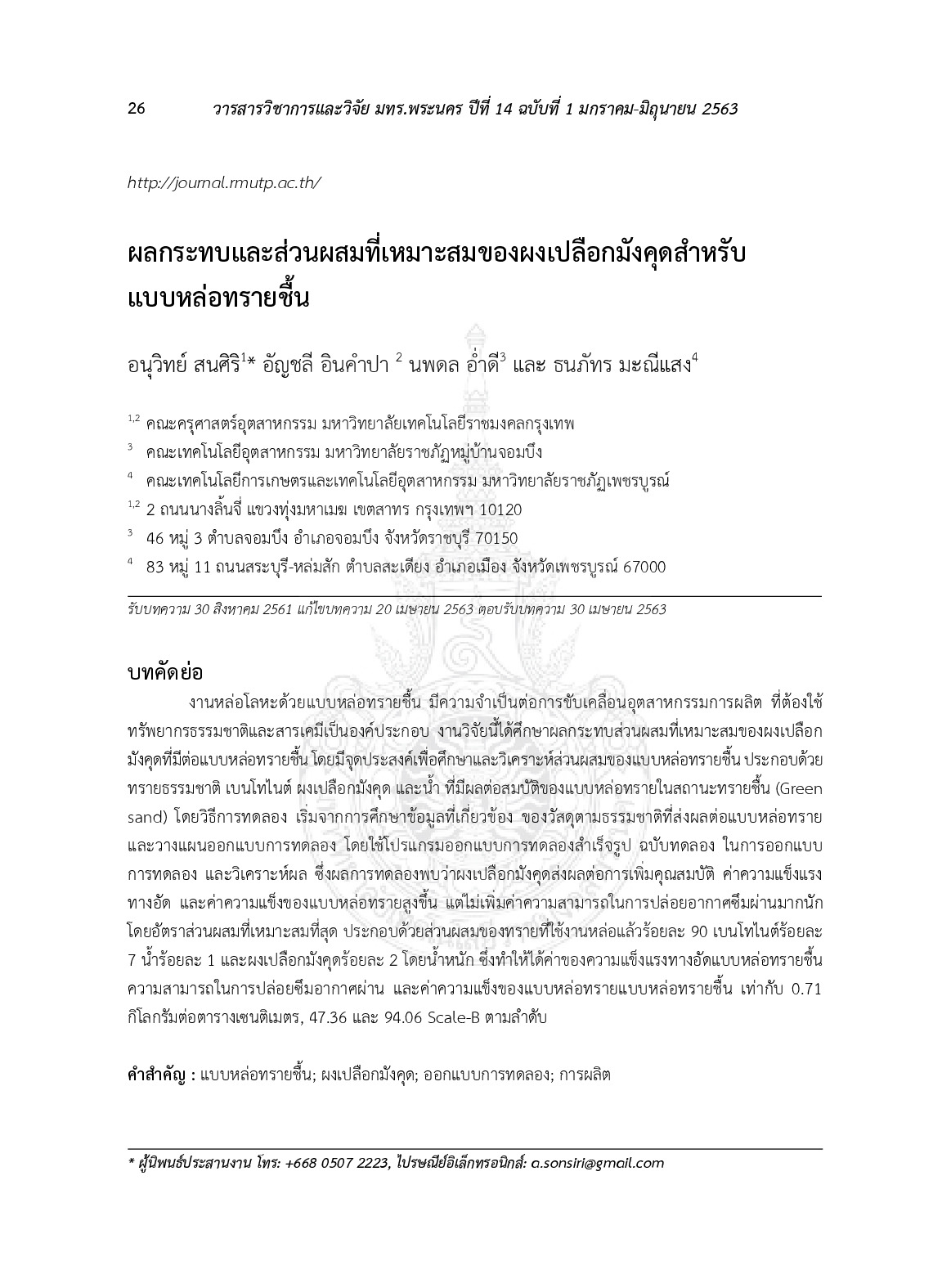
ผลกระทบและส่วนผสมที่เหมาะสมของผงเปลือกมังคุดสำหรับแบบหล่อทรายชื้น
Metal casting with Green sand mold is essential for participation in the manufacturing industry that requires natural resources and chemicals as an element. This research studied the effects of the right mix of mangosteen shell powder on green sand mold. The objective is to study and analyze the mixture of moist sand formations consisting of natural sand bentonite mangosteen shell powder and water affecting the properties of green sand mold by experiment method. Starting from studying relevant information of natural materials that affect sand mold and planning experimental design by using the experimental design program for the trial version in the experimental design and analyze results. The results showed that mangosteen peel powder had an effect on the properties Compression strength and higher hardness of sand mold but does not increase the ability to release a lot of air permeability The optimum blend ratio was composed of 90% reused sand 7% bentonite 1% water and 2% mangosteen powder by weight air permeability. The hardness of the sand casting was 0.71 kg/cm2 47.36 and 94.06 Scale B respectively.
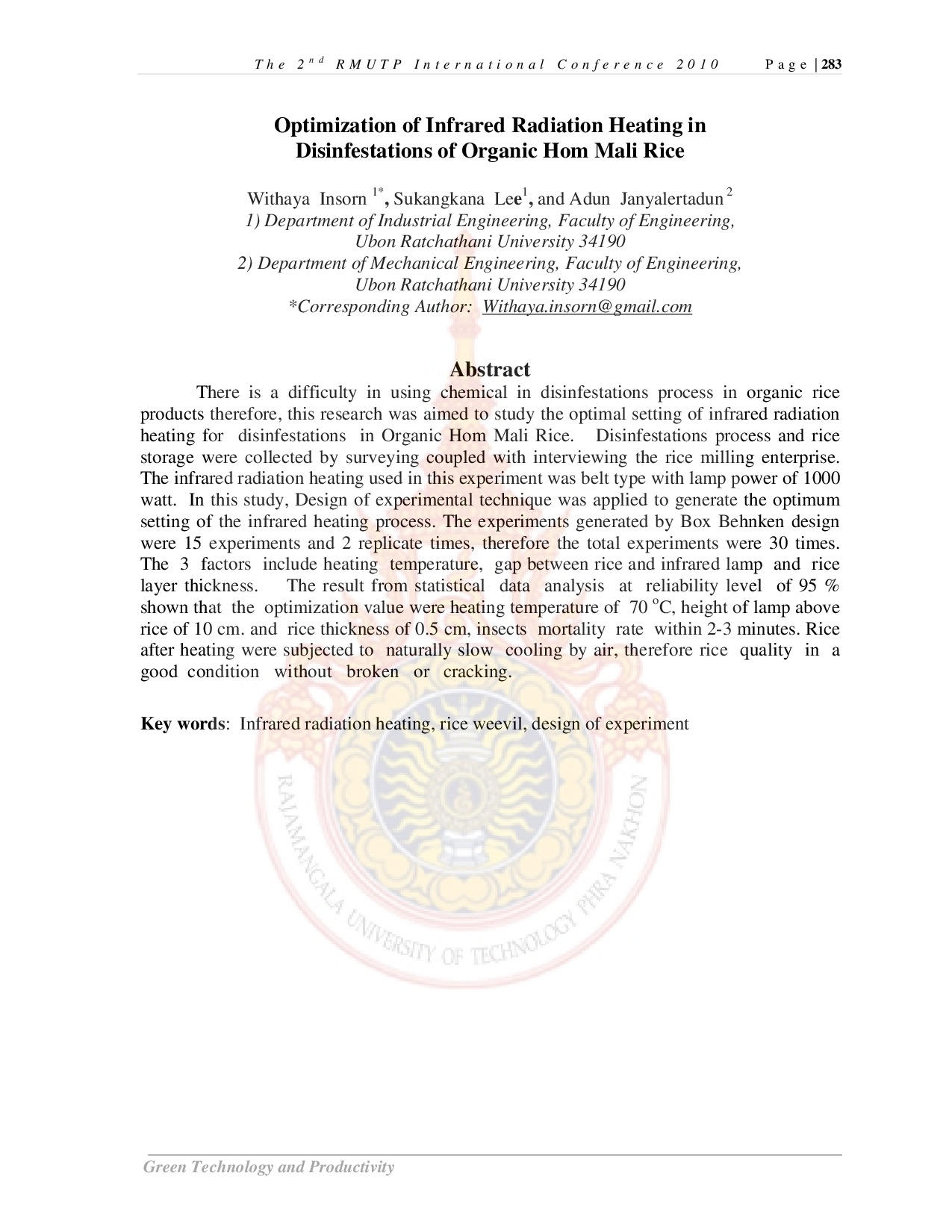
Optimization of Infrared Radiation Heating in Disinfestations of Organic Hom Mali Rice
There is a difficulty in using chemical in disinfestations process in organic rice products therefore this research was aimed to study the optimal setting of infrared radiation heating for disinfestations in Organic Hom Mali Rice. Disinfestations process and rice storage were collected by surveying coupled with interviewing the rice milling enterprise. The infrared radiation heating used in this experiment was belt type with lamp power of 1000 watt. In this study Design of experimental technique was applied to generate the optimum setting of the infrared heating process. The experiments generated by Box Behnken design were 15 experiments and 2 replicate times therefore the total experiments were 30 times. The 3 factors include heating temperature gap between rice and infrared lamp and rice layer thickness. The result from statistical data analysis at reliability level of 95 % shown that the optimization value were heating temperature of 70 oC height of lamp above rice of 10 cm. and rice thickness of 0.5 cm insects mortality rate within 2-3 minutes. Rice after heating were subjected to naturally slow cooling by air therefore rice quality in a good condition without broken or cracking.