จำนวน Repository ( 22 )

ตัวแบบเบย์สำหรับข้อมูลอนุกรมเวลาเชิงพื้นที่ ประยุกต์ใช้กับผลผลิตยางพารา ในจังหวัดภาคใต้ของประเทศไทย
The objectives of this research are to propose a Bayesian model for spatial time series analysis to apply the proposed model to forecast a monthly rubber yield in Southern provinces of Thailand and to compare the performance of the proposed model with the classical Holt-Winters Additive Exponential smoothing. The proposed model is a linear mixed model (LMM) with spatial effects which follow a conditional autoregressive model (CAR). Dummy variables are used for seasonal effects. A Bayesian method is used for parameter estimation. The estimated monthly yields are used for the monthly rubber yield forecasting. The dependent variables are the rubber yield in each month of each province. The data are secondary data at a provincial level. The factors considered are spatial effects heterogeneity effects and seasonal effects. The results show that the factors influencing on the amount of rubber yields are spatial heterogeneity and seasonal effects. The proposed model is proper and forecast accurately. Using the mean absolute error (MAE) the proposed model has a better performance compared to the classical Holt-Winters Additive Exponential smoothing in both model fitting and model validating. The proposed model should be the first consideration for spatial time series forecasting.
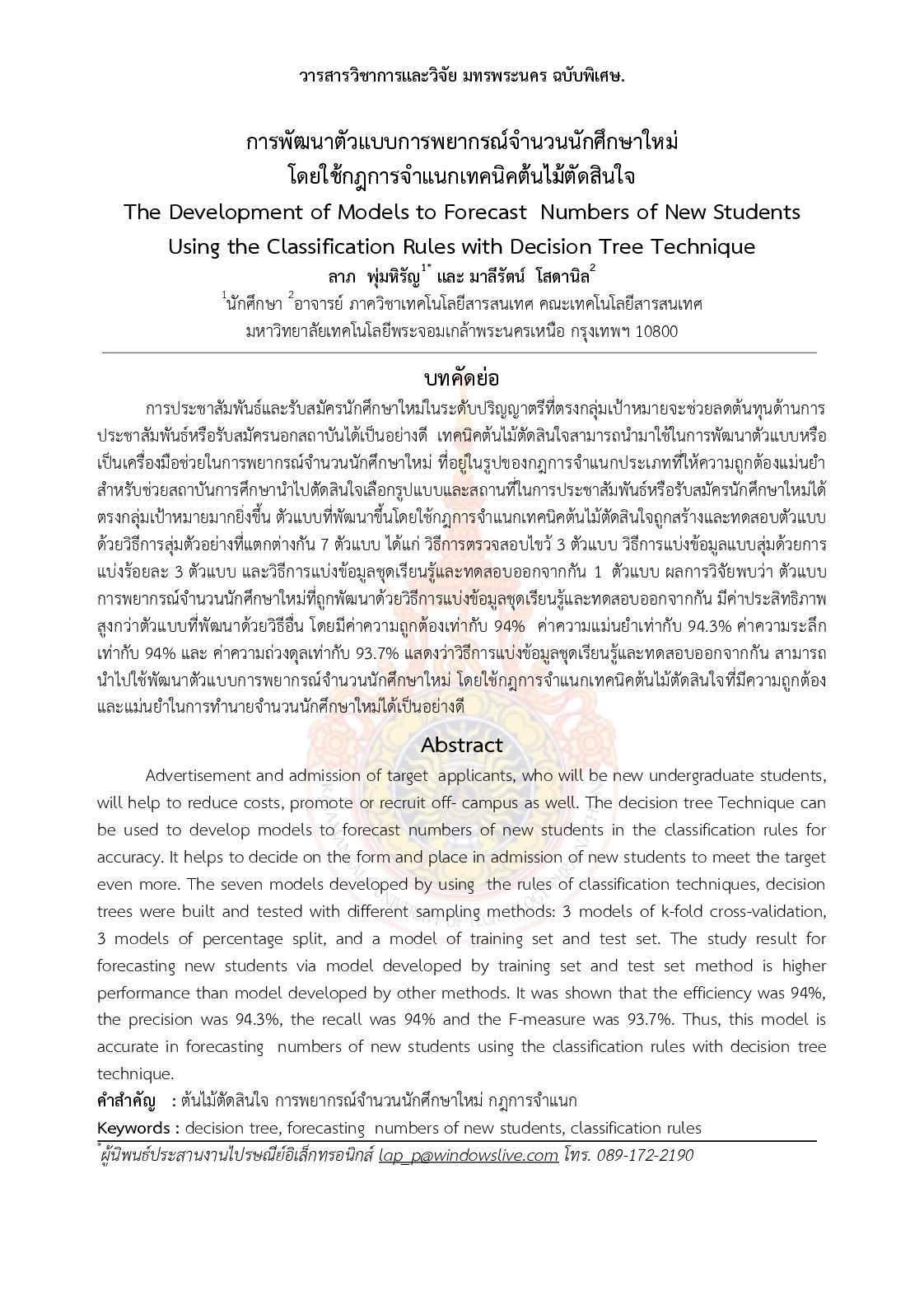
The Development of Models to Forecast Numbers of New StudentsUsing the Classification Rules with Decision Tree Technique
Advertisement and admission of target applicants who will be new undergraduate studentswill help to reduce costs promote or recruit off- campus as well. The decision tree Technique can be used to develop models to forecast numbers of new students in the classification rules for accuracy. It helps to decide on the form and place in admission of new students to meet the target even more. The seven models developed by using the rules of classification techniques decision trees were built and tested with different sampling methods: 3 models of k-fold cross-validation 3 models of percentage split and a model of training set and test set. The study result for forecasting new students via model developed by training set and test set method is higher performance than model developed by other methods. It was shown that the efficiency was 94% the precision was 94.3% the recall was 94% and the F-measure was 93.7%. Thus this model is accurate in forecasting numbers of new students using the classification rules with decision tree technique.