จำนวน Repository ( 77 )
การปรับปรุงสมบัติทางกลของพอลิแลกติกแอซิดด้วยเส้นใยปาล์มน้ำมัน
This research work was to study the improvement of toughness of polylactic acid (PLA) and the cost reduction of raw material with addition of untreated and treated oil palm fiber (OPF). The detail of this work was divided into two parts. The first was to find the suitable condition for surface treatment of OPF with sodium hydroxide (NaOH). The second part was to study the effect of untreated and treated OPF contents on the mechanical properties of PLA. For surface treatment of OPF NaOH concentrations and immersion times were varied from 0 to 15 wt% and 0 to 30 min respectively. Aspect ratio (L/D) and surface of untreated and treated OPF were investigated by using optical microscope and scanning electron microscope (SEM) respectively. The result suggested that the most suitable condition for surface treatment of OPF was NaOH concentration of 10 wt% at immersion time of 20 min. Treated OPF was occurred microporous and had more rough as compare to untreated fiber. For the effect of untreated and treated OPF contents on the mechanical properties of PLA it was evaluated by tensile and impact testing. SEM was used for investigation of interfacial adhesion and fiber dispersion. The results showed that tensile modulus and impact strength tend to increase with adding 2.5 wt% OPF content and slightly changed at higher OPF content whereas ultimate tensile strength and elongation at break decreased with increasing fiber content. Surface treatment with NaOH led to enhancement of mechanical properties of composite due to improve interfacial adhesion and fiber dispersion.
การใช้น้ำเฉาก๊วยทดแทนน้ำในขนมขี้หนู
The objectives of this special project were to investigate three basic formulas of Using black cincau water in Kanom Kee Noo and to study the content of black cincau water as partial substitute for water in Kanom Kee Noo with different four proportions of black cincau water at 0% 20% 40% and 80%. Randomized Complete Block Design (RCBD) was used as the research design. Sensory evaluation was conducted to assess appearance (rise crumbling) color flavor taste texture (softness) and overallikng preference with 9-Point Hedonic Scale. 80 tasters were instructors and students in Foods and Nutrition Faculty of Home Economics Technology Rajamangala University of Technology Phra Nakhon. Data collected were analyzed to determine mean (x̅) and Analysis of Variance (ANOVA). The statistical comparison was conducted by using Least Significant Difference (LSD) and Duncans New Multiple Range Test (DMRT). Data were analyzed through statistical software packages. The results of studying three basic formulas of Kanom Kee Noo indicated that tasters preferred the first formula over the second and the third formulas in terms of appearance (rise and crumbling) color taste and overall preference at a moderate level of preference with mean scores of 7.85 8.17 7.85 7.75 and 7.87 respectively. For the second formula over the first and the third formulas in terms of flavor at a moderate level of preference with mean scores of 7.45 respectively. The tasters had a moderate level of preference. When ANOVA and statistical comparison were considered there were the differences in appearance (rise crumbling) color flavor taste texture (softness) and overallikng preference with a statistical significance level of 0.05 The results of studying the content of black cincau water as partial substitute for water in Kanom Kee Noo with different four proportions of black cincau water showed that tasters preferred the 40% black cincau water formula over 0% 20% and 80% formulas in terms of color flavor taste texture (softness) and overallikng preference with mean scores of 7.60 7.51 7.69 7.58 and 7.63 respectively. The tasters had a moderate level of preference. The tasters preferred 20% black cincau water formula in terms of appearance (rise crumbling) over 0% 40% and 80% formulas with mean score of 7.67. The tasters had a moderate level of preference. When ANOVA and statistical comparison were considered there were statistically insignificant differences in appearance (rise crumbling) flavor taste texture (softness) and overallikng preference with a level of 0.05. There were the differences in color with a statistical significance level of 0.05.
คุณค่าทางโภชนาการ คุณภาพทางกายภาย และประสาทสัมผัสของเค้กเนยสดที่มีการทดแทนแป้งข้าวสาลีด้วยเปลือกทุเรียนผง
Durian has been very popular not only local people but also tourists. As a result there are many durian peels wasted so this research is explored the utilization of durian peels. Durian rind is a biological waste but contains high amount of crude fiber. This research aims to study using durian rind powder to replace wheat flour in butter cakes at 5 10 and 15 % (w/w) (DRB-5 DRB-10 and DRB-15). Physical properties chemical composition and sensory evaluation of the butter cakes were analyzed. The results showed that durian rind powder contained 51.43 % of crude fiber. Increasing of durian rind powder in butter cakes showed significant decreasing of lightness (L*) blue–yellow component (b*) springiness and cohesiveness values while green–red component (a*) hardness and gumminess values were significantly higher than the control sample (BC) (p≤0.05). Dietary fiber content of the products shown significantly increased by 13.98% for DRB-5 48.92 % for DRB-10 and 54.84% for DRB-15 as compared with BC (p≤0.05). The acceptance scores of DRB-5 including appearance odor taste texture and overall liking scores were highest. There are 300.28 kcal for 1 serving of butter cake which contain 1.70 gram of dietary fiber. However durian rind powder can be used as a food ingredient and source of dietary fiber in other food recipes for further studies.
การพยากรณ์ราคาพริกไทยดำ
The objective of this study was to construct the black pepper prices forecasting model by 4 statistical methods: Box-Jenkins method Holt’s exponential smoothing method Brown’s exponential smoothing method and damped trend exponential smoothing method. Time series of monthly black pepper prices which were gathered from the website of the Office of Agricultural Economics during January 2005 to December 2018 of 168 observations were divided into 2 datasets. The first dataset had 156 observations from January 2005 to December 2017 for constructing the forecasting models. The second dataset had 12 observations from January to December 2018 for comparing the accuracy of the forecasts via the criteria of the lowest mean absolute percentage error (MAPE) and root mean squared error (RMSE). Research findings indicated that for all forecasting methods that had been studied the most accurate method was damped trend exponential smoothing method (MAPE = 6.5773 RMSE = 10.3775)
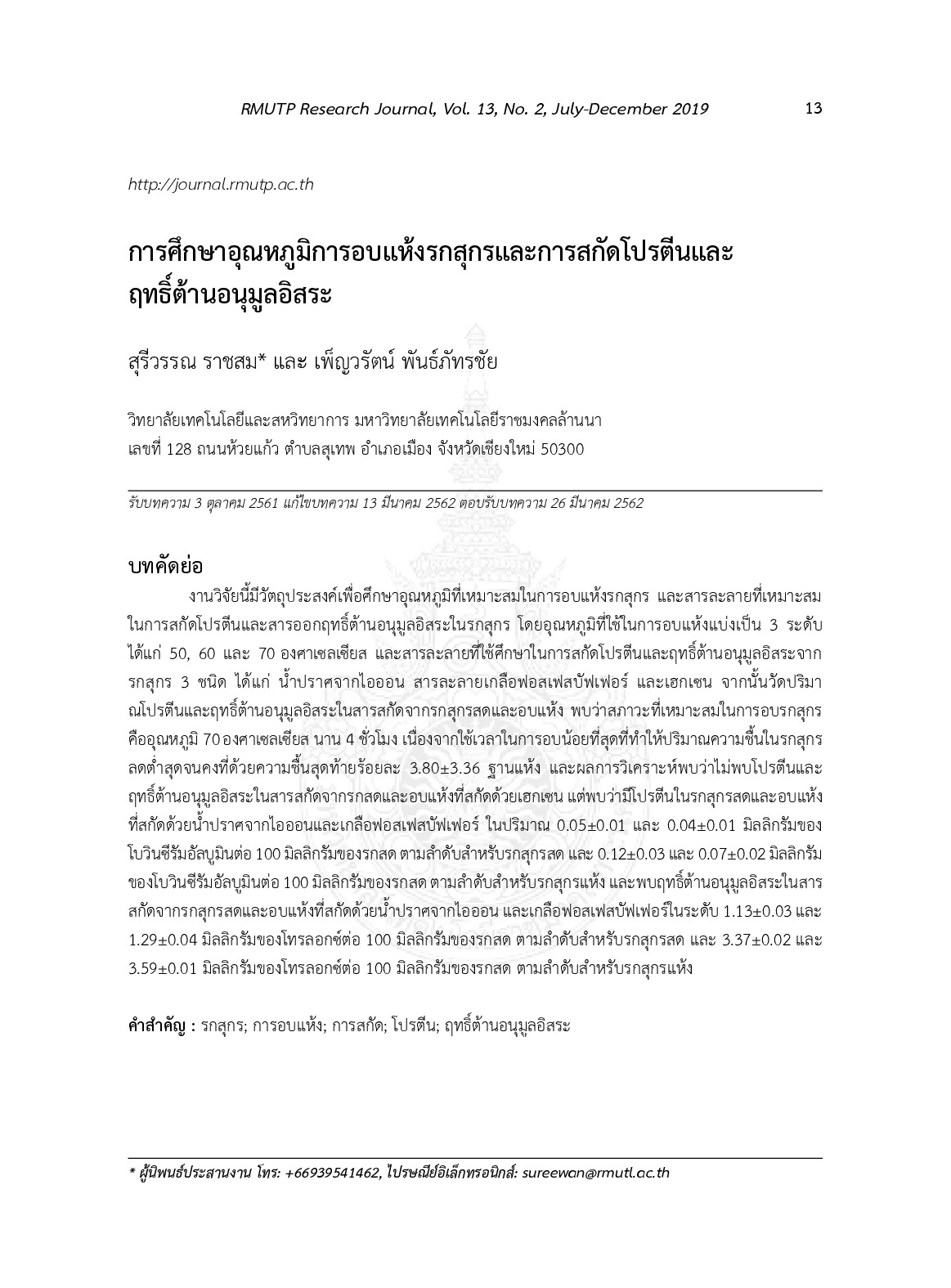
การศึกษาอุณหภูมิการอบแห้งรกสุกรและการสกัดโปรตีนและฤทธิ์ต้านอนุมูลอิสระ
This research aims to study the appropriate drying condition and extraction solvent for extracting protein and antioxidants from the porcine placenta. Three levels of drying temperature were used in this study which were 50 60 and 70ºC the result shows that the best drying condition for porcine placenta was 70ºC for 4 hours because this condition provided the least drying time and the lowest moisture content of porcine placenta (3.80±3.36% dry basis). After that the fresh and dried porcine placenta were extracted by using three solvents which were deionized water (DI) phosphate buffered saline (PBS) and hexane. The efficiency of extraction was investigated by measuring the crude protein and antioxidant of the porcine placenta. It was found that there was no protein and antioxidant in fresh and dried porcine placenta extracted by hexane. However the protein was found as 0.05±0.01 and 0.04±0.01 mg of bovine serum albumin/100 mg fresh for fresh porcine placenta and 0.12±0.030 and 0.07±0.016 mg of bovine serum albumin/100 mg fresh for dried porcine placenta extracted by DI and PBS respectively. In additional the antioxidant was found as 1.13±0.03 and 1.29±0.04 mg of trolox/100 mg fresh for fresh porcine placenta and 3.37±0.02 and 3.59±0.01 mg of trolox/100 mg fresh for dried porcine placenta extracted using DI and PBS respectively.