จำนวน Repository ( 1174 )
กำลังอัดความสามารถเก็บกักคลอไรด์และสัมประสิทธ์การแพร่คลอไรด์ของคอนกรีตผสมเถ้าก้นเตาบดละเอียดและผงหินปูน
This research was aimed to study the compressive strength chloride binding capacity and chloride diffusion coefficient of concrete replaced by ground bottom ash (GBA) and limestone powder in ordinary Portland cement (OPC). The water to binder ratios were 0.55. The results showed that the compressive strength of concrete with GBA was lesser than that of OPC concrete at 28 days. Also the compressive strength of concrete with limestone powder was close to that of OPC concrete and compressive strength could develop of concrete with GBA 20% and 30% higher than that of OPC concrete at 56 days. Moreover the total chloride of the concrete containing GBA and limestone powder was less than that of OPC concrete. The chloride penetration of the concrete containing GBA and limestone powder was less than that of OPC concrete. The chloride binding capacity of the concrete made with ground bottom ash and limestone powder were higher than that of OPC concrete. Finally the chloride diffusion coefficient of the concrete containing GBA and limestone powder was less than that of OPC concrete.
อิทธิพลของสภาวะการผลิตและการเก็บรักษาต่อสมบัติทางเคมีกายภาพของพริกป่นและพริกป่นคั่ว
Development of chili powder products through consumer survey to be used as the information for the development of high quality chili powder. The quality and physicochemical properties of chili powder during storage were investigated. The sound and red pods of fresh chili were washed and blanched at 100ºC for 3 min. Blanched chili pods were soaked in 0.25% sodium metabisulfite with 1.0% citric acid for 30 min prior to drying in a tray dryer at 65°C for 14 h to obtain dried chili with a final moisture content of approximately 8%. Dried chili pods without stem were ground to obtain chili powder. Roasting before grinding resulted in the reduction of moisture aw and color values. The results of study on the quality changes of chili powder during storage showed that storage temperature was the important factor affecting the changes in physicochemical properties and percentage of consumer acceptance. Meanwhile aluminum foil packaging slowed the increase of aflatoxin content in chili powder better than polypropylene. However aerobic bacterial count of the developed chili powder product is very low compared to the microbiological specifications while yeast and mold were not detected. The product contains a standard level of aflatoxin content after 12 weeks in all storage conditions which corresponds to the awareness of consumers in terms of quality cleanliness and safety are important factors in deciding to buy chili products.
การประเมินประสิทธิภาพเครื่องอัดลูกอมขิง
This research objective was to design the ginger candy compression machine and determine the efficiency and capacity for saving time and labor in pressing ginger candy for community enterprise groups Pim Malaherb Chiang Rai Province. Ginger candy compression machine consists of the main structure namely the extruder and power transmission systems. The machine was designed with two horsepower motors or 1.5 kilowatts to drive the shaft and to rotate the screw through the flange. This study installs the inverter to control the motor speed at 1000±10 1200±10 and 1400±10 rpm. The extrusion die had an average diameter of 9.7 millimeters. The results found that the motors speed that was suitable for compression was a Rotational speed of 1400±10 rpm. When the speed increased the efficiency and the working rate increased too. The amount of ginger stirred was used at 300 500 600 900 1000 1500 2000 and 3000 grams. The maximum efficiency was 90.85 percent. The efficiency increased with the amount of ginger stirred. The ginger candy compression machines engineering economic analysis results found that the machines operating cost was 18063.6 baht per year. When considering the machines operation at 792 hours per year the payback period was 6 months and 11 days.
การเปรียบเทียบภาระขาดของรอยเชื่อมผ้าทอทางสถาปัตยกรรมจากการเชื่อมลมร้อนและเหนี่ยวนำ
Architectural fabrics were continuously developed on their unique performance. Architects and Engineers designed them for the application of important buildings around the world despite the symptom that Architectural fabric sizes from manufactures are smaller than the application sizes. Recently although the well-known method used to weld Architectural fabrics to enlarge their size is the high frequency welding there were some application issues. To mitigate those issues the researcher created the hot air welding to replace the high frequency welding in consideration on the failing loads of welded seams which are variable factors of the failing loads to indicate the weld strength and it is crucial for the Architectural fabric application. This research presents the comparison of failing load of weld seams between the hot air welding and high frequency welding by the test of Taguchis Orthogonal arrays L25 method. The test results demonstrated that Architectural fabrics welded by the hot air welding has the highest failing loads of wrap equal to 95.38 kN/m and the highest failing loads of weft at 86.17 kN/m. Conversely Architectural fabrics welded by the high frequency welding has the highest failing loads of wrap equal to 101.37 kN/m and the highest failing loads of weft at 97.78 kN/m. Based on a forementioned results there is no significant difference from both welding methods and thus concluded that the hot air welding could be used to replace the high frequency welding method.
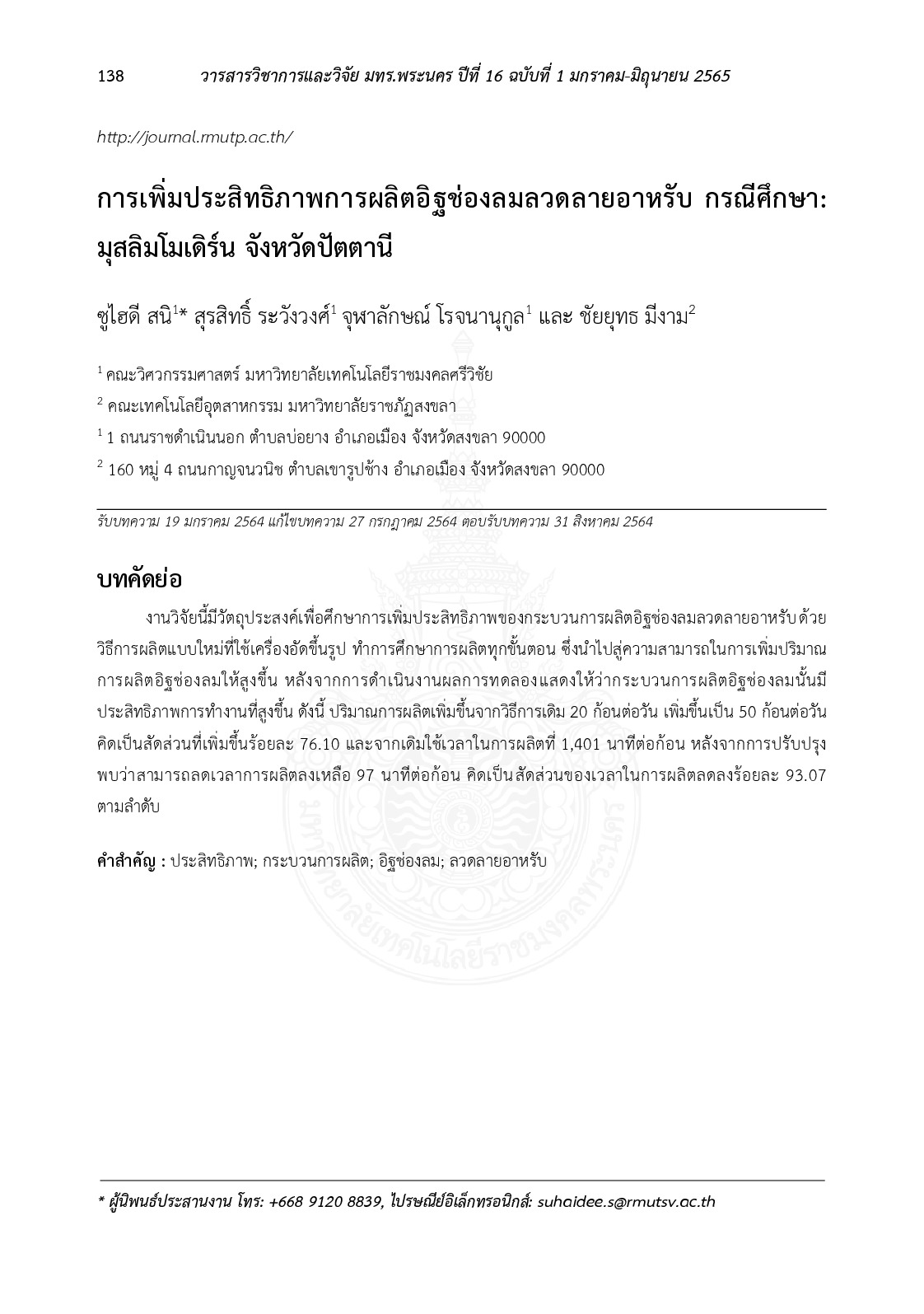
การเพิ่มประสิทธิภาพการผลิตอิฐช่องลมลวดลายอาหรับ การณีศึกษา : มุสลิมโมเดิร์น์ จังหวัดปัตตานี
The objective of this study is to improve the efficiency in manufacturing process of Arabian-style ventilation bricks with a new production method that uses a machine. The study focuses on all steps of productions in order to increase productivity. After the experiment the study shows that the improvement of ventilation brick manufacturing includes the increase in production volume from 20 pieces per day to 50 pieces per day representing an increase of 76.19 percent; and the decrease in production cycle time originally from 1401 minutes per piece to 97 minutes per piece representing a decrease of 93.07 percent respectively.