จำนวน Repository ( 1852 )
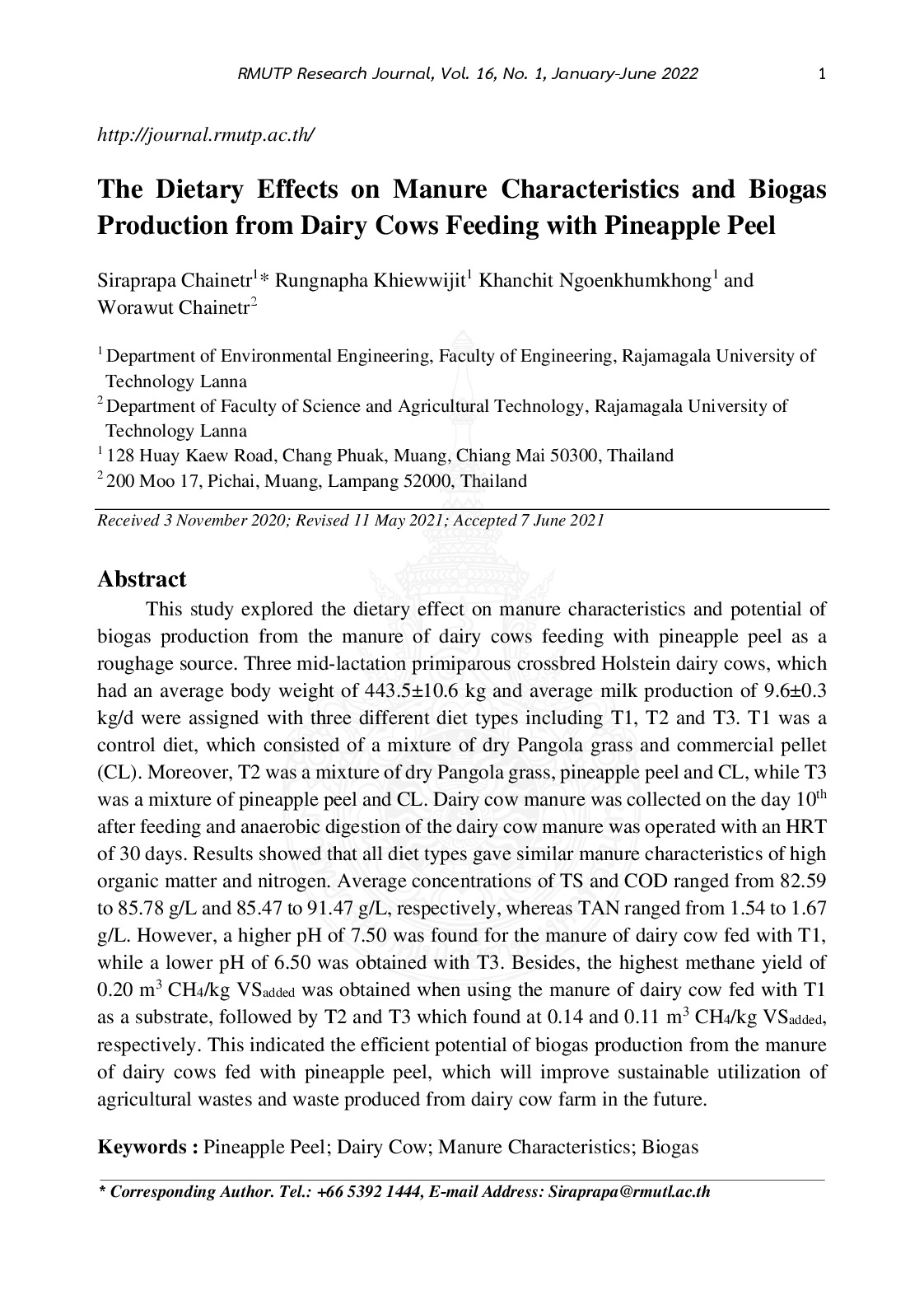
The Dietary effects on manure characteristics and biogas production from dairy cows feeding with pineapple peel
This study explored the dietary effect on manure characteristics and potential of biogas production from the manure of dairy cows feeding with pineapple peel as a roughage source. Three mid-lactation primiparous crossbred Holstein dairy cows which had an average body weight of 443.5±10.6 kg and average milk production of 9.6±0.3 kg/d were assigned with three different diet types including T1 T2 and T3. T1 was a control diet which consisted of a mixture of dry Pangola grass and commercial pellet (CL). Moreover T2 was a mixture of dry Pangola grass pineapple peel and CL while T3 was a mixture of pineapple peel and CL. Dairy cow manure was collected on the day 10th after feeding and anaerobic digestion of the dairy cow manure was operated with an HRT of 30 days. Results showed that all diet types gave similar manure characteristics of high organic matter and nitrogen. Average concentrations of TS and COD ranged from 82.59 to 85.78 g/L and 85.47 to 91.47 g/L respectively whereas TAN ranged from 1.54 to 1.67 g/L. However a higher pH of 7.50 was found for the manure of dairy cow fed with T1 while a lower pH of 6.50 was obtained with T3. Besides the highest methane yield of 0.20 m3 CH4/kg VSadded was obtained when using the manure of dairy cow fed with T1 as a substrate followed by T2 and T3 which found at 0.14 and 0.11 m3 CH4/kg VSadded respectively. This indicated the efficient potential of biogas production from the manure of dairy cows fed with pineapple peel which will improve sustainable utilization of agricultural wastes and waste produced from dairy cow farm in the future.
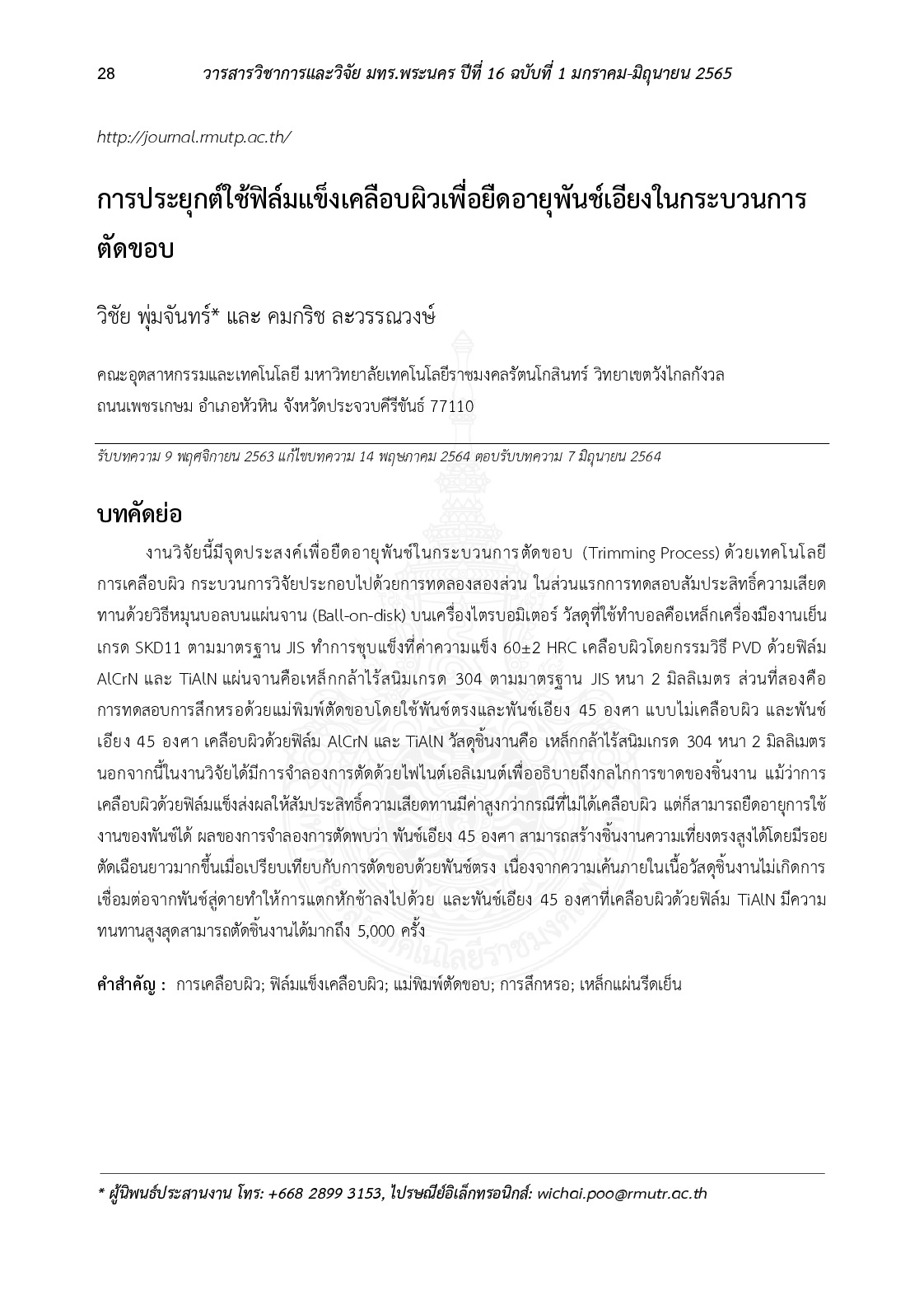
การประยุกต์ใช้ฟิล์มแข็งเคลือบผิวเพื่อยืดอายุพันช์เอียงในกระบวนการตัดขอบ
The objective of this research is to increase the tool life of trimming process by surface coating technology. The procedure of this research consists of two sections. In the first section the friction coefficient was investigated with the ball on disk technique by using a tribometer. Steel ball was produced from cold work tool steel grade SKD11 (JIS) hardened to 60±2 HRC. Two types of surface coating namely AlCrN and TiAlN were conducted by PVD technique. Disk material used in this experiment was made by stainless steel JIS; SUS 304 of 2 mm thickness. For the second section the wear tests of trimming die were performed by using flat punch and inclined punch 45 degrees without surface coating as well as the inclined punch 45 degrees coated with AlCrN and TiAlN (PVD). Workpiece material used for the wear test was stainless steel JIS; SUS 304 of 2 mm thickness. Additionally the finite element analysis was carried out for explanation the deformation of the workpiece during trimming operation. Although the friction coefficient of the surface coating was higher than non-coating it could be extended the tool life ostensibly. As the result of FEM the inclined punch 45 degrees could be generated the long sheared surface more than the flat punch. This is due to the internal stress of workpiece that did not connect from the punch to the die so the crack propagation would be delayed. The inclined punch 45 degrees coated TiAlN has a highly durable which can be used up to 5000 strokes.
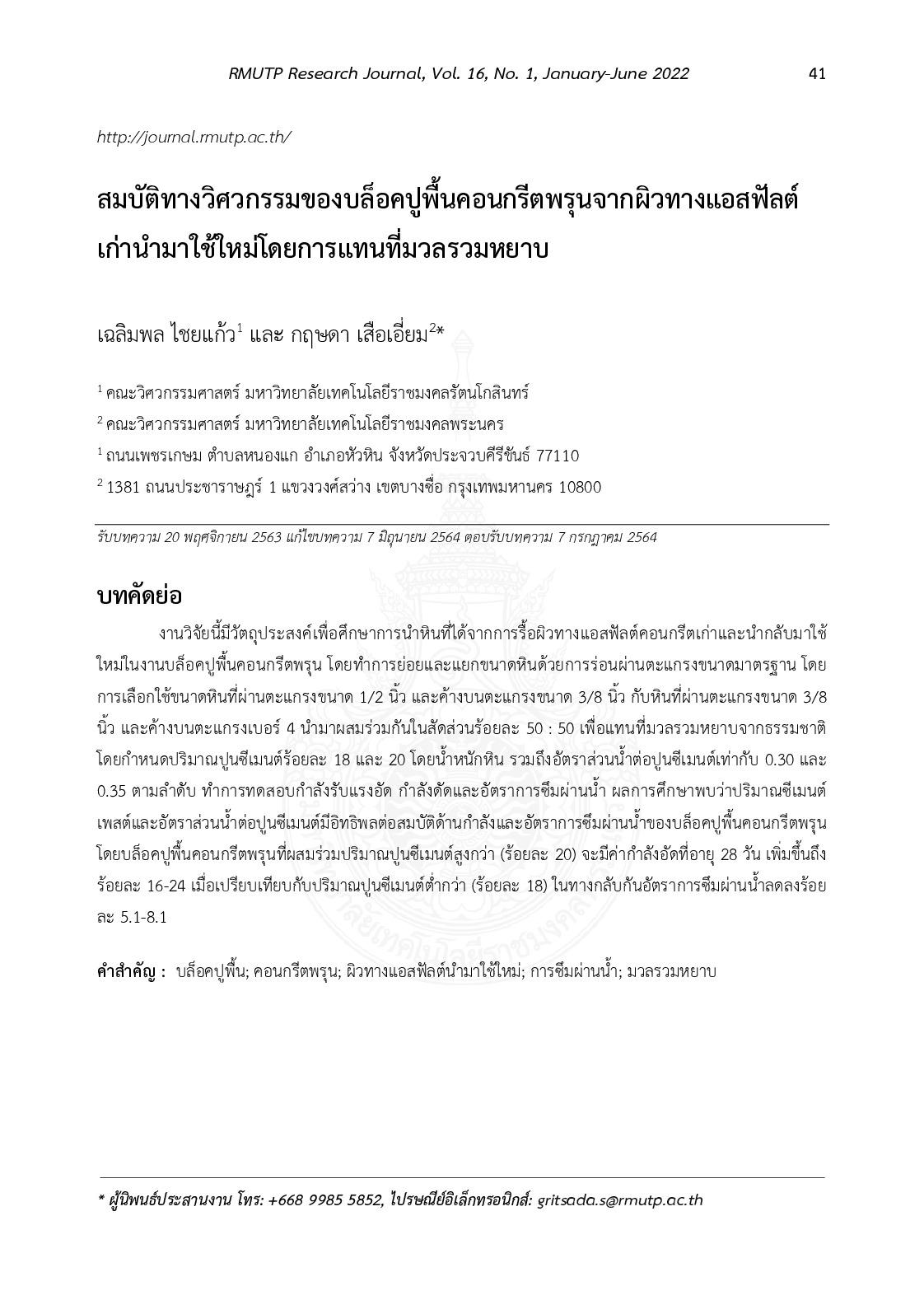
สมบัติทางวิศวกรรมของบล็อคปูพื้นคอนกรีตพรุนจากผิวทางแอสฟัลต์เก่านำมาใช้ใหม่โดยการแทนที่มวลรวมหยาบ
This research aimed to study the use of coarse aggregate obtained from removing old recycled asphalt pavement (RAP) in the production of the porous concrete paving block. Crushing and size separation of the coarse aggregate by using standard sieve size by selected the gradation size of the coarse aggregate that passed to sieve size 1/2” and retained on sieve size 3/8” and other that passed to sieve size 3/8” and retained on sieve size No.4 by mixing ratio 50 : 50 of the mass as replaced natural coarse aggregate. Portland cement quantity about 18% and 20% by weight of the aggregate. The water to cement ratio was 0.30 and 0.35 respectively. Compressive strength flexural strength and water permeability were investigated. The results showed that the cement content and water to cement ratio was influenced the strength properties and water permeability rate of the porous concrete paving block. The porous concrete paving block mixed with higher cement content (20%) had the compressive strength at the age of 28 days increased by 16-24% when compared with lower cement content (18%). On the other hand the water permeability rate decreased by 5.1-8.1%.
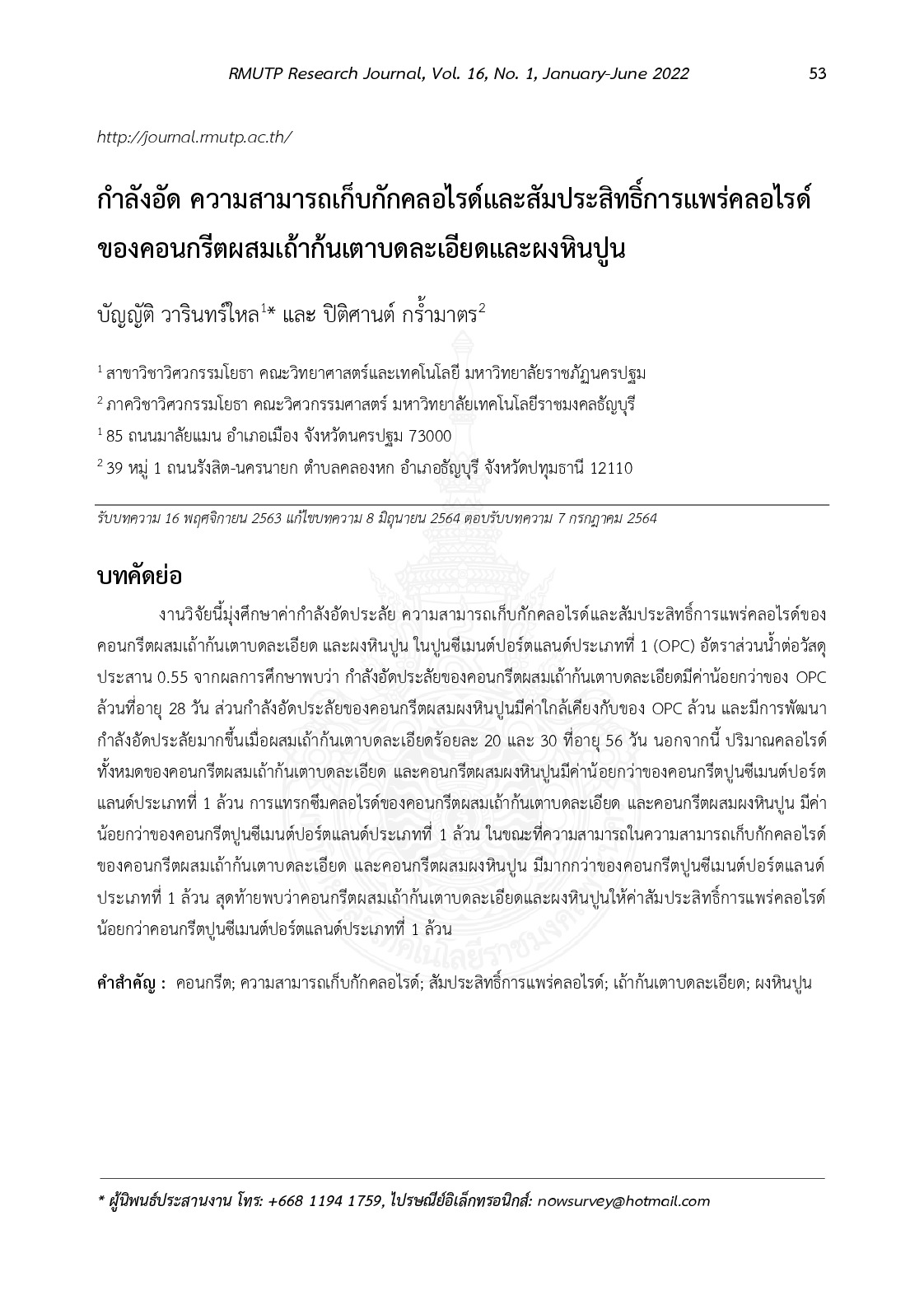
กำลังอัดความสามารถเก็บกักคลอไรด์และสัมประสิทธ์การแพร่คลอไรด์ของคอนกรีตผสมเถ้าก้นเตาบดละเอียดและผงหินปูน
This research was aimed to study the compressive strength chloride binding capacity and chloride diffusion coefficient of concrete replaced by ground bottom ash (GBA) and limestone powder in ordinary Portland cement (OPC). The water to binder ratios were 0.55. The results showed that the compressive strength of concrete with GBA was lesser than that of OPC concrete at 28 days. Also the compressive strength of concrete with limestone powder was close to that of OPC concrete and compressive strength could develop of concrete with GBA 20% and 30% higher than that of OPC concrete at 56 days. Moreover the total chloride of the concrete containing GBA and limestone powder was less than that of OPC concrete. The chloride penetration of the concrete containing GBA and limestone powder was less than that of OPC concrete. The chloride binding capacity of the concrete made with ground bottom ash and limestone powder were higher than that of OPC concrete. Finally the chloride diffusion coefficient of the concrete containing GBA and limestone powder was less than that of OPC concrete.
อิทธิพลของสภาวะการผลิตและการเก็บรักษาต่อสมบัติทางเคมีกายภาพของพริกป่นและพริกป่นคั่ว
Development of chili powder products through consumer survey to be used as the information for the development of high quality chili powder. The quality and physicochemical properties of chili powder during storage were investigated. The sound and red pods of fresh chili were washed and blanched at 100ºC for 3 min. Blanched chili pods were soaked in 0.25% sodium metabisulfite with 1.0% citric acid for 30 min prior to drying in a tray dryer at 65°C for 14 h to obtain dried chili with a final moisture content of approximately 8%. Dried chili pods without stem were ground to obtain chili powder. Roasting before grinding resulted in the reduction of moisture aw and color values. The results of study on the quality changes of chili powder during storage showed that storage temperature was the important factor affecting the changes in physicochemical properties and percentage of consumer acceptance. Meanwhile aluminum foil packaging slowed the increase of aflatoxin content in chili powder better than polypropylene. However aerobic bacterial count of the developed chili powder product is very low compared to the microbiological specifications while yeast and mold were not detected. The product contains a standard level of aflatoxin content after 12 weeks in all storage conditions which corresponds to the awareness of consumers in terms of quality cleanliness and safety are important factors in deciding to buy chili products.