จำนวน Repository ( 29 )
การศึกษาการออกแบบด้วยกรรมวิธีการฉีดยางและประยุกต์ใช้ยางธรรมชาติในการผลิตขึ้นรูปยางหุ้มปลั๊กไฟด้วยแม่พิมพ์
The plastic outlet problem is a rigid inflexible material. When assembling with a metal outlet set then it is usually not completely homogeneous. When used The outlet burns out quite often. And the plastic itself is less heat resistant. This allows the plastic to melt burn easily and conform to the upgrade of technology capabilities in precision mold manufacturing. And high complexity The researcher has foreseen the factors in making Developing the design and manufacturing of rubber plug molds economic opportunities for Natural Rubber Applications Therefore came up with the idea to develop the design and material selection. And the factors that affect the production is the mold and the process of forming. To help entrepreneurs to exchange knowledge and study the knowledge from this research to continue in the application of natural rubber to increase future value. From the results and experiments it was found that the study of the method of creating a prototype compression molding kit by using rubber forming techniques can be applied and used by various components of forming rubber can be used to develop forming Rubber plug sockets are possible and this process can produce prototypes from natural rubber.
การพัฒนาฟิล์มย่อยสลายได้จากแป้งมันแกวเพื่อประยุกต์ใช้เป็นถุงเพาะชำ
This research aimed to study the production of a biodegradable film from Jicama starch (Pachyrhizus erosus (L.) Urbar) for plant bag application. The film was prepared by dissolving Jicama starch in water to the concentration of 5 wt%. To study the effect of the glycerol content the glycerol was added at 6 levels; 0 10 20 30 40 50 and 60 wt%. The film was casted in a molded and dried at 60 oC for 24 h. After drying properties of films; thickness water activity (aw) solubility tensile strength (TS) elongation (%E) puncture strength and the degradation of the films were evaluated. The thickness of the films was in the range of 0.16-0.28 mm. The aw of films ranged from 0.36-0.49. The water vapor permeability water solubility and flexibility of the film increased with the increasing of glycerol content. Tensile and puncture strength of the starch films tended to increased when the glycerol content decrease. After the films were buried under the ground (8-10 cm depth) for 12 weeks they were degraded by 100%. The Jicama starch film with 40 wt% glycerol showed the best overall properties.
การปรับปรุงความเหนียวของพอลิแลกติกแอซิดด้วยวัสดุธรรมชาติที่ผ่านการดัดแปร
This research work was to study the toughening modification of polylactic acid by the mixing with epoxidized natural rubber (ENR) and the increase of effectiveness of mechanical properties with a compatibilizer. Enhancement of properties in polylactic acid was evaluated by tensile and impact testings Fourier-transform Infrared Spectroscopy (FTIR) technique Differential Scanning Calorimetry (DSC) technique and Scanning Electron Microscope (SEM). For the addition of ENR it was revealed that the increase of ENR contents improved elongation at break and impact strength but decreased tensile modulus and ultimate tensile strength. Glass transition temperature (Tg) percentage crystallinity and the melting point of polylactic acid tended to decrease with the addition of ENR. Chemical change was found that position of C=O peak in polymer blend was slightly shifted as compared to the spectrum of neat polylactic acid. The optimum formulation for toughening modification was ENR content of 30 wt%. Its impact strength was 1982.55 % of neat polylactic acid. For increasing effectiveness of mechanical properties with a compatibilizer it revealed that the addition of Joncryl ® ADR-4300 as compatibilizer improved both tensile and impact properties. The optimum loading of a compatibilizer for improving mechanical properties was 0.5 wt% of polylactic acid. The decreases of crystallinity and melting point of polylactic acid with adding Joncryl ® ADR-4300 might be because Joncryl ® ADR-4300 was also chain extender of polylactic acid and it might be obstructing crystallization. The presence of Joncryl ® ADR-4300 unaffected on Tg value and chemical change.
การปรับปรุงสมบัติทางกลของพอลิแลกติกแอซิดด้วยเส้นใยปาล์มน้ำมัน
This research work was to study the improvement of toughness of polylactic acid (PLA) and the cost reduction of raw material with addition of untreated and treated oil palm fiber (OPF). The detail of this work was divided into two parts. The first was to find the suitable condition for surface treatment of OPF with sodium hydroxide (NaOH). The second part was to study the effect of untreated and treated OPF contents on the mechanical properties of PLA. For surface treatment of OPF NaOH concentrations and immersion times were varied from 0 to 15 wt% and 0 to 30 min respectively. Aspect ratio (L/D) and surface of untreated and treated OPF were investigated by using optical microscope and scanning electron microscope (SEM) respectively. The result suggested that the most suitable condition for surface treatment of OPF was NaOH concentration of 10 wt% at immersion time of 20 min. Treated OPF was occurred microporous and had more rough as compare to untreated fiber. For the effect of untreated and treated OPF contents on the mechanical properties of PLA it was evaluated by tensile and impact testing. SEM was used for investigation of interfacial adhesion and fiber dispersion. The results showed that tensile modulus and impact strength tend to increase with adding 2.5 wt% OPF content and slightly changed at higher OPF content whereas ultimate tensile strength and elongation at break decreased with increasing fiber content. Surface treatment with NaOH led to enhancement of mechanical properties of composite due to improve interfacial adhesion and fiber dispersion.
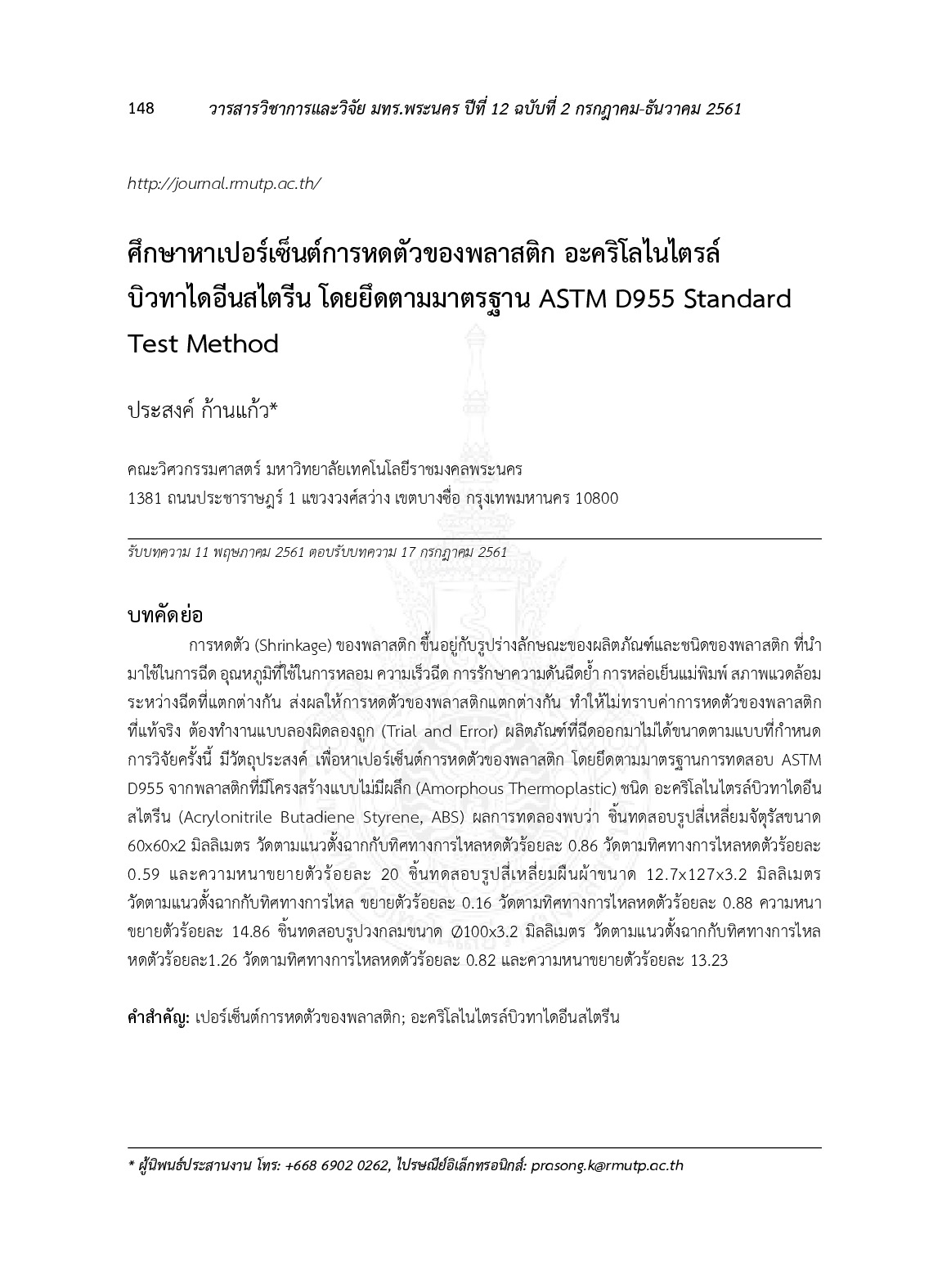
การศึกษาหาเปอร์เซ็นต์การหดตัวของพลาสติก อะคริโลไตรล์บิวทาไออีนสไตรีน โดยยึดตามาตรฐาน ASTM D955 standard test method
The shrinkage of plastic was caused by the shape of the product and the type of plastic used in the injection. The plastic shrinkage difference was resulted from the temperature used in melting the injection speed mold cooling and different injection surroundings. These led to unknown exact value of plastic shrinkage and the trial and error work has been done. As a result of trial and error work the injection products were not in the determined size. This research aims to find the percentage of plastic shrinkage according to standard test ASTM D955 from (Amorphous Thermoplastic) (Acrylonitrile Butadiene Styrene ABS). The findings showed that square specimen size 60x60x2 mm measured from vertical perpendicular to flowing direction the shrinkage was at 0.86% the shrinkage was at 0.59% when measured from flowing direction and the thickness expanded at 20%. For the rectangular specimen size 12.7x127x3.2 mm measured from vertical perpendicular to flowing direction the expanding was at 0.16% the shrinkage was at 0.88% when measured from flowing direction and the thickness expanded at 14.86%. The circular specimen size 100x3.2 mm the shrinkage was at 1.26 when measured from vertical perpendicular to flowing direction the shrinkage measured from flowing direction was at 0.82% and the thickness expanded at 13.23%