จำนวน Repository ( 26 )

Preparation of Thickener from Dry Dioscorea hispida powder for Textile Printing
The objective of this research was to study the feasibility for producing the dry Dioscorea hispida powder as a thickener. The product was investigated in their properties the compatibility with dye and chemicals in print paste color appearance by indicated with color hue value the time durability storage the residual substance after washing treatment and the color fastness in washing and rubbing methods. The results shown the dry Dioscorea hispida powder was used as thickener that it was the good characteristic like the famous textile printing thickener as alginate. The dry Dioscorea hispida powder thickener was 10%w/w had the equivalent viscosity as 8%w/w alginate. It had 3 days stability storage and good compatibility for direct dye reactive dye acid dye and disperse dye print pastes. The color appearances were corresponding with owned hue in color index databases. The thickener was completely in washing process. And the washing and rubbing fastness were good to excellent.
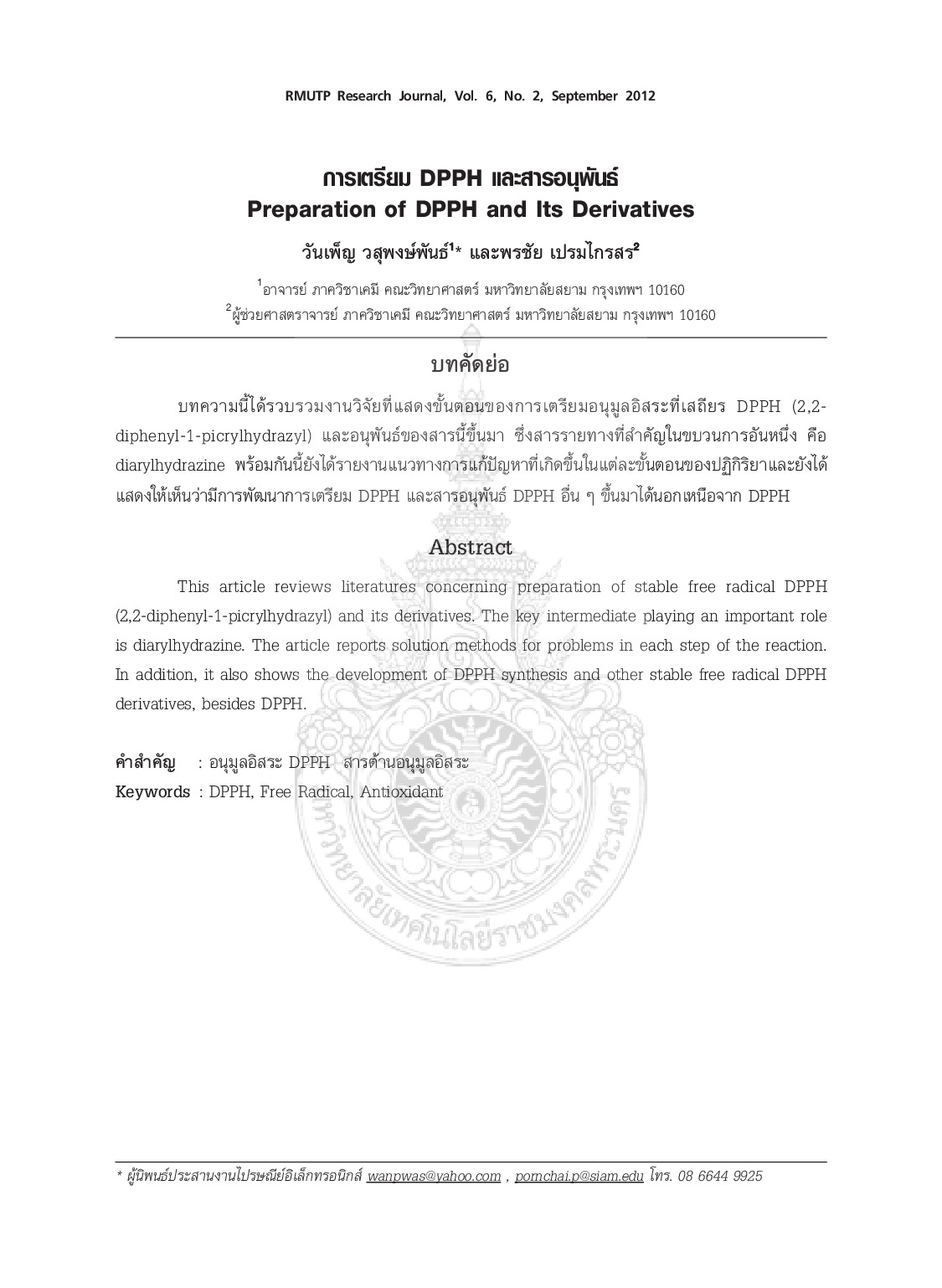
Preparation of DPPH and Its Derivatives
Abstract This article reviews literatures concerning preparation of stable free radical DPPH (22-diphenyl-1-picrylhydrazyl) and its derivatives. The key intermediate playing an important role is diarylhydrazine. The article reports solution methods for problems in each step of the reaction. In addition it also shows the development of DPPH synthesis and other stable free radical DPPH derivatives besides DPPH
การเตรียมผ้าไม่ทอจากใบอ้อย
This research was concerned with the fiber separation and non-woven preparation form sugar canes leaves. The separation process was carried out by chemical pulping method at 100 degree Celsius. In order to study the suitable condition for separation process the concentration of sodium hydroxide ranging from 0 -20 grams per liter and boiling time 15 30 45 60 75 90 105 and 120 minutes were performed. Web formation process was performed by wet laid method and polyvinyl alcohol was selected as binder in web bonding process. in order to study the suitable amount of binder in bonding process concentration of polyvinyl alcohol ranging from 1 2 4 6 8 and 10 % w/v coated on web surface and cured at 120 degree Celsius. Bursting strength as well as physical properties evaluation of non-woven fabrics was performed. For antimicrobial finishing process was performed by spray method and pad method. The finishing result was evaluated by MTCC test method 147-1998 (Qualitative) and 100 -1999 (Quantitative) The result was found that appropriate condition for fiber separation was recommended as follows: the amount of sodium hydroxide of 10 grams per liter and boiling time 60 minutes. The suitable amount of polyvinyl alcohol for web bonding process was 2 % w/v. Bursting strength of non-woven fabric was 53 kN/m 3 and padding method was a suitable method for antimicrobial finishing (antimicrobial area 0.3 millimeters )
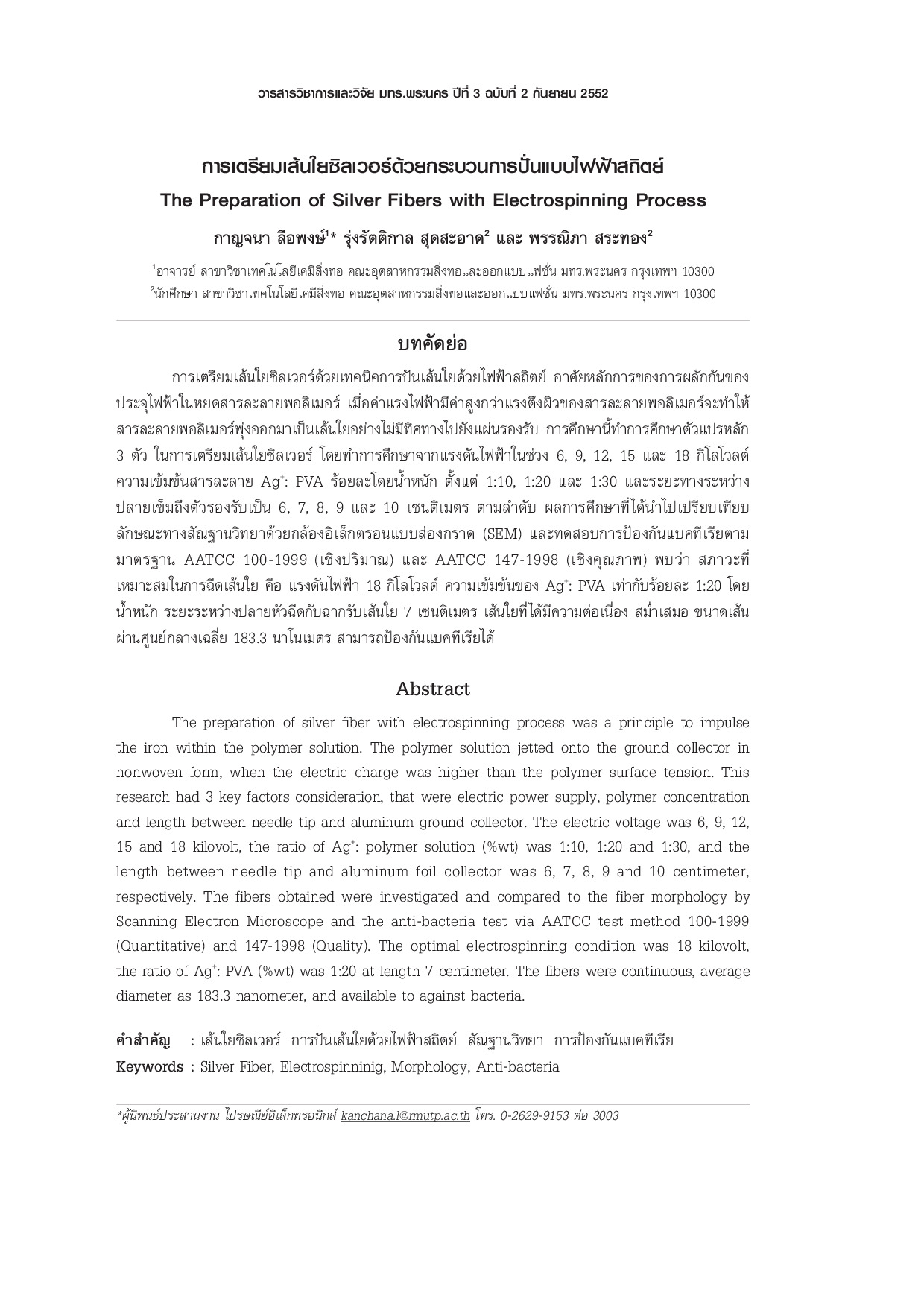
The Preparation of Silver Fibers with Electrospinning Process
The preparation of silver fiber with electrospinning process was a principle to impulse the iron within the polymer solution. The polymer solution jetted onto the ground collector in nonwoven form when the electric charge was higher than the polymer surface tension. This research had 3 key factors consideration that were electric power supply polymer concentration and length between needle tip and aluminum ground collector. The electric voltage was 6 9 12 15 and 18 kilovolt the ratio of Ag : polymer solution (%wt) was 1:10 1:20 and 1:30 and the length between needle tip and aluminum foil collector was 6 7 8 9 and 10 centimeter respectively. The fibers obtained were investigated and compared to the fiber morphology by Scanning Electron Microscope and the anti-bacteria test via AATCC test method 100-1999 (Quantitative) and 147-1998 (Quality). The optimal electrospinning condition was 18 kilovolt the ratio of Ag : PVA (%wt) was 1:20 at length 7 centimeter. The fibers were continuous average diameter as 183.3 nanometer and available to against bacteria.
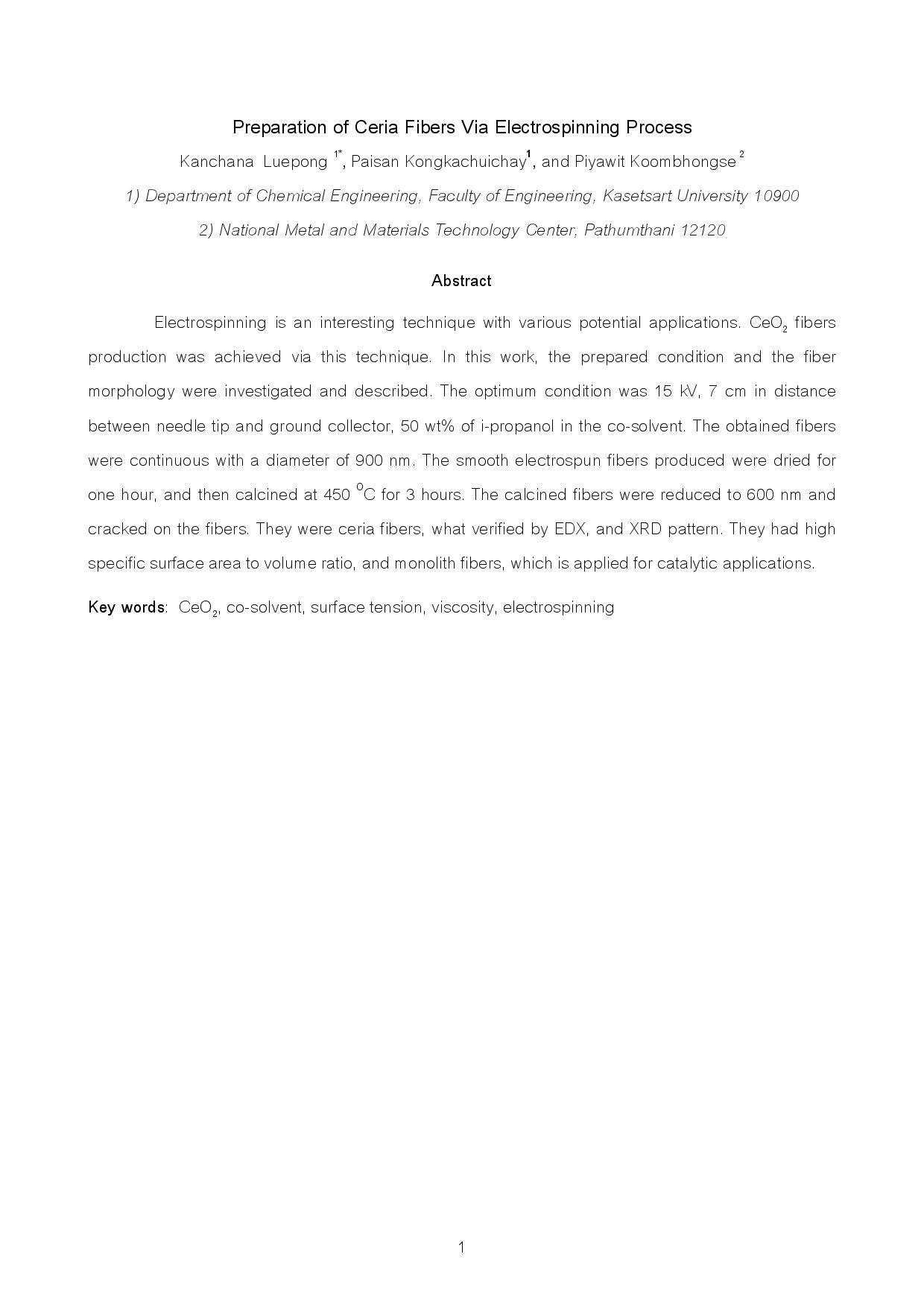
Preparation of Ceria Fibers Via Electrospinning Process
Electrospinning is an interesting technique with various potential applications. CeO2 fibers production was achieved via this technique. In this work the prepared condition and the fiber morphology were investigated and described. The optimum condition was 15 kV 7 cm in distance between needle tip and ground collector 50 wt% of i-propanol in the co-solvent. The obtained fibers were continuous with a diameter of 900 nm. The smooth electrospun fibers produced were dried for one hour and then calcined at 450 OC for 3 hours. The calcined fibers were reduced to 600 nm and cracked on the fibers. They were ceria fibers what verified by EDX and XRD pattern. They had high specific surface area to volume ratio and monolith fibers which is applied for catalytic applications.