จำนวน Repository ( 25 )

การผลิตไม้อัดเทียมจากโพลิเอทธิลีนผสมเส้นใยปาล์มน้ำมันสำหรับวิสาหกิจชุมชน
This research aims to study the using oil palm fiber to develop pseudo-plywood from polyethylene product. The mixture ratios of oil palm fiber : polyethylene are 50 : 50 55 : 45 60 : 40 65 : 35 and 70 : 30 by weight. The pseudo-plywood samples are cast in 30 x 30 x 1.5 centimeter in dimension. The pseudo-plywood sample testing follows the TIS 966-2547. The results show that the density bending strength modulus of elasticity thermal conductivity and tension perpendicular to surface of pseudo-plywood with high quantity of oil palm fiber are lower than pseudo-plywood with low quantity of oil palm fiber while that the water absorption and swelling by density of pseudo-plywood with high quantity of oil palm fiber are higher. However all of oil palm fiber samples with lower than 65 of ratio can pass the standard.
การพัฒนาผลิตภัณฑ์แผ่นใยอัดซีเมนต์จากเส้นใยปาล์มน้ำมันสำหรับวิสาหกิจชุมชน
This research aims to study the using oil palm fiber to develop cement-bonded fiberboard product. The mixture ratios of Portland cement type1: fine sand: oil palm fiber:tap water: catalyst are 1 : 1.95 : 0.05 : 0.40 : 0.03 1 : 1.94 : 0.06 : 0.40 : 0.03 1 : 1.93 : 0.07 : 0.40 : 0.03 1 : 1.92 : 0.08 : 0.40 : 0.03 and 1 : 1.91 : 0.09 : 0.40 : 0.03 by weight. The cement-bonded fiberboard samples are cast in 30 x 30 x 1.5 centimeter in dimension. The cement-bonded fiberboard sample testing follows the TIS 878-2537. The results show that the density thermal conductivity bending strength modulus of elasticity and tension perpendicular to surface of cement-bonded fiberboard with high quantity of oil palm fiber are lower than cement-bonded fiberboard with low quantity of oil palm fiber while that the water absorption and swelling in water of cement-bonded fiberboard with high quantity of oil palm fiber are higher. However all of oil palm fiber samples with lower than 0.06 of ratio can pass the standard.
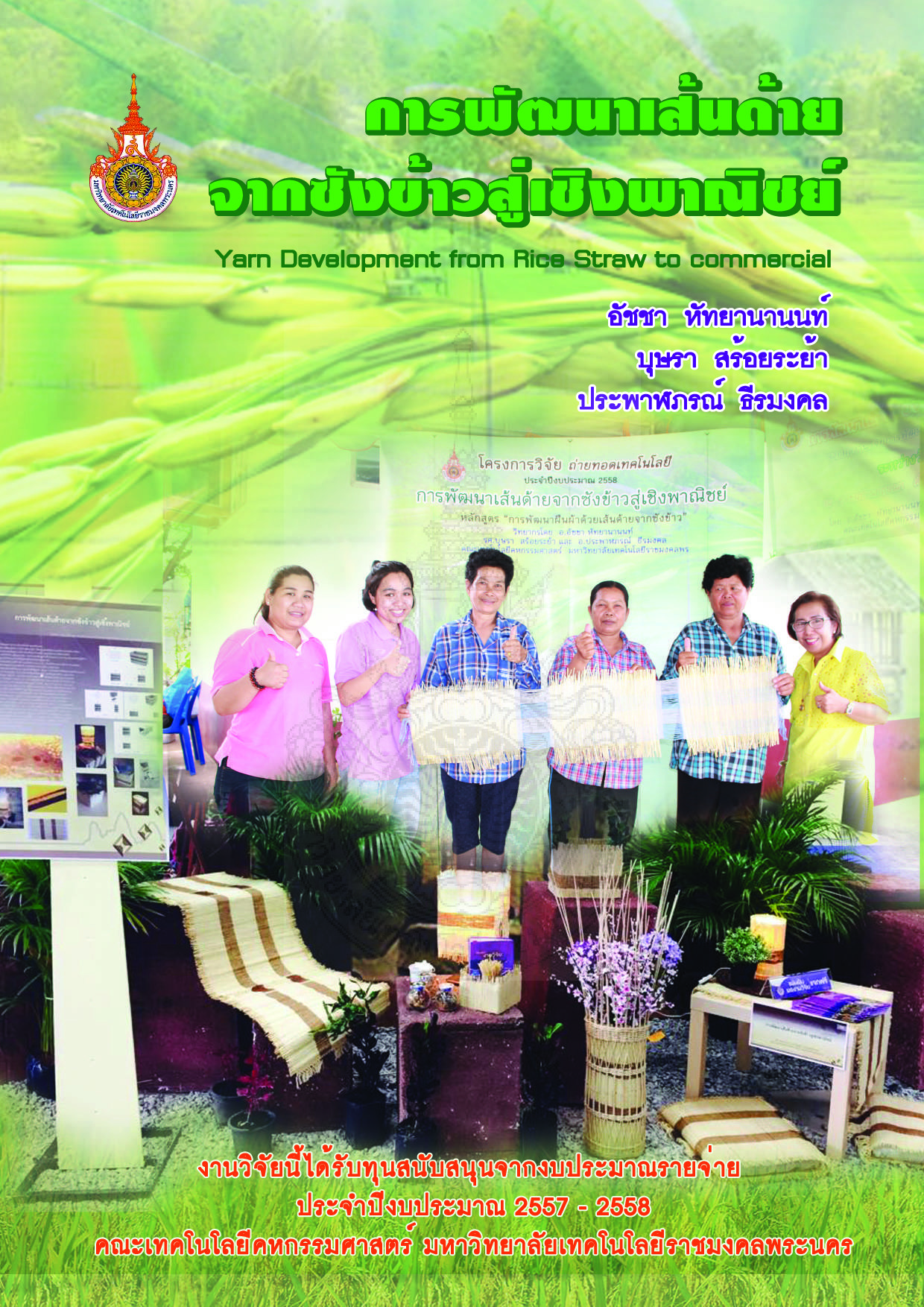
การพัฒนาเส้นด้ายจากซังข้าวสู่เชิงพาณิชย์
This research is Yarn Development from Rice straw to commercial. It aims to study the process of seperating fibers from rice straw. To study the physical properties of fibers from rice straw and to study the process of manufacturing yarn from rice straw fibers. The research material is rice straw fibers after that data was analyzed byphysical textile testing laboratory. The result of the first year’s research was the rice straw yarn has been developed as woven and develop into commercial products to promote. The process of separating fibers from rice straw which dried the sun for a few days. Selecting the rice straw fiber length at least 30 cm. to subtract the joints of the lower end of the stem by hand. peel off the rice straw fiber and place flat on a horizontal line. Then Rice straw fiber were tested in the physical laboratory was found that it is cellulose fibers tensile strength (Newton) at 28.18 elongation (percent) is at 2.01. The amounts of metals has plenty of CADMIUM at 0.1 mg/kg CHROMIUM (TOTAL) / (VI) at 0.5 mg/kg COPPER at 0.5 mg/kg and LEAD at 0.1 mg/kg which was not found to be risk for using. The fiber cross-section of rice straw fiber were found to be oval the middle is clearly. The fiber length is smooth and transparent when viewed from the side to see the clarity of the fiber. Rice straw fiber was weave in plain structure. Warp yarn uses a special brown cream and brown flat yarns. We use rice straw fiber with the same type of yarn. There are 2 warp yarn and using natural color without blench. Rice straw fabric was dyeing with dried hibiscus flowers (Kaa-Jeab herb) and mordant as ashes. The result is red light because of rice straw fiber surface is smooth and lustrous. Therefrom When woven as a fabric to develop be 4 products prototype : table lamps tablecloths in Japanese style potted plants and Accessories Box The result of the second year’s research there are focus group inquire for people it is interesting in this research and Date for transfer knowledge as: Ban-Krit-Sa- Na community Krit-Sa-Na sub-district bang-pra-ma district in Supanburi province. To plan the schedule and set the date place amount of participate and lectures 34 people The range of time to transfer as 3 days on 3 – 5 May 2015 and asking for consumer satisfaction of the curriculum and lecture for “transfer knowledge Yarn Development from Rice straw to commercial” by Questionnaire of participate satisfaction. Last the evaluation data was analyzed by using SPSS program in mean and percentage. The second year found that mostly participates were female aged under 21 years old finished the secondary school and also there are farmer. The participates are their income under 5000 baht and no income. For the participates questions relation to technology transfer of “Yarn Development from Rice straw to commercial” about course divided into 3 parts: The purpose The curriculum and The knowledge. The satisfaction of participates about project divided into 3 parts: Service process Lecturer and Facilities found that have been satisfied at maximum average and highest level of satisfaction in every parts of both satisfied participates questions. The participants are mainly used to provide benefits to themselves for one month to apply the gained after the training. Satisfaction with the benefits of technology transfer and utilization. Satisfaction at the highest level the participants used knowledge to apply with local and waste material. Moreover the participates make product as soon as finish course and they are planning to produce the table Hand Woven for weaving the Rice straw yarn fabric and push it to be OTOP products. The comments and suggestions of the participants found that they need for re-training again. They would like to have a longer period of training in order to gain more knowledge. All lecturer can transfer knowledge during the training as well.
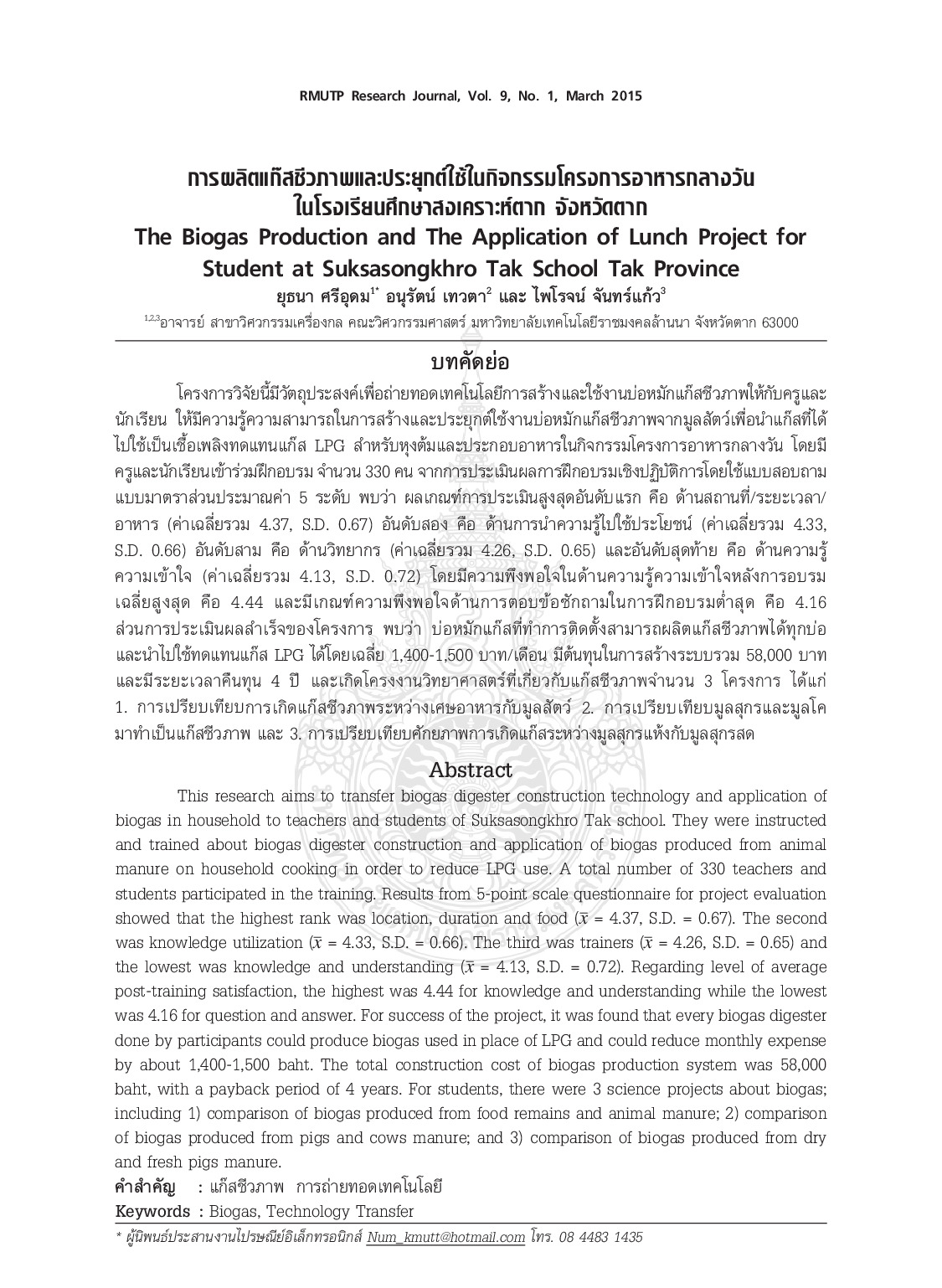
The biogas production and the application of lunch project for student at suksasongkhro tak school tak province
This research aims to transfer biogas digester construction technology and application of biogas in household to teachers and students of Suksasongkhro Tak school. They were instructed and trained about biogas digester construction and application of biogas produced from animal manure on household cooking in order to reduce LPG use. A total number of 330 teachers and students participated in the training. Results from 5-point scale questionnaire for project evaluation showed that the highest rank was location duration and food ( = 4.37 SD = 0.67). The second was knowledge utilization ( = 4.33 SD = 0.66). The third was trainers ( = 4.26 SD = 0.65) and the lowest was knowledge and understanding ( = 4.13 SD = 0.72). Regarding level of average post-training satisfaction the highest was 4.44 for knowledge and understanding while the lowest was 4.16 for question and answer. For success of the project it was found that every biogas digester done by participants could produce biogas used in place of LPG and could reduce monthly expense by about 1400 – 1500 baht. The total construction cost of biogas production system was 58000 baht with a payback period of 4 years. For students there were 3 science projects about biogas; including 1) comparison of biogas produced from food remains and animal manure; 2) comparison of biogas produced from pigs and cows manure; and 3) comparison of biogas produced from dry and fresh pigs manure.
การพัฒนาและแปรรูเครื่องแต่งกายและส่วนประกอบการแต่งกายจากผ้าทอกะเหรี่ยง ภายใต้แผนงานวิจัย การจัดการองค์ความรู้ทางสิ่งทอในการพัฒนาและอนุรักษ์ภูมิปัญญาชุมชน กรณ๊ศึกษาผ้าทอกะเหรี่ยง
This research had an objective to research and development the garments and accessory products from Karen Woven Fabric. There were 3 product types as dress:D shirt:S and accessory:A what they were 15 styles/type. This research was survey research that used the Index of item-Objective congruence questionnaires (IOC) as the major tool. Addition the computer graphic aided was used to design the products under the design principle. The results showed the good level consumer responsibility. The consumer favored of the products followed: for dress was D8 > D7 > D3 > D5 > D1 > D4 > D2 > D10 > D11 > D6 > D14 > D10 > D13 > D12 > D15 for shirt was S8 > S7 > S3 > S5 > S1 > S11 > S10 > S9 > S1 > S4 > S6 > S14 > S13 > S15 > S12 and accessory was A5 > A2 > A4 > A1 > A3 > A11 > A6 > A7 > A10 > A14 > A15 > A8> A9 > A13 > A12. Moreover the whole satisfactions level of the consumer for all products in term of the useful modern style Karen conservation style and color theme were good. All of results were transfer to the target group at Bann YangNamkladtai school Phetchaburi province. The transfer group was satisfied and gain the worth knowledge. This cognition was a way for building the career and produces the commercial products in the future.