จำนวน Repository ( 286 )
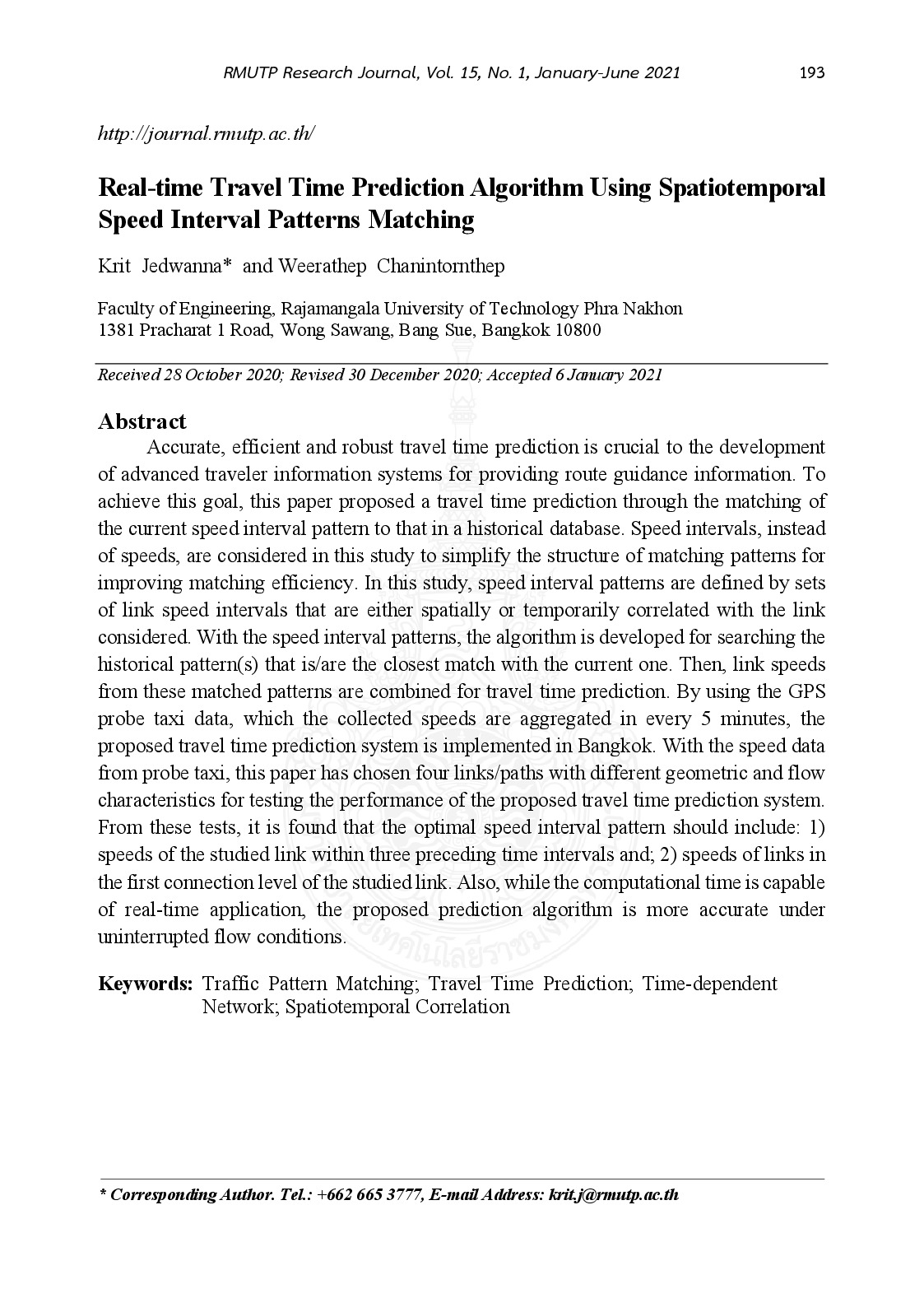
Real-time travel time prediction algorithm using spatiotemporal speed interval patterns matching
Accurate efficient and robust travel time prediction is crucial to the development of advanced traveler information systems for providing route guidance information. To achieve this goal this paper proposed a travel time prediction through the matching of the current speed interval pattern to that in a historical database. Speed intervals instead of speeds are considered in this study to simplify the structure of matching patterns for improving matching efficiency. In this study speed interval patterns are defined by sets of link speed intervals that are either spatially or temporarily correlated with the link considered. With the speed interval patterns the algorithm is developed for searching the historical pattern(s) that is/are the closest match with the current one. Then link speeds from these matched patterns are combined for travel time prediction. By using the GPS probe taxi data which the collected speeds are aggregated in every 5 minutes the proposed travel time prediction system is implemented in Bangkok. With the speed data from probe taxi this paper has chosen four links/paths with different geometric and flow characteristics for testing the performance of the proposed travel time prediction system. From these tests it is found that the optimal speed interval pattern should include: 1) speeds of the studied link within three preceding time intervals and; 2) speeds of links in the first connection level of the studied link. Also while the computational time is capable of real-time application the proposed prediction algorithm is more accurate under uninterrupted flow conditions.
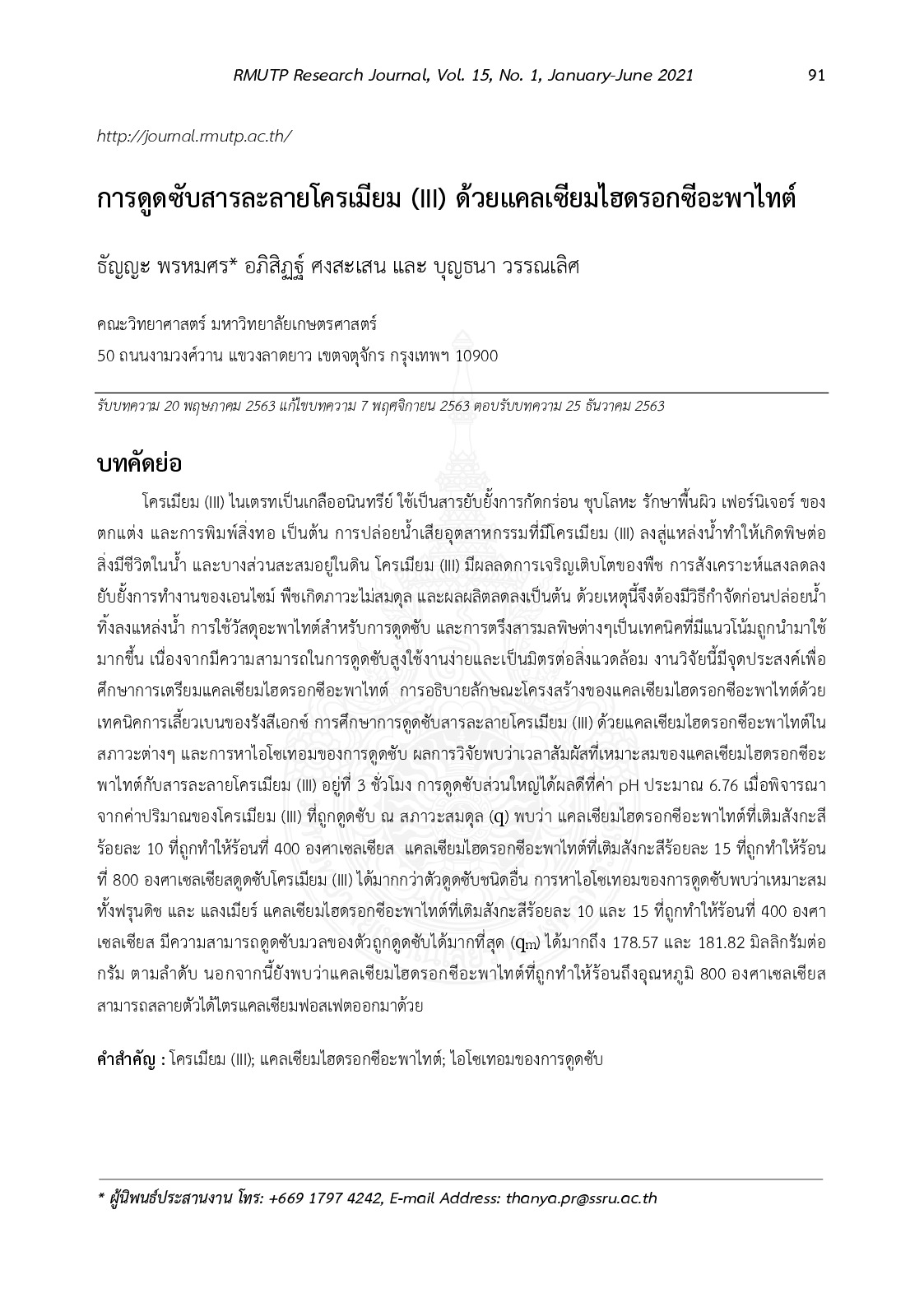
การดูดซับสารละลายโครเมียม (III) ด้วยแคลเซียมไฮดรอกซีอะพาไทต์
Chromium (III) is an inorganic salt being used as corrosion inhibitor plating agents surface treating agents furniture furnishings and textile printing and etc. The discharge of industrial waste water containing chromium (III) into the water source was toxic to the aquatic lives and some parts accumulate in the soil chromium (III) reduces the growth of plants reduced photosynthesis inhibit the enzyme activity imbalanced in plants and reduced productivity and etc. For this reason method to remove it before discharge the effluent into the water source is necessary. The use of apatite materials for adsorption and immobilization of various pollutants was a technique that was more likely to be used.Due to its high adsorbency easy to use and environmentally friendly. The purpose of this research was to study the preparation of calcium hydroxyapatite structural characterization of calcium hydroxyapatite by X-ray diffraction technique adsorption study of chromium solution with calcium hydroxyapatite in various conditions and the determination of adsorption isotherm. The results showed that the optimum contact time of calcium hydroxyapatite and chromium solution was 3 hours. Most adsorption works well at a pH of around 6.76. Considering the amount of chromium (III) adsorbed at equilibrium (q) it was found that the calcium hydroxyapatite with 10 % zinc added that has been calcined to 400 OC and the calcium hydroxyapatite with 15 % zinc added that has been calcined to 800 OC were to adsorb chromium (III) more than other sorbents. The adsorption isotherm was suited with Fruendlich and Langmuir. The calcium hydroxyapatite with 10 % and 15 % zinc added that has been calcined to 400 OC had the highest adsorption capacity (qm) up to 178.57 and 181.82 mg/g respectively. In addition it was found that calcium hydroxyapatite which heated to 800 degrees Celsius can decompose tricalciumphosphate.
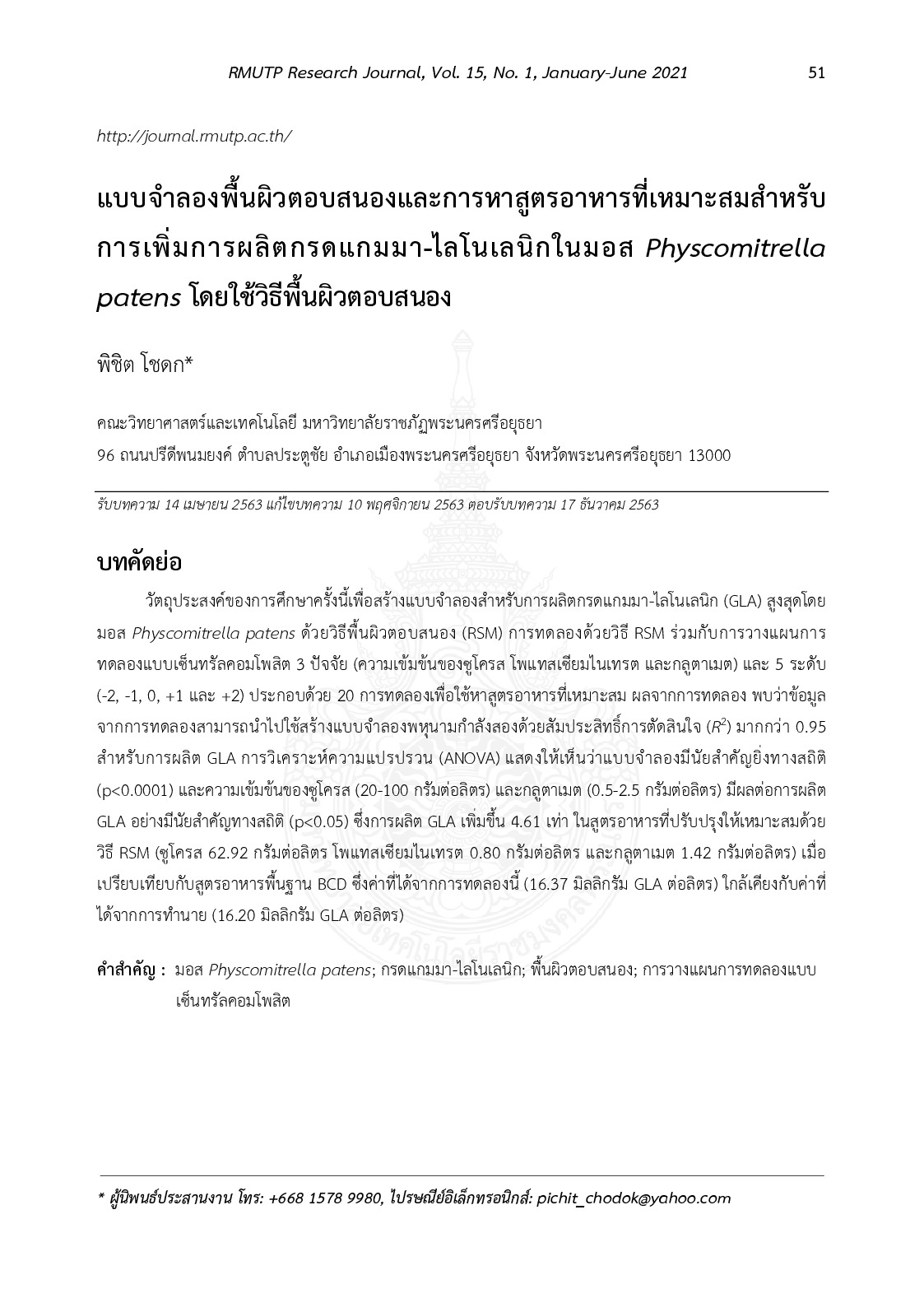
แบบจำลองพื้นผิวตอบสนองและการหาสูตรอาหารที่เหมาะสมสำหรับการเพิ่มการผลิตกรดแกมมา-ไลโนเลนิกในมอส Physcomitrella patens โดยใช้วิธีพื้นผิวตอบสนอง
The objective of this study is to obtain a model that maximize production of γ-linolenic acid (GLA) by the moss Physcomitrella patens employing response surface methodology (RSM). The RSM with a three-variables (sucrose potassium nitrate and glutamate concentrations) and five-level (-2 -1 0 1 and 2) central composite design (CCD) including 20 experimental runs was employed to optimize the medium composition. Results showed that the experimental data could be appropriately fitted into a second-order polynomial model with a coefficient of determination (R2) more than 0 .9 5 for GLA production. Analysis of variance (ANOVA) revealed that the model was highly significant (p<0.0001) and the effects of the sucrose (20-100 g/L) and glutamate (0.5-2.5 g/L) concentrations on GLA production were significant (p<0.05). The GLA production with the optimized culture medium (sucrose concentration of 62.92 g/L potassium nitrate of 0.80 g/L and glutamate concentration of 1 .4 2 g/L) by RSM increased 4.61 folds when compared with the standard BCD medium. This experimental value (16.37 mg GLA/L) fit well with the predicted values (16.20 mg GLA/L).
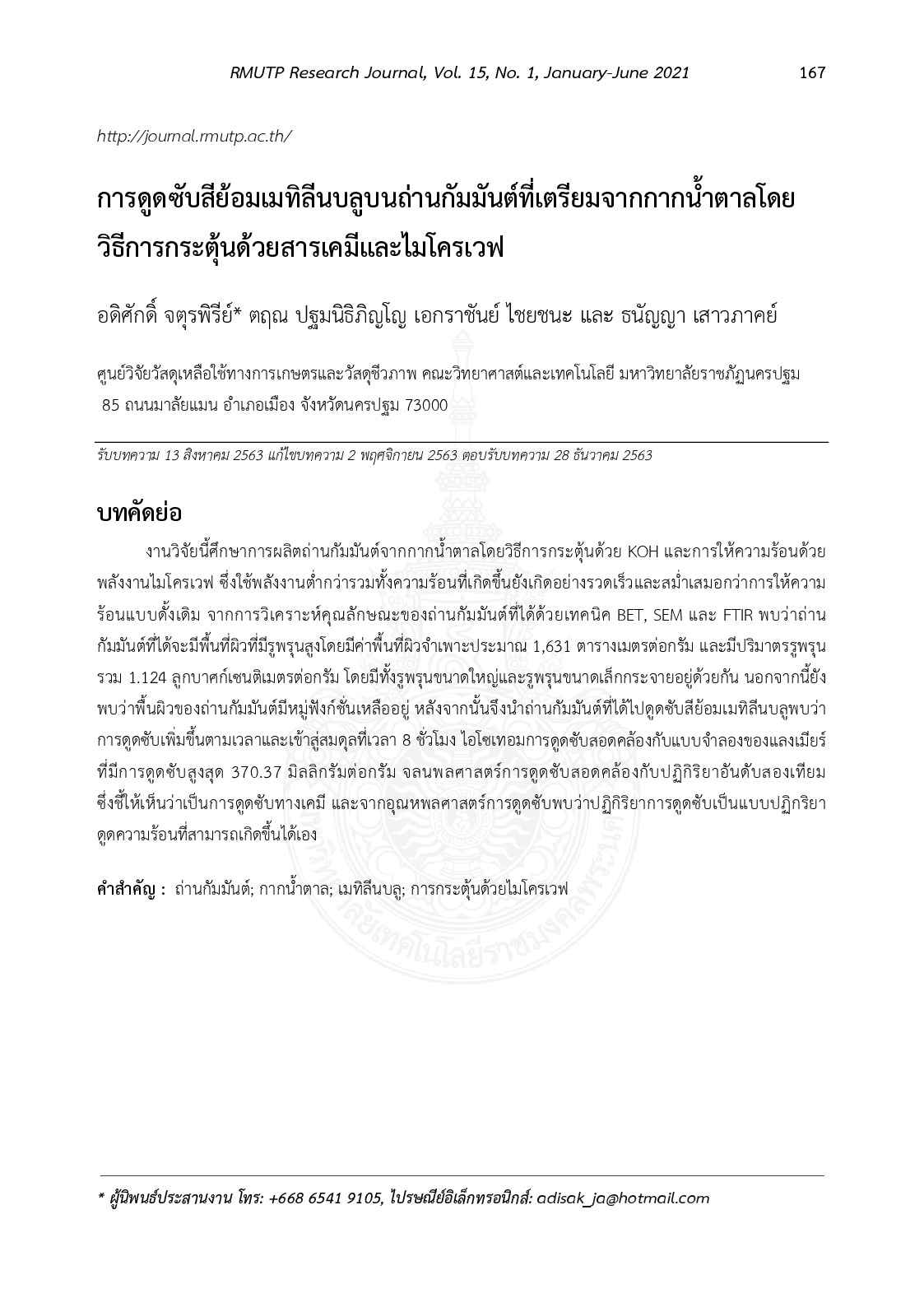
การดูดซับสีย้อมเมทิลีนบลูบนถ่านกัมมันต์ที่เตรียมจากกากน้ำตาลโดยวิธีการกระตุ้นด้วยสารเคมีและไมโครเวฟ
This research aims to produce activated carbon from molasses via a chemical activation process with potassium hydroxide (KOH) and a microwave heating process which consumes less energy and provides more rapid and uniform heat distribution than a conventional heating. The obtained activated carbon was then characterized with BET SEM and FTIR. It exhibited a large specific surface area of 1631 m2/g and a total pore volume of 1.124 cm3/g consisting of mesopore and micropore. In addition the active functional groups were also found on the surface of the activated carbon. Thus it was brought for the adsorption test with methylene blue. It was found that the adsorption capacity of the activated carbon increased with time and reached the equilibrium within 8 hours. The adsorption data of the activated carbon were corresponded to Langmuir isotherm with the highest adsorption capacity of 370.37 mg/g. The adsorption kinetic of the activated carbon exhibited pseudo-second order reaction suggesting to the chemisorption phenomenon. From the thermodynamic study it revealed that the adsorption process were endothermic and spontaneous reactions.
การเสริมสร้างความร่วมมือของชุมชนท้องถิ่นเพื่อสร้างความมั่นคงด้านที่อยู่อาศัย
This research uses a participatory action methodology which is divided into 3 phases: meanings analysis significance and housing problems of low-income people. Development stage of local community cooperation activities including the system synthesis and mechanism of cooperation of local communities towards housing security use in-depth interviews group chat workshop lesson learned together with observation and field notes. The target groups are members and the committee of Baan Mankong Tha Makham community leader the network development partner’s representatives and relevant officers. This focuses on qualitative data collecting which uses content analysis and summarization. The study found that: for the meaning the importance and the housing problems of low-income people the following are considered: (1) Meaning and importance of the word Nice city and Tha Makham Model. It consists of three dimensions: dimension of residence dimension of happiness and dimension of quality of life. (2) housing Problems of low-income people such as urban problems residence condition problems the problem of inequality and problems of accessing capital. Most of people are low-income and disadvantaged who live in urban areas. Some live with relatives or in a rented house on the land of Royal Property land of a temple and land of State Railway of Thailand. Some don’t have any land or residence of their own. Some were expelled and their houses were dismantled from the area. The system and mechanism of cooperation of local communities towards housing security has four characteristics as follows: (1) People system including members committee as well as committees that look after and manage various funds in Baan Mankong project. 2) The organizational system i.e. the local government organization and related agencies (3) Information system i.e. information and various activities related to the development of Baan Mankong project. 4) Capital system consists of monetary capital or budget such as fund credit community welfare and social capital. These are the value of coexistence support sacrifice and sharing including social relations that requires 3 main thinking bases: (1) thinking principles e.g. living according to the concept of sufficiency economy and self-reliance (2) principles namely Baan Mankong principle saving principle cooperative principle house construction principles and development principle towards sustainability and (3) doing principles refer to the participation on thinking participating doing developing and taking the benefits. .