จำนวน Repository ( 23 )

การดูดซับทางชีวภาพสีย้อมโรดามีน บีด้วยรากผักตบชวาดัดแปร
The biosorption of Rhodamine B using modified water hyacinth roots was studied. The adsorption experiments were conducted in a batch setup. Parameters affecting the adsorption of Rhodamine B including pH of a solution adsorption time adsorbent dose and dyes concentration were investigated. With the 80 mg/L Rhodamine B solution of pH 6.0 adsorption time of 60 min and 0.10 g of modified water hyacinth roots the kinetic models pseudo-first order and pseudo-second order kinetic model were applied to examine the kinetic adsorption. The adsorption kinetic data correlates with pseudo-second order kinetic model. The Langmuir and Freundlich adsorption models were applied to describe the isotherms and isotherm constants. Adsorption isotherm data correlates with Langmuir adsorption model. The maximum adsorption capacity of modified water hyacinth roots for Rhodamine B was found to be 63 mg/g
การบำบัดน้ำเสียจากกระบวนการฟอกย้อมด้วยเทคนิคโฟโตแคตตาไลติคร่วมกับกระบวนการดูดซับ
Dye effluent treatment with photocatalytic technique and adsorption process had an objective for studying the combination process between Titanium dioxide and activated carbon from dye effluent. The dye effluents were prepared from the direct dye reactive dye acid dye disperse dye and basic dye. The effluent dyes from the completely dyeing process at 1 % owf initially. All of dye structures were azo. From the study direct dye and reactive were successfully using combination process between photocatalytic technique and adsorption process whereas disperse dye favored in adsorption process. However acid dye and basic were ignored in this experiment cause of they were a bit of dye concentration in their effluent. The optimum condition for direct dye was 10g/l Titanium dioxide for 6 hours and 5 g/l activated carbon for 6 hours continuously. Reactive dye was performed in continuous condition as 10g/l Titanium dioxide for 6 hours and 10 g/l activated carbon for 6 hours. Disperse dye was the particular process in adsorption by activated carbon 15 g/l for 4 hours. It was summarized that the treatment of photocatalytic technique and adsorption process were upon on the type of dye.
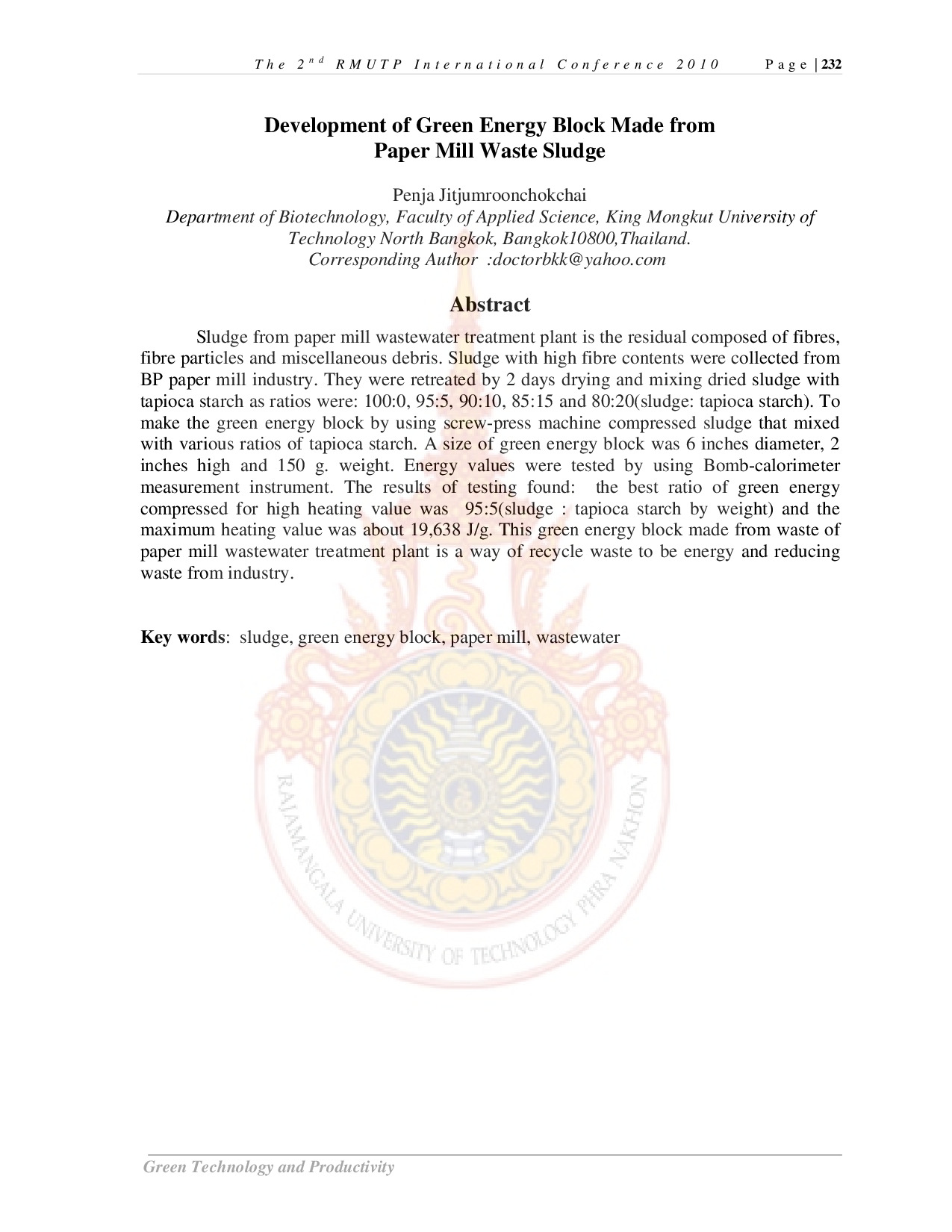
Development of Green Energy Block Made from Paper Mill Waste Sludge
Sludge from paper mill wastewater treatment plant is the residual composed of fibres fibre particles and miscellaneous debris. Sludge with high fibre contents were collected from BP paper mill industry. They were retreated by 2 days drying and mixing dried sludge with tapioca starch as ratios were: 100:0 95:5 90:10 85:15 and 80:20(sludge: tapioca starch). To make the green energy block by using screw-press machine compressed sludge that mixed with various ratios of tapioca starch. A size of green energy block was 6 inches diameter 2 inches high and 150 g. weight. Energy values were tested by using Bomb-calorimeter measurement instrument. The results of testing found: the best ratio of green energy compressed for high heating value was 95:5(sludge : tapioca starch by weight) and the maximum heating value was about 19638 J/g. This green energy block made from waste of paper mill wastewater treatment plant is a way of recycle waste to be energy and reducing waste from industry.