จำนวน Repository ( 26 )
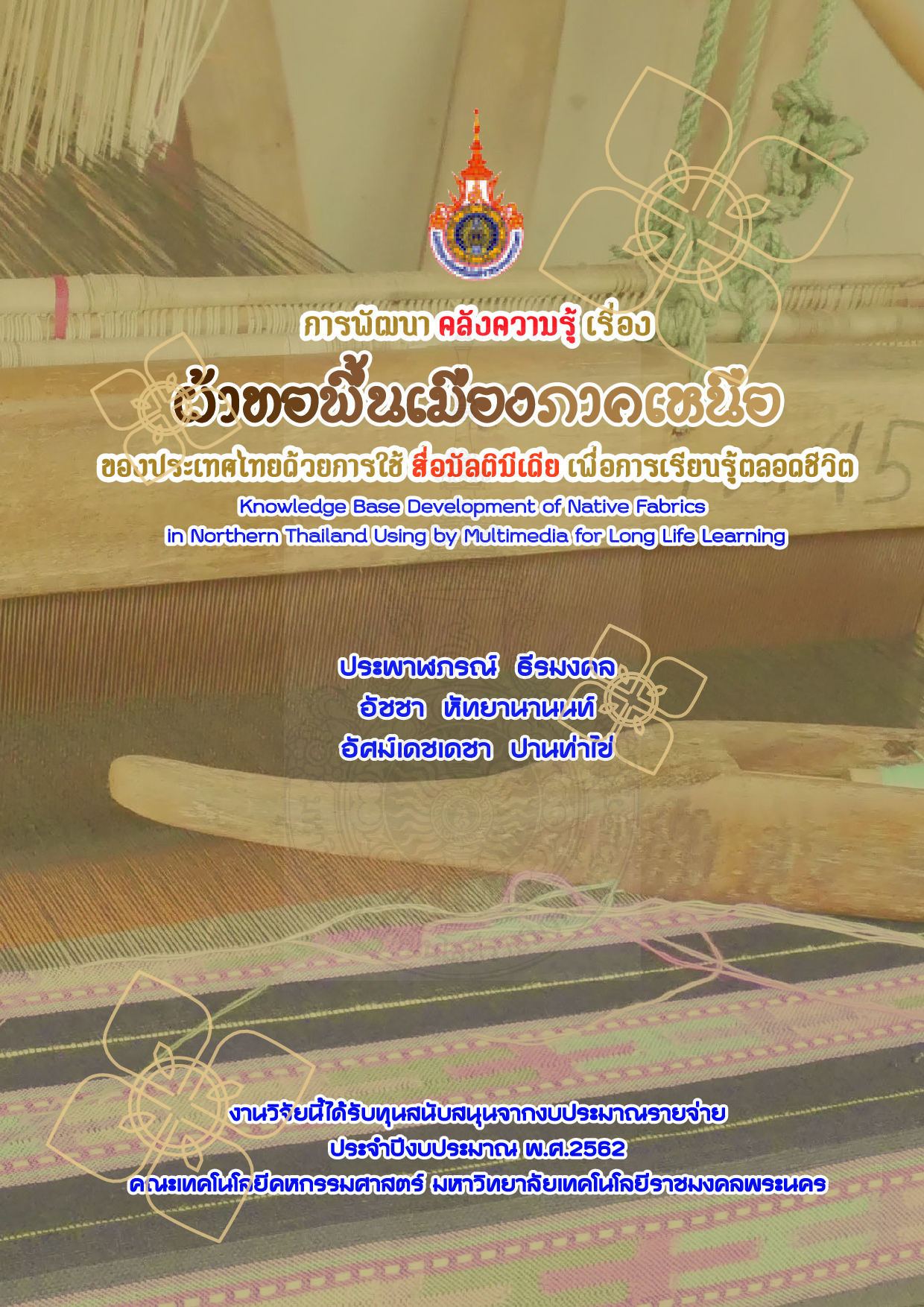
การพัฒนาคลังความรู้เรื่องผ้าทอพื้นเมืองภาคเหนือของ ประเทศไทยด้วย การใช้สื่อมัลติมีเดียเพื่อการเรียนรู้ตลอดชีวิต
This research is the development of the knowledge base on local textiles of northern Thailand by using multimedia for lifelong learning. The aim is to study compile and gather information of local cloths in northern Thailand. Develop a knowledge base by using multimedia on the local textiles of northern Thailand for lifelong learning and transferring knowledge and disseminating the knowledge base on northern Thai fabric by using multimedia for lifelong learning to the community. The research team proceeded to gather primary knowledge from the roots of the researchers who are interested in the local woven fabric. Therefore proceeding further knowledge in the upper reaches from literature reviews Including from field trips for data collection through in-depth interviews with important people Interviewing people who have knowledge about social context community local weaving characteristics weaving characteristics name of pattern type of fabric weaving technique of local textiles in northern Thailand in 9 provinces as well as studying primary data from textbooks textbooks and technical documents and in the internet. Thus the research shown that into 3 parts which are 1. Ethnic groups of Northern Thailand 2. Local woven fabric in northern Thailand and 3. Woven process and pattern. After that the knowledge library was developed by using multimedia on the local textiles of Northern Thailand for lifelong learning. This research can summarize the results in the form of a written description showing that the northern region of Thailand in the past was the Lanna Kingdom area. In the area of Xishuangbanna Before moving to the north of Thailand including the Tai Lue Tai Kheen Thai people Tai Yai people Meng (Mon) Lua people villages scattered throughout the highlands of the Lanna region such as Karen (Pak Kahen M) Mien (Yao) Hmong (Meo) Akha (Akha) Lahu (Mso) Lisu. In addition there are some groups in the Lanna fringe such as Khmu Labri (Tong Lueang). Each ethnic group has its own unique style especially Common skirt Has the same basis with the resin head the resin body and the resin tip but each part is not woven differently Have different colors Some ethnicities have a section called Lep which is the part that the weaver often weaves to keep the thread as for knowledge transfer. The research created a book Local woven cloth consists of videos from local knowledge sources and digital documents and to make the transfer of knowledge more complete Therefore held a forum and exhibition on the topic primary fabric of Lanna Kingdom as a medium for those interested in Local woven fabrics in the Lanna Kingdom of Thailand attended. Exchange ideas from various sources of knowledge from the research. While also receiving multimedia for lifelong learning from the inquiry regarding the satisfaction of the participants. The Keynote speakers are interesting and event condition caused the interest in the knowledge content that used to organize the exhibition. Overall the work is most satisfied.
การพัฒนาชุดราตรีโดยการตกแต่งด้วยเทคนิคการสานจากเศษเส้นด้ายไหม เหลือทิ้ง ของกิจการผ้าไหมบ้านครัว เขตราชเทวี กรุงเทพมหานคร
The creation of nightgown decorated by woven silk yarn scrap from Baan Krua Cottage Industrial Village in Ratchathewi Bangkok Thailand. Objectives are: 1) to study the weaving technique using the silk yarn scrap 2) to design a nightgown decorated with woven silk yarn scrap and 3) to study the overall satisfaction of nightgown designs which utilize silk yarn scrap. The sample population in this research is 250 women found on Silom Road central Bangkok. The research instrument is a questionnaire with 9 prototype nightgowns decorated with woven silk yarn scrap. The collection consists of 3 sets one set with 3 short nightgowns another set with 3 long nightgowns and the last set with 3 short nightgowns with long tails. The research methodology is to hand out the questionnaire to 250 non-specific women on Silom Road. Data analysis is done by statistic percentage average and standard deviation. Results of studying the survey show that most of the sample populations are women age between 31 -35 years old with bachelor degrees or the equivalent. Most are married and work as state enterprise officers. Incomes are between 20001 - 30000 baht. Most of them have bought a silk nightgown before and chosen to buy at department stores. The reason that they do not prefer silk nightgowns is because most in the current market are not innovative enough. Most of the sample populations have never seen a nightgown decorated with woven silk yarn scrap before. The results of studying the satisfaction of the sample population found that for the short nightgown set most of the sample population prefer number 2 standard deviation is 4.48. For the long nightgown set most of the sample populations prefer number 2 standard deviation is 4.44. And for the short nightgown with long tail set most of the sample populations prefer number 2 standard deviation is 4.46.
การพัฒนาชุดราตรีโดยการตกแต่งด้วยเทคนิคการสานจากเศษเส้นด้ายไหม เหลือทิ้ง ของกิจการผ้าไหมบ้านครัว เขตราชเทวี กรุงเทพมหานคร
The creation of nightgown decorated by woven silk yarn scrap from Baan Krua Cottage Industrial Village in Ratchathewi Bangkok Thailand. Objectives are: 1) to study the weaving technique using the silk yarn scrap 2) to design a nightgown decorated with woven silk yarn scrap and 3) to study the overall satisfaction of nightgown designs which utilize silk yarn scrap. The sample population in this research is 250 women found on Silom Road central Bangkok. The research instrument is a questionnaire with 9 prototype nightgowns decorated with woven silk yarn scrap. The collection consists of 3 sets one set with 3 short nightgowns another set with 3 long nightgowns and the last set with 3 short nightgowns with long tails. The research methodology is to hand out the questionnaire to 250 non-specific women on Silom Road. Data analysis is done by statistic percentage average and standard deviation Results of studying the survey show that most of the sample populations are women age between 31 -35 years old with bachelor degrees or the equivalent. Most are married and work as state enterprise officers. Incomes are between 20001 - 30000 baht. Most of them have bought a silk nightgown before and chosen to buy at department stores. The reason that they do not prefer silk nightgowns is because most in the current market are not innovative enough. Most of the sample populations have never seen a nightgown decorated with woven silk yarn scrap before. The results of studying the satisfaction of the sample population found that for the short nightgown set most of the sample population prefer number 2 standard deviation is 4.48. For the long nightgown set most of the sample populations prefer number 2 standard deviation is 4.44. And for the short nightgown with long tail set most of the sample populations prefer number 2 standard deviation is 4.46.
Development of household textiles from batik silk: a case study of the motif of ancient khmer art at sikhoraphum castle
This study aims to develop household textiles from Surin Batik silk with pattern of Ancient Khmer Art at Sikhoraphum Castle and to study customers’ satisfaction of household textiles. The population was 400 assessors within the age range of 20 - 50 years in Surin province. The research instrument was questionnaire. Data were statistically analyzed for Percentage Mean and Standard Deviation. Results showed that the majority of respondents were females with ages around 31 - 35 years old. Most of them were married and had income of 15000 – 25000 baht. Most got Bachelor’s degree and used to use household silk textile. Working clothe was the most purchased category. Most household textiles were purchased as souvenirs. Personal preference was the initial motivation for purchase decisions and utilization was the key factor for selecting a product. Regarding onsumers’ satisfaction in 3 types of household textiles from Mudmee Batik silk - cushion lamp and bed cloth – it was found that satisfaction in style pattern colour price and utilization were in similar high level. Cushion was the most purchased household textile. Peacock was the most favorite pattern and consistency of the pattern was the most important factor for purchasing.

การพัฒนาผลิตภัณฑ์สิ่งทอจากเส้นใยตะไคร้
A study on developing textile products from fiber lemongrass has been carried out aimed at processing yarn from lemongrass fiber developing textile fabrics such as clothing hats and shoes and teaching product design and technology to a community. Lemongrass leaves were processed with chemicals to produce a fiber lemongrass then spun to 100% lemongrass yarn with large unsmooth surfaces the used to produce handbag hats and shoes. However for garment fabrics the researchers developed the lemongrass yarn for weaving by mixing cotton in a 60:40 ratio to produce hand-woven cloth. Using hand-woven folk wisdom the Takfa community in Nakhon Sawan produced natural dyes from Bengal Almond leaves a performed surface finishing for a smoother touch. After weaving lemongrass fiber cloth gives off a lemongrass odor but this fades gradually. The physical properties of lemongrass fiber cloth are then tested for strength resistance and abrasion. Processing lemongrass cloth fiber to textile products enables us to produce various products such as clothes bags and hats. In passing technology to the community the residents recognized the advantages and benefits of using the fabric. Further research should investigate mixing lemongrass fibers with other natural fibers improved fiber durability luster of the fiber to increase fiber value or using lemongrass fiber for household products.