จำนวน Repository ( 278 )
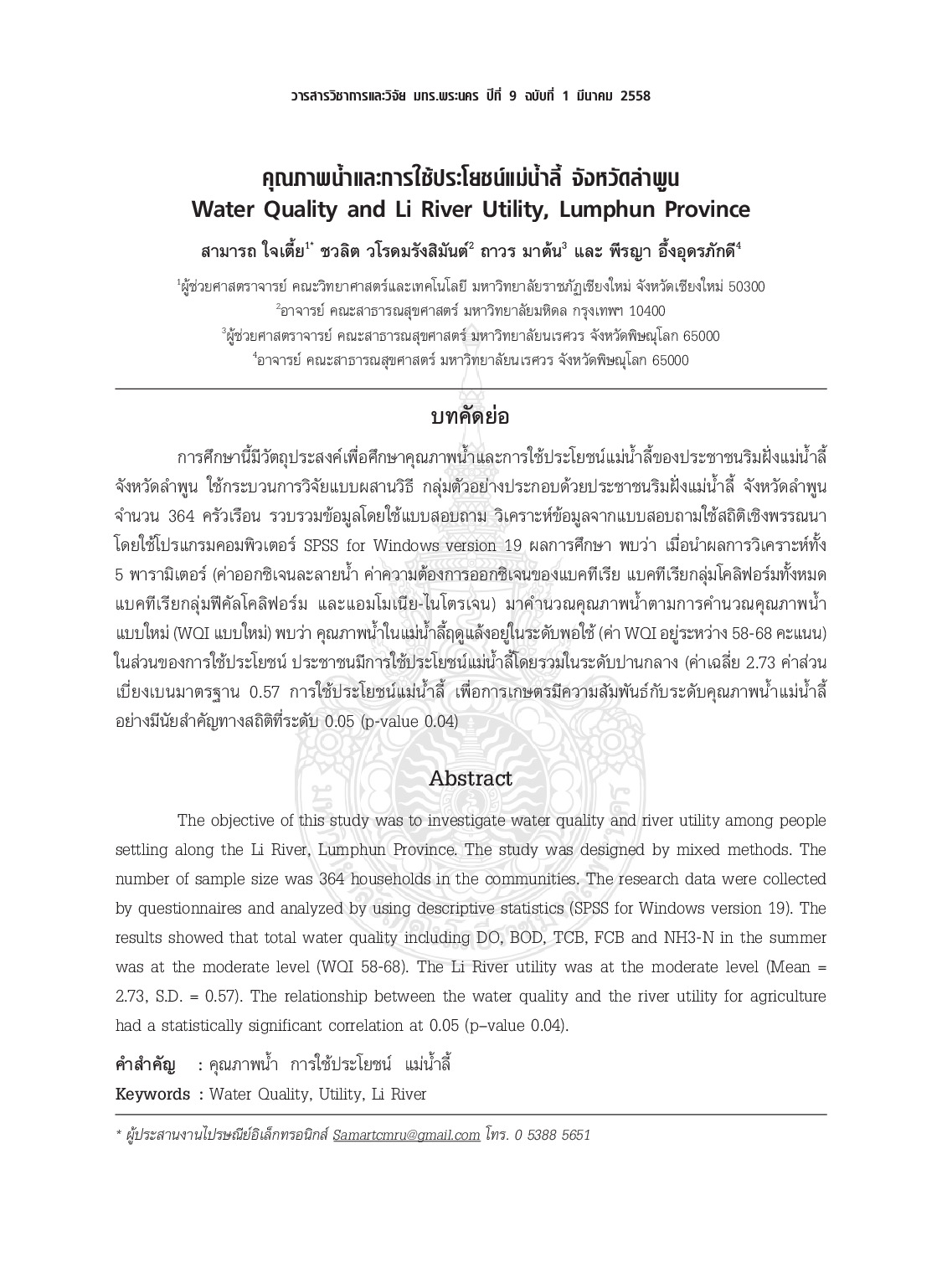
Water quality and li river utility, lumphun province
The objective of this study was to investigate water quality and river utility among people settling along the Li River Lumphun Province. The study was designed by mixed methods. The number of sample size was 364 households in the communities. The research data were collected by questionnaires and analyzed by using descriptive statistics (SPSS for Windows version 19 ).The results showed that total water quality including DO BOD TCB FCB and NH3-N in the summer was at the moderate level (WQI 58 - 68). The Li River utility was at the moderate level (Mean = 2.73 S.D. = 0.57). The relationship between the water quality and the river utility for agriculture had a statistically significant correlation at 0.05 (p –value 0.04).
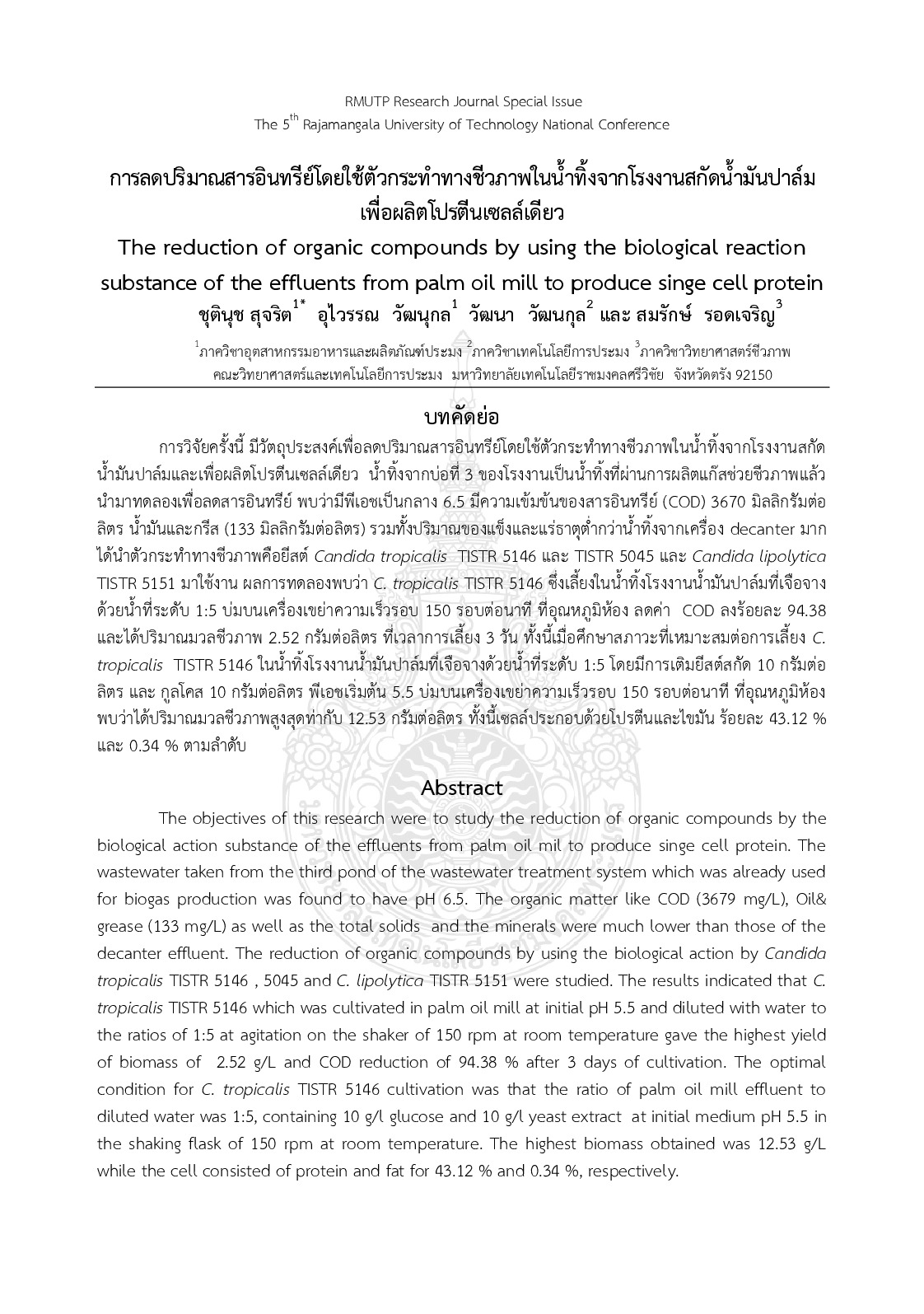
The reduction of organic compounds by using the biological reaction substance of the effluents from palm oil mill to produce singe cell protein
The objectives of this research were to study the reduction of organic compounds by the biological action substance of the effluents from palm oil mil to produce singe cell protein. The wastewater taken from the third pond of the wastewater treatment system which was already used for biogas production was found to have pH 6.5. The organic matter like COD (3679 mg/L) Oil& grease (133 mg/L) as well as the total solids and the minerals were much lower than those of the decanter effluent. The reduction of organic compounds by using the biological action by Candida tropicalis TISTR 5146 5045 and C. lipolytica TISTR 5151 were studied. The results indicated that C. tropicalis TISTR 5146 which was cultivated in palm oil mill at initial pH 5.5 and diluted with water to the ratios of 1:5 at agitation on the shaker of 150 rpm at room temperature gave the highest yield of biomass of 2.52 g/L and COD reduction of 94.38 % after 3 days of cultivation. The optimal condition for C. tropicalis TISTR 5146 cultivation was that the ratio of palm oil mill effluent to diluted water was 1:5 containing 10 g/l glucose and 10 g/l yeast extract at initial medium pH 5.5 in the shaking flask of 150 rpm at room temperature. The highest biomass obtained was 12.53 g/L while the cell consisted of protein and fat for 43.12 % and 0.34 % respectively.
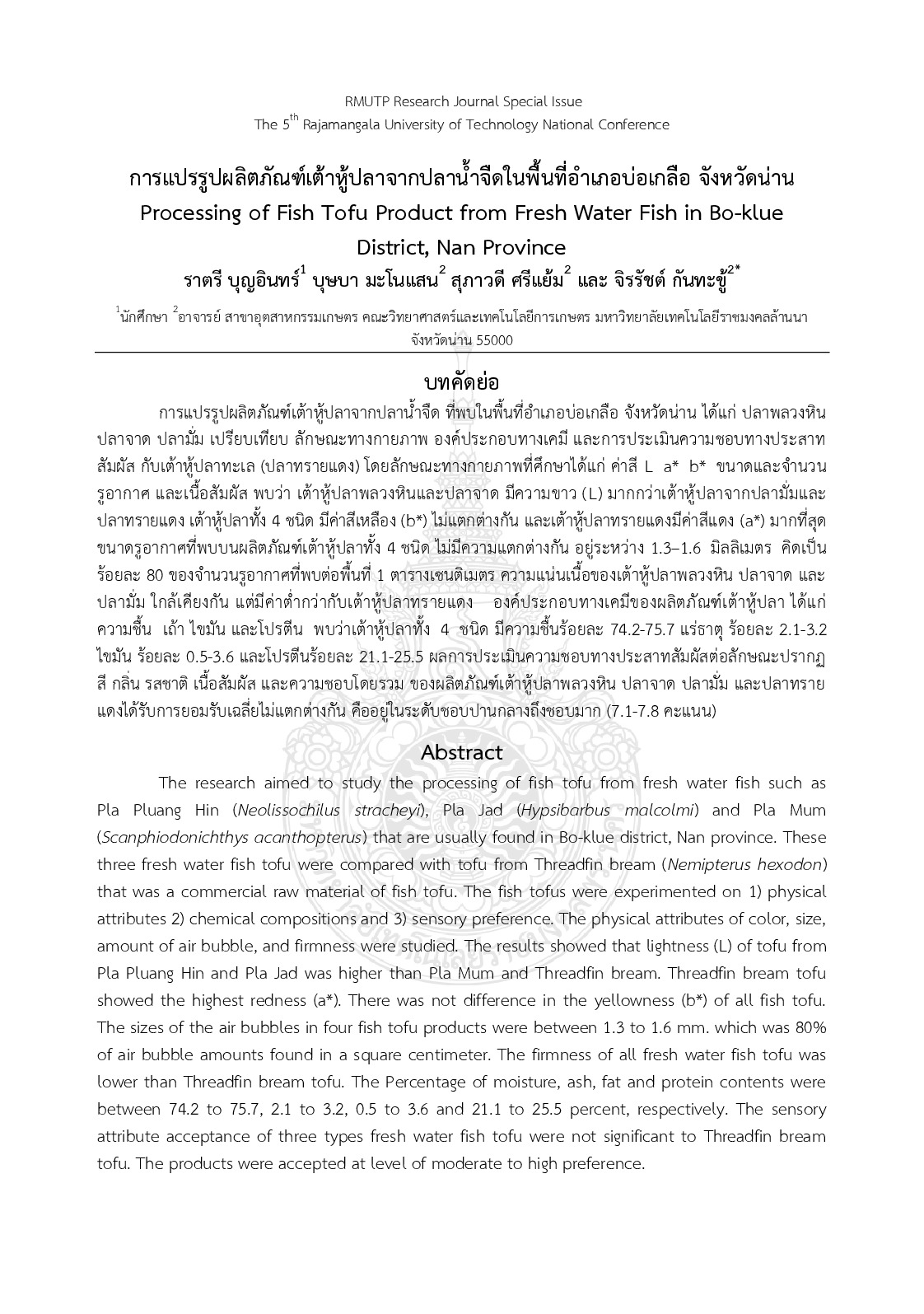
Processing of fish tofu product from fresh water fish in bo-klue district, nan Province
The research aimed to study the processing of fish tofu from fresh water fish such as Pla Pluang Hin (Neolissochilus stracheyi) Pla Jad (Hypsibarbus malcolmi) and Pla Mum (Scanphiodonichthys acanthopterus) that are usually found in Bo-klue district Nan province. These three fresh water fish tofu were compared with tofu from Threadfin bream (Nemipterus hexodon) that was a commercial raw material of fish tofu. The fish tofus were experimented on 1) physical attributes 2) chemical compositions and 3) sensory preference. The physical attributes of color size amount of air bubble and firmness were studied. The results showed that lightness (L) of tofu from Pla Pluang Hin and Pla Jad was higher than Pla Mum and Threadfin bream. Threadfin bream tofu showed the highest redness (a*). There was not difference in the yellowness (b*) of all fish tofu. The sizes of the air bubbles in four fish tofu products were between 1.3 to 1.6 mm. which was 80% of air bubble amounts found in a square centimeter. The firmness of all fresh water fish tofu was lower than Threadfin bream tofu. The Percentage of moisture ash fat and protein contents were between 74.2 to 75.7 2.1 to 3.2 0.5 to 3.6 and 21.1 to 25.5 percent respectively. The sensory attribute acceptance of three types fresh water fish tofu were not significant to Threadfin bream tofu. The products were accepted at level of moderate to high preference.
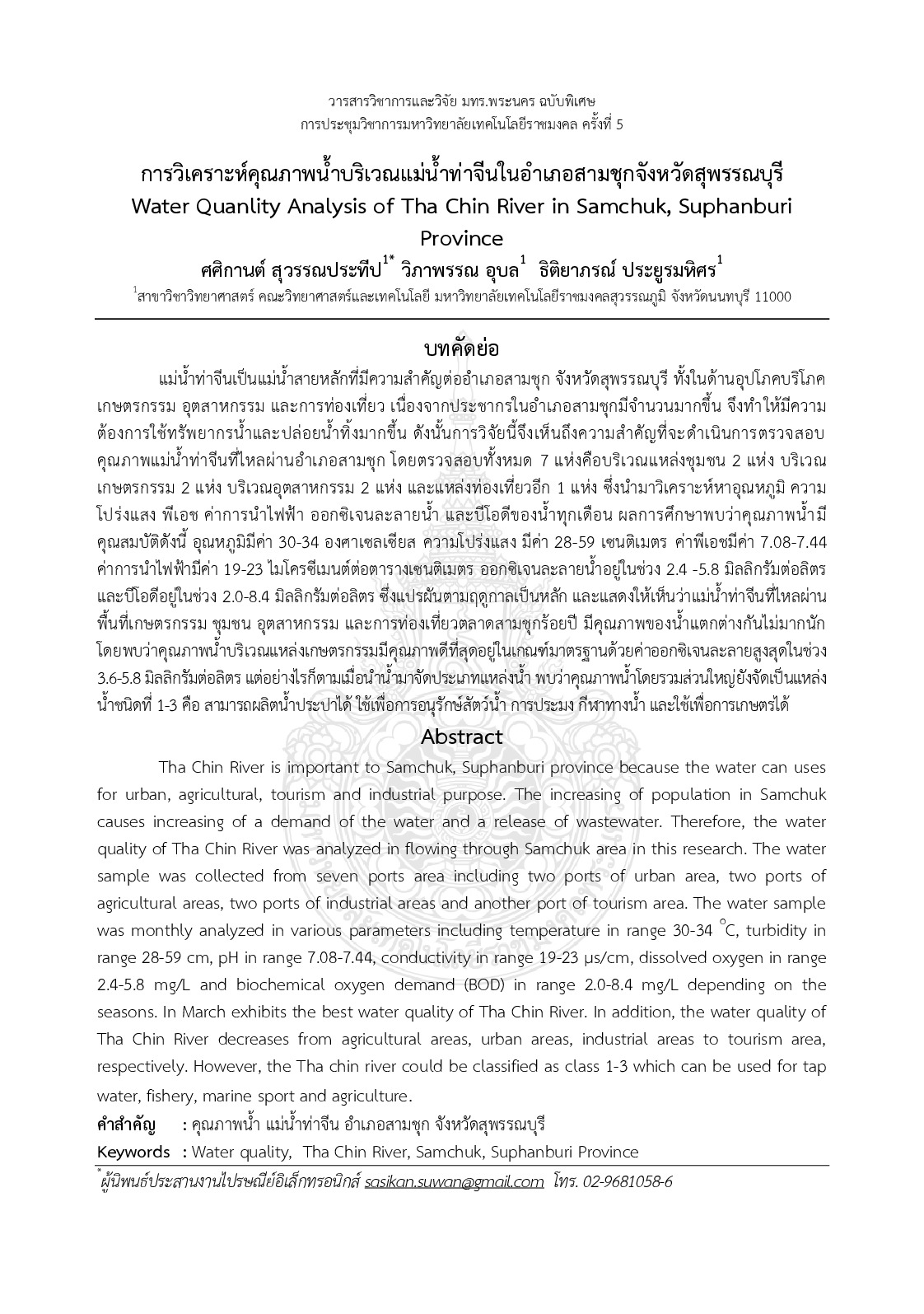
Water quanlity analysis of tha chin river in samchuk, suphanburi province
Tha Chin River is important to Samchuk Suphanburi province because the water can uses for urban agricultural tourism and industrial purpose. The increasing of population in Samchuk causes increasing of a demand of the water and a release of wastewater. Therefore the water quality of Tha Chin River was analyzed in flowing through Samchuk area in this research. The water sample was collected from seven ports area including two ports of urban area two ports of agricultural areas two ports of industrial areas and another port of tourism area. The water sample was monthly analyzed in various parameters including temperature in range 30-34 oC turbidity in range 28-59 cm pH in range 7.08-7.44 conductivity in range 19-23 s/cm dissolved oxygen in range 2.4-5.8 mg/L and biochemical oxygen demand (BOD) in range 2.0-8.4 mg/L depending on the seasons. In March exhibits the best water quality of Tha Chin River. In addition the water quality of Tha Chin River decreases from agricultural areas urban areas industrial areas to tourism area respectively. However the Tha chin river could be classified as class 1-3 which can be used for tap water fishery marine sport and agriculture.
The resource management with value engineering technique: case study water distillation RMUTL-tak campus
Pure water was consumed and insufficient that causes from the population continuous increasing. The water was contaminated with some pollutants. The most of science laboratory produced only the distillation water for experimental learning. In present distillation technology was released a lot of wastewater. Therefore a research group interested in applies to use value engineering for water resource management. This research collected the data analysis of distillation water process and designed of renewable wastewater for cooling process. The results shown that before improve system a distillation water and wastewater were found 3.7 l/h and 140.3 l/h respectively. For after improve system a distillation water was found only 3.82 l/h and without wastewater. Furthermore economical study found that the cost of water and electric were saved 394.23 bath/month when compared with old system. And the payback period was 114.16 month (9 years 6 months 3 days). Hence the applied value engineering for water resource management could be saved wastewater 100 percent.