จำนวน Repository ( 268 )
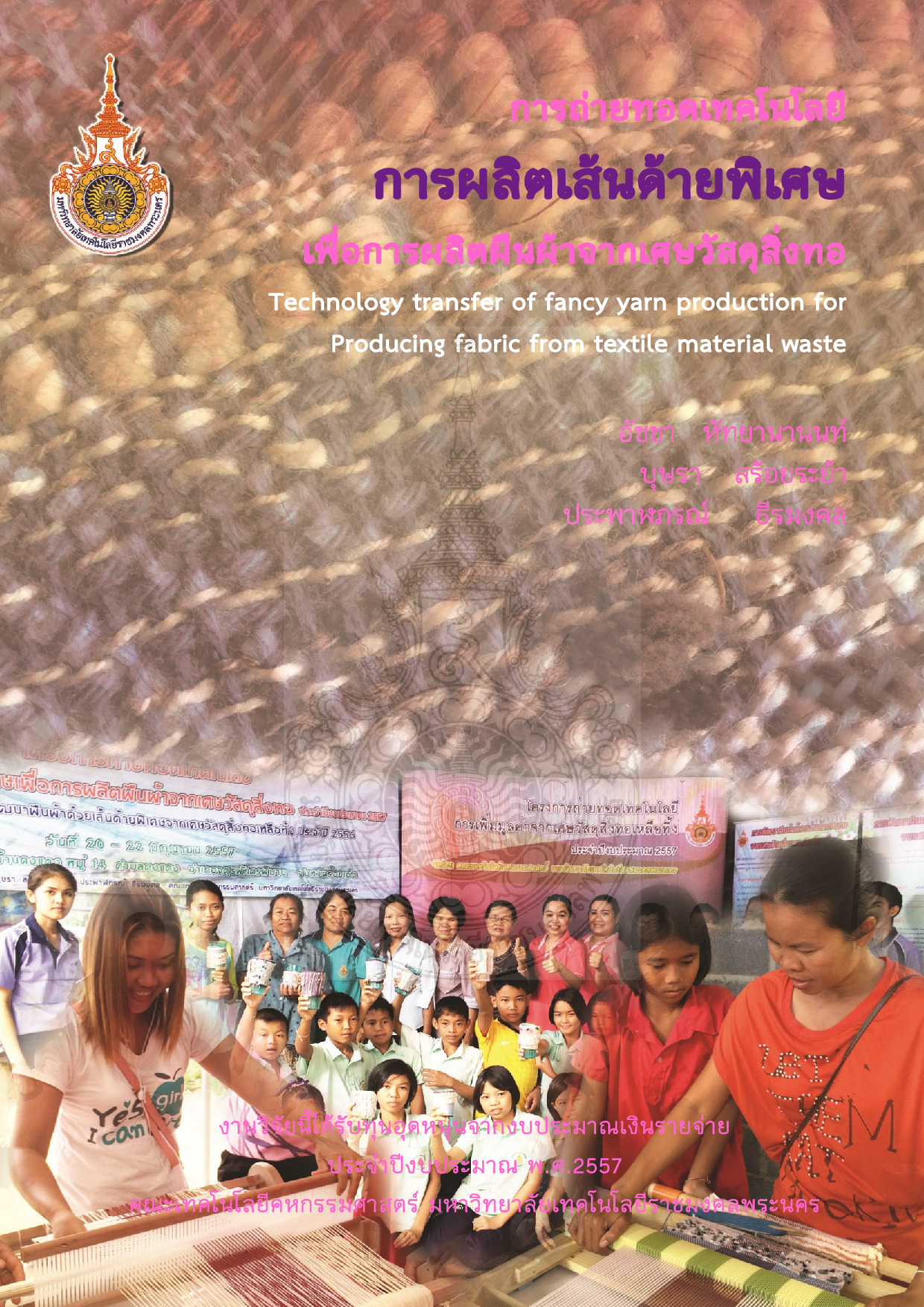
การถ่ายทอดเทคโนโลยีการสร้างตราสินค้าและบรรจุภัณฑ์เพื่อเพิ่มมูลค่าผลิตภัณฑ์จากเศษวัสดุสิ่งทอเหลือทิ้ง
The research aimed to Technology transfer of fancy yarn production for producing fabric from textile material waste. The purpose is to technology transfer of fancy yarn production for producing fabric to people and community and to evaluate of technology transfer of fancy yarn production for producing fabric. The procedures were as follows target population for the transfer of knowledge and technology as Small and Micro community Enterprise--SMCE and individuals interested in Dang Dong sub-district Bang Bon district at Roi-Ed province. A total of 34 peoples and two days on 20 - 21 June 2557 and a satisfaction survey with a questionnaire after training. The data were analyzed using frequency percentage and mean. The results that general Information are female and younger than 21 years of education in elementary education as a student. A question that asking about their satisfaction with the course and to divide into three aspects: the purpose of the project The course structure and the contents of the course. The majority were satisfied with the very best. The purpose and the content are high level of satisfaction. In relation to technology transfer of fancy yarn production for producing fabric from textile material waste divided into three aspects: the process provides trainers and facilities was found that were satisfied at all of the 3 parts. The participants are mainly used to provide benefits to themselves for one month to apply the knowledge gained after the training. The participants modified using a new material and used local materials applied accordingly. Moreover a focus will be capped by the school to take courses and workshops and to teach another one for working out or as part of the courses taught at the school. Satisfaction with the benefits of technology transfer and utilization. Satisfaction at the highest level. The comments and suggestions of the participants found that they need for re-training again. They would like to have a longer period of training in order to gain more knowledge. All lecturer can transfer knowledge during the training as well.

Optimization for sewing machine setup using experimental design technique
The objective of the research was to identify the optimized thread tensile values for the setup of Model D – We 1218-55 computerized 18-needles sewing machine in order to minimize a number of times the machine halts. The cause of the sewing machine halting which reduced the efficiencies of the machine was found to be torn threads. In order to maximize the efficiencies the experimental design technique was utilized to find the optimal values for five types of cloth: polo tc-cool cotton jacket and shirt. The method involved three nested designs which are the type of thread number of sewing layers and thread-hole size. The three thread tensile levels experimented were low (2 oz.) medium (5 oz.) and high (8 oz.) and the response was the number of times the machine halted in the span of 30 minutes. The ANOVA (Analysis of Variance) used for the experimental design showed that the three factors significantly affected the machine’s halt. The number of times the machine halted was used to create Surface Plot with polynomial trend-lines and the quadratic equation was applied to determine the optimal value for each type of thread number of sewing layers and thread-hole size. The values obtained were then set for another experiment the results of which were that the sewing machine halted less frequently and the efficiencies thus increased about by 77.01%.
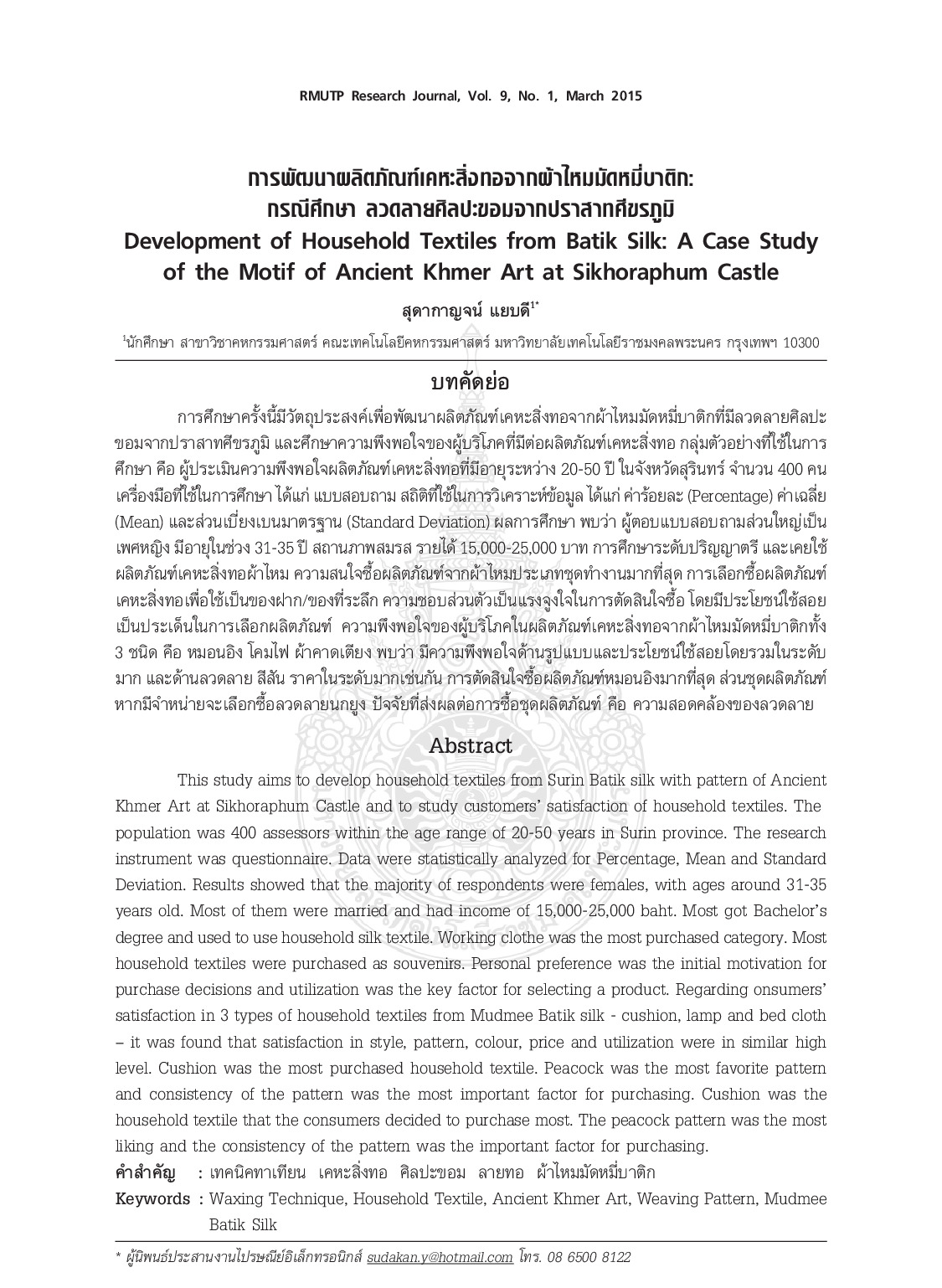
Development of household textiles from batik silk: a case study of the motif of ancient khmer art at sikhoraphum castle
This study aims to develop household textiles from Surin Batik silk with pattern of Ancient Khmer Art at Sikhoraphum Castle and to study customers’ satisfaction of household textiles. The population was 400 assessors within the age range of 20 - 50 years in Surin province. The research instrument was questionnaire. Data were statistically analyzed for Percentage Mean and Standard Deviation. Results showed that the majority of respondents were females with ages around 31 - 35 years old. Most of them were married and had income of 15000 – 25000 baht. Most got Bachelor’s degree and used to use household silk textile. Working clothe was the most purchased category. Most household textiles were purchased as souvenirs. Personal preference was the initial motivation for purchase decisions and utilization was the key factor for selecting a product. Regarding onsumers’ satisfaction in 3 types of household textiles from Mudmee Batik silk - cushion lamp and bed cloth – it was found that satisfaction in style pattern colour price and utilization were in similar high level. Cushion was the most purchased household textile. Peacock was the most favorite pattern and consistency of the pattern was the most important factor for purchasing.
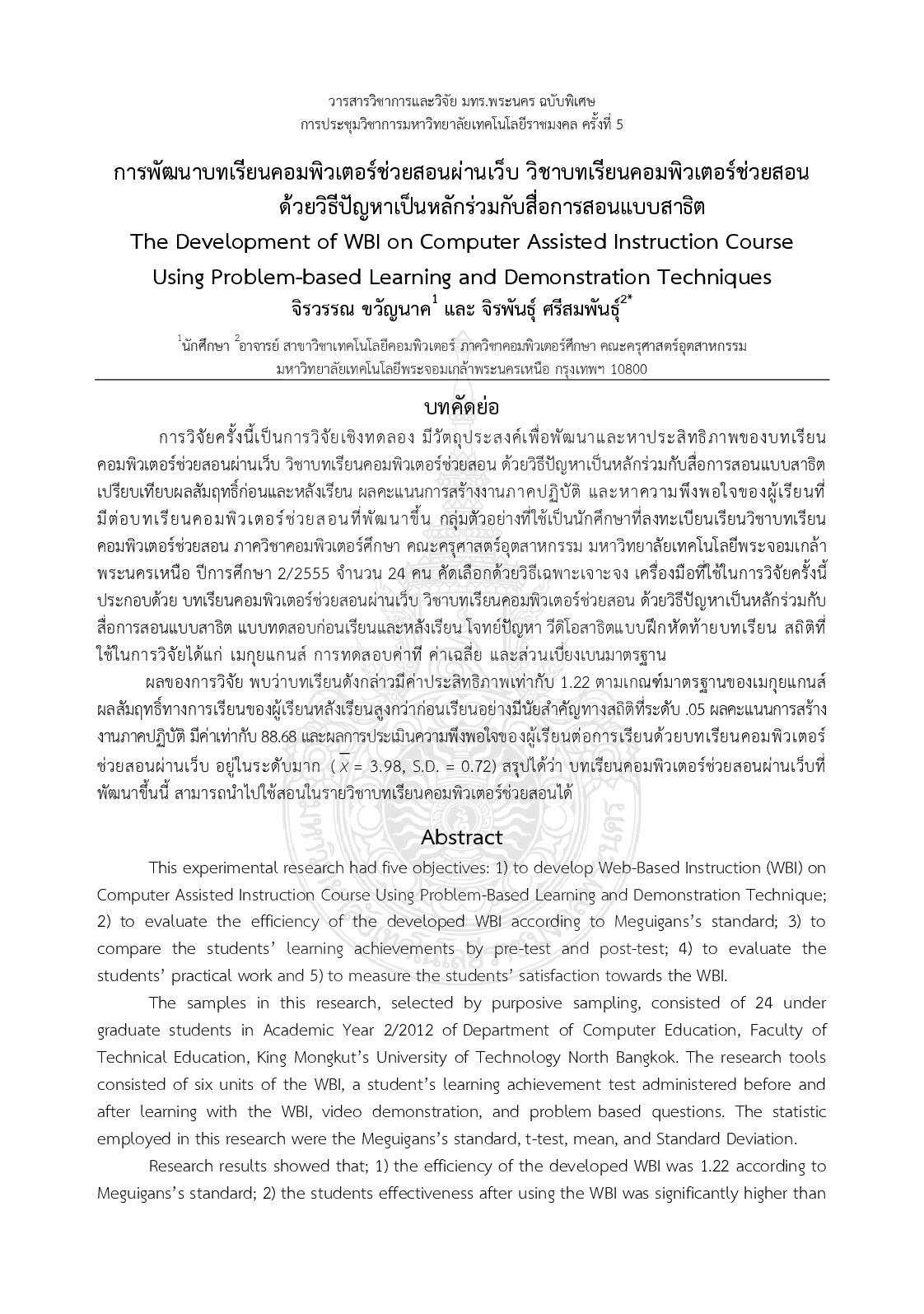
The development of wbi on computer assisted instruction course using problem-based learning and demonstration techniques
This experimental research had five objectives: 1) to develop Web-Based Instruction (WBI) on Computer Assisted Instruction Course Using Problem-Based Learning and Demonstration Technique; 2) to evaluate the efficiency of the developed WBI according to Meguigans’s standard; 3) to compare the students’ learning achievements by pre-test and post-test; 4) to evaluate the students’ practical work and 5) to measure the students’ satisfaction towards the WBI. The samples in this research selected by purposive sampling consisted of 24 under graduate students in Academic Year 2/2012 of Department of Computer Education Faculty of Technical Education King Mongkut’s University of Technology North Bangkok. The research tools consisted of six units of the WBI a student’s learning achievement test administered before and after learning with the WBI video demonstration and problem based questions. The statistic employed in this research were the Meguigans’s standard t-test mean and Standard Deviation. Research results showed that; 1) the efficiency of the developed WBI was 1.22 according to Meguigans’s standard; 2) the students effectiveness after using the WBI was significantly higher than before using it at .05; 3) the average score of the practical work was 88.68 higher than 80; 4) the students’ satisfactory was at a good level. In conclusion the developed WBI can be used for the target group properly.
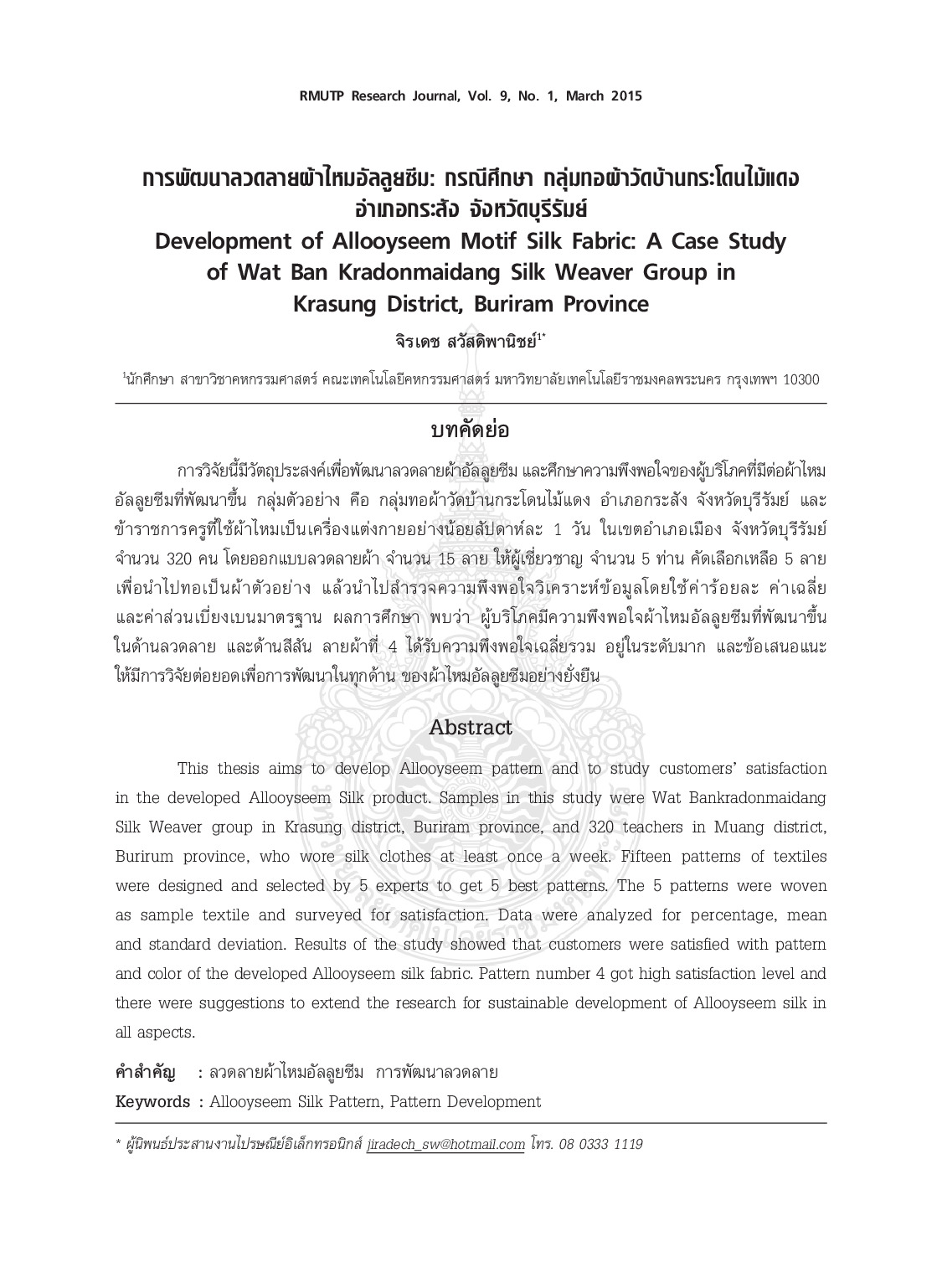
Development of allooyseem motif silk fabric : a case study of wat ban kradonmaidang silk weaver group in krasung district, buriram province
This thesis aims to develop Allooyseem pattern and to study customers’ satisfaction in the developed Allooyseem Silk product. Samples in this study were Wat Bankradonmaidang Silk Weaver group in Krasung district Buriram province and 320 teachers in Muang district Burirum province who wore silk clothes at least once a week. Fifteen patterns of textiles were designed and selected by 5 experts to get 5 best patterns. The 5 patterns were woven as sample textile and surveyed for satisfaction. Data were analyzed for percentage mean and standard deviation Results of the study showed that customers were satisfied with pattern and color of the developed Allooyseem silk fabric. Pattern number 4 got high satisfaction level and there were suggestions to extend the research for sustainable development of Allooyseem silk in all aspects.