จำนวน Repository ( 361 )
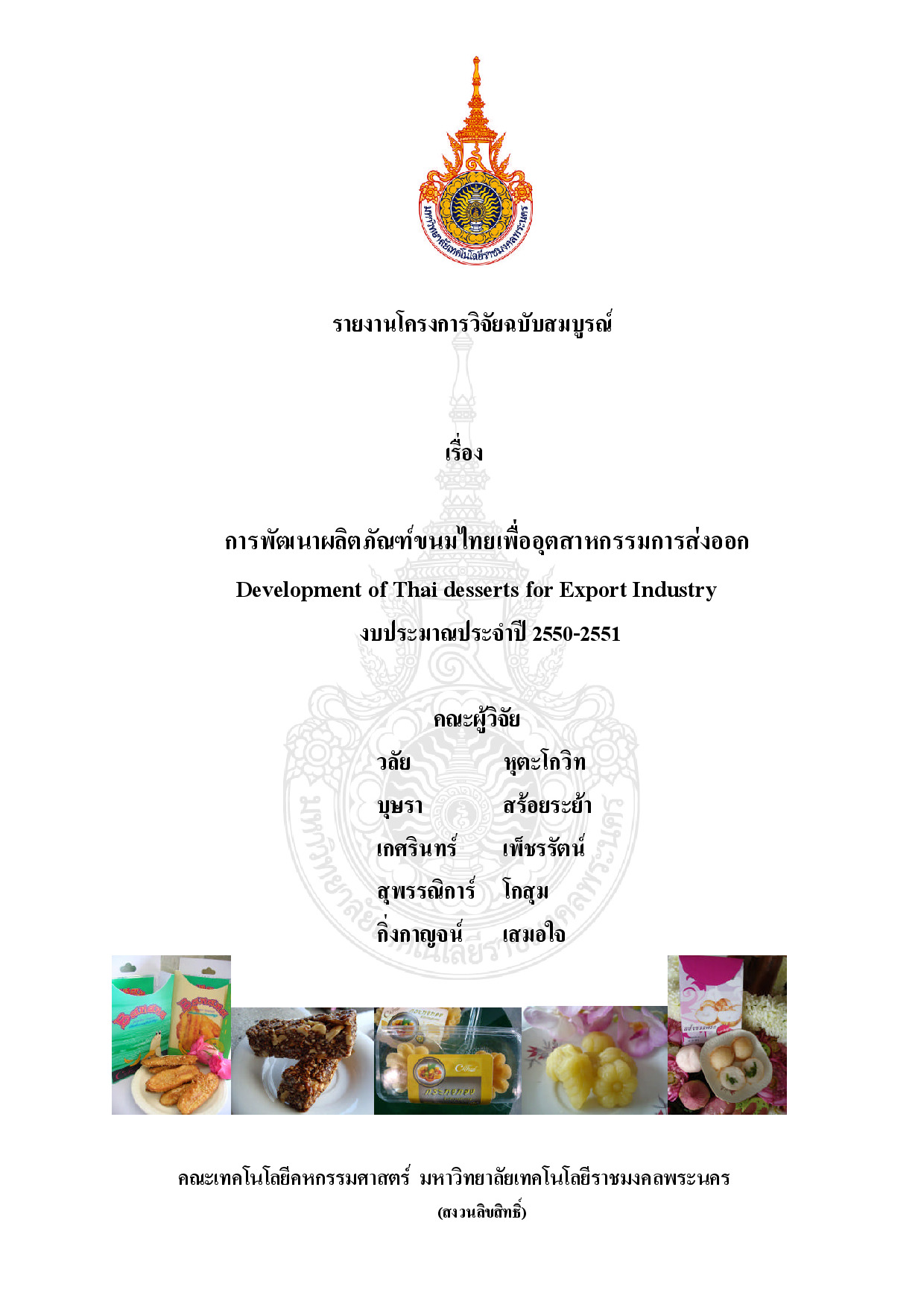
การพัฒนาผลิตภัณฑ์ขนมไทยเพื่ออุตสาหกรรมการส่งออก
Development Project of Thai dessert products for export industry aimed to develop 5 kinds of Thai dessert recipes and process which consisted of cereal bar instant peanut paste powder instant fried banana flour Kratong Thong (Golden Thai Pastry Cups) adapted for keeping longer and instant Kanom Krok flour (Coconut Rice Cake). The result was found that cereal bar from black sticky rice was developed by using 2 % high-fructose syrup and 12% glucose syrup and total soluble solid of syrup was at 90 Brix. The product tested was accepted moderately. Instant peanut paste powder recipe development made by Miss Suphannika Kosum was tested for sensory evaluation to compare with other peanut paste produced in marketplace. It was found that the product was accepted and there was statistically significant difference at p< 0.05. The five sensory overall liking attributes (colour smell taste texture and total impression) were 7.83 7.76 7.73 7.63 and 8.03 respectively. The product had high preference score. Instant fried banana flour recipe development was done by using rice flour to wheat flour ratio at 120:20 12.5% baking soda and 0.5% calcium chloride. Water requirement was 200 milliliter. The product was accepted at medium to high level. The second recipe of Kratong Thong (Golden Thai Pastry Cups) was the most accepted because it was golden yellow and smooth and stir frying for 1.3 minutes. The product was accepted at medium to high level. For instant Kanom Krok flour (Coconut Rice Cake) it was found that 3 recipes of them were significantly different for texture liking at p< 0.05. 100 and 90 gram of rice flour were studied for producing Kanom Krok it was found that there was no statistically significant difference for overall liking attributes (p> 0.05). Because of indifferent quantity of flour Kanom Krok was slightly different. However Kanom Krok made by 90 gram rice flour was less firming when compared to 100 gram rice flour and the product quantity obtained was also less. There was no statistically significant difference for overall liking attributes. The researcher transferred this knowledge and technology to the target private organization. The first time held on “Thai Dessert Products Course” in Lopburi province between 12-13 May 2008. The result of the technology transfer was found that 80 % of the participants’ satisfaction was accepted and after the course was finished the target groups applied this knowledge and technology for their careers to increase community’s income. It is regarded that this project was accomplished according to its success in the goal and objectives. Remark: 1Assistant Professor 2Lecturer of the Faculty of Home Economics Technology 3Lecturer of the Faculty of Architecture and Design

รูปแบบการจัดการแข่งขันกีฬามหาวิทยาลัยเทคโนโลยีราชมงคลแห่งประเทศไทย
The purpose of this study was to investigate organization model of Rajamangala University of Technology Games of Thailand. Samples were 15 persons from the Executive Board of Rajamangala University of Technology Games of Thailand and specialists in sport management from various sport organizations. Questionnaire research instrument constructed by the researcher was used to collect data by Delphi technique. The data were then analyzed into frequency percentage median and inter-quartile range. It was found that: Appropriate organization model of Rajamangala University of Technology Games of Thailand should be divided into 7 aspects. The aspect details were: 1. OBJECTIVES: Objectives of games should be to develop students and personnel to be fit and healthy to show good spirit team-work self discipline and dedication; to promote conserve and develop Thai sports. 2. SCHEDULING AND MANAGEMENT: The games should be held annually for 8 days this should include Opening and Closin ceremony; method of competitive organizing in each sport should be in accordance with fixed time and according to international sport standards. Additionally current rules of sport associations of Thailand should be used. 3. THE NUMBER OF SPORTS: The number of sports should not be less than fifteen types and not more than twenty sports from four different groups of sport. Five from Required Sports: athletics swimming football basketball and volleyball. Eight from Elective International Sports i.e. Olympic Games Asian Games SEA Games or World University Games. One each from General Elective Sport and Thai sport. 4. PLAYERS: Players should be students who had already registered to study in the year of sport organizing. They should be players for only one university and were amateur players under the jurisdiction rules of Sport Authority of Thailand. They should have grade point average (GPA) not less than 2.00.5. HOST: The host university should prepare medals and certificates for champion and the two runner-ups. The Executive Board of Rajamangala University of Technology Games of Thailand should give rewards to the players who post a new record. 6. BOARDs: The board of Rajamangala University of Technology Games of Thailand should be comprised of two boards; the Executive Board and the Organizing Committee 7. EVALUATION: Rajamangala University of Technology Games of Thailand should be . evaluated from athletes team managers coaches referees and spectators within 30 days after the end of competition.
ผลการสอดแทรกจริยธรรมในการสอนภาษาไทยโดยใช้เพลงไทยและธรรมะเป็นสื่อ
The purposes of this research were to study and to compare the addition of ethics to Thai teaching using Thai songs and Dhama lessons. The samples chosen by purposive sampling were the first year English for International Communication students of the faculty of Liberal Arts Rajamangala University of Technology Phra Nakhon. They were divided into 2 groups and each group consisted of 30 students. The first group learned Thai with the addition of ethics using Thai songs while the second group learned Thai using Dhama lessons. The instruments were a pretest and a posttest. The results revealed that the test scores of the two groups of students after the addition of ethics to Thai teaching using Thai songs and Dhama lessons were higher. The means scores and standard deviations of the test results of the first group were23.13 and 3.18 and the second group were 22.23 and 3.49 respectively. In addition there was no significant difference (.05) in teaching Thai with the addition of ethics using Thai songs and Dhama lessons.
การสร้างบทเรียนคอมพิวเตอร์ช่วยสอนภาษาไทยเบื้องต้นเพื่อการสื่อสารธุรกิจ มหาวิทยาลัยเทคโนโลยีราชมงคลพระนคร
The purpose of the study was fourfold: 1) to construct a computer-assisted-instruction (CAI) of Basic Thai for Business Communication at 2) to determine the efficiency of the CAI at 80/80; 3) to compare the student learning achievement of the CAI based on the pretest and posttest scores ; and 4) to determine the students’ satisfaction towards the CAI. The subjects of the study were the 30 first-year undergraduate students majoring in Finance and Marketing the Faculty of Business Administration at Rajamangala University of Technology Pranakorn in 2008. The instrument and procedures comprised 4 parts. Part one contains the 8 units of CAI of Basic Thai for Business Communication each consisting of examples an end-of-unit exercise and a 5-item-end-of-unit test to measure lesson efficiency. Part two is the try-out CAI to determine its efficiency based on the results of the three respective groups which were initially 6 students majoring in Accountancy then 10 students majoring in Accountancy and finally 30 students majoring in Accountancy from the Faculty of Business Administration. The data were analyzed in percentage and mean. Part three comprises the tests consisting of the 30-item pretest and posttest containing the shuffled pretest items to compare the student achievement. The learning achievement was determined by t-test. Part four is the 10-rating scale items to survey the students’ satisfaction towards the CAI. The data were interpreted in mean score.The results indicated as follows: 1) the CAI of Basic Thai for Business Communication can be effectively complemented to teaching and learning; 2) the efficiency indication of the CAI of Basic Thai for Business Communication was higher than the set criteria 80/80 at 84.58/87.44; 3) the posttest scores were significantly higher than the pretest scores at 0.05; 4) The students were extremely satisfied with the CAI of Basic Thai for Business Communication in all aspects at Σ x 4.37.