จำนวน Repository ( 534 )
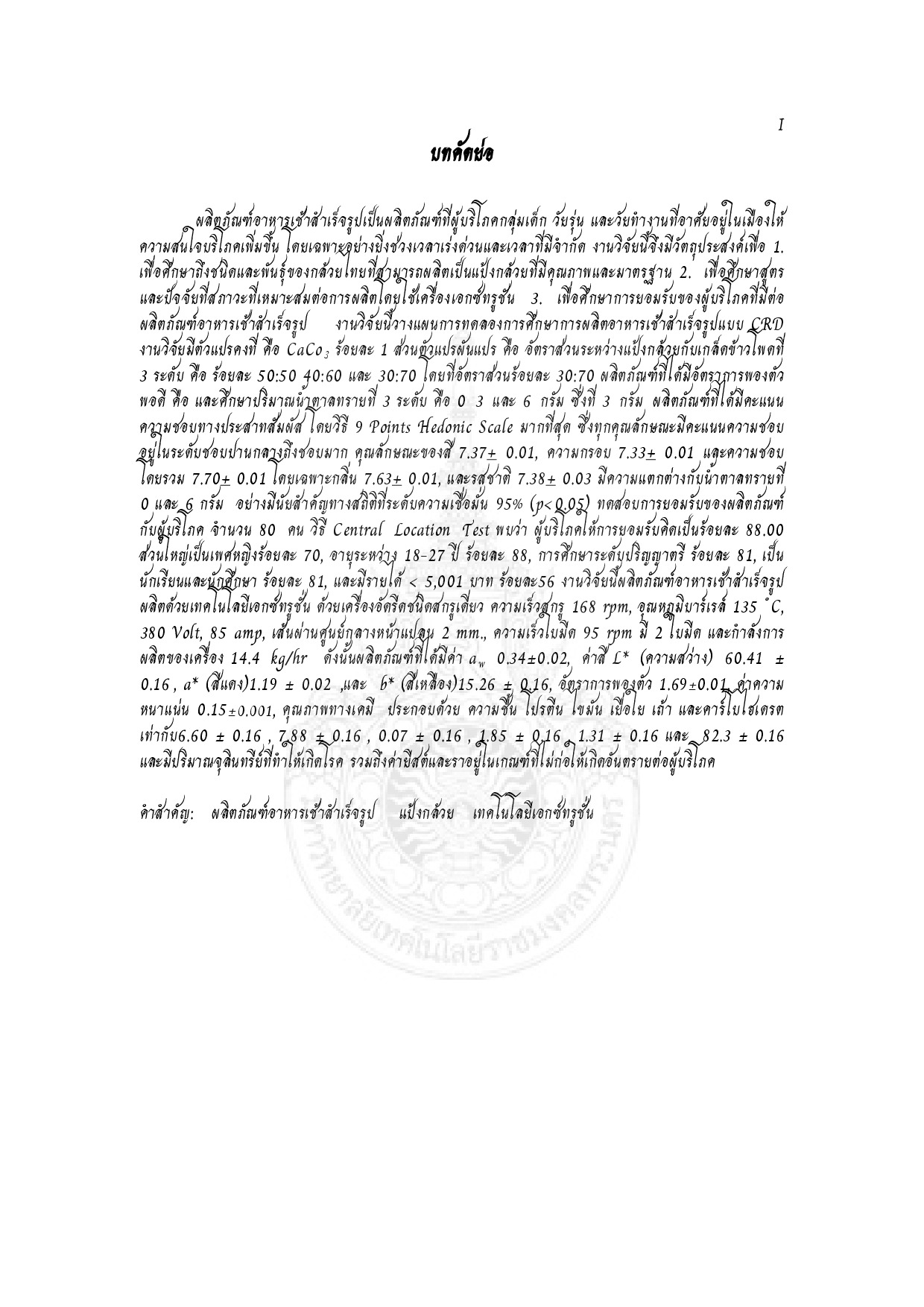
ผลิตขนมขบเคี้ยวจากพืชสมุนไพรไทยพื้นบ้านด้วยเทคโนโลยีเอ็กซ์ทรูชั่น
Thai Local Herbs Snack Product (TLHSP) is very popular and has increase tendency the target group in worldwide such as children teenager and adult which live in metropolis. The aim was 1.) to study the formular and condition to produce TLHSP by extruder machine 2.) to study the type and quantity of Thai Local Herbs which was added 3.) to study the shelf-life and type of package to keep TLHSP. The study used CRD to design the method and has a stable variable is 1% CaCo3and varies 2 variables are the ratio between a speed of single screw at 3 levels such as 250 300 and 350 rpm and moisture content of raw material at 3 levels such as 15 17.5 and 20. And this research study about the level of grinded sugar (GS) at 3 levels such as 0 3 and 6 g. which at 3 g. the TLHSP had well scores of 7 to 8 (like moderately to like very much; used 9 Points Hedonic Scale method for the sensory test) the characteristic for color was 7.37+ 0.01 texture in crisp was 7.33+ 0.01 and overall acceptance was 7.70+ 0.01. Especially odor was 7.63+ 0.01 and taste was 7.38+ 0.03 there were significant differences (p<0.05) with 0 and 6% grinded sugar. TLHSP was well accepted by consumers with 88.00% (By the Central Location Test for questionnaire paper survey). Almost 70% were female 88% had 18-27 years-old 81% were student and 56% hadincome cash < 5001 baht/ months. This study used the extrusion technology to produceTLHSP which the fixed specification fallow as; a speed of single screw was 300 rpm Barrel temperature was 134-165 ˚C 380 Volt 85 amp a diameter in front of machine was 2 mm. a speed of blade 95 rpm and had 2 pieces. And the capacity was 14.4 kg/hr. Therefore aw0.34±0.02 Lightness 60.41 ± 0.16 %extended ratio1.69±0.01 %bulk density 0.15± 0.001. Chemical Properties for %moisture6.60±0.16 %protein 7.88±0.16
ผลการใช้นาโนเทคโนโลยีของเครื่องแต่งกายเชฟที่มีผลต่อความปลอดภัยในอาหาร
The research regarding effect of nanotechnology use in making chef apparel on safety of food had the objectives to study about the result of using nano materials coating on yarn and fabric; to study about the use of nano materials which are suitable for fabric to be sewn for being chef apparel and to study the effect of using of nanotechnology for chef apparel on smell and the inhibition of pathogenic bacteria growth using three types of nano materials including Zinc oxide nano Silver nano and Titanium dioxide nano to be coated on four samples including cotton thread T/R thread cotton fabric and T/R fabric. The researcher tested the fabric sample for inhibiting growth of pathogenic bacteria and found that Zinc oxide nano and Silver nano were not different in inhibiting growth of pathogenic bacteria. But the coating on the fabric is more convenient and cheaper. And effective against Gram-positive bacteria. A bacterium that is often found in personal hygiene unclean conditions better than or equal to SS.S3%. Then Four kinds of fabric were sewn to be chef apparel. Actual chef tried wearing to test effectiveness in resisting bacteria. When the apparel was used for two times it was found that T/R fabric which was coated with Zinc oxide nano and Silver nano had different ability to resist gram-positive bacteria and gram-negative bacteria. Fabric T/R Silver nano coating remains effective against bacteria as well and proper to be sewn as chef apparel.
ปัจจัยที่ส่งผลต่อเจตคติต่อการทำงานในโรงงานอุตสาหกรรมเสื้อผ้าของนักศึกษา คณะเทคโนโลยีคหกรรมศาสตร์ มหาวิทยาลัยเทคโนโลยีราชมงคลพระนคร
This research aims to study the factors affecting the attitude of students in faculty of home economics technology towards work in factory of garment industry. Contain factor of personal characteristics of students the family background of students and the learning environment of students. Population is divisions of fashion merchandising technology and fashion clothing & textile design class 1-4 of Year 2555 total 210 people. Tool used was the questionnaire. Statistics used were percentage mean standard deviation correlation coefficient of Pearson and multiple regression analysis. The results showed factors affecting attitude towards work in factory of garment industry of students in faculty of home economics technology statistically significant at the .01 level has 3 factors. Sort by factors affecting most to the least 1) learning environment of students 2) Number of subjects for textile cutting and sewing learned ever 3) Personal characteristics of students and could explain the variability of attitude towards work in factory of garment industry at 77.1 percent of this population.
ผลการจัดการเรียนรู้แบบร่วมมือเชิงบูรณาการ วิชาเทคนิคการจัดดอกไม้ ของนักศึกษา ระดับปริญญาตรี สาขาวิชาการบริหารธุรกิจคหกรรมศาสตร์ มทร.พระนคร
The research studied results of integrated learning management in flower arrangement techniques subject of students from the bachelor’s degree in Home Economics Business Administration program Rajamangala University of Technology Phra Nakhon. The researchers provided the cooperative learning and selected three units of flower arrangement techniques subject consisting of materials and tools for arranging flowers creative flower arrangement and international flower arrangement. The research samples were the second year students of Home Economics Business Administration program. The research methods used in this study were a learning achievement form a satisfaction form and a participant observation form. Results of the study found were: 1. The effects of cooperative learning on students flower arrangement techniques subject achievement was found that there was a statistically significant difference between students pretest and post-test scores at the level .05. 2. The satisfaction of students toward flower arrangement techniques subject was at the highest level ( x = 4.00). It showed that students’ attitudes toward cooperative learning were at good level.
พฤติกรรมการใช้น้ำ และไฟฟ้า ของนักศึกษาคณะเทคโนโลยีคหกรรมศาสตร์ มหาวิทยาลัยเทคโนโลยีราชมงคลพระนคร
The purposes of this research are to study water and electricity consumption behavior of the students to study understanding of water and electricity saving and to compare the difference of water and electricity consumption behavior classified as personal characteristic of the students Faculty of Home Economics Technology Rajamangala University of Technology Phra Nakhon. This research was descriptive research. The sample group used in the research was the students Faculty of Home Economics Technology Rajamangala University of Technology Phra Nakhon. Size of the sample group was specified to be 325 people by stratified sampling. The tool used in data analysis was questionnaire divided into 3 parts including part 1: questions regarding general details of a respondent part 2: questions regarding knowledge of water and electricity saving consumption the students of Faculty of Home Economics Technology Rajamangala University of Technology Phra Nakhon and part 3: questions regarding water and electricity consumption behavior of the students Faculty of Home Economics Technology Rajamangala University of Technology Phra Nakhon. The statistics used in data analysis consisted of frequency percentage mean standard deviation and hypothesis testing using t-test and ANOVA (Analysis of Variance) for testing parallel difference by LSD method. The research result found that: 1. The level of water and electricity consumption behavior of the students Faculty of Home Economics Technology Rajamangala University of Technology Phra Nakhon was overall in the moderate level. 2. The level of understanding and knowledge regarding water and electricity saving of the students Faculty of Home Economics Technology Rajamangala University of Technology Phra Nakhon was overall in the moderate level. 3. The comparison of different behavior of water and electricity consumption specified according to personal characteristics could be summarized that the students having different gender class and major had identical water consumption behavior and the students having different gender class and major had identical electricity consumption behavior. On the other hand the students having different major had statistical significance in electricity consumption behavior at 0.05