จำนวน Repository ( 361 )
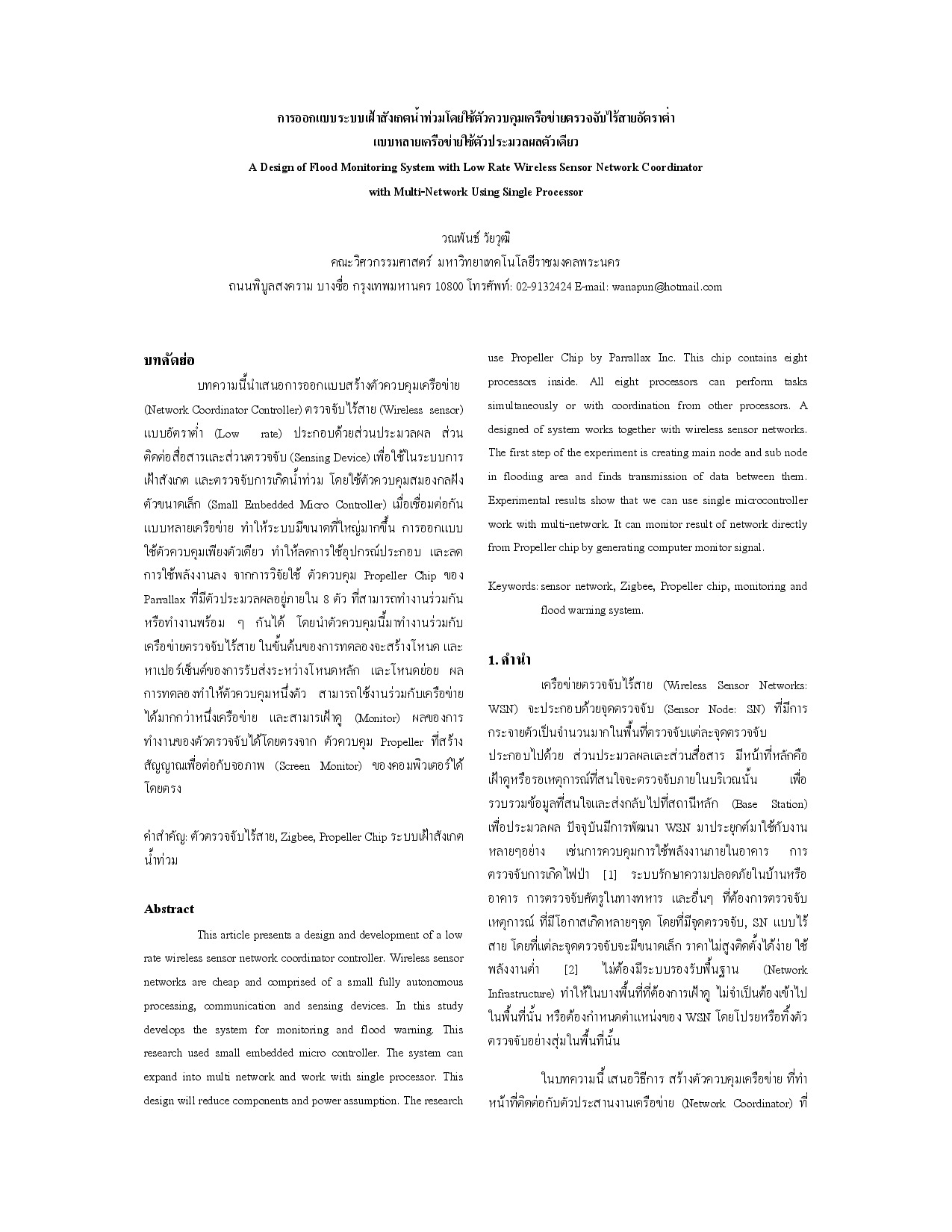
A Design of Flood Monitoring System with Low Rate Wireless Sensor Network Coordinator with Multi-Network Using Single Processor
This article presents a design and development of a low rate wireless sensor network coordinator controller. Wireless sensor networks are cheap and comprised of a small fully autonomous processing communication and sensing devices. In this study develops the system for monitoring and flood warning. This research used small embedded micro controller. The system can expand into multi network and work with single processor. This design will reduce components and power assumption. The research use Propeller Chip by Parrallax Inc. This chip contains eight processors inside. All eight processors can perform tasks simultaneously or with coordination from other processors. A designed of system works together with wireless sensor networks. The first step of the experiment is creating main node and sub node in flooding area and finds transmission of data between them. Experimental results show that we can use single microcontroller work with multi-network. It can monitor result of network directly from Propeller chip by generating computer monitor signal.
A Design of Low Rate Wireless Sensor Network Coordinator with Multi-Network Using Single Processor
This paper presents the development of a low rate wireless sensor network coordinator with multi-network. This research used small embedded micro controller. The system can expand into multi network and work with single processor. This design will reduce components and power assumption. The research use Propeller Chip by Parrallax Inc. This chip contains eight processors inside. All eight processors can perform tasks simultaneously or with coordination from other processors. It comprised of zigbee chip to perform wireless sensor network that work with 802.15.4 protocol. Experimental results show that we can use single microcontroller work with multi-network. It can monitor result of network directly from Propeller chip by generating computer monitor signal.

Product design and development of the cutting tools complete set
This research is to study the cutting tools product in reverse engineering for turning milling and drilling included Tool holder Arbor and Insert tool. It is sampled the imported cutting tools from three areas worldwide composed with Sweden United State of America and Japan. The study emphasis in Arbor 136 mm. (6 tooth) Arbor 63 mm. (4 tooth) the changeable Insert tool typeTool bolder 20 mm. and Tool holder for turning. The result is found that Tool holder materials has the mixture of 0.387-0.437 %C hardness is 39.36-53 HRC which was full hardening. The price of Arbor (6 tooth) surveyed from four brands maximum is 22350 Baht and 2.41 times of price differentiation. The price of Arbor (4 tooth) surveyed from two brands maximum is 19000 Baht and 0.1-0.5 times of price differentiation. The price of Tool holder surveyed from three brands maximum is 14300 Baht and 0.15-0.55 times of price differentiation. And the price of Tool Holder for turning surveyed from four brands maximum is 1900 Baht and 0.5-1 times of price differentiation. The provider set up Tool holder and Insert tools will not be compatible together for marketing strategy. There are not much key player providers so there is no strong competition. The provider forces to distribute a set of 10 Insert tools and the most of Tool holder is Hardening and quenching not less than 39 HRC. The metal removal might be necessary use high technology and precision CNC Milling Machine. Therefore the study will lead to design and produce the prototype of cutting tools complete set which is compatible with Insert tools in all processes for turning milling and drilling. This cutting tools complete set differentiates from others because it helps to reduce costs reduce times and work comfortable. The development of compatible cutting tools complete set is the approach to reduce costs and times of work decrease maintenance costs and it will be the foundation to development of multi-function cutting tools complete set in place of the imported cutting tools.
การพัฒนาลวดลายผ้ามัดหมี่ : กรณีศึกษาเส้นกรอบนอกของปราสาทศีขรภูมิเพื่อนำมาใช้ในการออกแบบลายผ้า
The aims of this study are to 1.) develop a new woven Mudmee pattern which inspired by optical art integrated with the silhouette of Prasat Si Khoraphum in Surin province 2.) use the developed Mudmee pattern to improve clothing design influenced from 1960s fashion 3.) test the satisfaction level of the finished Mudmee clothes from the sample group. There are 7 textiles professionals including pattern designers textile artists Mudmee textile specialists and 5 fashion designers as supervisors in screening the patterns and designs. The sample group is selected from the staffs who work in Rajaphat Surindra University and Rajamangala Northeast (Surin Campus). The tool in this research are the fabric pattern sketches inspired by optical art integrated with the silhouette of Prasat Si Khoraphum the 1960 fashion clothing design sketches and the satisfaction survey. The satistical package for the social science program was employed fro mean and percentage. This study found that the most selected designs from 7 textiles professionals were Pra Sart Moom Soong 1 pattern Nammatam1pattern and Rekhakanit 4 pattern. There were 9 jacket sketches that had been selected. The level of satisfaction on the clothing design from 1960 era of 213 women staff who work in Rajabhat Surindra University and Rajamangala Northeast University (Surin Campus) showed that the Pra Sart Moom Soong 1 pattern gained the highest level of satisfaction (4.78) The Rekhakanit 4 pattern was the most aesthetics pattern (4.70). Finally the sample group satisfied the color and pattern of Nammatam1 the most (4.73). In Chon-Phoa group the most aesthetic jacket patterns were Pra Sart Moom Soong 1 (4.67) and Nammatam1 (4.70). While the Rekhakanit 4 pattern appeared to has the highest level of correlation between pattern and clothing design (4.74). In the uniform group the most aesthetic 1960 jackets pattern were Pra Sart Moom Soong 1 (4.74) and Nammatam1 (4.71). While the Rekhakanit 4 pattern appeared to has the highest level of correlation between pattern and clothing design (4.73). In Art and Fashion group highest level of correlation between pattern and clothing designs for each pattern were Pra Sart Moom Soong 1 pattern(4.67) Rekhakanit 4 pattern (4.69) and Nammatam1 (4.70).
Development of Structural Design for Hang Khra Rok Silk.
The aimed of this study are to 1) Pattern design development of silk loincloth (hangkrarok silk) of Community Silk-Weavers Groups in Huairat district Buriram province. 2) The study of customer satisfaction of developed silk loincloth (hangkrarok silk) by Community Silk Weavers Groups in Huairat district Buriram Buriram province. The procedure of this research is population of Community Silk-Weavers Groups in Huairat district Buriram province. All population is 8 (Tam-bon) districts. In pattern design development processing it used pattern design of silk loincloth (hangkrarok silk) by 18 patterns design sketching as instrument and selected 9 patterns design sketching by 5 specialists. For corresponded with colors using of silk yarn and to combine twist silk yarn pattern design development with weaving technique apply and pattern design development with applying of structure weaving. In order to taking sketch to weaving by the random sampling from population is Community Silk- Weavers Groups in Huairat district Buriram province.The random sampling is 1 group. The weaving proceed had to progress to get the pattern design specialist selected; there are 9 patterns. In conclusion of this research 9 patterns design selected and progressed with the development step and get the products of silk loincloth (hangkrarok silk) as follow the 9 patterns design selected was 100 percent. And then the researcher process in next step was taking developed silk loincloth (hangkrarok silk) for studying the satisfaction of silk loincloth (hangkrarok silk) of Community Silk-Weavers Groups in Huairat district Buriram province. by taking a random purposive sampling there are 320 samples. To study in 3 parts as follow 1) colors 2) patterns and 3) the structure of patterns design developed silk loincloth (hangkrarok silk). The result of this research is the customers had the satisfaction in the parts of colors pattern and the structure of patterns design developed silk loincloth (hangkrarok silk) in high level. Thus the researcher recommended that having the afterward researching for the sustainable silk textile development.