จำนวน Repository ( 580 )
การพัฒนาศักยภาพเนื้อทุเรียนสุกในการแปรรูปผลิตภัณฑ์อาหาร
This research has the purpose to study about the process of transforming of food products supplemented with five types of ripe durian having grade failure. It aims to study about quality of food products transformed from ripe durian having grade failure. It is the study about consumer test having effect towards food products transformed from ripe durian having grade failure and transferring of technology for developing of processed food product from ripe durian texture to the community. The experiment found that study of suitable quantity of pipe durian having grade failure in supplementing food products in 5 types by testing about acceptance of testers who were 40 instructors in Field of Food and Nutrition Field of Food Science and Nutrition and Field of Food Service Industry. The researcher used methods of giving scores of favor in type of 9-point hedonic scale. The researcher added ripe durian having grade failure into durian coconut milk at levels of 0 30 60 and 90 per cent of total ingredients. It was found that testers accepted the durian coconut milk at level of 90 per cent which was in much favor level. Coconut Custard in golden cup (dessert stuffed ingredient) was supplemented at level of 0 50 75 and 100 per cent of all cooked taro ingredient it was found that testers accepted such coconut custard at level of 100 per cent. Coconut Custard in golden cup pastry flour ingredient) was supplemented at level of 0 10 20 and 30 per cent of total ingredient. It was found that testers accepted such coconut custard at level of 30 per cent which was in level of moderate favor to much favor (7-8). Moose supplemented with ripe durian texture having grade failure at level of 0 10 20 and 30 per cent of total ingredient it was found that testers accepted the moose at level of 20 per cent which was in the level of moderate favor to much favor (7-8). Marshmallow supplemented with ripe durian texture having grade failure at level of 10 20 and 30 per cent of total ingredient it was found that testers accepted such marshmallow at level of 20 per cent; which was in level of moderate favor to much favor (7-8). Ancient toffee supplemented with ripe durian texture having grade failure at level of 0 20 40 and 60 per cent of total ingredient it was found that testers accepted the ancient toffee at level of 40 per cent which was in the most level which was in the much favor (8). When physical feature of food products supplemented with five types of ripe durian having grade failure was studied it was found that only one product of durian coconut milk had value of 88.933 cp or centipoises. Regarding nutritional value of processed food product with ripe durian having grade failure it was found that durian coconut milk supplemented with 100% ripe durian having grade failure had protein for 3.23 per cent fat for 8.58 per cent ash for 0.78 per cent fiber residue for 2.01 per cent and moisture quantity for 54.87 per cent. It was found that coconut custard in golden cup with stuffed pastry supplemented with ripe durian having grade failure for 100 per cent and coconut custard with pastry flour in golden cup with ripe durian having grade failure for 30 per cent had protein for 10.87 per cent fat for 18.67 per cent ash for 0.91 per cent fiber residue for 2.35 per cent and moisture quantity for 25.31 per cent. It was found that moose supplemented with 20% ripe durian having grade failure had protein for 3.67 per cent fat for 17.09 per cent ash for 0.55 per cent fiber residue for 1.45 per cent and moisture quantity for 62.26 per cent. It was found that marshmallow supplemented with 20% ripe durian having grade failure had protein for 5.89 per cent fat for 0.68 per cent ash for 0.28 per cent fiber residue for 0.56 per cent and moisture quantity for 41.64 per cent. It was found that ancient toffee supplemented with 40% ripe durian having grade failure had protein for 18.22 per cent fat for 23.11 per cent ash for 12.1 per cent fiber residue for 1.10 per cent and moisture quantity for 8.91 per cent. However supplementing with ripe durian having grade failure in five types of food product can be done but there should be realizing about chemical elements of the initial components for example moisture quantity and fat. These components may affect physical features such as smell taste and texture. These features have effect on product acceptance. From transfer of food product technology from ripe durian texture having grade failure at Faculty of Home Economics Technology Rajamangala University of Technology Phra Nakhon there were 40 receivers of technology transfer. Result of evaluation of satisfaction for 5 aspects of providing service including providing service of officials resource persons service providing process/step facilities and benefit from service receiving all these aspects obtained scores in much satisfaction level in every aspect.
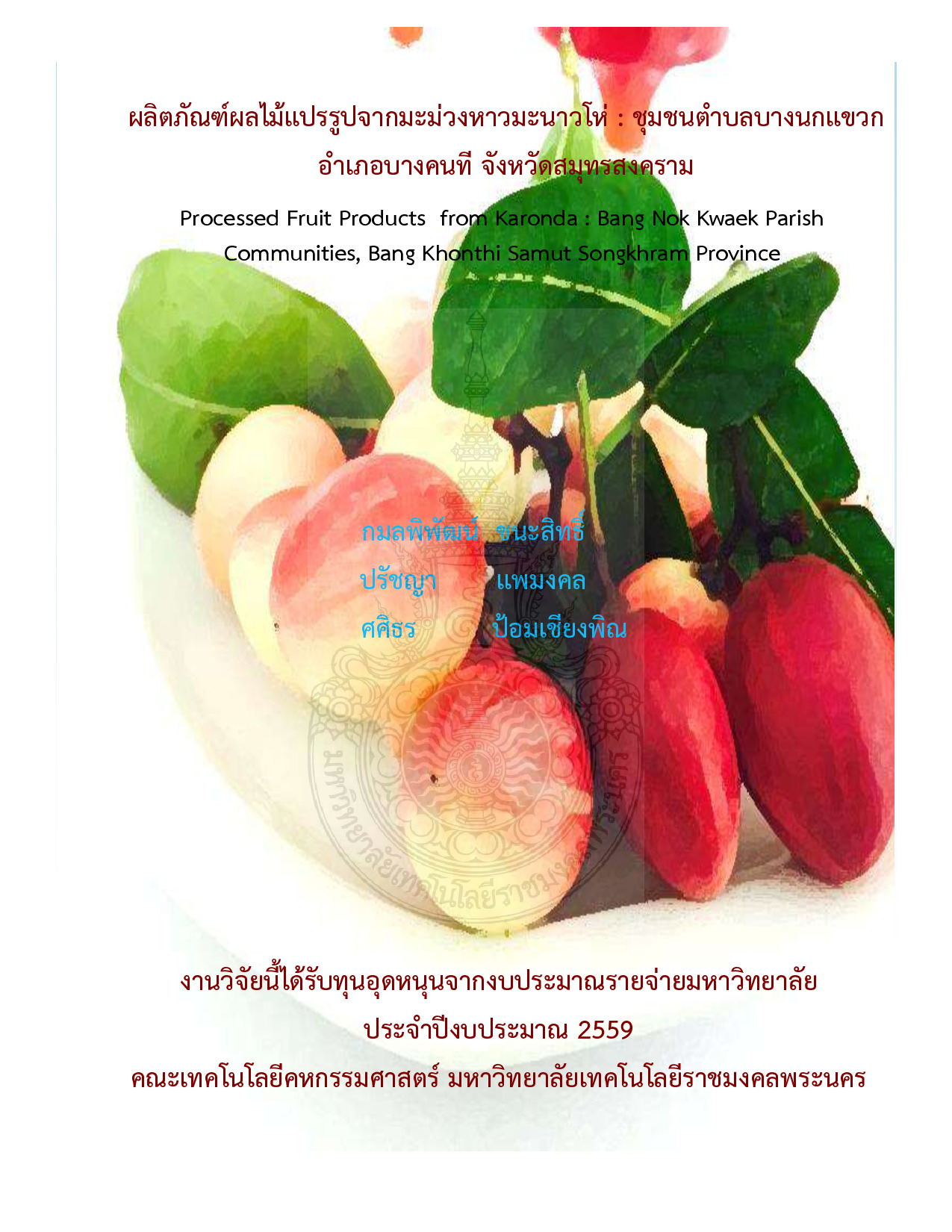
ผลิตภัณฑ์ผลไม้แปรรูปจากมะม่วงหาวมะนาวโห่ : ชุมชนตำบลบางนกแขวก อำเภอบางคนที จังหวัดสมุทรสงคราม
The purpose of the study of processed fruit products from Karonda : Bang Nok Kwaek parish communities Bang Khonthi Samut Songkhram Province is to study the proper quantity of the Koranda fruit in the product the quality in the product’s process and the consumers’ acceptance (Consumer Test) in the product. The processed products are Karonda fruit jelly instant pasteurized Karonda fruit juice with extra fiber Karonda fruit sorbet Karonda fruit yoghurt ice-cream and concentrated juice (sauce) for drink mixing. The product has been tested by Randomized Complete Block Design (RCBD) method. The process was consisted with offering a tasting and evaluated in color scent taste matter and overall satisfaction by giving 9 point Hedonic scale from 70 consumers. And has been compared the difference of average means at 95% trustiness by Duncan’s New Multiple Range Test (DMRT) by an instant statistical analysis software. The result information is as the followings; The physical properties indicates of Karonda fruit the total acidity of 2.30 with the pH and the color was found that the brightness (L *) of 16.52 fee (a *) equal to 8.95 and (b. *) equals 5.37. The study of the chemical quality of Karonda fruit amount of energy in calories carbohydrates 73.2 percent 18.3 percent protein 1.57 percent 1.32 percent humidity fats fiber 83.7 percent ash 4.26 percent and 0.75 Vitamin C is found. The duration of ripening fruit yawning lemon booed affect the vitamin C in the fruit of the mango yawning lemon booed the oil will have more vitamin C than ripe to t 2 so I scratched the reduction of vitamin C may. Is due to be deployed as a compound to breathe. And led to the synthesis of new carbon structures during ripening. Karonda fruit jelly. The most acceptances level for Karonda fruit juice in the product is at 1:6 for its best flexibility. Since the juice concentration affects the jelly as it lowers the matter (flexibility). Too much of acid in Karonda fruit juice is able to unstabilize jelly matter. From the study of Pectin quantity the consumer has the most acceptance at the level of 10 grams which is the best recipe that keeps the good jelly matter (flexibility) stabilized. The physical properties indicates that there are the level of color hue at 5R color brightness at Value 4 Chroma at 14 sweetness at 35 Brix and pH at 3.05. The study of the chemical quality of Karonda fruit jelly in each 100 grams provides 120 kilocalories of energy 69.60 grams of humidity 0.11 gram of fat 29.80 grams of carbohydrate 0.41 gram of fiber 0.50 gram of ash and 0.45 gram of acidity. The consumer satisfaction is at 97.30 percent. Instant pasteurized Karonda fruit juice with extra fiber. The acceptance is at 100 percent of replacing Okra fruit juice by Karonda fruit juice. The acceptance study shows that the most proper fiber quantity adding to Karonda fruit juice is at 15 percent. The acceptance study shows that the most proper Pectin quantity affecting coconut jelly spreading is at 3 percent. The analysis results of the physical properties indicate that instant pasteurized Karonda fruit juice with extra fiber has color hue level at 5R value at 4 and Chroma at 12 which rendered the product to dark red. Also the pH level is at 3.29 sweetness is at 17 Brix firness g force 1 is at 11.29 g Viscosityag.sec AREA F-T 1:2 is at 339.507 ag.sec. The study of the chemical quality of Karonda fruit juice in each 100 grams provides 63.3 kilocalories of energy 83.9 grams of humidity 0.01 gram of fat 0.10 gram of protein 15.8 grams of carbohydrate 0.41 gram of fiber 0.24 gram of ash and 0.18 gram of pH balance. The consumer satisfaction to instant pasteurized Karonda fruit juice with extra fiber is at 98.66 percent. Karonda fruit sorbet. The most proper quantity of Karonda fruit juice is at 30 percent. The physical properties of Karonda fruit sorbet contain the brightness level at L*34.32 red color level at a*41.26 yellow color level at b*21.18 meltable solid quantity at 30*Brix and pH balance at 2.40. The study of the chemical quality of Karonda fruit sorbet in each 100 grams provides 91.8 kilocalories of energy 77.1 grams of humidity 0.15 gram of fat <0.20 gram of protein 22.6 grams of carbohydrate 0.11 gram of fiber and 0.12 gram of ash. The consumer satisfaction to Karonda fruit sorbet is at 100 percent. Karonda fruit yoghurt ice-cream. The most proper quantity of Karonda fruit added in the yoghurt ice-cream is at 10 percent of the whole ingredient. The consumers’ acceptance has been given the most for its scent taste matter (smoothness) and overall satisfaction which has the average mean at 7.24 7.77 7.17 and 7.67 consequently. The physical properties of Karonda fruit yoghurt ice-cream contain the viscosity level at 364.798 cps. color hue at 10P Value at 8/6 Chroma at N9/.5 overrun statistics at 4.55 and Karonda fruit yoghurt ice-cream melting rate at 89.90. The chemical quality of Karonda fruit yoghurt ice-cream in each 100 grams provides 214 kilocalories of energy 64.0 grams of humidity 14.6 gram of fat 3.14 gram of protein 17.5 grams of carbohydrate 0.76 gram of fiber 0.74 gram of ash and 5.67 pH balance. The consumer satisfaction to Karonda fruit yoghurt ice-cream is at 100 percent. Concentrated juice (sauce) for drink mixing. The most acceptance recipe is the strawberry sauce recipe number 1 with the replacement of Karonda fruit at 80 percent. The physical properties contain the viscosity level at 9.28 cps sweetness at 21 Brix color hue at 5R Value at 2 and Chroma at 4. The chemical quality of concentrated juice (sauce) for drink mixing in each 100 grams provides 91.1 kilocalories of energy 77.2 grams of humidity 0.30 gram of fat 0.1 gram of protein 22.3 grams of carbohydrate 0.76 gram of fiber 0.4 gram of vitamin C and 0.56 of pH balance. The consumer satisfaction concentrated juice (sauce) for drink mixing is at the maximum satisfaction at 92.0 percent as the concentrated juice (sauce) emphasizes the better taste of smoothie drink mixing and easy to consume.
การพัฒนาผลิตภัณฑ์จากกระดาษดอกธูปฤาษีเพื่อเศรษฐกิจชุมชน
This research aims at studying the product development from Cattail flower paper for community economy by (1) studying the paper making process from Cattail flower (2) testing the efficiency of the paper made of Cattail flower (3) studying the product development process of Cattail flower paper and (4) propagating the knowledge on product made of Cattail flower paper for the community economy to the Women Group for Basketry Product Development in Laem Phak Bia sub-district Ban Laem district Phetchcburi province. The process of paper making from Cattail flower in its mature stage uses soda method in pulping process and hydrogen peroxide in bleaching process. Paper formation process has to be done on grate by (1) using 38 kilograms of fresh Cattail flower which requires pulp separation from the core of Cattail flower providing; 34.2 kilograms of fresh pulp considered as 90%—its average humidity at 51.04%; 3.8 kilograms of fresh core considered as 10% of the total weight (2) boiling in open system at 100 ºC for 3 hours with sodium hydroxide with the intensity at 4% 6% and 8% of its weight (3) bleaching with hydrogen peroxide with the intensity at 10% 20% and 30% of the weight of dried pulp; 2% of sodium silicate; 0.05% of magnesium sulfate; and 1.5% of sodium hydroxide at 100 ºC for 2 hours with the ratio of pulp and water at 1:15 (4) making paper with Thai traditional handmade method with the size of 72×84 centimeters then drying paper in indoor place in order to prevent paper contraction due to short pulp. The efficiency of the paper made of Cattail flower shows that the paper has average standard weight at 168.88 g2/m; average tensile strength at 26.40 N.m/g2; average tearing strength at 3.14 mN.m2/g; average bursting strength at 1.37 kPa.m2/g; average folding strength at 605; average luminance at 39.05%; average water holding capacity of dry weight at 395.65%; and total used bleach pulp at 69.90% of the bleached amount. The product development from Cattail flower paper has 3 types which are designed evaluated and suggested by the experts in accordance with the requirement of community on product development as follows: (1) Paper made of Cattail flower with various patterns; (2) Multi-purpose box made of Cattail flower and; (3) Flower made of Cattail flower paper. During 2 days of the training program the satisfaction of the 30 participants concerning the knowledge on product made of Cattail flower paper for the community economy of the Women Group for Basketry Product Development in Laem Phak Bia sub-district Ban Laem district Phetchaburi province shows that the participants who answer the questionnaire are extremely satisfied.
การพัฒนาผลิตภัณฑ์จากเปลือกนอกของก้านเผือกเหลือใช้ ในกลุ่มผู้ทานาเผือกอำเภอบ้านหมอจังหวัดสระบุรี เพื่อส่งเสริมเศรษฐกิจชุมชน
This research aims to produce paper and strands from taro fiber in order to develop into craft products and to transfer the body of knowledge and technology to community. The research consisted of 5 main steps: 1) development of paper – study concentration level of sodium hydroxide duration of pulp boiling suitable condition for breaching and softening reactive dyeing paper setting and physical testing of paper; 2) development of strand – stranding with machine strand spinning fiber combining and carding drawing reducing size of fiber and yarn spinning; 3) fiber property testing – cross-sectional test length crimp and fiber fineness; 4) product development – making evaluating and improving draft models of rubber-coated artificial flowers hanging clocks multipurpose boxes and product prototype development; and 5) transfer of technology to members of Talad Noi Agricultural Community Enterprise as well as nearby communities in Ban Moh district Saraburi province. Results of the study showed that the most suitable condition in separating fiber was boiling in 15 grams-per-liter sodium hydroxide solution at 100 Degree Celcius for 1 hour. Then breach with 9 grams-per-liter hydrogen peroxide solution at 100 Degree Celcius for 20 minutes. Next soften the fiber with 6 grams-per-liter anion softener at 60 Degree Celcius for 20 minutes. The use the fiber to set 40x40 centimeter piece of paper by spreading 20 grams of fiber equally. The resulting 0.237mg thick piece of paper was fairly resistance to piercing pressure and tearing force and was suitable to make craft products. In addition development of strands by yarn spinning method was suitable to produce strands which had more strength than strands from other plants. The strands were also suitable for further industrial production. The prototypes of utility and furnishing products were evaluated by consumers as highly suitable in 3 aspects - uniqueness of local product attractive design and size shape and weight – with mean values of 3.72 3.96 and 3.94 respectively. Price was evaluated as averagely suitable at a mean value of 3.12. Results of technology transfer showed that overall trainees were highly satisfied with the technology transfer process at a mean value of 4.55. Assessment of satisfaction and data for course improvement were both in the highest level with mean values of 4.60 and 4.51 respectively.
การพัฒนาผลิตภัณฑ์ผนังคอนกรีตมวลเบาด้วยการเสริมแผ่นโฟมอัดแน่น เพื่อเป็นฉนวนความร้อน
The objectives of this research are to study the production to find the proper ratio to test the physical mechanical properties and thermal conductivity to suggest the implementation and to transfer the technology of light-weight precast concrete wall panel product with adding high density foam sheet. The light-weight precast concrete wall panel product was produced by covering the foam sheet with steel pouring the mortar (M3 ratio which was proper ratio) and curing the light-weight precast concrete wall panel product. From the testing results followed the TIS.2226-2548 and TIS.878- 2537 the general characteristic of light-weight precast concrete wall panel product was perfect. The properties of light-weight precast concrete wall panel product include 17.81 MPa of compressive strength no bending when installed in common behavior 11.38% of water absorption passed in type1 of hardness and impact test 956.03 kg/m3 of density 9.18 MPa of bending strength and 0.170 watt/m.K of thermal insulation. This light-weight precast concrete wall panel product can use as the thermal insulation wall in building. Moreover the developing product can apply to register the petty patent.