จำนวน Repository ( 286 )
The Development of Mudmee Pattern : The Case Study of Silhouette of Prasat Si Khoraphum Using in Clothing Design
The aims of this study are as follows 1.) to develop a new woven Mud Mee pattern which inspired by optical art integrated with the silhouette of Prasat Si Khoraphom in Surin province 2.) to use the developed Mud Mee pattern to improve clothing design influenced from 1960s fashion 3.) to test the satisfaction level of the finished Mud Mee clothes from the sample group. There are 7 textile professionals including pattern designers textile artists Mud Mee textile specialists and 4 fashion designers as supervisors in screening the patterns and designs. The sample group was selected from the staffs who work in Rajaphat Surindra University and Rajamangala University of Technology Northeast (Surin Campus). The tools used in this research were the fabric pattern sketches inspired by optical art integrated with the silhouette of Prasat Si Khoraphum the 1960 fashion clothing design sketches and the satisfaction survey. The statistical package for the social science program was used to find mean and percentage. This study found that the most selected designs from 7 textile professionals were Pra Sart Moom Soong pattern Phasom Phasarn Nammatam pattern and Barai Sai Nam pattern. There were 9 jacket sketches that had been selected. The level of satisfaction on the clothing design from 1960 era of 213 women staff who work in Rajabhat Surindra University and Rajamangala University of Technology Northeast (Surin Campus) showed that the Phrasat Moom Soong pattern gained the highest level of satisfaction (4.78) The Barai Sainam pattern was the most aesthetics pattern (4.70). Finally the sample group satisfied the color and pattern of Phasom Phasan Nammatham the most (4.73). In Chon-Phoa group the most aesthetic jacket patterns were Phrasat Moom Soong (4.67) and Phasom Phasrn Nammatham(4.70). While the Bari Sainam pattern appeared to have the highest level of correlation between pattern and clothing design (4.74). In the uniform group the most aesthetic 1960 jacket patterns were Phrasat Moom Soong (4.74) and Phasom Phasrn Nammatham(4.71). While the Bari Sainam pattern appeared to has the highest level of correlation between pattern and clothing design (4.73). In Art and Fashion group highest level of correlation between pattern and clothing designs for each pattern were Phrasat Moom Soong pattern (4.67) Bari Sainam pattern (4.69) and Phasom Phasrn Nammatham (4.70).
Analysis of Electric field and Modeling Design of High Voltage Cable terminators for PD Testing Using SF6 Insulator
This paper presents the analysis of electric field by using FEMLAB simulation tool to find the optimal electric field and component designs. Design of Cable terminator is tested by finding PD Value with IEC standard. This paper also proposes the electric stress when we design the cable terminator includes SF6 insulator. The modeling design is very useful for High Voltage engineers to find the optimal solution of Cable terminator design.
Power Efficient Ant Colony System Wireless Sensor Networks Using Adaptive Node Function
Today wireless sensor networks are developed and comprised of a small fully autonomous processing communication and sensing devices. It has been restricted power supply low computing power. WSNs work in vast area unreachable or crucial area send and receive raw data from each sensor node. It has the ability to cooperatively collect data and retransmit in order to process or alert. This paper used ns-2 simulation propose a power efficient wireless sensor network ant colony system that can adapt it’s function to reduce average energy consumption per node and work in area for a longer time.
Color Removal in Wastewater form Traditional Alcoholic Beverage Factory by Chemical Process : Using Aluminium Sulphate with Burned Husk
Feasibility Study of the enhancing of the color removal efficiency in wastewater using aluminium sulphate with burned husk as a core coagulant in the coagulation process is investigated. The compositions of wastewater from traditional alcoholic beverage factory are given as follows: pH of 4.15-4.24 suspended solids of 204-300 mg/l COD of 4761-5644 mg/l color intensity of 21.05-35.90 S.U. and turbidity of 166-197 NTU. The experimental results revealed that using aluminium sulplate at concentration 0.4 g/l with burned husk sieve number 100 mesh at 2.2 g/l and aluminium sulphate at 0.5 g/l together with burned husk of size 200 mesh at 2.6 g/l can enhance the efficiency of color removal in wastewater. The color removal efficiencies were at 83.06% and 86.00% respectively.
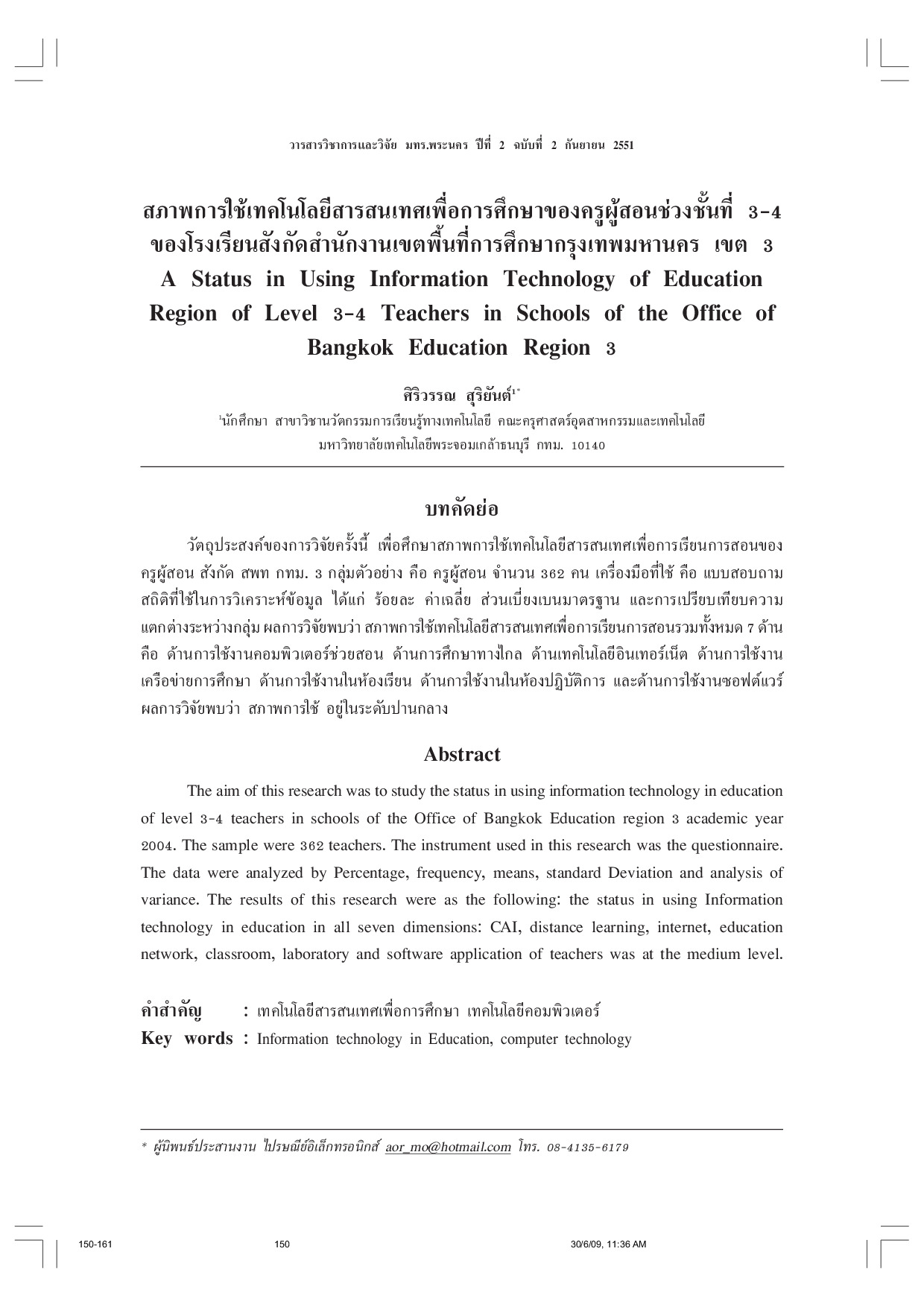
A Status in Using Information Technology of Education Region of Level 3-4 Teachers in Schools of the Office of Bangkok Education Region 3
The aim of this research was to study the status in using information technology in education of level 3-4 teachers in schools of the Office of Bangkok Education region 3 academic year 2004. The sample were 362 teachers. The instrument used in this research was the questionnaire. The data were analyzed by Percentage frequency means standard Deviation and analysis of variance. The results of this research were as the following: the status in using Information technology in education in all seven dimensions: CAI distance learning internet education network classroom laboratory and software application of teachers was at the medium level.