จำนวน Repository ( 3447 )
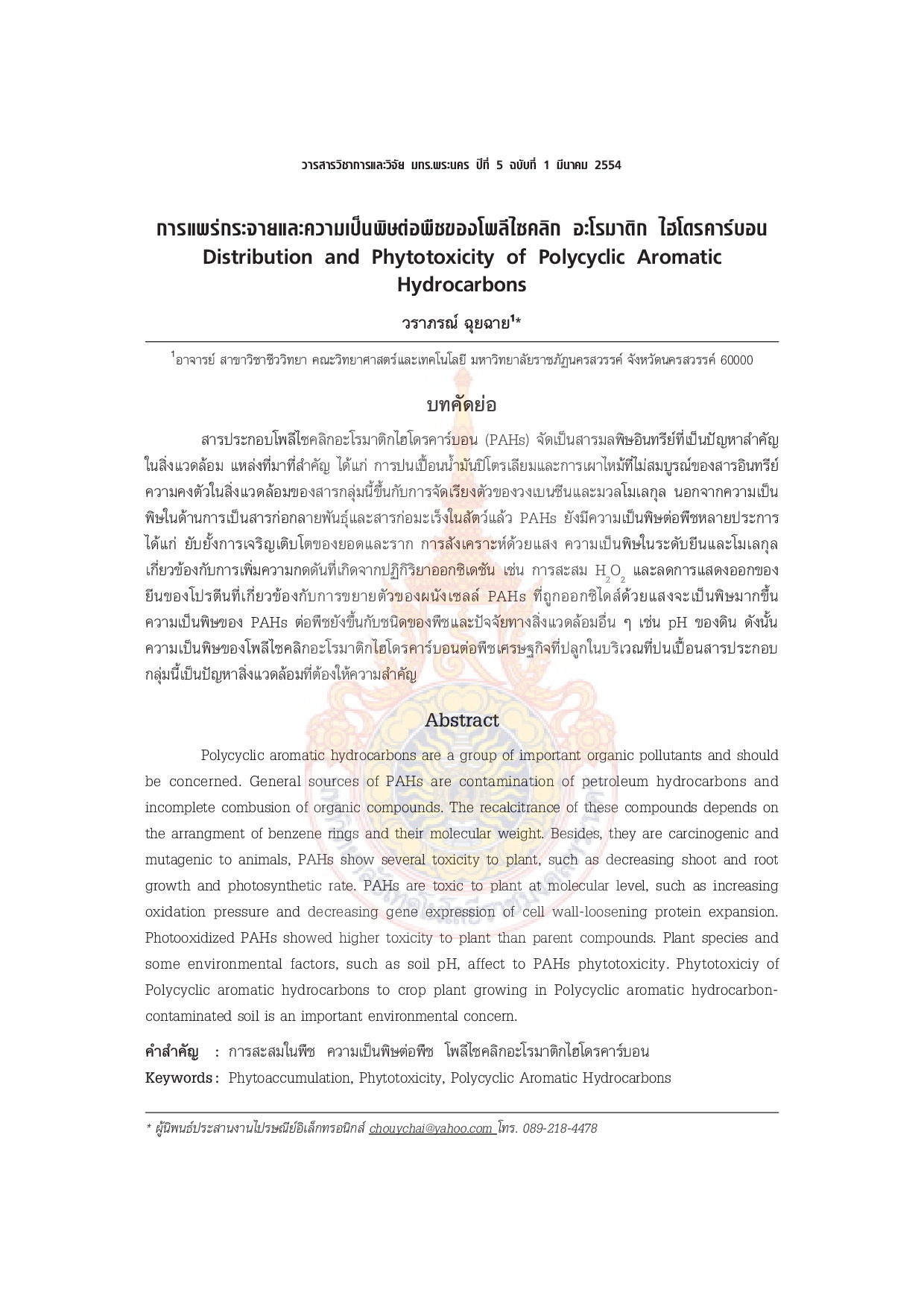
Distribution and Phytotoxicity of Polycyclic Aromatic
Polycyclic aromatic hydrocarbons are a group of important organic pollutants and should be concerned. General sources of PAHs are contamination of petroleum hydrocarbons and incomplete combusion of organic compounds. The recalcitrance of these compounds depends on the arrangment of benzene rings and their molecular weight. Besides they are carcinogenic and mutagenic to animals PAHs show several toxicity to plant such as decreasing shoot and root growth and photosynthetic rate. PAHs are toxic to plant at molecular level such as increasing oxidation pressure and decreasing gene expression of cell wall-loosening protein expansion. Photooxidized PAHs showed higher toxicity to plant than parent compounds. Plant species and some environmental factors such as soil pH affect to PAHs phytotoxicity. Phytotoxiciy of Polycyclic aromatic hydrocarbons to crop plant growing in Polycyclic aromatic hydrocarboncontaminated soil is an important environmental concern
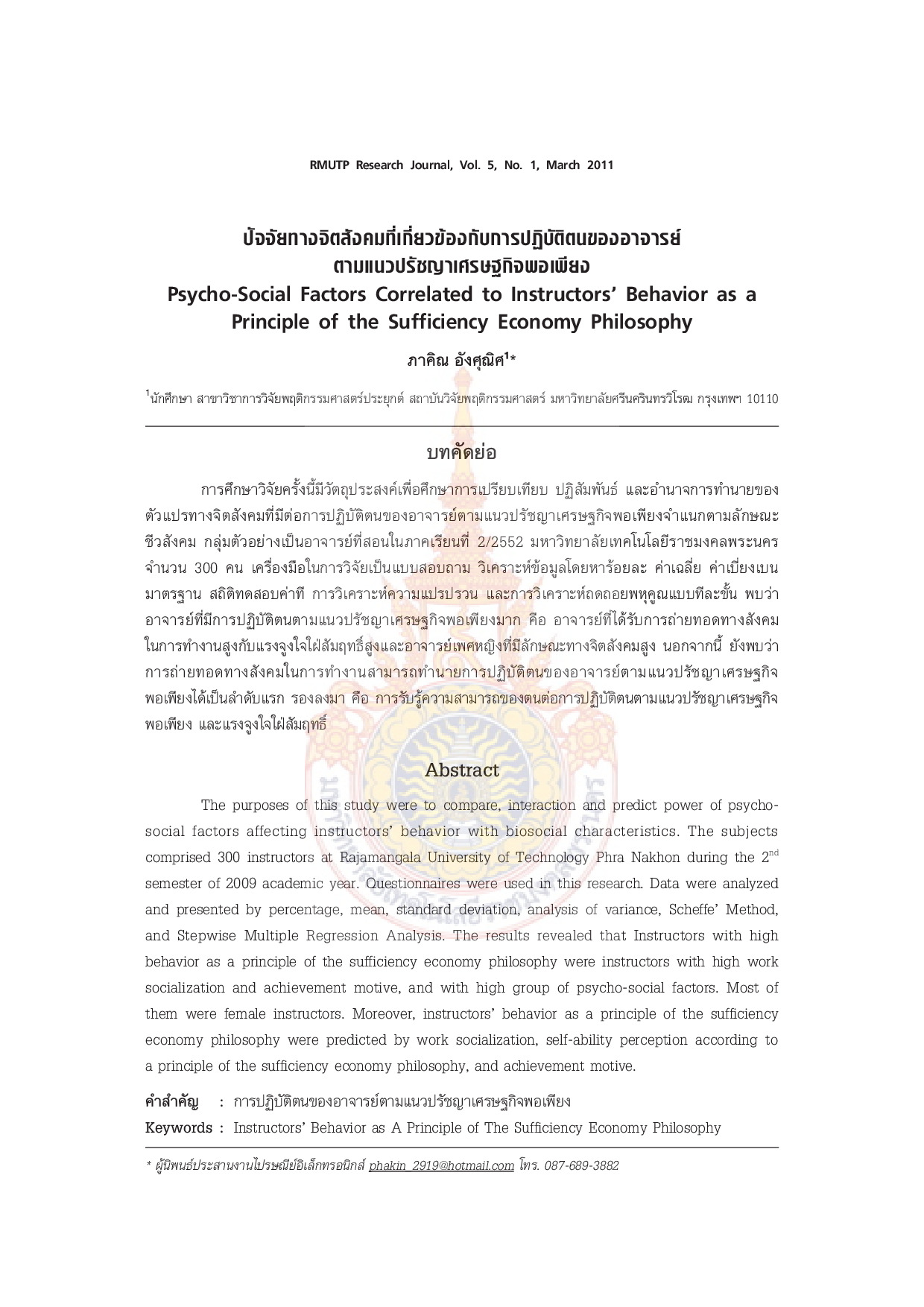
Psycho-Social Factors Correlated to Instructors’ Behavior as a Principle of the Sufficiency Economy Philosophy
The purposes of this study were to compare interaction and predict power of psychosocial factors affecting instructors’ behavior with biosocial characteristics. The subjects comprised 300 instructors at Rajamangala University of Technology Phra Nakhon during the 2nd semester of 2009 academic year. Questionnaires were used in this research. Data were analyzed and presented by percentage mean standard deviation analysis of variance Scheffe’ Method and Stepwise Multiple Regression Analysis. The results revealed that Instructors with high behavior as a principle of the sufficiency economy philosophy were instructors with high work socialization and achievement motive and with high group of psycho-social factors. Most of them were female instructors. Moreover instructors’ behavior as a principle of the sufficiency economy philosophy were predicted by work socialization self-ability perception according to a principle of the sufficiency economy philosophy and achievement motive

Cytotoxic and Antimicrobial Activities of Mushrooms and Medicinal Plant
Extractions of bioactive constituent from the Russula eburneureolata Hongo.stem bark of Xylocarpus gangeticus Parking. root and leaf of Walsura trichostemon Miq.and Parinari anamense Hancewith a polarity sequential extraction and maceration technique with hexaneethyl acetate and methanol.respectively.Crude extract was employed to evaluate the biological activity for their cytotoxic activity against human mouth carcinoma (KB) human small cell lung cancer (NCI-H187) and breast cancer (MCF-7)cancer cell lines tested using the Resazurin microplate assay (REMA).Antimycobacterial activity against Mycobacterium tuberculosis H37Ra strain (Anti-TB) using the Green Fluirescent Protein Microplate Assay (GFPMA)
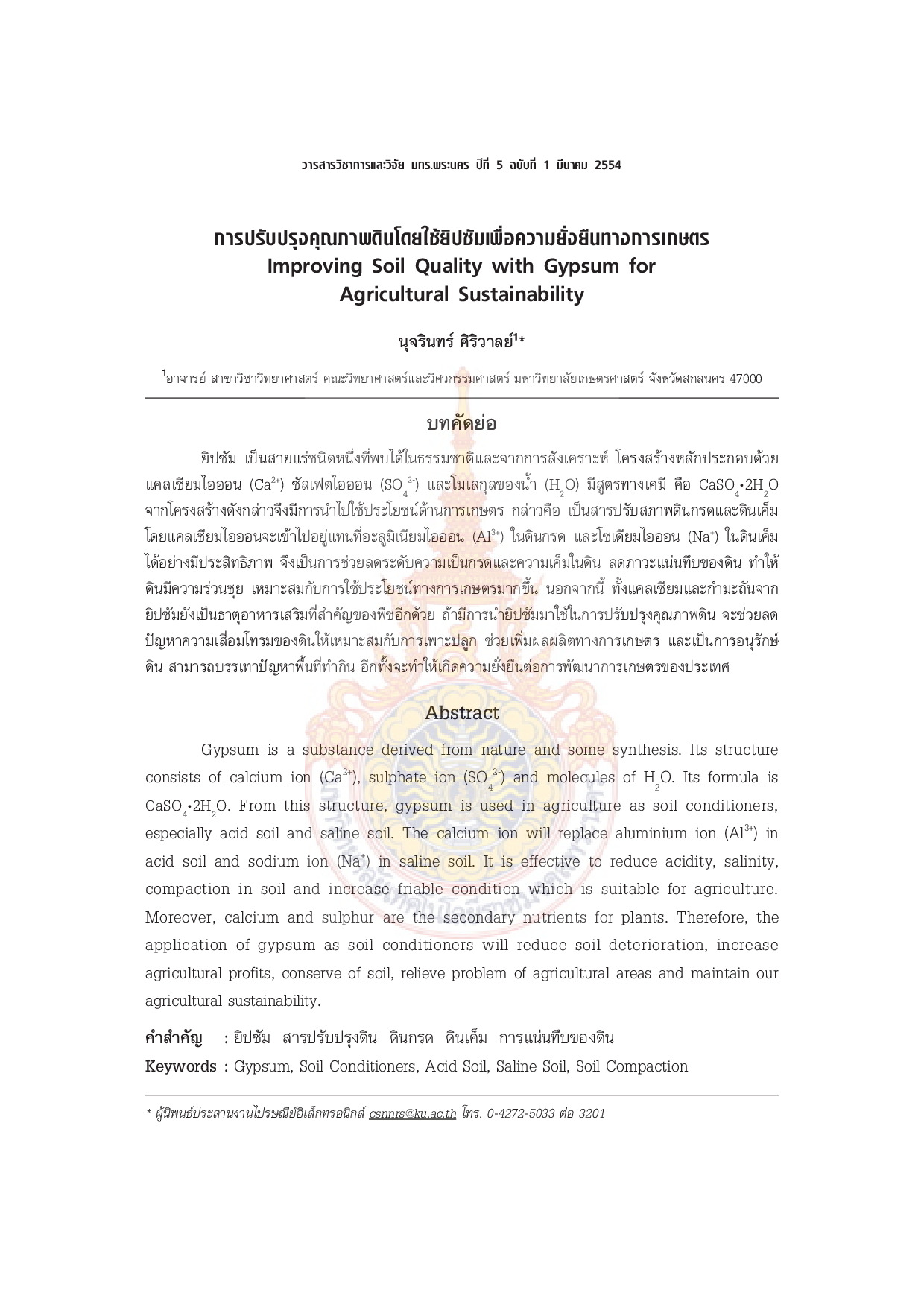
Improving Soil Quality with Gypsum for Agricultural Sustainability
Gypsum is a substance derived from nature and some synthesis. Its structure consists of calcium ion (Ca2+) sulphate ion (SO4 2-) and molecules of H2O. Its formula is CaSO4.2H2O. From this structure gypsum is used in agriculture as soil conditioners especially acid soil and saline soil. The calcium ion will replace aluminium ion (Al3+) in acid soil and sodium ion (Na+) in saline soil. It is effective to reduce acidity salinity compaction in soil and increase friable condition which is suitable for agriculture. Moreover calcium and sulphur are the secondary nutrients for plants. Therefore the application of gypsum as soil conditioners will reduce soil deterioration increase agricultural profits conserve of soil relieve problem of agricultural areas and maintain our agricultural sustainability

Cost of safety system in building construction
The goal of this study is to study the cost of safety system in building construction by studying multipurpose building with durable goods project. The cost of safety system in building construction is divided into two categories are the safety measure cost and the safety program cost in construction. From the study it is found out that the value of safety measure cost is approximately 1.85 % of a project cost and the value of safety program cost is approximately 0.98 % of a project cost. To sum up the cost of safety system in building construction is approximately 2.83 % of a project cost .Moreover the study found out that the safety measure cost is higher than the safety program cost about 1.88 as much. From the data of this study it can be used as the guideline in estimating the cost of safety system in building construction for the future project.