จำนวน Repository ( 30 )
ปัจจัยที่มีอิทธิพลต่อประสิทธิผลของการบริหารความเสี่ยงเพื่อความยั่งยืนขององค์กร กรณีศึกษาสำนักงานสรรพากรในเขตพื้นที่กรุงเทพมหานคร
sustainability; case study of an anonymous revenue office in Bangkok Region by using In-depth interview technique participative observation and open-ended questionnaire. The participants in the interview process consists of management superintendents and operators totaling 22 persons. The results show that there is a harmonization in each operational level of the organization and comply with the three objectives of risk management under COSO approach. However there is a lack of a measurement of successful level Evaluation to strategic planning and clear hedging guidelines under COSO - ERM in order to build concrete sustainability for the organization. In this study the author has proposed conceptual framework about factors affecting the effectiveness of risk management for organization sustainability to be tested in the future.

การตัดสินใจและพฤติกรรมการใช้บริการสถานเสริมความงามของผู้ใช้บริการในเขตอำเภอเมืองนนทบุรี จังหวัดนนทบุรี
The study on beauty salon users’ decisions and behaviors in Maung district Nonthaburi was aimed to (1) investigate the beauty salon users’ personal factors (2) explore their decision levels (3) look into their behaviors (4) compare the decision levels according to the personal factors and (5) examine the relationship between the personal factors and the behaviors. The samples in this study were 400 beauty salon users’ selected through non purposive sampling nonprobability sampling and quota sampling. The questionnaire was administered to obtain data and the statistics used to analyze the data were frequency distribution percentage distribution mean standard deviation t-test and One-way ANOVA. Cross-Tabulation was applied using statistical package for social science. The study results revealed that most of the samples were single females ranging from 20 to 30 years of age holding bachelor degrees. Most of them were employed by companies with the average income salaries ranging from 5000 to 10000 Baht. The data analysis indicated that the decision level towards marketing mix factors of the 400 beauty salon users was high; and in terms of their behaviors concerning the use of the beauty salon showed that they went to the salon mostly to have their cut and set with the minimum of 500 baht payment. The purpose of going there twice to three times per month was to promote their personality and gain more confidence. They normally went there in the evening (from 4 pm. – 7.00 pm.) spending one to two hours and paying with cash. The personal factors of the beauty salon users affected the level of decisions made to go to different beauty salons. The personal factors of the beauty salon users related to the behaviors of the beauty salon use.
Factors affecting successful implementation of balanced scorecard of companies in Bangkok Metropolitan
The purposes of the study were to explore success of the organizations which applied Balanced Scorecard to assess the performance and also investigate factors affecting successful implementation of the balanced scorecard of companies in Bangkok metropolitan. The data were collected from the samples which were organizations in production industry registered with Federation of Thai Industries up to 2010 by means of 400 copies of the questionnaire and analyzed by the frequency distribution percentage distribution standard deviation Pearson Product Moment Correlation Coefficient and Multiple Regression Analysis. The result showed that factors that influenced the implementation of the balanced scorecard in the organizations were factors regarding working process organizational structure and conflicts respectively.

Resource constrained project scheduling by review relationship option case study orthopaedics building renovate project, ramathibodi hospital
Resource leveling schedule is important for construction planning process very much because quantity of resource such as labors is limited. The optimal solution to allocate enough resource for every activity is main principle for project successful. But in ordinary they always observe that have different quantity of resource every time periods is called of “Resource fluctuation”. So planners have to adjust first schedule is called of “Resource Leveling”. This method necessary for decrease resource fluctuations or make uniformly resource demand level . However normal method (heuristic method) to solve this problem is difficult and use much time. So in present there is new developed method by create model in spreadsheet computer programs such as Microsoft Excel. This new method can solve very complex resource leveling problem well..So in this research if we add vary relationship options such as SS (Start-To-Start) FF (Finish-To- Finish) or NO (No Relation) for activity in model objective is increasing optimal solution flexibly and output solution is better than El Rayes & Jun ‘s Model. We can discover for optimal solution from this new model that received uniformly resource demand level of project schedule in the end
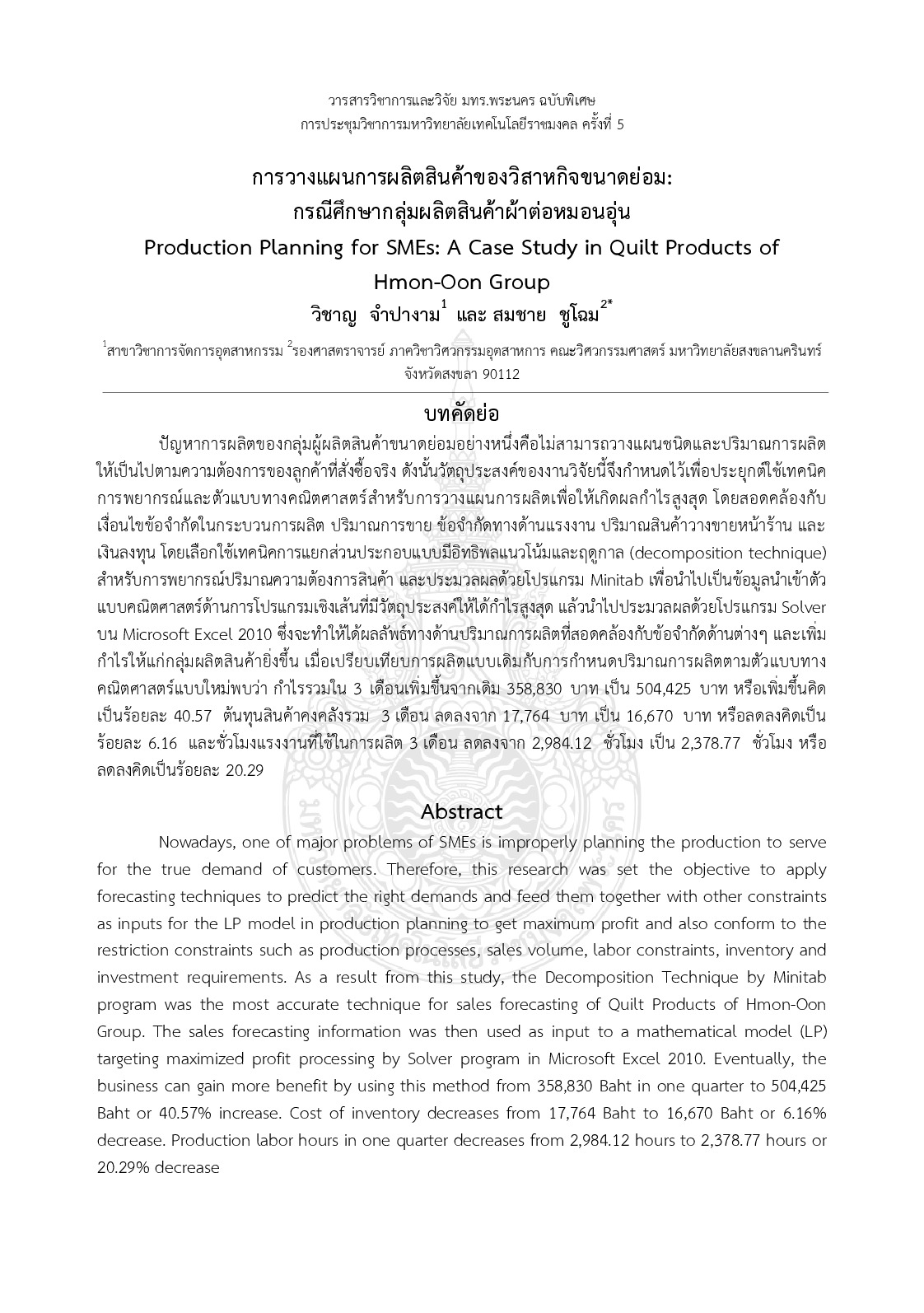
Production planning for SMEs: a case study in quilt products of hmon-oon group
Nowadays one of major problems of SMEs is improperly planning the production to serve for the true demand of customers. Therefore this research was set the objective to apply forecasting techniques to predict the right demands and feed them together with other constraints as inputs for the LP model in production planning to get maximum profit and also conform to the restriction constraints such as production processes sales volume labor constraints inventory and investment requirements. As a result from this study the Decomposition Technique by Minitab program was the most accurate technique for sales forecasting of Quilt Products of Hmon-Oon Group. The sales forecasting information was then used as input to a mathematical model (LP) targeting maximized profit processing by Solver program in Microsoft Excel 2010. Eventually the business can gain more benefit by using this method from 358830 Baht in one quarter to 504425 Baht or 40.57% increase. Cost of inventory decreases from 17764 Baht to 16670 Baht or 6.16% decrease. Production labor hours in one quarter decreases from 2984.12 hours to 2378.77 hours or 20.29% decrease