จำนวน Repository ( 33 )

กระบวนการผลิตกระเจี๊ยบเขียวแผ่นอบกรอบโดยการใช้เครื่องอบแห้งแบบลมร้อน
The study on baked crispy okra sheets (Hit 9701 species) by using a hot air dryer. The objective of this study was to investigate the okra sheets formula and manufacturing procees by hot air dryers with 3 methods; pouring finely blended okra onto the inside tray pouring finely blended okra onto the outside tray and pouring finely blended okra into an aluminum block. It was found that pouring finely blended okra into an aluminum block resulted in the least crack in the dried sheet with the rectangular shape remaining intact. After the forming method is decided on a study was conducted on the temperature to bake okra at 3 levels namely 70 80 and 90 C.It was found that baking okra at 80 C for 4.5 hours was suitable the baking and crispy okra sheets ended up with the lightness(L*) of 49.75 the green (a*) was-2.53 and yellowness (b*) of 23.71. The moisture content was at 5.07 % water activity content was 0.27 The hardness was 5.01 N and the crispness was 4.67. The results of chemical analysis showed that the carbohydrate content was 76.34% crude fibers was 10.72% ash content was 8.24% moisture content was 4.24% and fat content was 0.46%. From the study on the bacteriological quality it was found that the crispy okra sheet products can be stored at room temperature for 28 days.
การเตรียมสีผงจากสีย้อมธรรมชาติ
The preparation of dye powder from natural dyes is to study the preparation methods of dye powder and comparison of color fastness. The natural dyes were used in this study containing of Lac Ebony heart wood Sappan heart wood and Turmeric. were selected in this work to prepare dye powder drying salt adsorption and salt precipitation methods were selected in this work. And dye powder was dyed on silk fabric. The result showed that the dye powder from drying and salt precipitation methods showed higher K/S than salt adsorption method. The dye powder of turmeric from drying method showed highest K/S. The dye powders of Lac Ebony heart wood Sappan heart wood from salt precipitation method showed highest K/S. And the washing fastness showed that the preparation methods were not significant. The dye powder of Lac Ebony heart wood Sappan heart wood showed good light fastness and the dye powder from Turmeric showed poor light fastness.
Effects of foaming agents on the quality of mahajanaka mango by foam-mat drying
Mahajanaka mango (Mangifera indica L.) the yellow fruit had identity on color aroma and sweet taste. It had the highly potential to develop into a powdered beverage with a aroma and flavor similar to fresh fruit juices as possible. The objective of this study was to determine an appropriate foaming substance from 6 types ; Methocel? 65 HG Glyceryl monostearate (GMS) Carboxy methyl cellulose (CMC) Methocel? 65 HG mixed with GMS Methocel? 65 HG mixed with CMC and GMS mixed with CMC with 1:1 w/w with completely Randomized experimental design. Physicochemical properties of mahajanaka mango juice the color values L* a* b* pH total soluble solid citric acid and total solid equals 39.02 18.79 67.36 3.96 14.00๐Brix 0.40 milligram per 100 grams and 15.14%. The mahajanaka mango juice was adjusted 0.70% total acidity (as citric acid) 25๐Brix of total soluble solid and added 2.0% of maltodextrin. The result showed that an appropriate foaming agent was added 45% of 1.8% mixture of Methocel? 65 HG with CMC into mahachanaka mango juice. It had foam stability and density. The mahajanaka mango juice foam had values of stability density and overrun equals 0.001 milligram per min 0.14 gram per milligram and 602.11% respectively and Scanning Electron Microscope (SEM) had a porous structure with sphere and ellipsoid particle.
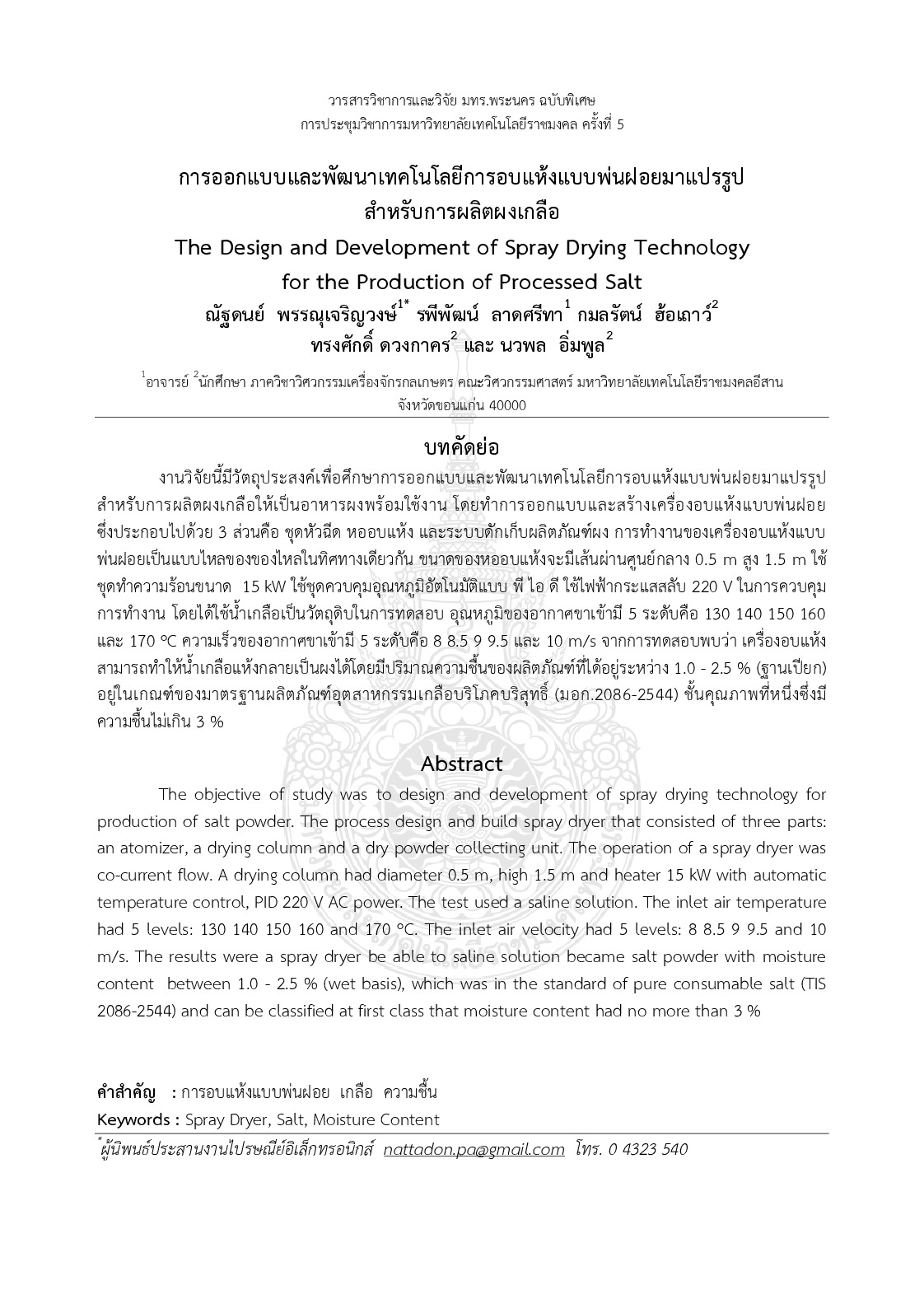
The design and development of spray drying technology for the production of processed salt
The objective of study was to design and development of spray drying technology for production of salt powder. The process design and build spray dryer that consisted of three parts: an atomizer a drying column and a dry powder collecting unit. The operation of a spray dryer was co-current flow. A drying column had diameter 0.5 m high 1.5 m and heater 15 kW with automatic temperature control PID 220 V AC power. The test used a saline solution. The inlet air temperature had 5 levels: 130 140 150 160 and 170 ?C. The inlet air velocity had 5 levels: 8 8.5 9 9.5 and 10 m/s. The results were a spray dryer be able to saline solution became salt powder with moisture content between 1.0 - 2.5 % (wet basis) which was in the standard of pure consumable salt (TIS 2086-2544) and can be classified at first class that moisture content had no more than 3 %
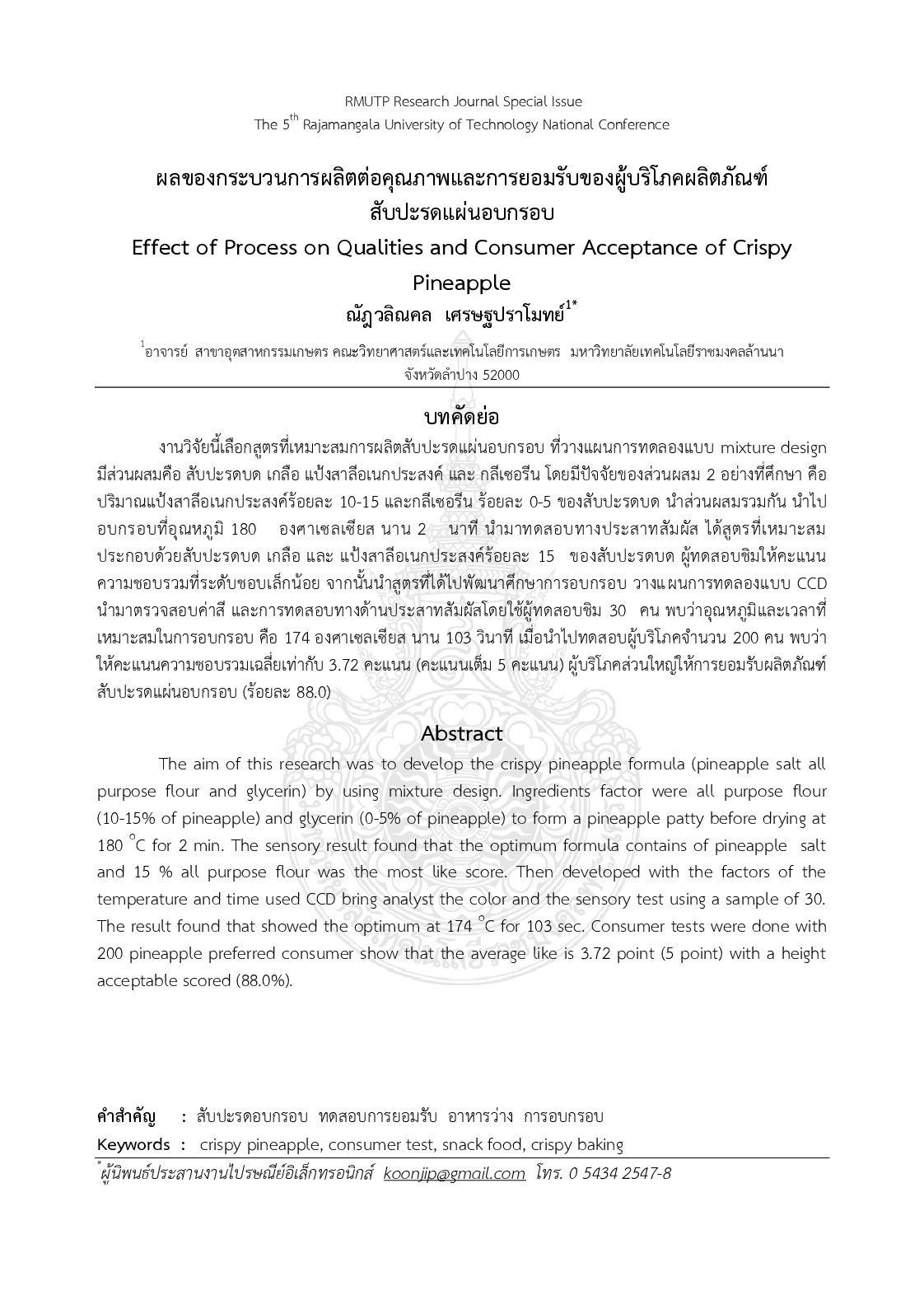
Effect of process on qualities and consumer acceptance of crispy pineapple
The aim of this research was to develop the crispy pineapple formula (pineapple salt all purpose flour and glycerin) by using mixture design. Ingredients factor were all purpose flour (10-15% of pineapple) and glycerin (0-5% of pineapple) to form a pineapple patty before drying at 180 oC for 2 min. The sensory result found that the optimum formula contains of pineapple salt and 15 % all purpose flour was the most like score. Then developed with the factors of the temperature and time used CCD bring analyst the color and the sensory test using a sample of 30. The result found that showed the optimum at 174 oC for 103 sec. Consumer tests were done with 200 pineapple preferred consumer show that the average like is 3.72 point (5 point) with a height acceptable scored (88.0%).