จำนวน Repository ( 29 )

Evaluation of genetic variation of neolissochilus stracheyi wild populations in the nan river watershed using microsatellite dna markers
This study evaluated the genetic diversity of two natural populations of Neolissochilus stracheyi in Nan River watershed Amphoe Bokluea (BK) and Amphoe Mae Jarim (MJ). We analyzed microsatellite markers originally developed for Tor tambroides (Nguten et al. 2009). Three out of five microsatellite loci analyzed were polymorphic . Genetic variation within BK and MJ populations were not different. The number of allele per locus and allelic richness averaged over three loci was 2.33 and 2.67 for BK and MJ respectively. Observed heterozygosity value was 0.50 and 0.56 and the average expected heterozygosity was 0.41 and 0.53 for BK and MJ respectively. In addition the two populations were genetically distinct (P<0.05) and geographic isolation of two locations may explain this genetic pattern.
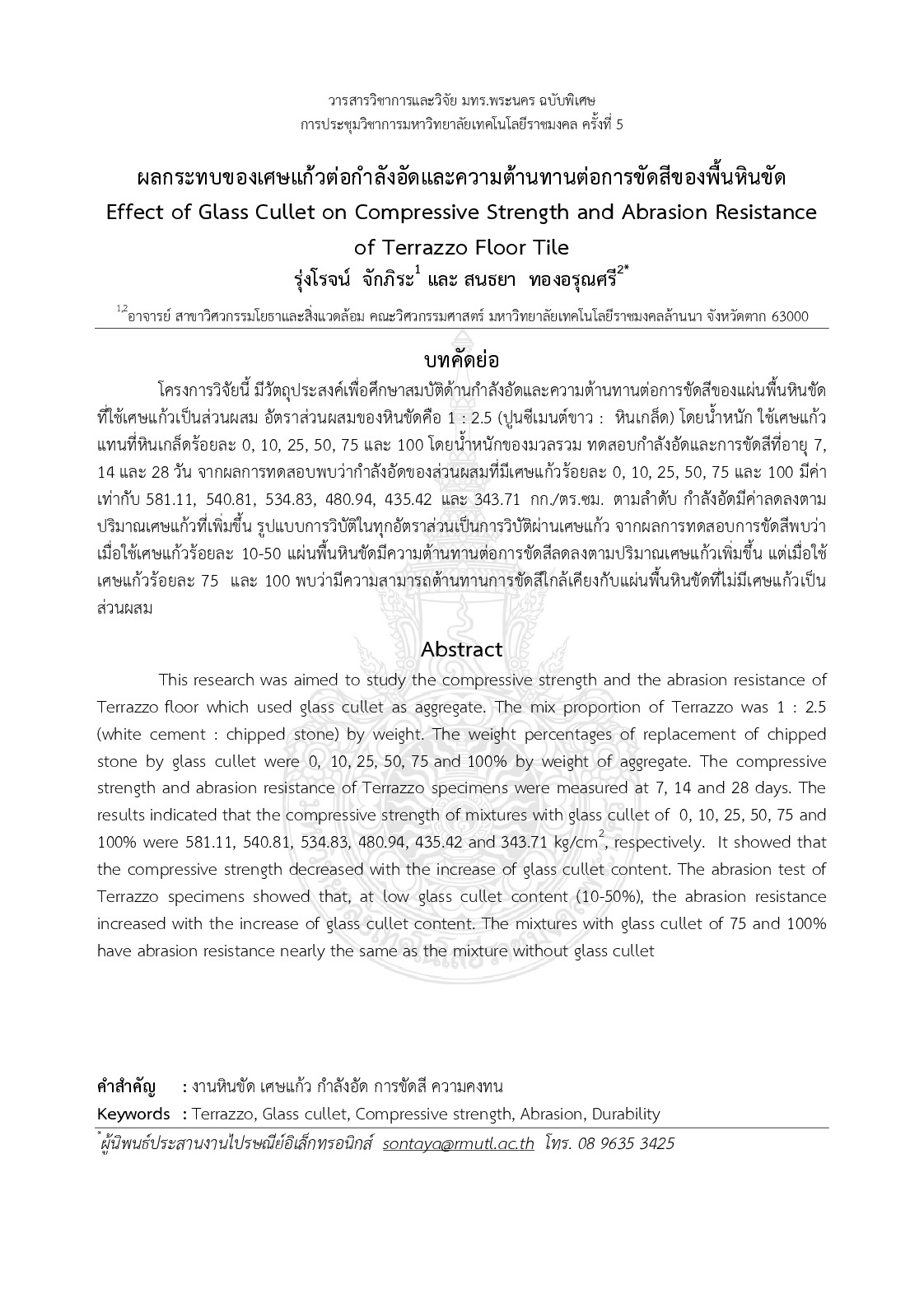
Effect of glass cullet on compressive strength and abrasion resistance of terrazzo floor tile
This research was aimed to study the compressive strength and the abrasion resistance of Terrazzo floor which used glass cullet as aggregate. The mix proportion of Terrazzo was 1 : 2.5 (white cement : chipped stone) by weight. The weight percentages of replacement of chipped stone by glass cullet were 0 10 25 50 75 and 100% by weight of aggregate. The compressive strength and abrasion resistance of Terrazzo specimens were measured at 7 14 and 28 days. The results indicated that the compressive strength of mixtures with glass cullet of 0 10 25 50 75 and 100% were 581.11 540.81 534.83 480.94 435.42 and 343.71 kg/cm2 respectively. It showed that the compressive strength decreased with the increase of glass cullet content. The abrasion test of Terrazzo specimens showed that at low glass cullet content (10-50%) the abrasion resistance increased with the increase of glass cullet content. The mixtures with glass cullet of 75 and 100% have abrasion resistance nearly the same as the mixture without glass cullet
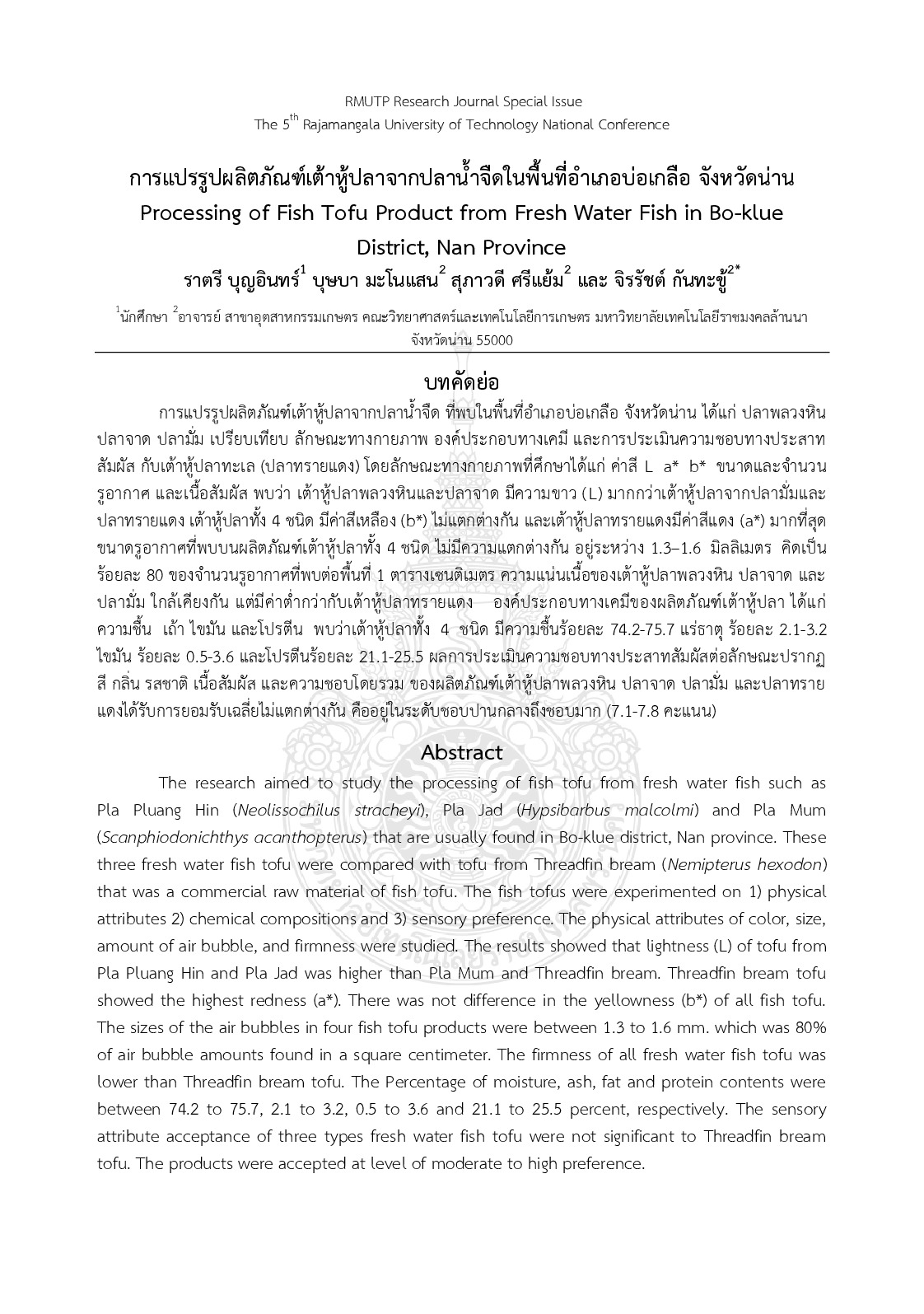
Processing of fish tofu product from fresh water fish in bo-klue district, nan Province
The research aimed to study the processing of fish tofu from fresh water fish such as Pla Pluang Hin (Neolissochilus stracheyi) Pla Jad (Hypsibarbus malcolmi) and Pla Mum (Scanphiodonichthys acanthopterus) that are usually found in Bo-klue district Nan province. These three fresh water fish tofu were compared with tofu from Threadfin bream (Nemipterus hexodon) that was a commercial raw material of fish tofu. The fish tofus were experimented on 1) physical attributes 2) chemical compositions and 3) sensory preference. The physical attributes of color size amount of air bubble and firmness were studied. The results showed that lightness (L) of tofu from Pla Pluang Hin and Pla Jad was higher than Pla Mum and Threadfin bream. Threadfin bream tofu showed the highest redness (a*). There was not difference in the yellowness (b*) of all fish tofu. The sizes of the air bubbles in four fish tofu products were between 1.3 to 1.6 mm. which was 80% of air bubble amounts found in a square centimeter. The firmness of all fresh water fish tofu was lower than Threadfin bream tofu. The Percentage of moisture ash fat and protein contents were between 74.2 to 75.7 2.1 to 3.2 0.5 to 3.6 and 21.1 to 25.5 percent respectively. The sensory attribute acceptance of three types fresh water fish tofu were not significant to Threadfin bream tofu. The products were accepted at level of moderate to high preference.
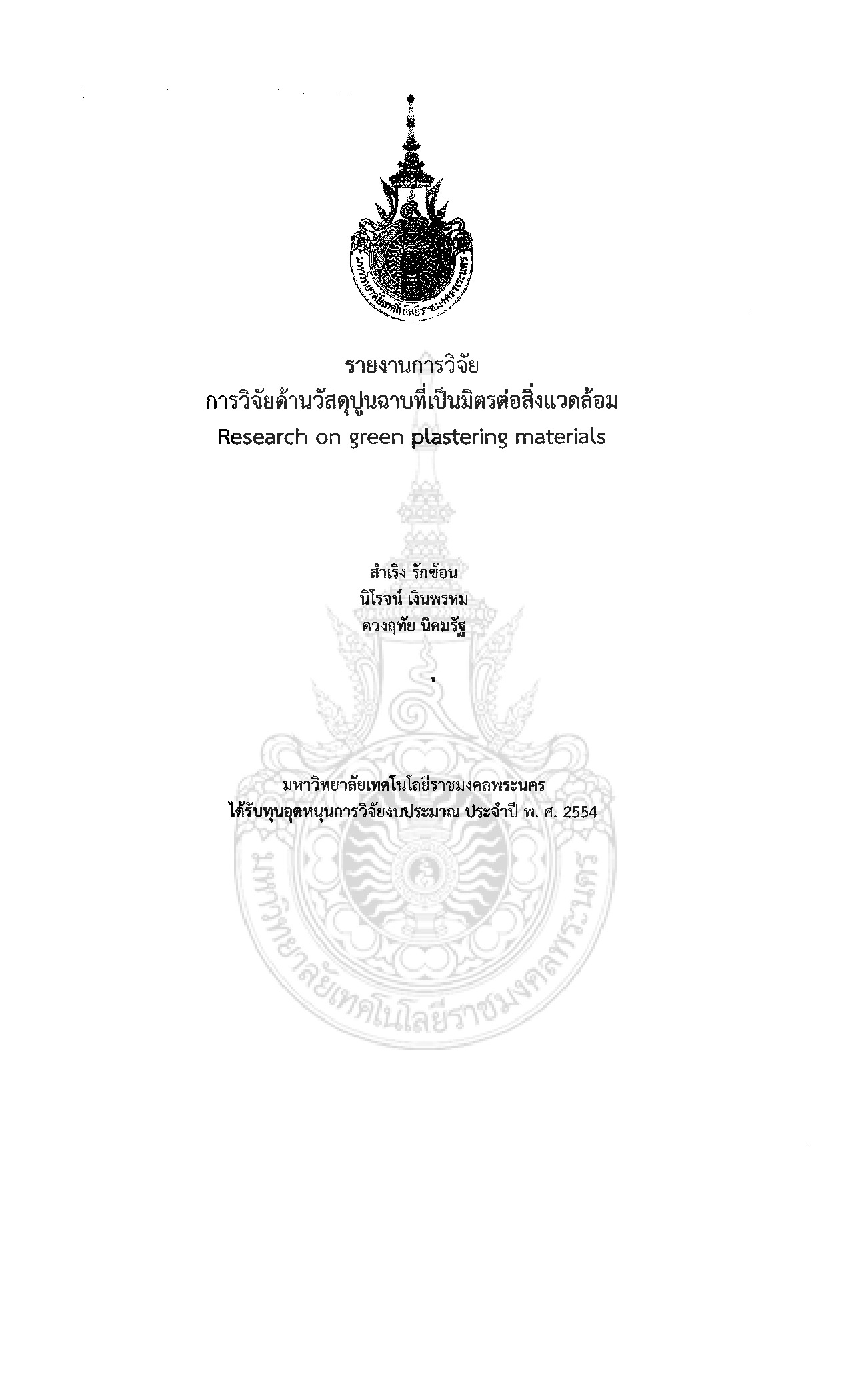
การวิจัยด้านวัสดุปูนฉาบที่เป็นมิตรต่อสิ่งแวดล้อม
This research studies the potential for using waste ash from industrial and agricultural by-products as a plastering material. This paper presents a study of the water requirement compressive strength flexural strength normal consistency setting time and air content of plastering material containing classified fly ash (FA) and ground rice husk ash (RHA). Fine fly ash and fine rice husk ash have a high potential to be used as a good pozzolanic material. The use of finer pozzolan results in a stronger and denser mortar which is due to better Q!spersion and filling effect as well as an increase in the pozzolanic reaction. Fine fly ash and fine rice husk ash can be incorporated into mortar as replacement of the mortar mix cement for the plastering. Mortar mix cement containing 20% fine fly ash and fine rice husk ash can be used to make plastering materials.