จำนวน Repository ( 30 )

Method of preparing and drying on physical and chemical croperties of germinated khaohang rice from kdml105
These researches were to determine the preparing and drying on physical and chemical properties of germinated khaohang rice from KDML105. Two factors on study were preparing germinated khaohang rice (chill at 5 oC and frozen -20 oC) and drying method (tray drier and infrared drier). The results on expansion (%) and texture of cooked rice found that there were not significant influence interaction and two main factors. But main factor on infrared drying method were affected to the highest head rice yield (%) and lowest on Chroma (C*). As same as gamma amino butyric acid (GABA) had the highest 23.37 (mg/100g) and preparing germinated khaohang rice had between 20.50 to 22.21 (mg/100g). The pasting properties reducing sugar total phenolic scavenging activity of DPPH free radical (%) and resistance starch were significant influence interaction.
Effects of foaming agents on the quality of mahajanaka mango by foam-mat drying
Mahajanaka mango (Mangifera indica L.) the yellow fruit had identity on color aroma and sweet taste. It had the highly potential to develop into a powdered beverage with a aroma and flavor similar to fresh fruit juices as possible. The objective of this study was to determine an appropriate foaming substance from 6 types ; Methocel? 65 HG Glyceryl monostearate (GMS) Carboxy methyl cellulose (CMC) Methocel? 65 HG mixed with GMS Methocel? 65 HG mixed with CMC and GMS mixed with CMC with 1:1 w/w with completely Randomized experimental design. Physicochemical properties of mahajanaka mango juice the color values L* a* b* pH total soluble solid citric acid and total solid equals 39.02 18.79 67.36 3.96 14.00๐Brix 0.40 milligram per 100 grams and 15.14%. The mahajanaka mango juice was adjusted 0.70% total acidity (as citric acid) 25๐Brix of total soluble solid and added 2.0% of maltodextrin. The result showed that an appropriate foaming agent was added 45% of 1.8% mixture of Methocel? 65 HG with CMC into mahachanaka mango juice. It had foam stability and density. The mahajanaka mango juice foam had values of stability density and overrun equals 0.001 milligram per min 0.14 gram per milligram and 602.11% respectively and Scanning Electron Microscope (SEM) had a porous structure with sphere and ellipsoid particle.
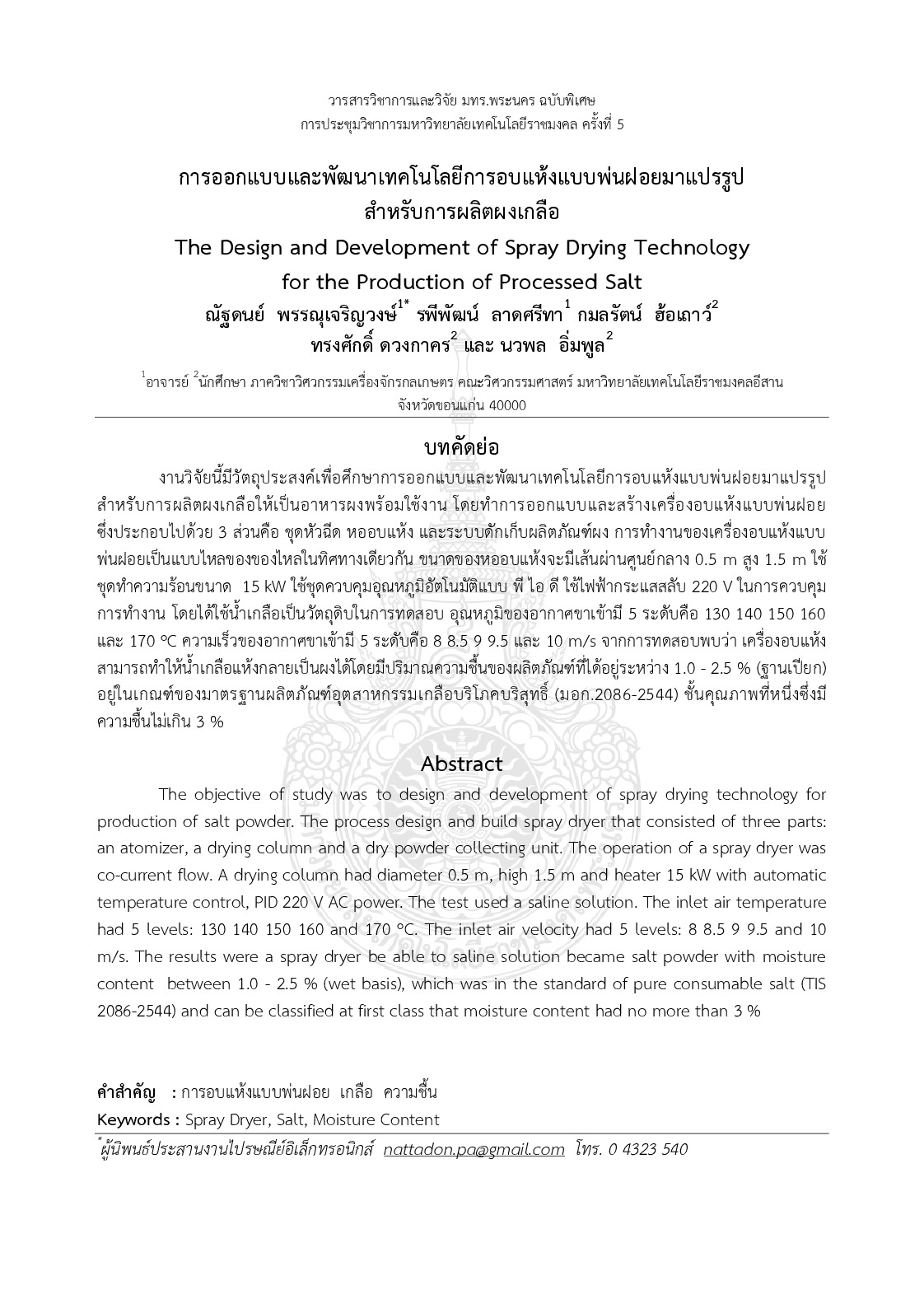
The design and development of spray drying technology for the production of processed salt
The objective of study was to design and development of spray drying technology for production of salt powder. The process design and build spray dryer that consisted of three parts: an atomizer a drying column and a dry powder collecting unit. The operation of a spray dryer was co-current flow. A drying column had diameter 0.5 m high 1.5 m and heater 15 kW with automatic temperature control PID 220 V AC power. The test used a saline solution. The inlet air temperature had 5 levels: 130 140 150 160 and 170 ?C. The inlet air velocity had 5 levels: 8 8.5 9 9.5 and 10 m/s. The results were a spray dryer be able to saline solution became salt powder with moisture content between 1.0 - 2.5 % (wet basis) which was in the standard of pure consumable salt (TIS 2086-2544) and can be classified at first class that moisture content had no more than 3 %
Drying of ground fish slices using superheated steam
Superheated steam drying has gained more attention due to its absence of oxidative reactions and high drying rate. This research involved drying of ground fish slices using superheated steam. The influences of superheated steam temperature (120 130 and 140 ?C) and thickness of ground fish slices (1.3 and 2.2 mm) on drying kinetics and quality attributes of dried fish slices were studied. Effective moisture diffusion coefficients (Deff) of the ground fish slices dried at different conditions were also investigated. From the experimental results it was seen that an increase in drying temperature and a decrease in thickness of ground fish slices led to faster moisture reduction. In terms of qualities it was found that the lightness value (L-value) decreased. However the redness value (a-value) percentage of shrinkage hardness and toughness values increased when the thickness of ground fish slices and superheated steam temperature increased. Moreover it was also found that the Deff of the ground fish slices increased with the increase of superheated steam temperature and thickness of ground fish slice.
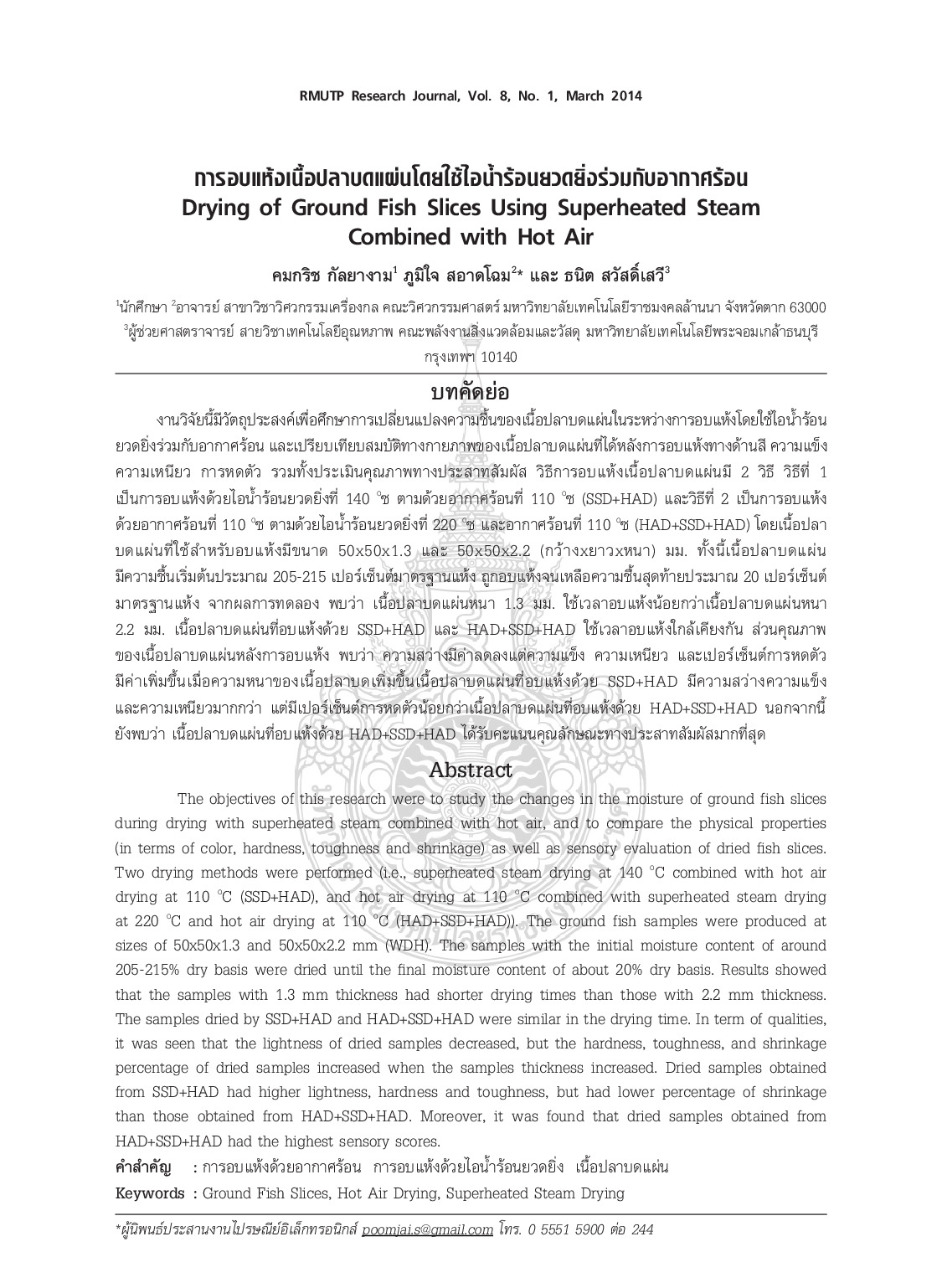
Drying of ground fish slices using superheated steam combined with hot air
The objectives of this research were to study the changes in the moisture of ground fish slices during drying with superheated steam combined with hot air and to compare the physical properties (in terms of color hardness toughness and shrinkage) as well as sensory evaluation of dried fish slices. Two drying methods were performed (i.e. superheated steam drying at 140 ?C combined with hot air drying at 110 ?C (SSD+HAD) and hot air drying at 110 ?C combined with superheated steam drying at 220 ?C and hot air drying at 110 ?C (HAD+SSD+HAD)). The ground fish samples were produced at sizes of 50?50?1.3 and50?50?2.2 mm (WDH). The samples with the initial moisture content of around 205-215% dry basis were dried until the final moisture content of about 20% dry basis. Results showed that the samples with 1.3 mm thickness had shorter drying times than those with 2.2 mm thickness. The samples dried by SSD+HAD and HAD+SSD+HAD were similar in the drying time. In term of qualities it was seen that the lightness of dried samples decreased but the hardness toughness and shrinkage percentage of dried samples increased when the samples thickness increased. Dried samples obtained from SSD+HAD had higher lightness hardness and toughness but had lower percentage of shrinkage than those obtained from HAD+SSD+HAD. Moreover it was found that dried samples obtained from HAD+SSD+HAD had the highest sensory scores.