จำนวน Repository ( 30 )
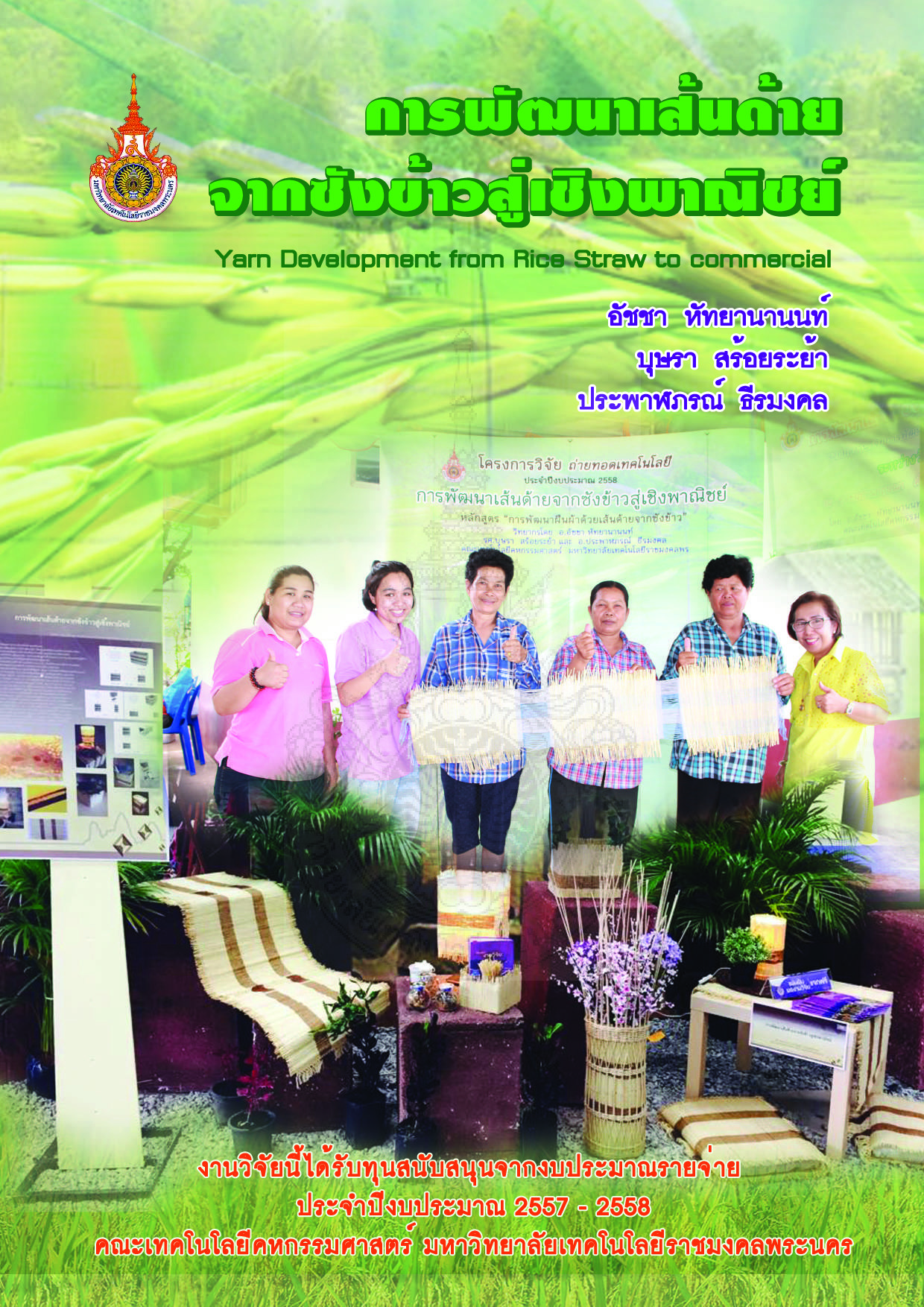
การพัฒนาเส้นด้ายจากซังข้าวสู่เชิงพาณิชย์
This research is Yarn Development from Rice straw to commercial. It aims to study the process of seperating fibers from rice straw. To study the physical properties of fibers from rice straw and to study the process of manufacturing yarn from rice straw fibers. The research material is rice straw fibers after that data was analyzed byphysical textile testing laboratory. The result of the first year’s research was the rice straw yarn has been developed as woven and develop into commercial products to promote. The process of separating fibers from rice straw which dried the sun for a few days. Selecting the rice straw fiber length at least 30 cm. to subtract the joints of the lower end of the stem by hand. peel off the rice straw fiber and place flat on a horizontal line. Then Rice straw fiber were tested in the physical laboratory was found that it is cellulose fibers tensile strength (Newton) at 28.18 elongation (percent) is at 2.01. The amounts of metals has plenty of CADMIUM at 0.1 mg/kg CHROMIUM (TOTAL) / (VI) at 0.5 mg/kg COPPER at 0.5 mg/kg and LEAD at 0.1 mg/kg which was not found to be risk for using. The fiber cross-section of rice straw fiber were found to be oval the middle is clearly. The fiber length is smooth and transparent when viewed from the side to see the clarity of the fiber. Rice straw fiber was weave in plain structure. Warp yarn uses a special brown cream and brown flat yarns. We use rice straw fiber with the same type of yarn. There are 2 warp yarn and using natural color without blench. Rice straw fabric was dyeing with dried hibiscus flowers (Kaa-Jeab herb) and mordant as ashes. The result is red light because of rice straw fiber surface is smooth and lustrous. Therefrom When woven as a fabric to develop be 4 products prototype : table lamps tablecloths in Japanese style potted plants and Accessories Box The result of the second year’s research there are focus group inquire for people it is interesting in this research and Date for transfer knowledge as: Ban-Krit-Sa- Na community Krit-Sa-Na sub-district bang-pra-ma district in Supanburi province. To plan the schedule and set the date place amount of participate and lectures 34 people The range of time to transfer as 3 days on 3 – 5 May 2015 and asking for consumer satisfaction of the curriculum and lecture for “transfer knowledge Yarn Development from Rice straw to commercial” by Questionnaire of participate satisfaction. Last the evaluation data was analyzed by using SPSS program in mean and percentage. The second year found that mostly participates were female aged under 21 years old finished the secondary school and also there are farmer. The participates are their income under 5000 baht and no income. For the participates questions relation to technology transfer of “Yarn Development from Rice straw to commercial” about course divided into 3 parts: The purpose The curriculum and The knowledge. The satisfaction of participates about project divided into 3 parts: Service process Lecturer and Facilities found that have been satisfied at maximum average and highest level of satisfaction in every parts of both satisfied participates questions. The participants are mainly used to provide benefits to themselves for one month to apply the gained after the training. Satisfaction with the benefits of technology transfer and utilization. Satisfaction at the highest level the participants used knowledge to apply with local and waste material. Moreover the participates make product as soon as finish course and they are planning to produce the table Hand Woven for weaving the Rice straw yarn fabric and push it to be OTOP products. The comments and suggestions of the participants found that they need for re-training again. They would like to have a longer period of training in order to gain more knowledge. All lecturer can transfer knowledge during the training as well.

ศึกษาวิถีวัฒนธรรม อนุรักษ์และพัฒนาผ้าชนเผ่าสู่เชิงพาณิชย์ กรณีศึกษา ผ้าทอกะเหรี่ยงจังหวัดภาคเหนือ
The purpose of this research was to study the ways of Karieng tribal culture conserve and develop Karieng’s fabric and transfer technology to the target groups. The research instruments consisted of the interview the product prototype the opinion evaluation the performance evaluation the training evaluation. The sample groups used for this study comprised Karieng of Tambon Sridongyen Amphur Chaiprakan in Chaingmai province Karieng of Tambon Pangmoo Amphur Muang in Maehongson province Karieng of Tambonkhanaechue Amphur Maeramad in Tak province. Groups of 100 people were interested in these products and 25 trainees of Karieng of Tambon Sridongyen Amphur Chaiprakan in Chaingmai. Statistics used were percentage average and standard deviation. The results revealed that 3 Karieng groups were the same culture ways in the religion languages the life ways costumes occupation culture tradition residents and family systems. They were different from Karieng of Tambon Pangmoo Amphur Muang in Maehongson who wore a brass collar were called long neck Karieng but some people weren’t wearing them in this day. Groups of Karieng Tumbon Khanechue Amphur Maeramad in Tak province will use the urban lifestyle and costumes. Groups of Karieng Tumbon Sridongyen Amphur Chaiprakan in Chiangmai will use in sufficient style farmers and employees. All of them were similar to wear Karieng’s fabric in ceremonies. The researchers concluded that the development of tribe’s fabric were applied the costumes style from the origins. We used two methods: the striped fabric and decorative materials were made in ten patterns. The evaluation of Karieng’s fabric product found that the sixth clothes pattern were the best suitable in decoration the pattern and design averaged 4.45. and the transfer technology evaluation trainees groups were Karieng of Tumbon Sridongyen Amphur Chaiprakan in Chaingmai province wanted to know and practice to develop the modern garment pattern base on the conservative of wisdom and creation the economic communities. The assessment result found that the female trainees who were farmer’s occupation primary education income less than 4000 baht were over 40 years. Before training they knew the Karieng garment design in moderate level. Sewing and decoration of Karieng garment were in high level. After training they knew more three things. They brought the knowledge to use in high level. The trainees want to train the next time in the highest.
ศักยภาพภูมิปัญญาท้องถิ่นด้านอาหารพื้นบ้านเพื่อเพิ่มมูลค่าพืชท้องถิ่น ของชุมชนแพรกหนามแดง อาเภออัมพวา จังหวัดสมุทรสงคราม
The purposes of this research were to investigate the types of local foods of Praknamdaeng Community and the potential of local wisdom of the community’s traditional foods in the aspect of raw material resources production process commercial production wisdom transfer to collect the knowledge of food ingredients and cooking methods and to study nutritive values of 15 recipes (using INMUCAL-Nutrients program) in Praknamdaeng Community Amphawa Samutsongkhram. This research was conducted by in-depth interviews with 12 local food experts who have lived in six villages of Praknamdaeng Community. Two people per village were purposively selected. The research tools were interview forms a tape recorder and a camera. The data were analyzed by mean percentage and rating scales. The study revealed that 132 types of local foods were found and classified into three groups namely main dish (75%) dessert (15.15%) as well as preserved and processed foods (9.85%). As for the potential in raw material resources all types of traditional foods were at a high level (100%) and in the aspect of the potential in production process all kinds of the foods were also at a high level namely main dish (93.94%) preserved and processed foods (84.62%) and dessert (80%). Furthermore the potential in preserved and processed food’s commercial production was at a high level (53.85%) whereas the potential in dessert’s commercial production was at a moderate level (40%) and the potential in main dish was at a low level (52.53%). From the result of wisdom transfer all types of the foods were at a moderate level including dessert (100%) preserved and processed foods (100%) and main dish (67.67%). As a result of the collection of the knowledge of food ingredients and cooking methods the commonly used meat to cook main dishes were found in the local areas and consisted of cuttle fish tilapia long-whiskered catfish mullet sea catfish sea bass rock cod mackerel bream white bait nile tilapia shakehead fish giant tiger prawn banana shrimp jinga shrimp sea crab and salt mardi crab. Moreover the vegetable ingredients were phak plang (Bacella alba Linn.) cha-kram (seablite) luk sam sip (Asparagus race mosus willd) phak bia (rose moss) nam pung do (Azima sarmentosa Benth) and phak kom hin (Trianthema portulacastrum). Most dessert ingredients were coconut milk palm sugar and granulated sugar whereas the ingredients of preserved and processed foods were fishes shrimps and salt which were used to preserve foods; for example drying salting etc. In addition the findings showed that the main dishes’ cooking methods of six villages were curries with local vegetables including hot and sour soup with phak kom hin (Trianthema portulacastrum) hot and sour soup with cha-kram (seablite) hot and sour soup with phak plang (Bacella alba Linn.) hot and sour soup with tua tob tab (Derris trifoliate Lour.) hot and sour soup with yod prong thalee (queen sago leaf) hot and sour soup with sano (Sesbania javanica Mig.) flower kaeng liang (spicy herb soup) with phak kom hin (Trianthema portulacastrum) kaeng oom (dill soup) with nam pung do leaf and red curry with Nipa palm’s fruit. Nowadays the ready-made curry paste which is available in the market is normally used. If any vegetables used were bitter salty or astringent they would be boiled before cooking. Most of the desserts were boiled ones such as khanom tom (Thai coconut munchkins) khuay buat chi (banana in sweet coconut milk) buat fak thong (pumpkin in sweet coconut milk) green beans in light syrup soft sweet sticky rice pudding with young coconut meat and tapioca pearl pudding with young coconut meat. Due to lots of fishes all year-round most of the favorite preserved and processed foods in the community were sun-dried fish and deep-fried marinated fish. Due to study the nutritive values of 15 recipes of local foods of Praknamdaeng Community it was found that cha-kram red curry with cockle provided highest energy (2578.59 kcal) highest fat (196.29 g) highest iron (74.35 mg.) highest Vitamin B1 (0.70 mg) and highest Vitamin B2 (2.76 mg) respectively. Cha-kram Jam provided highest carbohydrate (347.76 g). Steamed tilapia curry in banana leaves with cha-kram provided highest protein (135.15 g) highest Vitamin C (65.65 mg) and highest Niacin (24.73 mg) respectively. Nam Pung Do scrambled egg provided highest Vitamin A (736 µg RE). According to sensory evaluation test on appearance color odor taste texture and preference of 15 recipes of Praknamdaeng’s local foods the result of taster acceptability test indicated that they highly liked every aspect of 13 recipes while steamed tilapia curry in banana leaves with cha-kram and Cha-kram Jam were accepted between a moderate level and a high level.