จำนวน Repository ( 93 )

แนวทางการพัฒนาศักยภาพการดำเนินงานของวิสาหกิจชุมชนแปรรูปผลิตภัณฑ์อาหารในจังหวัดสมุทรปราการ
The objectives of this study were :1) to evaluate the basic information :2) to determine the operational status and problems and :3) to study the potential development guidelines for the operation of community enterprises of food processing groups in Samut Prakran Province. Samples selected by stratified random sampling technique were 112 members of community enterprises in Samut Prakran Province. These samples was drawn from the presidents of community enterprises of food processing in Samut Prakran Province which were assessed as the good level in potential operation. Data collection were done by using questionnaire technique while the data were analyzed with frequency percentage mean and standard deviation. The results revealed that the assessment of potential operation of the community enterprises of food processing groups 268 in Samut Prakran Province were at the good level of 114 the average level of 117 and the improvement level of 20. The community enterprises had strong intention to the strengthening of communities and the supportive system from the partite participation consisted of knowledge and developing budget. The overall of operational status was at a high level while the overall of operational problem was at a low level. The potential development guidelines for the operation of community enterprises of food processing groups in Samut Prakran Province were ;1) planning approach: making master plan for all sub-district ;2) organization structure approach: overall operation review with all of members ;3) personnel management approach: creating morale for work performance of personnel together ;4) marketing approach: producing products to meet market needs ;5) production approach: supporting the production knowledge by government sectors and ;6) accounting/ financial approach: making real income and expense accounts.
กระบวนการตรวจสอบย้อนกลับในโซ่อุปทานของอุตสาหกรรมเนื้อสัตว์แปรรูปฮาลาล ในประเทศไทยเพื่อรองรับการเปิดประชาคมเศรษฐกิจอาเซียน
The research objectives were (1) to study its traceability system and (2) study the relationship model of on the traceability process of the meat processing industry in Thailand to support the ASEAN Economic Community and (3) to determine the consistency of the empirical data. The variables used in this study were the transformation process as the independent variable; the supply chain production process and the certification process as the mediator variables; and the animal disease control traceability and supply chain of Halal meat-processing industry in Thailand to support the Economic Community Asia as dependent variables. Qualitative and quantitative mixed methods study was applied using the questionnaires to collect data from 510 meat sample operators in Thailand. The statistical methods used to analyze data were the frequency percentage average value standard deviation and structural equation model. The results revealed that the model was well consistent with the empirical data. Chi – Square (χ) value was 288.297 at the degrees of freedom (df) of 256 with the probability p-value equal to 0.081 and chi - square relative (χ22/df) of 1.126. The index of harmony (GFI) was equal to 0.965 and modified harmony index measuring (AGFI) was equal to 0.933 and the index measuring the comparative (CFI) equal to .965 with the accuracy in estimating the parameters (RMSEA) equal to 0.016. In addition the quality of transformation process the supply chain production process the certification process and the animal disease control traceability directly influenced on the traceability process of in the supply chain of Halal processed meat industry in
การพัฒนาคุณภาพผลิตภัณฑ์จากฐานภูมิปัญญาท้องถิ่นเรื่องสมุนไพรแปรรูป ของกลุ่มสตรีสหกรณ์เกษไชโยจังหวัดอ่างทองเพื่อเพิ่มศักยภาพการผลิต
This research aims to 1) improve quality of processed herbal product by developing recipe and production procedures 2) develop packaging of processed herbal products in oder to add value exhibit uniqueness and response to customers’ need and 3) transfer technology and body of knowledge about improving products’ quality and developing packaging of processed herbal products. Results from developing of recipe and production procedure of kaffir lime in syrup show that period in boiling kaffir lime before sweetening in syrup has an effect on textures. The suitable period of 5 minutes for boiling kaffir lime results in reducing hardness of kaffir lime core increasing lightness and gaining the highest sensory scores from testers. The suitable amount of fructose syrup used in place of sugar in producing sweetened kaffir lime at 80 percent of sugar weight results in increasing lightness reducing hardness increasing value of red color (a*) and aw when compared with the control group and increasing quality of texture with the highest sensory scores from testers. Quality of microorganism appearance color ordor and texture of sweetened kaffir lime stored in tight-closed polypropylene (PP) bag at room temperature could be maintained for at least 24 days. Regarding satisfactory in packaging prototype it was found that customers were highly satisfied in both overall (4.48) and by aspect of packaging form (4.48) and packaging graphic (4.49). In terms of transferring the technology to a target group of 30 people it was found that trainees were highly satisfied with the technology transfer process (4.56). The highest satisfaction level by aspects was usefulness of service at 4.64 followed by service of staff trainers and service procedure at 4.58 4.57 and
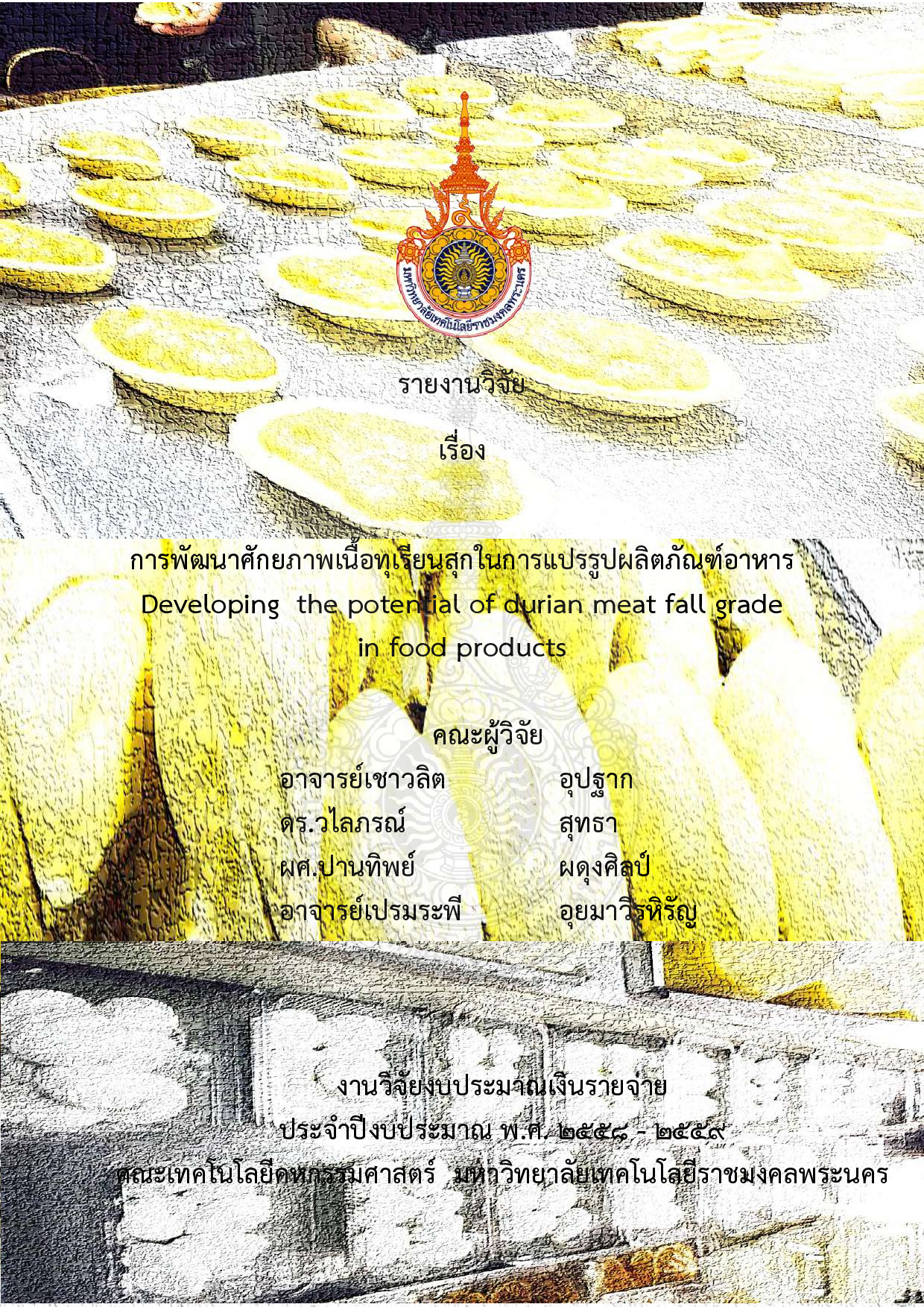
การพัฒนาศักยภาพเนื้อทุเรียนสุกในการแปรรูปผลิตภัณฑ์อาหาร
This research has the purpose to study about the process of transforming of food products supplemented with five types of ripe durian having grade failure. It aims to study about quality of food products transformed from ripe durian having grade failure. It is the study about consumer test having effect towards food products transformed from ripe durian having grade failure and transferring of technology for developing of processed food product from ripe durian texture to the community. The experiment found that study of suitable quantity of pipe durian having grade failure in supplementing food products in 5 types by testing about acceptance of testers who were 40 instructors in Field of Food and Nutrition Field of Food Science and Nutrition and Field of Food Service Industry. The researcher used methods of giving scores of favor in type of 9-point hedonic scale. The researcher added ripe durian having grade failure into durian coconut milk at levels of 0 30 60 and 90 per cent of total ingredients. It was found that testers accepted the durian coconut milk at level of 90 per cent which was in much favor level. Coconut Custard in golden cup (dessert stuffed ingredient) was supplemented at level of 0 50 75 and 100 per cent of all cooked taro ingredient it was found that testers accepted such coconut custard at level of 100 per cent. Coconut Custard in golden cup pastry flour ingredient) was supplemented at level of 0 10 20 and 30 per cent of total ingredient. It was found that testers accepted such coconut custard at level of 30 per cent which was in level of moderate favor to much favor (7-8). Moose supplemented with ripe durian texture having grade failure at level of 0 10 20 and 30 per cent of total ingredient it was found that testers accepted the moose at level of 20 per cent which was in the level of moderate favor to much favor (7-8). Marshmallow supplemented with ripe durian texture having grade failure at level of 10 20 and 30 per cent of total ingredient it was found that testers accepted such marshmallow at level of 20 per cent; which was in level of moderate favor to much favor (7-8). Ancient toffee supplemented with ripe durian texture having grade failure at level of 0 20 40 and 60 per cent of total ingredient it was found that testers accepted the ancient toffee at level of 40 per cent which was in the most level which was in the much favor (8). When physical feature of food products supplemented with five types of ripe durian having grade failure was studied it was found that only one product of durian coconut milk had value of 88.933 cp or centipoises. Regarding nutritional value of processed food product with ripe durian having grade failure it was found that durian coconut milk supplemented with 100% ripe durian having grade failure had protein for 3.23 per cent fat for 8.58 per cent ash for 0.78 per cent fiber residue for 2.01 per cent and moisture quantity for 54.87 per cent. It was found that coconut custard in golden cup with stuffed pastry supplemented with ripe durian having grade failure for 100 per cent and coconut custard with pastry flour in golden cup with ripe durian having grade failure for 30 per cent had protein for 10.87 per cent fat for 18.67 per cent ash for 0.91 per cent fiber residue for 2.35 per cent and moisture quantity for 25.31 per cent. It was found that moose supplemented with 20% ripe durian having grade failure had protein for 3.67 per cent fat for 17.09 per cent ash for 0.55 per cent fiber residue for 1.45 per cent and moisture quantity for 62.26 per cent. It was found that marshmallow supplemented with 20% ripe durian having grade failure had protein for 5.89 per cent fat for 0.68 per cent ash for 0.28 per cent fiber residue for 0.56 per cent and moisture quantity for 41.64 per cent. It was found that ancient toffee supplemented with 40% ripe durian having grade failure had protein for 18.22 per cent fat for 23.11 per cent ash for 12.1 per cent fiber residue for 1.10 per cent and moisture quantity for 8.91 per cent. However supplementing with ripe durian having grade failure in five types of food product can be done but there should be realizing about chemical elements of the initial components for example moisture quantity and fat. These components may affect physical features such as smell taste and texture. These features have effect on product acceptance. From transfer of food product technology from ripe durian texture having grade failure at Faculty of Home Economics Technology Rajamangala University of Technology Phra Nakhon there were 40 receivers of technology transfer. Result of evaluation of satisfaction for 5 aspects of providing service including providing service of officials resource persons service providing process/step facilities and benefit from service receiving all these aspects obtained scores in much satisfaction level in every aspect.