จำนวน Repository ( 39 )
การพัฒนาผลิตภัณฑ์กระดาษจากแกนสับปะรด
Technology transferring project on manufacturing pare from pineapple cores and designing packages and making souvenirs from pineapple core paper to community and interested persons was a continued part of the project pineapple core paper development. There were 7 steps of the project process. 1. Studying for basic information of paper manufacturing from pineapple cores designing and making products from the paper. 2. Surveying training needs of the target group of populations. 3. Designing training course. 4. Making model products used in training. 5. Preparing training materials and handouts. 6. Training 7. Course and training process evaluation. The researchers followed the designed processes of transferring the study to 90 populations which were the target population group consisted of pineapple farmers private company staff and interested persons by using random population sampling. The statistics used were percentage and mean.
Canonical Correlation Analysis Between some Factors and Motivation on Producing Academic Papers of Instructors in The Office of Rajamangala University of Techlnology Phra Nakhon
The purposes of this research were to study the canonical relationship between some factors and motivation on producing that relative contribute to academic papers and to study the canonical weights of some factory motivation on producing academic papers. The Sample were the 222 instructors in the office Rajamangala University of technology Phra Nakhon who work during the first semester of Academic year 2005. The stratified random sampling technique was used for selecting the sample. The instruments were the questionnaire considering the salary work load working experience Attitudes toward producing academic papers Self development Internal control Academic ability Motivation on advancement Motivation on recognition and Motivation on environment of producing academic papers. The findings were as follow: 1. The canonical correlation between Salary Work load Working experience Attitudes toward producing academic papers Self development Internal control Academic ability Motivation on advancement Motivation on recognition and Motivation on environment of producing academic papers were .510 .231 and .134 respectively. The first canonical function was Statistically Significant at .05 level. The second and third canonical function were Statistically nonsignificant. 2. The canonical weights for Attitudes toward producing academic papersself development and Internal Control relative contributed to Motivation on advancement Motivation on recognition and Motivation on environment of producing academic papers in the first canonical function.
Studying and Product Development of Handicraft from Elephant Dung Paper for Adding Income to Community at Changwat Phra Nakhon Si Ayutthaya
The research aimed to study and develop handicraft products from elephant dung paper for community income generation in Changwat Phra Nakhon Si Ayutthaya and to compare the product satisfaction of the target group for the original style and the new one of elephant dung paper. The target group was composed of 143 tourists from other provinces and 143 local tourists. Both target groups would like to buy handicraft products from elephant dung paper and help generate community income in Changwat Phra Nakhon Si Ayutthaya. Research tool used were questionnaire and data were analyzed by statistical percentage mean and mode. Questionnaire was used for the product attributes satisfaction evaluation of the target group including alternative evaluation process and comparison of product styles evaluation process. Data were analyzed by statistically percentage mean and t-test dependent sample. The results were as follows: 1. The target group chose the third style on 3 designs of handicraft products from elephant dung paper. 2. For the product attribute satisfaction of the target group it was found that the new style of handicraft product was more acceptable than the original one at a significance level of 0.05.
Development of Green Energy Block Made from Paper Mill Waste Sludge
Sludge from paper mill wastewater treatment plant is the residual composed of fibres fibre particles and miscellaneous debris. Sludge with high fibre contents were collected from BP paper mill industry. They were retreated by 2 days drying and mixing dried sludge with tapioca starch as ratios were: 100:0 95:5 90:10 85:15 and 80:20(sludge: tapioca starch). To make the green energy block by using screw-press machine compressed sludge that mixed with various ratios of tapioca starch. A size of green energy block was 6 inches diameter 2 inches high and 150 g. weight. Energy values were tested by using Bomb-calorimeter measurement instrument. The results of testing found: the best ratio of green energy compressed for high heating value was 95:5(sludge : tapioca starch by weight) and the maximum heating value was about 19638 J/g. This green energy block made from waste of paper mill wastewater treatment plant is a way of recycle waste to be energy and reducing waste from industry.
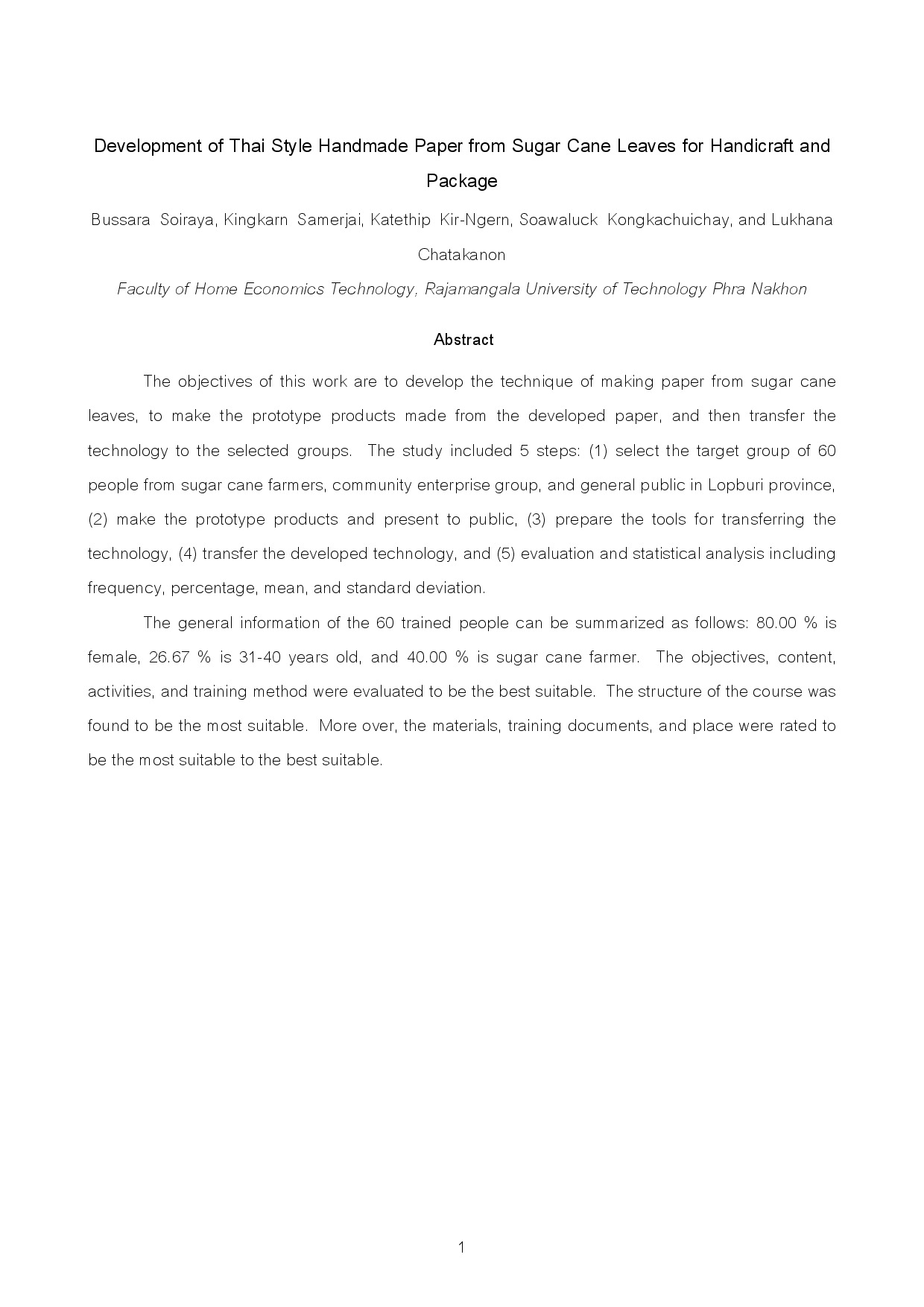
Development of Thai Style Handmade Paper from Sugar Cane Leaves for Handicraft and Package
The objectives of this work are to develop the technique of making paper from sugar cane leaves to make the prototype products made from the developed paper and then transfer the technology to the selected groups. The study included 5 steps: (1) select the target group of 60 people from sugar cane farmers community enterprise group and general public in Lopburi province (2) make the prototype products and present to public (3) prepare the tools for transferring the technology (4) transfer the developed technology and (5) evaluation and statistical analysis including frequency percentage mean and standard deviation. The general information of the 60 trained people can be summarized as follows: 80.00 % is female 26.67 % is 31-40 years old and 40.00 % is sugar cane farmer. The objectives content activities and training method were evaluated to be the best suitable. The structure of the course was found to be the most suitable. More over the materials training documents and place were rated to be the most suitable to the best suitable.