จำนวน Repository ( 51 )
ปัจจัยที่มีผลต่อการออกกลางคันตามความคิดเห็นของนักศึกษาระดับปริญญาตรีของมหาวิทยาลัยเทคโนโลยีราชมงคลพระนคร
The objectives of this research were to study and compare factors affecting dropping out of undergraduates in Rajamangala University of Technology Phra Nakhon. The finding on four types of factors were launched : personal educational institute family and social factor. Survey research methodology was exploited by distributing questionnaires to sample group of 638 RMUTP undergraduates in 2012 academic year. And the data was analyzed by the percentage the standard deviation the t-test and one way analysis of variance (ANOVA). The results were as followed : the personal factor as a whole was at low level they were : insufficient background knowledge in their fields capability in passing the examination getting low grade point average learning without planning boring of learning facing financial problem negative attitude in vocational field learning in dislike branch absence in class and having problems on family responsibility. On the institute factors as a whole it was at moderate level the causes were: inadequate facilities and services of the institute personal safety learning without instruments lack of helpfulness for the handicapped institute’s strict discipline inappropriate laboratory and buildings the executive management’s transparency institute’s relations with students unsuitable activities for learning expensive fee the students’ entrance without admission system overloaded extracurricular activities. On the family factor it was at low level as a whole they were : economics problems the family’s poverty parents’ attitude towards the institute single-mom’s burdens stability of parents career. Finally the social factor as a whole it was at low level they were : distance from students’ home the freshmen’s traditions self( 4) adjustment among peer group improperly learning environment quarrels and conflicts with others and freshmen’s assimilation in new surroundings. By comparing personal factors to family factors the study found that all factors were nonsignificantly different at the level of 0.05. While the institute factors and the social factors were significant different at the level 0.05
Cognition in philosophy of sufficiency economy towords consumer behavior Of undergraduate students in Rajamangala University ofTechnology Phra Nakhon
The purposes of this research Cognition in Philosophy of Sufficiency Economy Towords Consumer Behavior of Undergraduate Students in Rajamangala University of Technology Phra Nakhon of six education level and Faculty of study Results of the research are as Collows : respondents were male female and Faculty of study different cognition and perception influencing towarde behavioral decising making an behavioral consumer. Regarding the behavior of advertising media exposure most of the singles choose to be exposed to television media. For the other type the are study to knowledge and understanding but behavior consumer more than size effect from student have knowledge and Cognitive Philosophy of Safficiency economy loss.
The study of learning activites' results using (p) spc2pas model of business finance for business administration undergraduates at Rajamangala University of Technology Phra Nakhon
The objective of this study was: to experiment the activity using the (P) SPC2PAS model for Business Administration Undergraduates in Rajamangala university of Technology Phra Nakhon in (1) a comparison of achievement test of post-scores with pre-test scores of the first phase; (2) a comparison of post-test scores with pre-test scores of the second phase; (3) the result of the activity’s self-reflection of knowledge attitude and performance of learners; and (4) learners’ attitude towards an (P) SPC 2 PAS model. The research procedure was comprised of two phases. In Phase 1 there was the adjusted (P) SPC2PAS Model which was applied to use with Business Administration Undergraduates in Business Finance at Rajamangala University of Technology Phra Nakhon. In Phase 2 there was the experimentation of (P) SPC2PAS Model with Business Administration Undergraduates in Business Finance at Rajamangala University of Technology Phra Nakhon. The experimental group was the forty first-year financial undergraduates in the 2nd Semester of Academic Year 2010. The research instruments were: the business finance achievement test the self-reflective learning checklist and the attitude questionnaire analyzed by percentage mean standard deviation and the t-test. The result of the study showed that: (1) the mean scores of the sample group in the first phase of business finance comprehension’s post-test was significantly higher than of the pre-test at the statistical level of 0.05; (2) the mean scores of the sample group in the second phase of business finance comprehension’s post-test was significantly higher than of the pre-test at the statistical level of 0.05; (3) The learners’ spiral-learning development of the all activities’ self-reflection of knowledge attitude and performance of learners was 100 percentage; and (4) learners’ attitude towards using (P) SPC2PAS Model of Business Finance for Business Administration Undergraduates at Rajamangala University of Technology Phra Nakhon in the areas of the activity model teacher’s role instrument and learning evaluation was in mean scores at good to very good level-positive attitude.
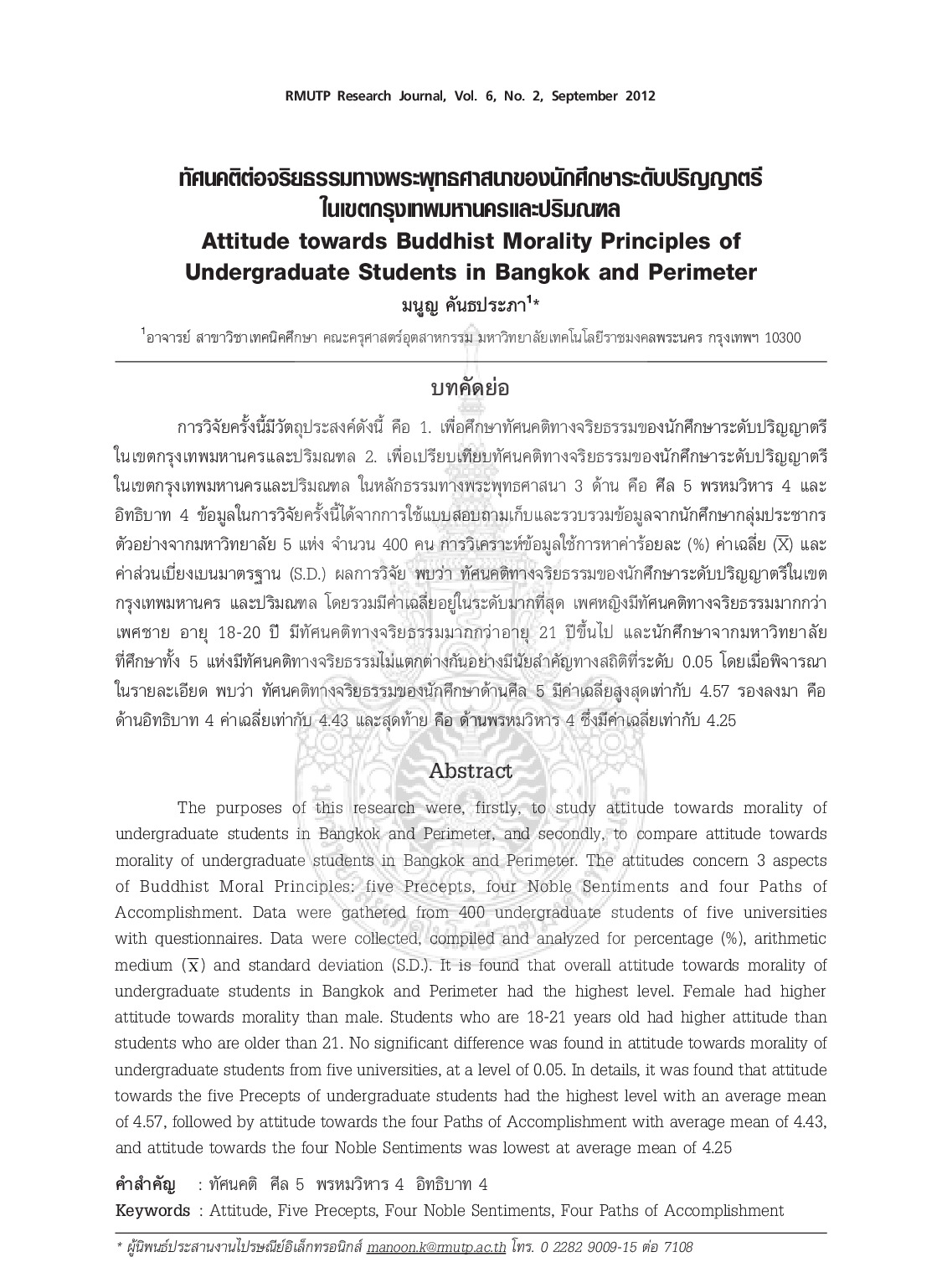
Attitude towards Buddhist Morality Principles of Undergraduate Students in Bangkok and Perimete
The purposes of this research were firstly to study attitude towards morality of undergraduate students in Bangkok and Perimeter and secondly to compare attitude towards morality of undergraduate students in Bangkok and Perimeter. The attitudes concern 3 aspects of Buddhist Moral Principles: five Precepts four Noble Sentiments and four Paths of Accomplishment. Data were gathered from 400 undergraduate students of five universities with questionnaires. Data were collected compiled and analyzed for percentage (%) arithmetic medium (X) and standard deviation (S.D.). It is found that overall attitude towards morality of undergraduate students in Bangkok and Perimeter had the highest level. Female had higher attitude towards morality than male. Students who are 18-21 years old had higher attitude than students who are older than 21. No significant difference was found in attitude towards morality of undergraduate students from five universities at a level of 0.05. In details it was found that attitude towards the five Precepts of undergraduate students had the highest level with an average mean of 4.57 followed by attitude towards the four Paths of Accomplishment with average mean of 4.43 and attitude towards the four Noble Sentiments was lowest at average mean of 4.25

The research and development of business news reading activities using reflective approach and group investigation for business administration undergraduates
The aims of this study were: (1) to develop an business news reading activity model using the reflective approach and group investigation and (2) to investigate the results by using the English business news reading activity model in business news reading achievement self-reflection of knowledge attitude and performance of learners and learners’ attitude towards the business news reading activity. The research procedure was comprised of 3 phases. In Phase 1 there was a creation and development of a new activity model which was verified by 3 experts. In Phase 2 the effectiveness of this activity model was developed by conducting the two-action researches. Moreover in the final phase this activity model was implemented with 36 staff members from private and public sectors that enrolled in this action seminar and the model effectiveness was evaluated against t-test. Different sample groups were utilized in each phase of this research : in Phase 2 the first action research was utilized by a sample group comprised of 40 second-year financial accounting undergraduates in the 1st Semester of Academic Year 2009 and the second action research was utilized by the sample group comprised of 36 first-year to third-year mixed-program undergraduates in the 2nd Semester of Academic Year 2009 ; and in the final phase the implementation and assessment of this activity model’s effectiveness was applied in which the sample group consisted of 36 staff members coming from the private and public sectors in Bangkok who enrolled in the English business news activity seminar. The research instruments were as follows : (1) the instruments for the study the creativity activity model were an activity-model’s quality evaluation and a Daily Business Vocabulary’s quality evaluation forms; (2) the instruments for the action researches were the learning achievement tests of the English business news reading the self-reflective learning checklist the learner’s behavior observation form and the attitude questionnaire; (3) the instruments for the activity model implementation and effectiveness assessment were the activity model the learning achievement tests of the English business news reading and the self-reflective learning checklist. The data were analyzed by means of percentage mean standard deviation and the t-test. The effectiveness of the activity model was assessed in terms of comparing the improvements of the mean scores of the students’ achievement in English business news reading comprehension. The findings of the study revealed that : (1) The English reading activity model using the reflective approach and group investigation developed by the researcher comprised 5 components which were as follows: Principles Objectives Content Learning-Teaching Procedures and Evaluation. The learning-teaching procedure synthesized from the study and used to teach reading in the English business news reading comprehension activity model using reflective approach and group investigation called (P) SPC2PAS model comprised 2 main stages and 7 sub-stages. Planning and SPC2PAS Model are as follows : S-Selecting the article/topic P-Planning and dividing labor C-Carrying out the study P-Preparing the public report P-Presenting the public report A-Authentic developmental evaluation and S-Self-reflection; (2) the development and assessment of the English business news reading comprehension activity model using reflective approach and group investigation revealed that: (2.1) The learners’ achievement of the first second and third action researches in the English reading comprehension was significantly increased at the statistical level of 0.05 which were the mean scores in the English reading comprehension of the mid-tests and post-tests which were significantly higher than those of the pre-tests at the statistical level of 0.05; (2.2) The learners’ spiral-learning development of the first second and third action researches using the activity model on self-reflection of knowledge attitude and practice reflected in the distribution of scores by percentage were in a range of good to very good level. In addition (2.3) three-group samples of all phases had a high to highest level-positive attitude towards the activity model using Reflective Approach and Group Investigation.