จำนวน Repository ( 32 )
การใช้ประโยชน์กากดินขาวเหลือทิ้งจากเหมืองหินเป็นมวลรวมละเอียดสำหรับก่อสร้างอาคารประหยัดพลังงานแบบสำเร็จรูป
The research aims to study and develop the Kaolinite mixed with cement powder for the mass wall. The Kaolinite development process to improve the characteristics. The Kaolinite mixed ratios are 10% 20% 30% and 40% and the result indicated that the experiment mortar-mix ratio at 0:8:2.75:0.2:0.05:0.04:0.5 of cement powder sand Kaolinite limestone superplasticised and clean water compared to No MK control sample covered ASTM standard in tensile strength more than 100 ksc compressive strength of MK20% with superplasticised at 434 ksc. The water absorption values under the standard passed
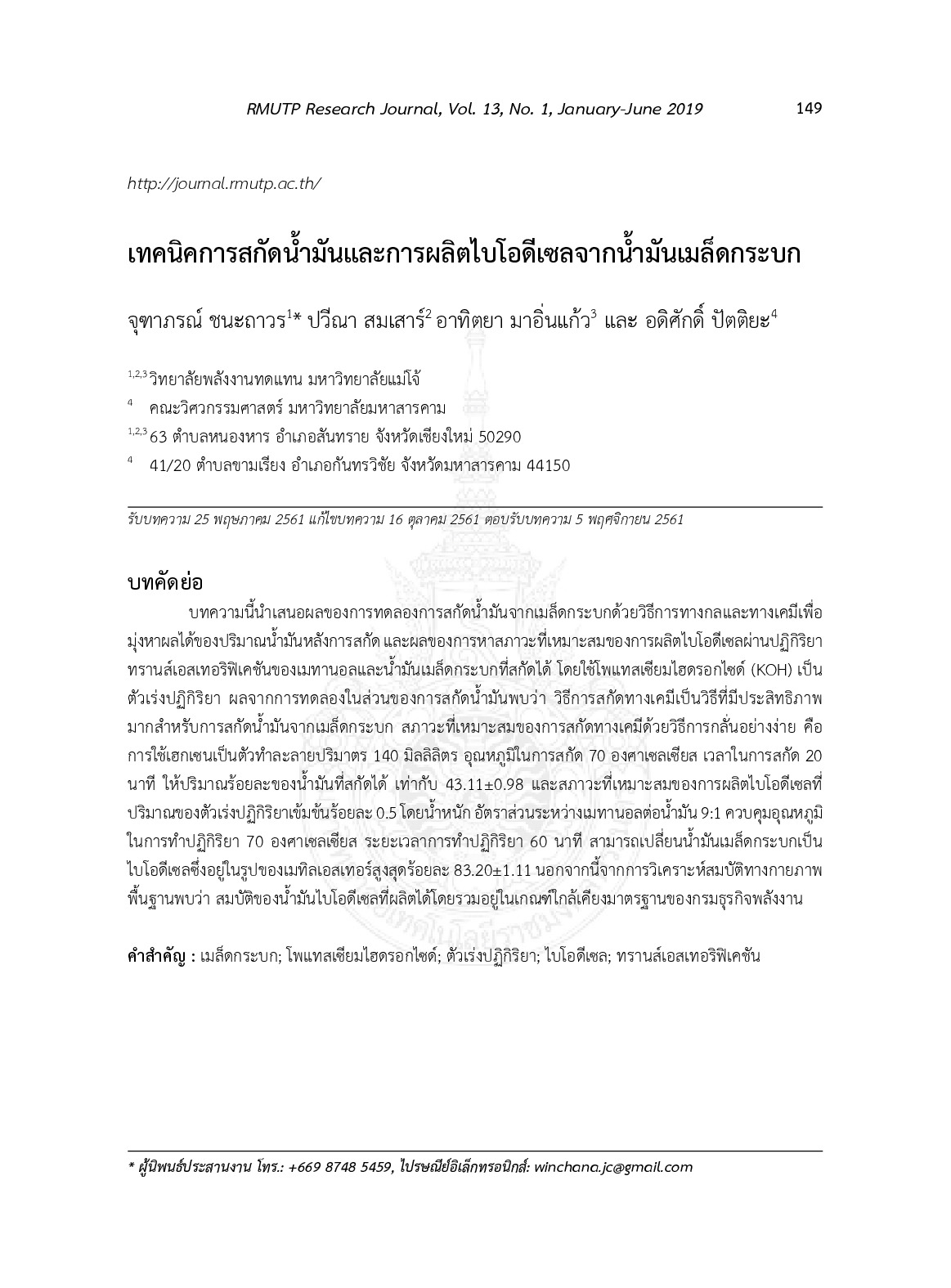
เทคนิคการสกัดน้ำมันและการผลิตไบโอดีเซลจากน้ำมันเมล็ดกระบก
This paper presents the experimental results of the oil extraction process from wild almond seeds by mechanical and chemical methods. The optimum conditions for the biodiesel production from the extracted oil via transesterification reaction using methanol and potassium hydroxide (KOH) are reported. Chemical extraction was found to be an effective technique for wild almond oil extraction. Simple distillation was used as oil extraction unit applying 140 ml of n-hexane as solvent at 70ºC for 20 min. The oil yield was 43.11±0.98%. This extracted oil was used as raw material for biodiesel production with the maximum yield of 83.20±1.11%. The optimum conditions for biodiesel production were the catalyst loading of 0.5 wt% and 9:1 molar ratio of methanol to oil in a controlled reaction temperature of 70ºC for 60 min. Finally the properties of biodiesel were analyzed and most properties met the requirements of the department of energy business standard.

การใช้ประโยชน์กากดินขาวเหลือทิ้งจากเหมืองหินเป็นมวลรวมละเอียดสำหรับ ก่อสร้างอาคารประหยัดพลังงานแบบสำเร็จรูป
The Kaolinite development process to improve the characteristics. The Kaolinite mixed ratios are 10% 20% 30% and 40% and the result indicated that the experiment mortar-mix ratio at 0:8:2.75:0.2:0.05:0.04:0.5 of cement powder sand Kaolinite limestone superplasticised and clean water compared to No MK control sample covered ASTM standard in tensile strength more than 100 ksc compressive strength of MK20% with superplasticised at 434 ksc. The water absorption values under the standard passed
ผลิตภัณฑ์กระเบื้องยางพาราผสมเศษขยะพลาสติกเหลือทิ้งจากโรงงานอุตสาหกรรม
This research aims to develop the Para-rubber floor tiles mixed with ethylene vinyl acetate plastic wastes (EVA plastics) from the factories. The study use Para-rubber STR 20 at 100 phr with various contents of EVA plastics (e.g. 0 5 10 20 40 and 80 phr) and then mixed with chemical substance at constant ratio include zinc oxide at 5 phr stearic acid at 2 phr sulfur at 3 phr mercaptobenzothiazole at 0.5 phr and diphenyl guanidine at 0.2 phr. The samples are ground by two-roll mill and formed by compression molding at 150 degree Celsius with 30x30x0.2 cm of dimension. The properties of the Para-rubber floor tiles are tested under ASTM standard. From the results it is found that the Para-rubber floor tiles mixed with 10 phr of EVA plastics is the suitable ratio for using as the rubber floor tiles and rubber wall tiles in building. This ratio can increase the hardness and wear resistant properties and decrease the density and thermal insulation properties when compare to the Para-rubber floor tiles without EVA plastic.
การผลิตแผ่นผนังภายในอาคารที่ทำจากวัสดุเหลือทิ้งจากต้นสบู่ดำ
ในการวิจัยครั้งนี้ มีวัตถุประสงค์เพื่อนาเอาต้นสบู่ดา ไปผลิตเป็นแผ่นผนัง ซึ่งเป็นการนาเศษวัสดุเหลือใช้ทางการเกษตรมาใช้ให้เกิดประโยชน์ ด้วยเหตุนี้ผู้วิจัยจึงเห็นว่าน่าจะนาเอาพืชดังกล่าวไปผลิตเป็นแผ่นผนังภายในอาคารแล้วทดสอบตาม มาตรฐานผลิตภัณฑ์อุตสาหกรรม แผ่นชิ้นไม้อัดชนิดอัดราบ (มอก. 876-2547)ได้แก่ การทดสอบหาค่าความชื้น ความหนาแน่น การดูดซึมและการพองตัวเมื่อแช่น้า หาค่าแรงยึดเหนี่ยวภายใน หรือแรงดึงตั้งฉากกับผิวหน้า และทดสอบหาค่าความต้านทานแรงดัดและมอดูรัสยืดหยุ่น โดยทาการทดลองที่สัดส่วนระหว่างต้นสบู่ดากับกาวยูเรียฟอร์มาลดีไฮล์ที่ 85:15 87:13 89:11 91:9 93:7 และ 95:5 ผลการทดลองพบว่า ขนาดของสบู่ดาที่ใช้อัดขึ้นรูปเป็นแผ่นควรไม่เกิน 2 ซม. สัดส่วนที่เหมาะสม ได้แก่ 89:11 (สัดส่วนระหว่างต้นสบู่ดา 89%ผสมกับกาวยูเรียฟอร์มาลดีไฮล์ 11 %) อุณหภูมิที่ใช้ในการอัดอยู่ที่ 120 องศาเซลเซียส ความหนาแน่นที่เหมาะสมในการอัดแผ่นเท่ากับ 0.80 กรัมต่อลูกบาศก์เซนติเมตร ปริมาณความชื้นก่อนอัดเฉลี่ยอยู่ที่ 8.89% แรงอัดที่เหมาะสมอยู่ที่ 150 ปอนด์ต่อตารางนิ้ว ค่าความชื้นอยู่ 7.64%ค่าความหนาแน่น อยู่ที่ 0.817กรัมต่อลบ.ซม. การพองตัวเมื่อแช่น้าที่ 2 ชม. อยู่ที่ 8.01% การดูดซึมน้าเมื่อแช่น้าที่ 2 ชม อยู่ที่ 14.22% แรงยึดเหนี่ยวภายในอยู่ที่ 0.56 MPa เมกกะปาสคาล ค่าความต้านทานแรงดัด อยู่ที่ 22.36เมกกะปาสคาล(MPa) ค่ามอดุลัสยืดหยุ่นอยู่ที่ 2112 เมกกะปาสคาล (MPa) ซึ่งผลการทดสอบอยู่ในเกณฑ์ตามมาตรฐานผลิตภัณฑ์อุตสาหกรรม แผ่นปาร์ติเคิลบอร์ด (มอก. 876-2547) กล่าวโดยสรุปคือต้นสบู่ดาสามารถนาไปผลิตเป็นแผ่นผนังภายในอาคารได้